
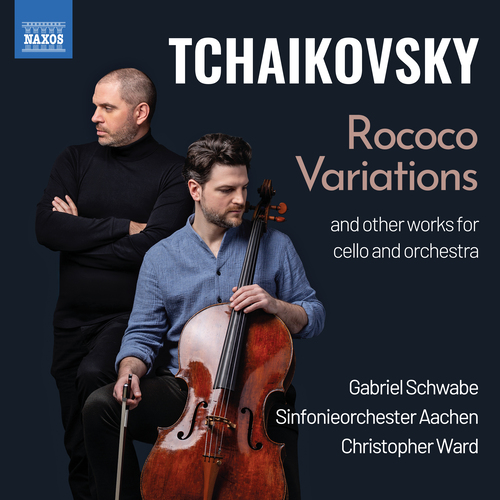
Gabriel Schwabe (cello), Sinfonieorchester Aachen / Christopher Ward
Tchaikovsky
Variations on a Rococo Theme Op. 33 (1876) – original version
Pezzo capriccioso in B minor Op.62 (1887)
Nocturne in D minor Op.19/4 (1873, arr. 1888 by composer)
Canzonetta in G minor Op.35/2 (1878, arr. 2025 by Schwabe)
Valse sentimentale Op.51/6 (1882, arr. 2019 by Schwabe)
Fantasy Overture, Romeo and Juliet (1870 version)
Naxos 8.574741 [56’45”]
Producer / Engineer Patrick Lemmens
Recorded 14 September 2018 (Romeo and Juliet) and 23-26 May 2025 at Eurogress, Aachen
Reviewed by Richard Whitehouse
What’s the story?
Naxos issues its latest recording by Gabriel Schwabe, featuring Tchaikovsky’s Variations on a Rococo Theme, alongside arrangements for cello and orchestra and a first recording of Romeo and Juliet in its second version, with the Aachen Symphony Orchestra and Christopher Ward.
What are the performances like?
Although long ago published and recorded on numerous occasions, the original version of the Rococo Variations still lags behind that made by Wilhelm Fitzhagen for whom it was written, and who shamelessly pointed up those opportunities for virtuosity at odds with the essentially Classical poise of Tchaikovsky’s own conception. Opting for the original, Schwabe makes the most of its innate formal or expressive modesty while never neglecting the element of display as surfaces in the guise of a playful humour not so often associated (though hardly unknown) with this composer. In particular the eighth variation, summarily omitted by Fitzhagen, has a genial animation that makes for a far more fitting segue into the coda – hence seeing through to its close a work whose keen lack of pretence is out of all proportion to its musical rewards.
Tchaikovsky finished one other piece for cello and orchestra, Pezzo capriccioso veering from moodiness to recalcitrance with its deftness much in evidence. Also here are his arrangement of the Nocturne from the Op. 19 piano pieces, pensive and soulful, together with Schwabe’s idiomatic takes on the Violin Concerto’s Canzonetta and wistful Valse Sentimentale from the Op. 51 piano pieces. Odd, however, that Tchaikovsky’s cello arrangement of the Andante cantabile from his First Quartet has been omitted as there was more than enough room for it; as there was for two song transcriptions – namely Legend, the fifth of his Op. 54 set, and Was I Not a Little Blade of Grass?, the seventh of his Op. 47 set – the composer also devised and which would have helped to place what is heard here in a wider, more balanced perspective.
What has been included is the second version of the fantasy overture Romeo and Juliet with (surprisingly?) its first commercial recording. Those familiar with the 1869 original will find this much closer to the third and definitive version from 1880 with the masterly introduction now in place (albeit its climax slightly underscored) then a very different lead-in (not a little akin to Balakirev) to the coda, which here seems rather over-protracted next to that of eight years later. All the right pieces are here, just in a different and ultimately less effective order.
Does it all work?
As a programme, it does. Certainly the Rococo Variations is much more effective a creative entity as Tchaikovsky conceived it, so making his reluctance to overrule Fitzhagen the more perplexing, while the other pieces with cello afford ready-made encore material Schwabe no doubt includes in his own concerts. Ward and his Aachen forces accompany sympathetically, before coming into their own with Romeo and Juliet – a fascinating intermediate version that, for all its failings, was worth making available to Tchaikovsky afficionados in this recording.
Is it recommended?
Indeed so. The performances are never less than well-attuned to the music and lack nothing in conviction, enhanced with weightily immediate sound and insightful booklet annotations. Those attracted (and why not?) to this programme should not hesitate to acquire this release.
Listen / Buy
You can listen to excerpts and explore purchase options at the Naxos website. Click on the names to read more about cellist Gabriel Schwabe, conductor Christopher Ward and the Sinfonieorchester Aachen
Published post no.2,900 – Thursday 28 May 2026

