
Listening to Beethoven #195 – 6 Variations on Ich denke dein WoO 74

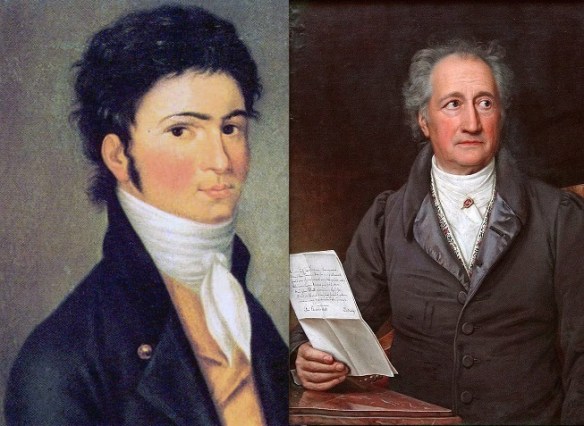
beethoven-goethe-2

Beethoven and Goethe

6 Variations on Ich denke dein WoO 74 for two pianos (1799-1803, Beethoven aged 31)

Dedication Therese, Josephine and Charlotte von Brunsvik
Duration 5′

Listen

Background and Critical Reception

Keith Anderson writes that in 1799, Beethoven ‘wrote a setting of Goethe’s Ich denke dein and four variations for piano duet on the theme for two pupils, the Countesses Therese and Josephine Brunsvik, daughters of a family with which Beethoven remained friendly through much of his life. In 1803 he added two more variations and the song and variations were published in 1805.

Pianist Peter Hill, writing for a recent recording he made with Benjamin Frith on the Delphian label, highlights Beethoven’s affection for Josephine, expressed in a passionate letter later in his life. He notes the romantic mood of the theme and its variations, pointing towards Mendelsssohn in the faster music especially.

Thoughts

As the story implies, this is a domestic piece for use among close friends. It certainly has that intimate, conversational feel, with less obvious opportunities for virtuosic display but plenty to keep the players occupied and impressed with Beethoven’s resourceful working.

The theme itself is warm hearted, the first variation too. Then Beethoven plays around with syncopations, the two players gainfully employed, before a thoughtful, slow third variation, which is unexpectedly deep in feeling. This time out enhances the fourth variation, a fizzy affair with exchanges between the two players which drew the Mendelssohn comparison from Peter Hill. Darker colours appear briefly for an instalment in the minor key, after which the sunlit textures of D major return and the piece ends calmly but warmly, providing a glimpse of an all-too rare warmth and tenderness in Beethoven’s life at the time.

Recordings used and Spotify playlist

Peter Hill & Benjamin Frith (Delphian)
Amy and Sara Hamann (Grand Piano)
Louis Lortie & Hélène Mercier (Chandos)
Jörg Demus & Norman Shetler (Deutsche Grammophon)

All excellent versions, capturing the intimacy of Beethoven’s writing but also the glint in the eye as he writes.

Also written in 1803 von Pasterwicz 300 Themata und Versetten Op.42

Next up Piano Concerto no.3 in C minor Op.37
Listening to Beethoven #194 – Graf, liebster Graf, liebstes Schaf, WoO 101

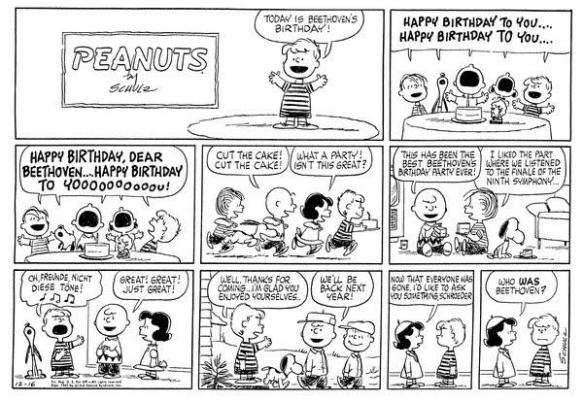
graf-grafPeanuts comic strip, drawn by Charles M. Schulz (c)PNTS
Graf, liebster Graf, liebstes Schaf WoO 101 for three voices (1802, Beethoven aged 31)

Dedication Count Nikolaus Zmeskall von Domanovecz
Text Beethoven
Duration 0’45”

Listen

Background and Critical Reception

This is one of Beethoven’s early musical jokes, which he included in a letter to his friend, Count Nikolaus Zmeskall von Domanovecz. The short text translates as ‘Count, Count, dear Count, best sheep!’

Thoughts

Literally scribbled on the back of an envelope, this is a charming fragment – cleverly working the pronunciations into the melody. Very much a case of less is more!

Recordings used

Cantus Novus Wien / Thomas Holmes (Naxos)

Coro della Svizzera / Diego Fasolis (Arts Music)

Also written in 1802 Reichardt Das Zauberschloss

Next up 6 variations on Ich denke dein WoO 74

Listening to Beethoven #193 – 6 Ländler WoO 15 (piano version)

ein-landler

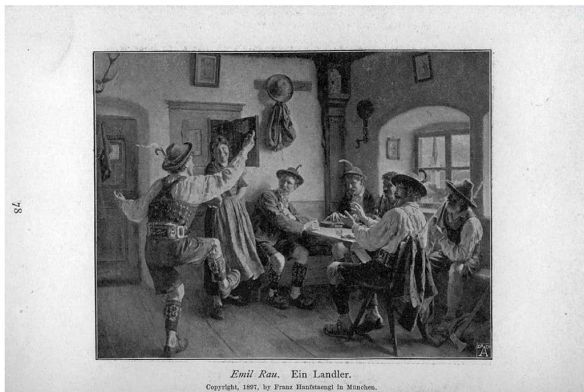
Ein Landler (anon, 1897)

6 Ländler WoO 15 for piano (1802, Beethoven aged 31)

Dedication unknown
Duration 6′

written by Ben Hogwood

Listen

Background and Critical Reception

Beethoven often turned to the Ländler, a folk dance in 3/4 time, as a way of helping entertain his Viennese clientele. He was able to score them for different instrumental combinations, presumably in response to the circumstances of the entertainers. This set is originally for two violins and a bass instrument – but as with many of these dances was also reworked into a piano version.

Thoughts

The piano version of these dance pieces brings out the ‘drone’ qualities in the accompaniment more. These can be heard on the first beat of the bar, where the left hand of the piano typically plays in intervals of a fifth, the support on which the more rhythmic elements of the dance can work their magic.

Recordings used and Spotify links

Jenő Jandó (Naxos)
Martino Tirimo (Hänssler)

Both versions are nicely played, bringing out the spring in Beethoven’s step.

Also written in 1802 Förster 3 String Quartets Op.21

Next up Graf, liebster Graf, liebstes Schaf WoO 101

Listening to Beethoven #192 – 6 Ländler WoO 15 (version for two violins and bass)

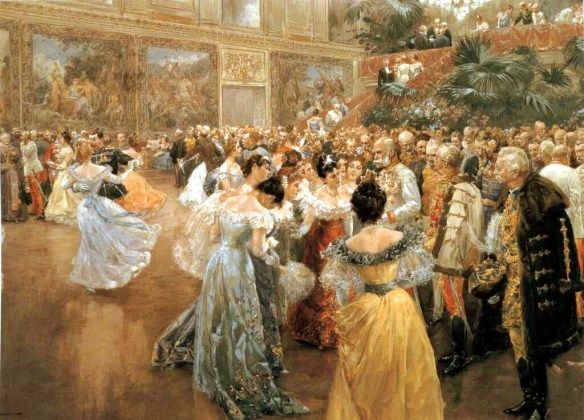
Wilhelm_Gause_Hofball_in_WienTwo ladies are presented to Emperor Franz Joseph at a ball in the Hofburg Imperial Palace, painting by Wilhelm Gause (1900)
6 Ländler WoO 15 for two violins and bass (1802, Beethoven aged 31)

Dedication unknown
Duration 6′

written by Ben Hogwood

Listen

Background and Critical Reception

As we know from earlier examples, Beethoven often turned to the Ländler, a folk dance in 3/4 time, as a way of helping entertain his Viennese clientele. He was able to score them for different instrumental combinations, presumably in response to the circumstances of the entertainers. This set is originally for two violins and a bass instrument – but as with many of these dances was also reworked into a piano version.

Thoughts

D major was Beethoven’s ‘go-to’ key for Ländler – and five of the six examples in this small set are in that key. The only exception is no.4 in D minor, which works well as a ‘trio’ section if all six are played back to back. It is a frown in comparison to the other five, which are carefree examples of Beethoven fulfilling a function with ease.

The first is bright, and light on its feet, the fifth has an attractive flourish but feels half-finished. Typically the sixth and final dance, a simple arpeggiated affair, signs off with a coda.

Recordings used and Spotify links

Tristan Siegel, Noa Sarid (violins), Aleck Belcher (double bass) (Naxos)
Lukas Hagen, Rainer Schmidt (violins), Alois Posch (double bass) (Deutsche Grammophon)
Consortium Classicum (Warner Classics)

Some attractive versions – including an account for small string ensemble, nicely played by Consortium Classicum.

Also written in 1802 Förster 3 String Quartets Op.21

Next up 6 Ländler for piano WoO 15 (1802)

Listening to Beethoven #191 – Bagatelle in C major WoO 54, ‘Lustig-Traurig’

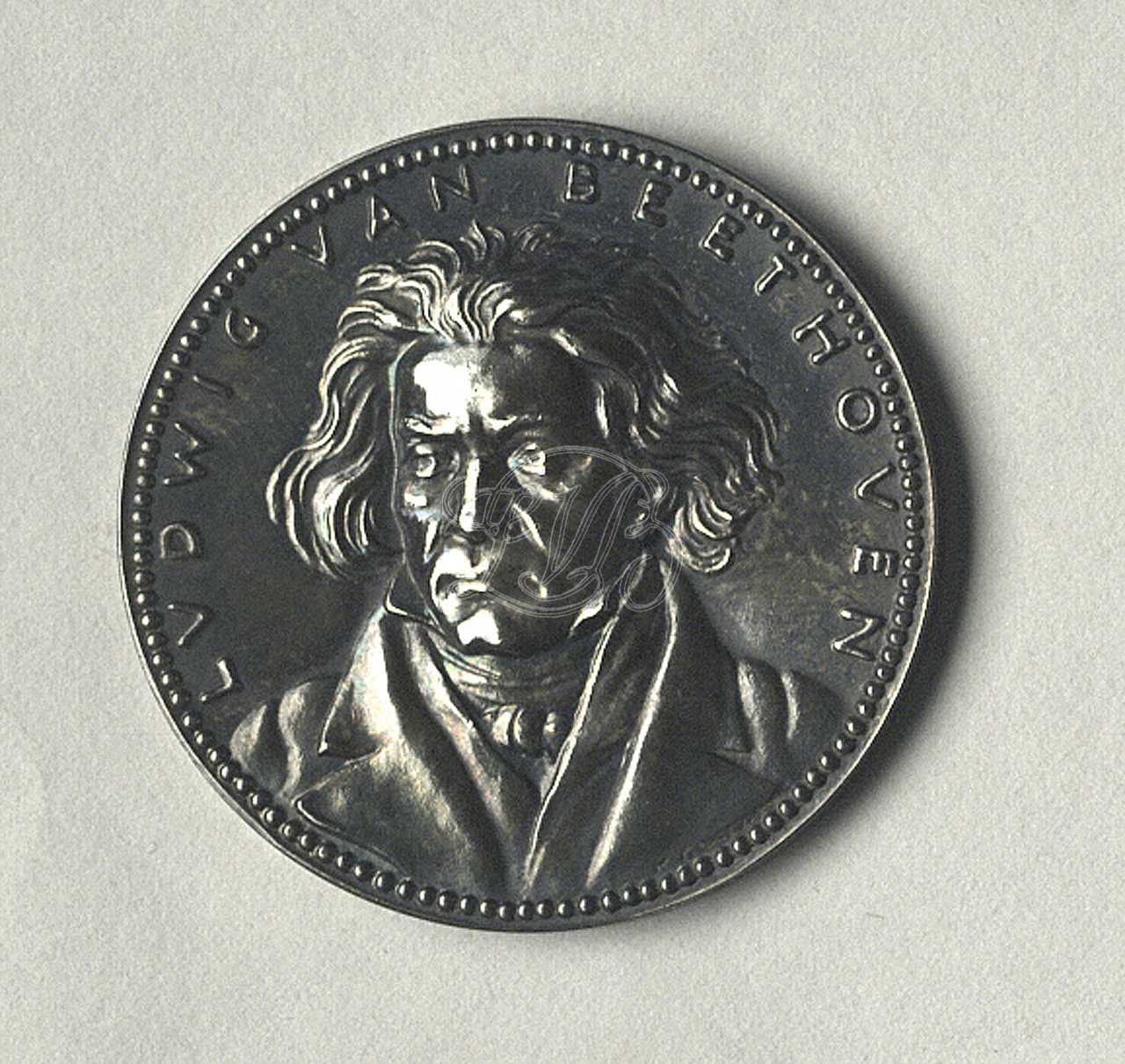
Beethoven-Medaille, 1927

Bagatelle in C major WoO 54, ‘Lustig-Traurig’ for piano (1802, Beethoven aged 31)

Dedication not known
Duration 2′

Listen

written by Ben Hogwood

Background and Critical Reception

Around his major compositions we will continue to find Beethoven’s miniatures. This piece, whose nickname translates as ‘happy-sad’, is thought by some to have originated in 1798 – and appears to have just missed out on inclusion in the Op.33 set published earlier in the year.

Perhaps because of its size, this piece is glossed over by Beethoven commentators in favour of its more substantial companions. It appears to have been written for pianists of moderate ability, as with many of the bagatelles.

Thoughts

The happy-sad elements of this bagatelle are all told through harmony. This short character piece follows the profile of its title – switching mood between happy (C major) and sad (C minor). It’s a little doubtful if the C minor is actually sad, as it sounds more agitated, and the C major sounds happy in a slightly wary way we might associate more with Schubert.

Yet here is an aspect of Beethoven’s genius, the ability to write for all levels – be it the advanced player or the occasional one – and leave each a memorable work, a catchy tune, an enjoyable piece to return to.

Recordings used and Spotify playlist

Jenő Jandó (Naxos)
Olli Mustonen (Sony BMG)
Ronald Brautigam (BIS)

Three very different recordings. Olli Mustonen always has an individual take and this longer, stretched version is no exception. Brautigam is brisk, and Jandó nicely measured.

You can chart the Arcana Beethoven playlist as it grows, with one recommended version of each piece we listen to. Catch up here!

Also written in 1802 Reichardt Das Zauberschloss

Next up 6 Ländler WoO15