
Listening to Beethoven #108 – 12 Variations on ‘Ein Mädchen oder Weibchen’ Op.66

Ludwig van Beethoven and Wolfgang Amadeus Mozart (right, in a portrait by Johann Georg Edlinger)

12 Variations on ‘Ein Mädchen oder Weibchen’ from Mozart’s Die Zauberflöte Op.66 for piano and cello (1796, Beethoven aged 26)

Dedication thought to be Friedrich Wilhelm II, King of Prussia
Duration 10′

Listen

What’s the theme like?

The theme is Papageno’s aria, from Mozart’s opera Die Zauberflöte (The Magic Flute), where he expresses his desire for a wife over a glass of wine:

Background and Critical Reception

Beethoven’s flurry of activity writing for the piano and cello in 1796 yielded four works. Alongside the two groundbreaking sonatas published as Op.5 came two sets of unpublished variations, seemingly inspired by the same dedicatee and performers. The first set had fun with music by Handel, yet – as the excellent Beethoven’s Cello book reveals – this one has slightly more serious origins.

‘In all likelihood Beethoven finished these variations after his return to Vienna’, says the book. They were not published until 1819, when they were assigned the opus number 66 – overlooked when the Fifth Symphony was published ten years earlier. The book suggests Beethoven encountered The Magic Flute in Berlin, thanks to Frederick William II’s promotion. The roots of the piece, however, appear to lie in Beethoven’s competitive edge. They may have been designed in response to Abbé Gelinek, a pupil of Beethoven’s teacher Albrechtsberger and a popular piano teacher in Vienna.

Gelinek had already completed a set of ‘frivolous piano variations’ on Ein Mädchen oder Weibchen three years earlier. ‘Beethoven seems to have taken his lead from Gelinek’s six variations by producing twelve’, says the book, ‘starting in the same manner so he could eventually ‘out-compose’ his rival’. Gelinek’s is entertaining and pleasing, but not musically adventurous; Beethoven’s more assertively tests the limits of the theme and probes the possibilities for constructing a little musical drama around it. A contemporary review questioned Beethoven’s potential as a composer, for he was guilty of unusual tonal movements and ‘harmonic harshness’.

Thoughts

Beethoven has a lot of fun here. A perky introduction of the theme sees piano and cello in level partnership, with straightforward musical punctuation. Then, as the variations proceed, both instruments really start to express themselves. The piano offers a nicely weighted variation before the cello shows off its prowess in the higher register. This is Steven Isserlis’ ‘nightmarish’ second variation, the most difficult – and it’s easy to see why, with a high register and some very tricky jumps.

Once that’s over there is a lot for the cello to enjoy in rich, expressive exchanges with the piano, Beethoven’s bubbling stream of ideas showing no sign of letting up. Some are quickfire and virtuosic, others slow and profound, showing off the expressive tone of the cellist. There are also a couple of brisk marches, the second with block chords from the piano. As often seems to be the case with these pieces, the minor-key variation (the tenth) proves pivotal, a plaintive start growing into a substantial and emotional duet with unusual, questioning harmonies. Coming out of this, the two instruments have renewed energy and finish with a flourish.

Recordings used and Spotify links

Adrian Brendel (cello), Alfred Brendel (piano) (Decca)
Mischa Maisky (cello), Martha Argerich (piano) (Deutsche Grammophon)
Miklós Perényi (cello), András Schiff (piano) (ECM)
Steven Isserlis (cello), Robert Levin (fortepiano) (Hyperion)
Nicolas Altstaedt (cello), Alexandre Lonquich (piano) (Alpha)

The Spotify playlist below includes all but one of the versions listed above – with the opportunity to hear a clip from Steven Isserlis and Robert Levin’s version on the Hyperion website

Again it is Robert Levin and Steven Isserlis who get the measure of the piece, from its light hearted moments to the deep and questioning minor key variation.

Also written in 1796 Haydn Saper vorrei se m’ami, Hob.XXVa:2

Next up Ah! Perfido Op.65
Listening to Beethoven #107 – 12 Variations on ‘See The Conquering Hero Comes’ from Handel’s Judas Maccabaeus WoO 45

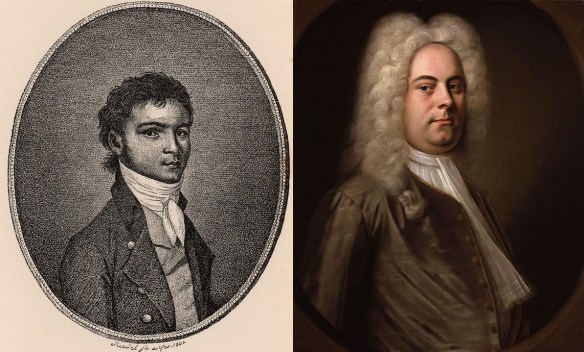
Ludwig van Beethoven and George Frideric Handel (right)
12 Variations on ‘See The Conquering Hero Comes’ from Handel’s Judas Maccabaeus WoO45 for piano and cello (1796, Beethoven aged 26)

Dedication thought to be Friedrich Wilhelm II, King of Prussia
Duration 12′

Listen

What’s the theme like?

Handel’s theme is a chorus from his oratorio Judas Maccabaeus. It is a popular tune which has been turned into a popular Christian hymn, Thine be the glory.

Background and Critical Reception

Soon after the success of his two Op.5 sonatas for piano and cello, Beethoven wrote a couple of sets of variations for the same instrumental combination. The dedicatee appears once again to have been Friedrich Wilhelm II, King of Prussia, with the cello-playing Duport brothers seemingly closely involved.

As Arcana discovered in a previous article, Beethoven’s love of the music of Handel ran deep. Later in his life he was to acquire Samuel Arnold’s first collected edition of Handel’s music (1787-97). Beethoven’s Cello – an excellent and compelling study of his music for the instrument by Marc D. Moskovitz and R. Larry Todd – has an engaging account of the work’s genesis.

It seems likely Beethoven attended a concert of Handel’s oratorio Judas Maccabaeus in Vienna in April 1794, but that his decision to use the ‘conquering hero’ theme came later. There are accounts of a concert in Berlin in 1796, when he improvised on the theme and, as Beethoven’s Cello recounts, ‘his listeners were so moved that they crowded around him and wept’. The decision to include cello ‘is not clear, but perhaps Duport played some role’, says the book.

There are twelve variations, beginning with keyboard-led music but gradually giving greater prominence to the cello. The seventh variation features a challenging display of tumbling triplets in the cello, noted by Moskovitz and Todd as having an affinity with Duport’s sixth etude. This variation is described by Steven Isserlis as the ‘one hideously difficult’ variation of the twelve.

Thoughts

Beethoven’s inspiration flows freely in this immediately likable work. The theme is memorable, one of Handel’s best tunes, and its triumphal air makes an early impact. The two instruments have an enjoyable and lightly spiced interplay, briefly turning baleful in the fourth, minor key variation but resuming its infectious optimism immediately afterwards.

The seventh variation is indeed a nasty one for the cellist, with skittish figures dancing all over the place, but then it’s the pianist’s turn, with a thundering statement. The two resume their ‘dance’, with a triumphant tenth variation – more bravura from the piano – and a substantial coda, with some slower thoughts, which leads to a subtly joyful finish.

Recordings used and Spotify links

Adrian Brendel (cello), Alfred Brendel (piano) (Decca)
Mischa Maisky (cello), Martha Argerich (piano) (Deutsche Grammophon)
Miklós Perényi (cello), András Schiff (piano) (ECM)
Steven Isserlis (cello), Robert Levin (fortepiano) (Hyperion)
Nicolas Altstaedt (cello), Alexandre Lonquich (piano) (Alpha)

The Spotify playlist below includes all but one of the versions listed above – with the opportunity to hear a clip from Steven Isserlis and Robert Levin’s version on the Hyperion website

There are some starry accounts of these variations, from father and son pairing Alfred and Adrian Brendel, from Martha Argerich and Mischa Maisky, and András Schiff with Miklós Perényi to name just three excellent versions. However it may not surprise you to learn that Steven Isserlis and Robert Levin pip them at the post with a thoroughly enjoyable account, recreating something of the air in the concert hall after Beethoven’s instinctive improvising in Berlin. Also highly commended is a new version from Alexander Lonquich and Nicolas Altstaedt.

Also written in 1796 Haydn Guarda qui, che lo vedrai Hob.XXVa:1

Next up 12 Variations on ‘Ein Mädchen oder Weibchen’ Op.66

Listening to Beethoven #94 – Variations on ‘Ich hab ein kleines Hüttchen nur’

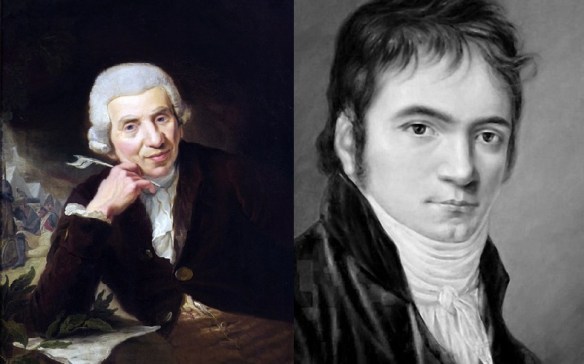
Ludwig Gleim, author to the melody Ich hab’ ein kleines Huettchen nur (portrait by Johann Heinrich Ramberg) and the young Beethoven

Variations on ‘Ich hab ein kleines Hüttchen nur’ WoO Anh.10 for piano (1795, Beethoven aged 24)

Dedication not known
Duration 6′

Listen

What’s the theme like?

Bright and quite breezy. A memorable tune that could easily have been whistled while walking down the street!

Background and Critical Reception

Another 1795 set of variations…but there is a little more doubt over the authenticity of these ones. If they were indeed from Beethoven’s pen they were not published until 1830 – and are thought to have been written in 1795.

The Unheard Beethoven website gives a characteristically detailed and involving commentary to the work, deducing the original tune to have been a popular melody that was ‘frankly a little creepy to a modern reader’!

The esteemed Beethoven scholar Willy Hess classed the piece as ‘doubtful’ rather than ‘spurious’, with no helpful evidence for or against its authenticity.

Thoughts

Beethoven or not, the eight variations are quickly despatched. Arguments in favour of Ludwig’s authorship would be the by now familiar pattern of a minor key fourth variation and a vigorous fifth, and a coda which allows itself to roam free in both mood and tempo.

The variations fit snugly alongside the other three sets we have heard so far from 1795, with passages suitable for the amateur pianist but others – the fifth especially – that are much more demanding. The soft end is a nice touch too.

Recordings used and Spotify links

Rudolf Buchbinder

Rudolf Buchbinder clearly enjoys his time with these variations, bringing the tune out nicely and applying some impressive virtuosity where required.

Also written in 1795 Hummel Piano Sonata no.8

Next up Sextet in E flat major Op.71

Listening to Beethoven #93 – 6 Variations on ‘Nel cor piu non mi sento’

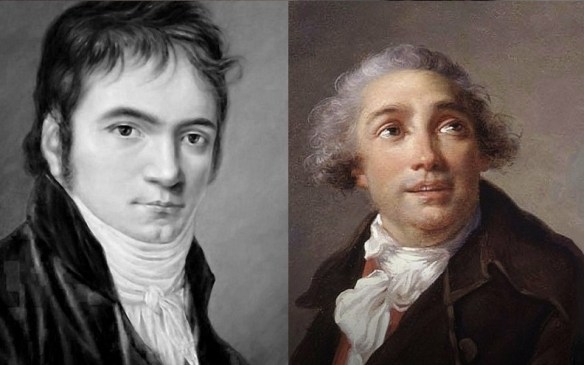
The  Portaits of Giovanni Paisiello (left) and the young Beethoven
6 Variations on ‘Nel cor piu non mi sento’ WoO 70 for piano (1795, Beethoven aged 24)

Dedication not known
Duration 6′

Listen

What’s the theme like?

Paisiello’s theme has a nice lilt to it, with a softly undulating accompaniment set in the left hand of the piano. The mood is amiable, set in G major. Beethoven pauses deliberately near the end, creating some very valid, stage-derived tension!

Background and Critical Reception

Beethoven operated with a remarkably quick turnaround for these variations, which explains their instinctive feel. Barry Cooper, writing in the booklet notes for DG’s Complete Beethoven Edition, tells of how ‘a lady whom he greatly admired once told him she used to own a set of variations on this theme but had lost them’. Beethoven ‘promptly composed his set for her and delivered them the next morning! He could, when necessary, compose extremely fast despite his reputation as a slow and painstaking worker’.

Thoughts

The six variations have an easy flow, the left and right hands often exchanging their melodic lines to keep things on the move. Beethoven’s first three variations move along effortlessly, before a slightly sorrowful fourth in the minor key, where the pronounced pause is really evident. Throughout the emphasis is on a vocal line, staying true to the context of Paisiello’s original.

As he often does Beethoven provides a direct contrast immediately after this, with an effervescent fifth variation and similarly bright sixth. The stream of consciousness, which works as a whole rather than six parts, is wrapped up very quickly.

Recordings used and Spotify links

Mikhail Pletnev

Rudolf Buchbinder

Cécile Ousset

Pletnev takes these variations at quite a lick, showing off his technical prowess but occasionally constricting the phrasing. Buchbinder and Ousset feel more natural in this respect, and again it is Ousset who has the most natural application, staying true to the theme’s origins as a vocal melody.

Also written in 1795 Hummel Piano Sonata no.8

Next up Variations on ‘Ich hab ein kleines Hüttchen nur’

Listening to Beethoven #92 – 9 variations on ‘Quant’e piu bello’

The young Ludwig van Beethoven (left) and Giovanni Paisiello

9 variations on ‘Quant’e piu bello’ WoO 69 for piano (1795, Beethoven aged 24)

Dedication not known
Duration 12′

Listen

What’s the theme like?

The theme is relatively simple but attractive, and a little playful towards the end.

Background and Critical Reception

This is another set of variations from Beethoven using a contemporary source for the theme. In this case it is an aria, Quant’e piu bello (How much more beautiful) from Paisiello’s opera L’amor contrastato (Doubtful Love). It is a bright theme in the key of A major.

Thoughts

These variations trip along very naturally, with more than a hint of play in each. Beethoven creates an illusion of the fingers of the right hand falling over each other in the first variation, but cannot resist the temptation to open up the accelerator for the second!

The fourth variation takes a serious countenance and moves to the minor key, but no sooner has it done that then the smile is back and the music is tripping along.

Recordings used and Spotify links

Cécile Ousset (Eloquence)

Rudolf Buchbinder (Warner Classics)

Ronald Brautigam (BIS)

Three excellent versions. Ousset’s recordings of Beethoven variations are some of her finest achievements, and her poise here is enviable. Ronald Brautigam offers a direct contrast on the fortepiano, though he suffers a little from a very roomy acoustic.

Also written in 1795 Hummel Piano Sonata no.8

Next up 6 Variations on ”Nel cor piu non mi sento”