
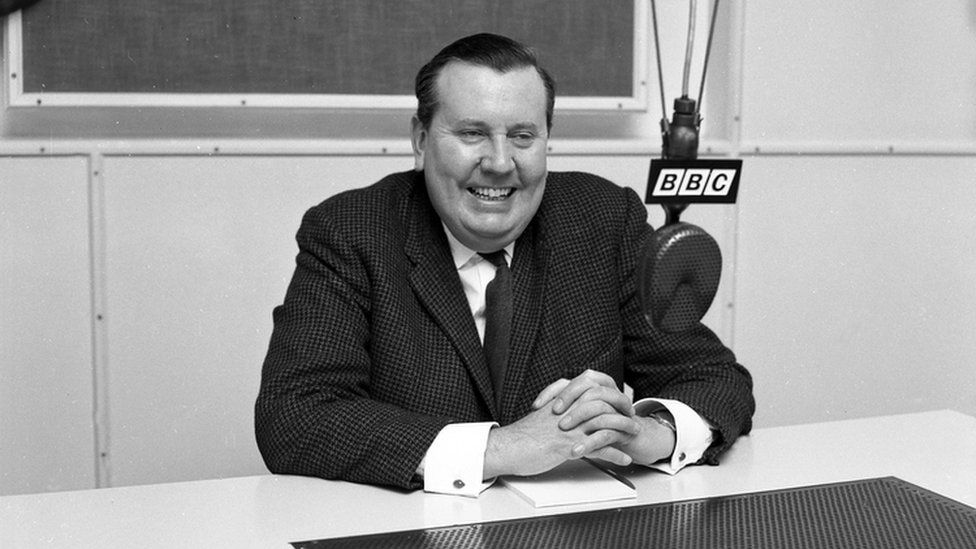
Malcolm Arnold at 100 – The Padstow Lifeboat

written by Ben Hogwood

Today marks 100 years since the birthday of English composer Sir Malcolm Arnold.

Arnold has always had a chequered relationship with the concert-going and record-buying public. He was too often seen as a vulgar composer, or someone who couldn’t resist a musical prank, which his work with Deep Purple, in the Concerto for Group and Orchestra of 1969, and his involvement in the Gerard Hoffnung concerts did little to dispel. Writing a piece that included parts for three vacuum cleaners (A Grand, Grand Overture) was a bridge too far for some. His personality is often cited too, for Arnold – who suffered consistently from poor mental health – gained a bad reputation amid his struggles with alcohol and financial problems.

Yet beneath the humour beat a deeply caring musical heart that revealed itself in a myriad of different compositions. The nine symphonies speak with power and concentrated thought of his struggles, and though many still lie dormant the success of the Fifth at the BBC Proms this year said much for the musical quality in the mind behind it.

Arnold mastered many forms, writing concertos for most of the principal orchestral instruments, chamber music that is still all too rarely heard, and stage works that are only just being properly discovered. The Dancing Master, winner of a BBC Music Magazine award this year thanks to a recent recording on Resonus, is testament to that, while the film music has started to get its due reward. The Bridge On The River Kwai, The Inn of the Sixth Happiness and Hobson’s Choice are all fine scores.

Since I am writing this from holiday in Cornwall, I have chosen to focus on some of the pieces Arnold wrote in his time living at St Merryn. The first one is a light-hearted treasure, The Padstow Lifeboat – with a striking written-out part intended to include the foghorn.

The piece was written in 1967 to commemorate the lifeboat’s inauguration, with Arnold still discovering more local musical appeal having not long moved from London. Due in part to the success of the piece, it was not long before he was made Bard of the Cornish Gorsedd in 1968. It is a lively, humourous march that can’t help but raise a smile!

Alexander von Zemlinsky at 150

Today marks 150 years since the birth in Vienna of composer, conductor and teacher Alexander von Zemlinsky.

Zemlinsky is a figure of great historical importance in classical music, with a marked impact behind the scenes on the direction it was to take in the 20th century. In his early twenties, he caught the attention of Brahms, who was impressed with the Clarinet Trio published as a composer’s Op.3 in 1896. Around this time Zemlinsky also met Schoenberg, and then Alma Schindler, with whom he had an intense relationship. Their union was unexpectedly and suddenly broken in 1902, however, when Alma married Gustav Mahler.

Zemlinsky’s musical family tree is an intriguing one. As a teacher he mentored and encouraged Berg, Webern and Korngold. As a conductor he received unreserved praise from Schoenberg, Stravinsky and Weill. Stravinsky declared in 1964, “I do believe that of all the conductors I have heard, I would choose Alexander Zemlinsky as the most outstanding, and this is a mature verdict.” Schoenberg admired his “natural, unforced and obvious greatness”.

It is as a composer that we remember him here, however, for Zemlinsky’s music has not yet reached the audience it deserves. One of his greatest works, the Lyric Symphony made a strong impression at the Proms in 2016, and the Clarinet Trio was performed at the same festival this year. Those are just two of many fine compositions, however. Brahms was also impressed with Zemlinsky’s symphonic writing, and as an orchestral composer both his tone poem Die Seejungfrau and the Sinfonietta are fine works. The magical opening bars of the former, as heard in a new recording from the Royal Liverpool Philharmonic Orchestra and Vasily Petrenko for Onyx Classics, are to be treasured:

The four string quartets are also highly regarded, as is the output for solo piano, while another strong area for Zemlinsky was Lieder. Here there are many fine settings, perhaps the best of which are his 6 Songs after Poems by Maeterlinck of 1910-13.

The Spotify playlist below brings a number of these pieces together – while you can visit the Alexander Zemlinsky website to learn more about his life and work. Meanwhile a biography by Antony Beaumont, published in 2000 by Cornell University Press, is also highly recommended.