Filmed at Worcester Cathedral, Saturday 4 June 2022
by Richard Whitehouse
The English Symphony Orchestra’s concerts at last year’s Royal Jubilee Elgar Festival have already yielded several online performances of note, with In the South perhaps the finest yet in terms of vindicating a work that can all too easily fall victim to its seeming ‘indulgencies’.
The main issue is in setting a tempo flexible enough to accommodate this concert overture’s extended sonata design without it becoming episodic. At around 24 minutes, this unhurried take was mindful of Worcester Cathedral’s expansive acoustic and utilized it to the music’s advantage. The surging initial theme, its speculative transition and suave second theme duly emerged with a formal continuity – the underlying tension carried through to a development whose impulsiveness was maintained despite (even because of?) the intervening first episode.
Evoking the grandeur of ‘empires past’, this episode necessitates astute handling so that its implacability avoids bathos. Kenneth Woods judged it accordingly, and if his tempo for the second ‘canto populare’ episode felt just a little reticent, its expressive raptness (along with Carl Hill’s playing of its indelible viola melody) more than compensated. Nor was there any loss of continuity across the reprise of the opening themes, with Woods’ gradual building of momentum at the start of the coda ensuring an irresistible but never overbearing apotheosis.
Certainly, the response suggested anyone who may previously have harboured doubts about this piece was won over on this occasion. Further evidence of this orchestra and conductor’s empathy with this music as augers well for the First Symphony at this year’s Elgar Festival.
Esther Abrami (violin), English String Orchestra / Kenneth Woods
Saxton Scenes from the Epic of Gilgamesh (2022-3) [World Premiere] Bruch Scottish Fantasy in E flat (1880) Mendelssohn Symphony no.3 in A minor Op.56 ‘Scottish’ (1841-2)
Sheldonian Theatre, Oxford Friday 10 March 2022
Reviewed by Richard Whitehouse
There cannot be any more historic or atmospheric performance venues than the Sheldonian Theatre in Oxford, which is still going strong after over 350 years and the setting for this latest contribution to the English Symphony Orchestra’s ‘21st-Century Symphony Project’.
Speaking only recently, Robert Saxton stated a reluctance to call his Scenes from the Epic of Gilgamesh a symphony and yet the piece, a result of many years’ thinking about the musical treatment right for one of the oldest written texts, has a formal cohesion and expressive unity comparable to previous instalments in the ESO’s project. Scored for late Classical forces of pairs of woodwind, horns and trumpets with timpani and strings, its textural clarity serves to imbue any illustrative aspect with an abstract focus duly sustained across the five movements.
Charting a deft course over its narrative, the work heads from the fluid motion of a Prologue to The Journey to the Forest of Cedar, whose passacaglia-like evolution finds this composer at its most harmonically alluring, then to From dawn to dusk and a scherzo as tensile as it is evocative. Lament distils a tangible emotional force into its gradual yet inexorable build-up, moving straight into an Apotheosis which opens out the melodic content of earlier ideas and so brings a powerful culmination as the hero is forced to seek his immortality by other means.
More overtly tonal it may have become, Saxton’s music still presents considerable challenges technical and interpretive. Suffice to add these were met with finesse and no little conviction by Kenneth Woods (above) and the ESO who, having previously recorded this work for future release, were fully conversant with its elusive while always approachable idiom. Almost four decades on from the flamboyant pieces which helped establish his name, Saxton revealed an orchestral mastery that will hopefully find an outlet in further such pieces – whether or not ‘symphonic’.
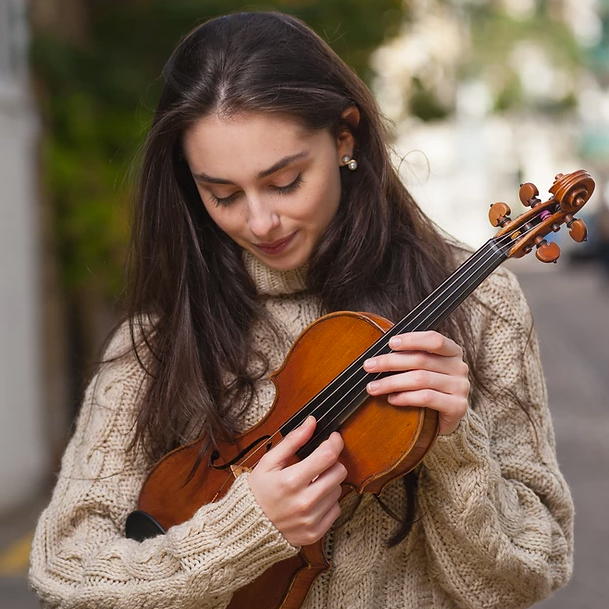
Tonight’s concert was also notable for featuring the ESO’s new Creative Partner and Artist in Residence – violinist Esther Abrami (above), her presence on social media enhanced by the release of her eponymous debut album for Sony. Stylishly attired (with an image that, for older readers, might recall Audrey Hepburn), she gave an account of Bruch’s Scottish Fantasy at its best in the transition from sombreness to eloquence of its Introduction and high-flown sentiments of an Andante in which the composer’s recourse to folk melodies is at its most felicitous. Before it, the Scherzo ideally needed more incisiveness for its engaging humour fully to register, with the final Allegro (given in abbreviated form) rather less than ‘warlike’ – though its mellifluous second theme enabled Abrami to conjure a tonal warmth which was never less than appealing.
After the interval, the ESO came fully into its own with an impressive take on Mendelssohn’s ‘Scottish’ Symphony. Whatever its genesis in his tour of that country when just 20, the work is demonstrably that of a composer who, having reached a creative mid-point, surveys his many successes but also failings. Hence the fatalistic aura such as informs the opening movement’s introduction or the tense agitation of its main Allegro – both of which were palpably brought out by Woods, who then gave the brief if scintillating scherzo its head. The highlight was an Adagio whose constant pivoting between pathos and anguish was graphically stated – aided by an orchestral discipline no less evident in the final Allegro, its martial overtones carrying through to a pause in which the decision to opt for tragedy or triumph is held in the balance.
That the work closes in triumph has often been felt its downfall but, as conveyed by Woods at a swift if not inflexible tempo, such an apotheosis is one of determination or even defiance in the face of whatever is to come. It certainly brought this concert to a memorable conclusion.
Vilde Frang (violin), City of Birmingham Symphony Orchestra / Mirga Gražinytė-Tyla
Elgar Violin Concerto in B minor Op.61 (1909-10) Andrzej & Roxanna Panufnik Five Polish Folk Songs (1940, rec. 1945, rev, 1959, orch. 2022) [CBSO Centenary Commission: World Premiere] Schumann Symphony no.1 in B flat major Op.38 ‘Spring’ (1841)
Symphony Hall, Birmingham Wednesday 8 March 2023
Reviewed by Richard Whitehouse
The relationship between Elgar and Schumann is a fascinating one, aspects of which surfaced in this coupling of the former’s Violin Concerto with the latter’s First Symphony; the City of Birmingham Symphony Orchestra joined by principal guest conductor Mirga Gražinytė-Tyla.
As with Sibelius not long before, Elgar was an able violinist whose solitary concerto for his instrument makes no technical concessions. There is also a symphonic dimension as seemed uppermost in the thoughts of Vilde Frang, her formidable technique (rightly) geared towards the work’s conveying emotions within an expansive while methodical framework. This was evident in the opening Allegro, the impetus of its initial tutti maintained by flexible handling of contrasted themes on to a climactic development whose intricacy was abetted by the clarity of the orchestral playing. Even finer was a central Andante whose main melodies, among the composer’s most affecting, were never indulged across the course of a movement where the expressive profile remains teasingly intangible right through to those soulful concluding bars.
Maybe the balance between display and insight slipped in the final Allegro molto, with Frang losing focus slightly during its more extrovert passages. Once the accompanied cadenza was underway, however, there was no doubting the rapport of soloist and orchestra as earlier ideas are recalled and speculatively transformed in what comes near to being a confession of intent. Nor was the sudden re-emergence of that earlier energy at all underplayed as the coda heads to its affirmative resolution: one whose conviction duly set the seal on a memorable reading.
After the interval, an additional item in the guise of Five Polish Folksongs written by Andrzej Panufnik after the outbreak of war, reconstructed at its close and orchestrated by his daughter Roxanna so the stark originals for children’s or female voices – with pairs of flutes, clarinets and bass clarinet – were cushioned by these richer orchestral textures. The CBSO Youth and Children’s choruses (finely prepared by Julian Wilkins) gave their all in what were appealing yet at times overly diffuse arrangements of settings that are best heard in their original guise.
So to Schumann’s ‘Spring’ Symphony, a piece whose encapsulating mid-Romantic sentiment seemed uppermost in MG-T’s insightful and, for the most part, convincing account. Evocative fanfares launched the opening Allegro in fine style, the often fitful momentum of its lengthy development vividly maintained through to a sparkling coda. Arguably too slow for its ‘song without words’ format, the Larghetto yet exuded undeniable pathos and made a spellbinding transition into the Scherzo. A (too?) leisurely take on its first trio took the listener unawares, but the winsome closing bars prepared well for a final Allegro whose animated progress was enlivened by delectable woodwind and horn playing on the way to its decisive close. Should MG-T return in future seasons, further Schumann symphonies would be more than welcome.
The CBSO returns next week in a rare UK hearing of Weinberg’s First Sinfonietta, alongside Schumann’s Piano Concerto with Kirill Gerstein and an extended selection from Prokofiev’s Romeo and Juliet – this latter and the Elgar also featuring in a Barbican concert the next day.
If you live in London or the south of England and love the piano, then consider this: Did you know there is a fully-fledged, international piano competition right on your doorstep?
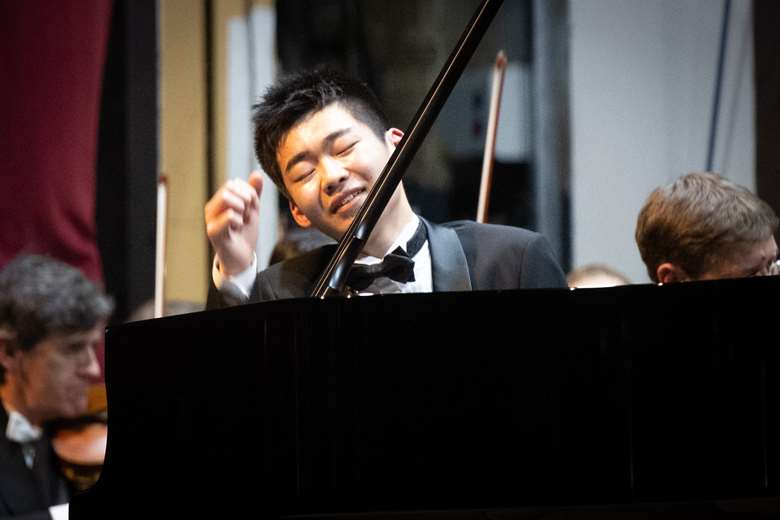
It is, of course, the Hastings International Piano Competition, hosting their Prize Winners’ Gala Concert at the White Rock Theatre in the town this Saturday 4 March. Performing at the concert, and accompanied by the Royal Philharmonic Orchestra under Rory Macdonald, will be two of the stars of last year’s competition. The winner, Japanese pianist Shunta Morimoto (above), will perform Beethoven’s Piano Concerto no.4, while third-placed Mariamna Sherling (below) will close the concert with Rachmaninov’s much-loved Rhapsody On A Theme of Paganini.
“It is a great honour for me to perform again on the historical stage of the White Rock Theatre”, said Sherling. “The Royal Philharmonic Orchestra is absolutely incredible! I was lucky to perform with this outstanding orchestra a year ago in the final of the Hastings International Piano Concerto Competition. I can’t wait to collaborate with them again.”
Shunta, meanwhile, is similarly excited for his performance of the Beethoven. “It will be my greatest delight to bring to my performance with the Royal Philharmonic Orchestra all the beauties I have uncovered studying the 4th concerto of Beethoven. It will be my honour to share this with the public of my most beloved city in England.”
The Hastings International Piano Competition is under the authoritative guidance of Paul Hughes who moved to the role from his previous post as Director of the BBC Symphony Orchestra. The competition itself has its roots in the Hastings Music Festival, which dates all the way back to 1908 – and it evolved from the festival, growing at a startling rate. Last year’s competition, says Hughes, was its best yet. “Yes, very much so. We had a record number of applicants – 360 – and a truly international field.”
Morimoto’s winning concerto in the 2022 competition, says Hughes, “demonstrated his extraordinary musicality and the maturity of his playing, as well as meeting all the technical demands of that particular work. Beethoven’s Piano Concerto no.4 has parallels in that it requires a deep understanding of the music, exceptional phrasing and an appreciation of the architecture of the concerto; all qualities that Shunta has in abundance.”
The concerto will begin with Dvořák‘s effervescent Carnival Overture, while Tchaikovsky’s Romeo and Juliet Fantasy Overture opens the second half – a prelude to Sherling’s Rachmaninov. “Mariamna (above) is the possessor of a fabulous technique, a razor-sharp mind and a sense of fun”, says Hughes. “I am expecting she will employ all of this to demonstrate many facets of Rachmaninov’s set of variations.”
Hastings has a reputation of being ‘The Friendly Competition’, which Hughes attributes to “a combination of the efficient organisation of HIPCC combined with the warmth of the community whose hospitality in looking after and supporting the young pianists at every stage of their progress through the competition makes such a difference. It is also the friendliness and openness of the jury who share insights and give constructive feedback to the competitors.”
Following the contestants after the competition has finished is imperative. “That is an important part of the Hastings International Piano experience”, he stresses. “We follow, support and offer performance opportunities to our pianists, and not just the finalists.” When choosing the winners, he says that “formally we don’t discuss the artists as a group of jurors. The range of experience within the jury means we are all looking for different aspects of a performance, and make our selections individually.”
Hughes (above) considers the future of the competition to be rosy. “Professor Vanessa Latarche was President of the jury in 2022 and fulfilled that role magnificently. She is now Artistic Director of Hastings International Piano and so I am confident we will attract an even wider range of pianists from across the world. One of the elements of the competition that distinguishes it from many others is that it focuses predominantly on the piano concerto; to that end we have conductor Rory Macdonald returning to conduct not just the finals, but also the semi-final round. One further innovation new to the Hastings competition is that we are commissioning a new piano solo work that each competitor will be required to perform in their solo recital round.”
These exciting developments are a natural progression from Paul’s previous role with the BBC Symphony Orchestra. “In my role there I have worked with and presented very many pianists, from early career new generation artists to the most distinguished pianists working today. I have commissioned new work for them, supported and developed long term relationships with these amazing artists and fostered a sense of loyalty that I believe is so important in our profession. I am calling on all those experiences in Hastings to create a platform where we can discover, support and nurture young pianists and engage the Hastings community in the wonderfully exciting journey of a young pianist from competition to the very top of the profession.”
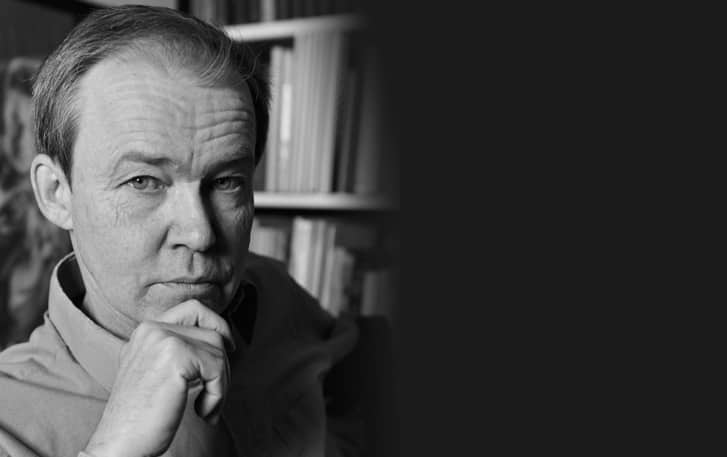
Philip Sawyers (above) Double Concerto for Violin and Cello (2020) Viola Concerto (2020)
Daniel Rowland (violin, viola), Maja Bogdanović (cello), English Symphony Orchestra / Kenneth Woods
Filmed at the Wyastone Concert Hall, Monmouth, Thursday 3 March 2022. Producer Phil Rowlands / Videographer Tim Burton
by Richard Whitehouse. Photo of Daniel Rowland and Maja Bogdanović (c) Stefan Bremer
Since returning to composition with a vengeance almost two decades ago, Philip Sawyers has created a varied output dominated by six symphonies along with five concertos that between them confirm the professionalism of his writing and a sensitivity to the instrument(s) at hand. Two of them were written, one after the other, in 2020 and received their public premieres at Hereford and Great Malvern in March last year.
Daniel Rowland (violin), Maja Bogdanović (cello)
Before that, they were recorded at one of the English Symphony Orchestra’s Wyastone sessions and it is these accounts which feature here. The live performances were covered when part of their respective concerts (see the reviews of the Double Concerto and Viola Concerto respectively), hence it only needs to be added that the studio recordings more than compensate for any lack of spontaneity with what they gain in subtlety of characterization.
The conviction of these readings should only be abetted when they are commercially issued on 6th March, as part of the ESO’s latest Sawyers release which also features his Octet for ensemble and Remembrance for strings (its public premiere to be given by the Leamington Chamber Orchestra at Holy Trinity Church, Leamington Spa on Sunday March 26th). Good news, moreover, that his oratorio Mayflower on the Sea of Time, whose premiere at the 2020 Three Choirs Festival fell victim to the pandemic, is to receive its first hearing later this year.







 Arcana.fm