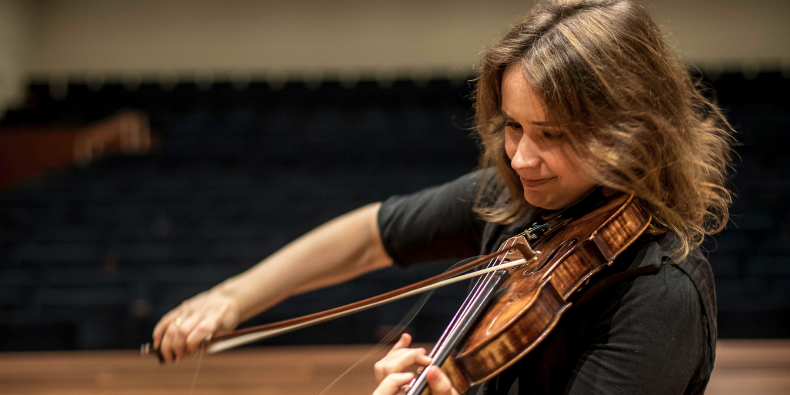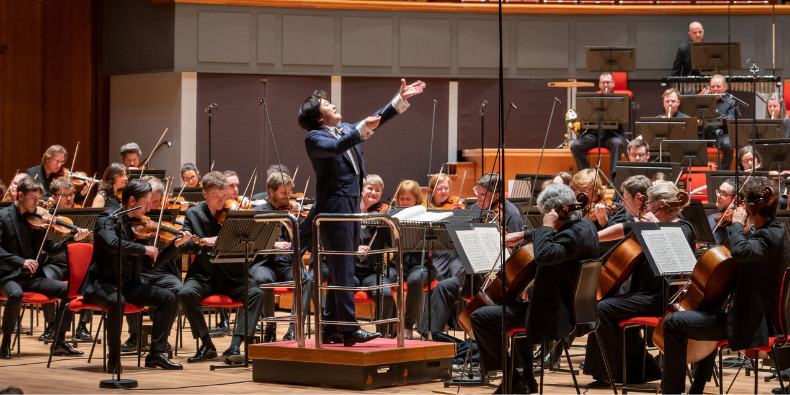
In concert – Elena Urioste, Ben Goldscheider, CBSO / Kazuki Yamada: Glinka, Ethel Smyth & Rachmaninoff

Glinka Ruslan and Lyudmila (1842) – Overture
Smyth Concerto for Violin and Horn (1926-7)
Rachmaninoff Symphony No. 2 in E minor, Op. 27 (1906-7)

Elena Urioste (violin), Ben Goldscheider (horn), City of Birmingham Symphony Orchestra / Kazuki Yamada

Symphony Hall, Birmingham
Sunday 24 July 2022

Written by Richard Whitehouse

It might have been a ‘warm up’ for tomorrow night’s Proms appearance, but this afternoon’s concert by the City of Birmingham Symphony Orchestra with its Chief Conductor designate Kazuki Yamada gave ample indication of what to expect of this partnership during 2022/23.

On one level, this was an appealingly old-fashioned programme in consisting of an overture, concerto and symphony. The former was that to Glinka’s opera Ruslan and Lyudmila, always an effervescent curtain-raiser which here unfolded at a lively but never headlong tempo that brought out the formal precision of this piece with its deft sonata design. Neither did Yamada under-characterize the amiable second theme, while the strangely ominous atmosphere of the development was made more so through a telling contribution by timpanist Matthew Hardy.

Ethel Smyth is a notable presence at this year’s Proms, the CBSO tackling her Concerto for Violin and Horn. Among her last major works (encroaching deafness saw her write little over the next 18 years), its nominally Classical trajectory belies a formal freedom as extends to an orchestration evoking her French contemporaries as much as her German forebears. Not least the initial Allegro with its trenchant and stealthily imitative writing for the soloists against an orchestral texture at once intricate and luminous. Yamada marshalled his forces accordingly, before giving Elena Urioste and Ben Goldscheider the stage for the ensuing Elegy whose ‘In memoriam’ marking encouraged a response of real eloquence. Robust yet never unyielding, the final Allegro took in a combative cadenza before striding forth to its decisive peroration.

Rachmaninoff’s Second Symphony has moved to the very centre of the repertoire in the four decades since Simon Rattle made it a signature piece with this orchestra. Yamada holds it in equally high esteem – witness the finesse with which he built the first movement introduction to its impassioned apex, before subsiding into an Allegro which drew anxiety and grace into a purposeful accord heightened by the development’s surging inevitability then a coda of terse finality. Unfolding at an animated while not unduly hectic tempo, the scherzo was marginally over-indulged in its lilting second theme, but this did not pre-empt an incisive response in the central fugato – the CBSO strings at their collective best – nor a transition back into the main theme of irresistible verve. The coda exuded a fugitive inwardness that was no less arresting.

Ubiquitous these days as a radio staple, the Adagio needs astute handling if its rapture is not to become cloying and Yamada responded accordingly – not least in his attentive pacing of the main theme with a contribution from clarinettist Oliver Janes of melting poignancy, then a climax whose emotional intensity never became hectoring. The slightly too flaccid tempo for its easeful central span meant that the finale lacked the ultimate in cohesion, but Yamada balanced this elsewhere with an energy which carried through into a scintillating apotheosis.

So, an eminently worthwhile concert beyond merely enabling those who are unable to attend that Royal Albert Hall performance to hear Yamada with the CBSO in a programme such as played to both their strengths. Much to look forward to, then, over the course of next season.

For more information on the CBSO Prom, click on the link on their website. Meanwhile click on the artist names for more on Elena Urioste, Ben Goldscheider and Kazuki Yamada – and for a website dedicated to Dame Ethel Smyth
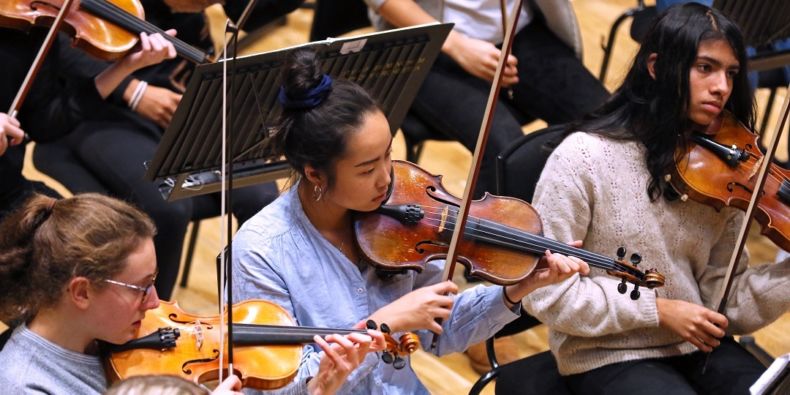
In concert – CBSO Youth Orchestra Academy: A Fist Full of Fives

cbso-youth

Sutton A Fist Full of Fives (2016)
Mozart
Violin Concerto no.5 in A major K219 ‘Turkish’ (1775)
Skalkottas
Five Greek Dances (1931-6, arr. 1936)
Beethoven
Symphony no.5 in C minor Op.67 (1804-8)

Irène Duval (violin), CBSO Youth Orchestra / Michael Seal

Royal Birmingham Conservatoire
Saturday 23 July 2022

Written by Richard Whitehouse

It may be the end of the main season, but that is no reason why the CBSO Youth Orchestra should not have had a concert scheduled for mid-July, with this judiciously contrasted and well-balanced programme assuredly playing to the collective strengths of its present line-up.

Although three of the works had a numerical connection with ‘five’, only the opening piece featured that number in its title. Written for an event featuring Beethoven’s Fifth and scored for similar forces, A Fist Full of Fives finds Adrian Sutton essaying a concert-opener whose interplay of vigorous (even a little martial) and more lyrical ideas evokes a mid-20th century American music evoking Piston or early Carter. Fluent and appealing if far from memorable, it duly put the orchestra through its paces to a degree which the CBSOYO met with alacrity.

Rather more memorable was the Five Greek Dances by Skalkottas which opened the second half. Admittedly the programme note led one to expect a selection from the overall 36 in the versions for full orchestra, rather than the present selection – from a set of seven – for strings. Yet the distinctive character of each dance is hardly diminished in these arrangements by the composer (a proficient violinist), and Michael Seal secured notably characterful playing in a sequence that proceeded from the swaggering Epirotikos, through the stealthy interplay of Kretikos and the bracingly astringent Tsamikos, to the gentle pathos of Arkadikos then the dashing Kleftikos. Fifty years after the CBSO’s world premiere of his First Symphonic Suite, it was good to hear these likely successors tackling Skalkottas with evident enjoyment.

In between those two pieces, Irène Duval gave Mozart’s Fifth Violin Concerto – not exactly underplayed these days, but worth hearing when rendered with such commitment. Not least an opening Allegro whose aperto marking (rightly) encouraged a deftness of phrasing that carried through to the closing bars. The Adagio was ingratiating without any hint of cloying, then the outer sections of the Rondeau an insouciance for which the lively Turkish music at its centre provided a bracing foil. The cadenzas (Duval’s own?) proved unfailingly apposite.

Closing the concert, Beethoven’s Fifth Symphony made a suitably unequivocal impression – not least an opening movement whose rhythmic trenchancy and purposeful rhetoric carried through to a forceful if never hectoring coda. Neither was there any hint of false grandeur in the Andante, its ruminative theme yielding subtlety and not a little humour as it wended its methodical yet never predictable course. Ensemble was a little ragged near the outset of the scherzo, but the transition into the finale had a simmering expectancy that made the latter’s blazing onset more visceral. This music’s familiarity tends to detract from its innovation of form and orchestration, but Seal pointed up such aspects in a reading that never risked losing focus as it headed to a coda whose reiterations of the home key made for a triumphal QED.

A worthwhile programme, then, with performances to match and exactly the sort of concert needed to inject needed impetus into the indolence of summer. The CBSOYO makes its first appearance next season with a programme of Verdi, Bruch and Lutosławski on October 30th.

For more information on the CBSO Youth Orchestra and their next concert, visit the dedicated page on their website. Click on the names for more information on Irène Duval and Michael Seal

In concert – CBSO / Edward Gardner: Simply Schubert – Symphonies 1 & 4

ed-gardner

Schubert

Fierrabras D796 – Overture (1823); Symphony no.1 in D major D82 (1813); Symphony no.4 in C minor D417 ‘Tragic’ (1816)

City of Birmingham Symphony Orchestra / Edward Gardner

Town Hall, Birmingham
Thursday 14 July 2022

Written by Richard Whitehouse

One of many projects left in abeyance by the pandemic, the City of Birmingham Symphony Orchestra’s Schubert cycle with its former principal guest conductor Edward Gardner duly continued this evening with a programme of that composer’s First and Fourth Symphonies.

Schubert may have been barely 16 when he essayed his First Symphony, but its confident if quirky assimilation of traits as derived from Haydn and Beethoven is more than a statement of intent – not least with an opening Allegro whose imposing introduction returns after the development to broaden the movement’s emotional scope. Gardner realized this unerringly, while drawing an incisive response from the CBSO in the first theme and winsome elegance in its successor as subsequently headed into a coda of bracing if not overly insistent finality.

For all its Mozartian gracefulness, the Andante yields an emotional ambivalence most notable in the plangent exchanges of woodwind and string towards its centre. These were enticingly conveyed, as was that contrast between rhythmic trenchancy in the Menuetto’s outer sections with its trio’s more affable demeanour. Precision of ensemble meant the final Allegro never risked seeming repetitious, Gardner steering it with assurance and not a little flexibility to a coda that emerged as never less than entertaining in its forceful reiterations of the home key.

Three years on, the Fourth Symphony confirms a greater formal and expressive breadth – not least in the first movement’s introductory Adagio whose underlying portentousness makes its contrast with an impulsive and often anxious Allegro more acute. Gardner and the CBSO had its measure, as they did the ensuing Andante in which Schubert’s woodwind writing is heard at its most felicitous. Any contrived distinction between the hymnic main theme and its more volatile alternate episodes was hardly in evidence as this movement drew to its easeful close.

For all its brevity, the Menuetto (a scherzo in all but name) can be rhythmically treacherous in its syncopation, but there was no lack of focus here or in the trio’s folk-like lyricism. Nor did the moto perpetuo underpinning the final Allegro run out of steam – Gardner sustaining   a cumulative momentum across the exposition’s repeat then into an intensive development which brought an opening-out of mood through to those decisive closing chords. Its ‘tragic’ connotations may be tangential, but the teenager’s seriousness of purpose cannot be denied.

Opening the programme was a relatively rare revival of the overture to Fierrabras, the last of Schubert’s ill-fated attempts at grand opera – even though time and subsequent stagings have largely vindicated his efforts. Gardner drew palpable expectation from its introduction, and if what ensues seemed a little stolid rhythmically, the dramatic flair of the composer’s orchestral writing was not in doubt. A pity the even less often heard Overture in E minor (1819) did not open the second half, as its abstract drama would have prefaced the Fourth Symphony ideally.

In any case, this was a welcome addendum to the CBSO’s current season and not least for an opportunity to hear the orchestra playing at its former venue of Town Hall. Hopefully another such concert, featuring Schubert’s Great Symphony, can be scheduled sometime next year.

For more information on the CBSO and their 2022-23 season, visit the dedicated page on their website. Meanwhile click here for more on conductor Edward Gardner.

In concert – Janai Brugger, Karen Cargill, CBSO Chorus & CBSO / Markus Stenz: Mahler ‘Resurrection’ Symphony

CBSO season finale: Mahler.

Mahler Symphony no.2 in C minor ‘Resurrection’ (1888-94)

Janai Brugger (soprano), Karen Cargill (mezzo-soprano), CBSO Chorus, City of Birmingham Symphony Orchestra / Markus Stenz

Symphony Hall, Birmingham
Saturday 25 June 2022

Written by Richard Whitehouse Photos courtesy of Beki Smith

At the end of another season by the City of Birmingham Symphony Orchestra what could be more fitting than the symphony to have been programmed by the orchestra’s last five principal conductors, defining the Simon Rattle era and been scheduled during the majority of seasons ever since?

Tonight’s performance (and that on the previous Wednesday) was to have been conducted by Mirga Gražinytė-Tyla, but maternity leave occasioned an infrequent UK appearance (at least since his highly regarded tenure with London Sinfonietta in the mid-1990s) for Markus Stenz, who has recorded a Mahler cycle with the Gürzenich Orchestra of Cologne as centrepiece of his discography majoring on 20th-century music and that of the post-war era. A ‘Resurrection’, indeed, where this work’s ‘darkness to light’ trajectory seemed by no means a fait accompli.

Many are the conductors who, even now, ride roughshod across the first movement’s fraught trajectory or fall victim to a deceptively sectional unfolding; under Stenz, there was no doubt as to the cohesion with which dramatic and pastoral elements were drawn into an integrated and dynamic whole. Suffused if not overloaded with pathos, those closing pages carried over the ensuing (two-minute) pause into an Andante whose alternation of the genial and ominous was pointedly but never self-consciously evident. Felicitous playing here from CBSO strings and woodwind, then by the brass in a scherzo whose barbed irony and ‘dancing on a volcano’ volatility was tangible. Stenz was right to proceed directly through the latter four movements with minimal pause – so ensuring an intensifying emotional curve into those conflicts ahead.

First, Karen Cargill made for an eloquent though not ideally steady exponent of the ‘Urlicht’ setting with its calm before the storm of the vast closing movement. Positioned at upper left of the platform, she and Janai Brugger gave of their best in a setting of Friedrich Klopstock’s (suitably Mahler-ized) hymn Die Auferstehung where the relatively lean CBSO Chorus gave notice of its long familiarity in this music. The route taken there brought out the best from the CBSO but also Stenz’s interpretive focus – the starkly contrasted orchestral episodes evincing a formal logic and expressive inclusiveness that, with playing of unfailing clarity (not least by his antiphonal placing of the violins), ensured the finale never degenerated into a sequence of dramatic tableaux – the sureness of Mahler’s symphonic reach tangible throughout its course.

At around 85 minutes, this was a spacious while never lethargic reading which positioned the work as a precursor to the existential symphonic battles ahead rather than the culmination of a symphonic lineage stretching back to Beethoven’s Fifth. Nor was there any impersonality or lack of conviction with Stenz’s approach – his grip on the formal dimensions of the outer movements being matched by his conception of the work as a cohesive and cumulative unity. The CBSO’s playing married assurance with a palpable sense of responding ‘to the moment’.

Birmingham might have waited until 1975 to hear Mahler Two, but it gave the premiere of Stanford’s Requiem back in 1897 and gives this work again when Martyn Brabbins directs the CBSO in a revival next Saturday. An event which, in itself, is of no mean significance.

For more information on the CBSO visit their website, and for more on the soloists click on the names to read about Janai Brugger, Karen Cargill and conductor Markus Stenz

In concert – Patricia Kopatchinskaja, CBSO / Ludovic Morlot: Britten & Shostakovich

patricia-kopatchinskaja-2

Britten Gloriana – Symphonic Suite, Op. 53a (1954)
Shostakovich Violin Concerto No. 1 in A minor, Op. 77 (1947-8)
Britten Peter Grimes – Four Sea Interludes, Op. 33a (1945)

Patricia Kopatchinskaja (violin, above), City of Birmingham Symphony Orchestra / Ludovic Morlot (below)

Symphony Hall, Birmingham
Thursday 16 June 2022, 2.15pm

Written by Richard Whitehouse

This afternoon’s concert by the City of Birmingham Symphony Orchestra might largely have repeated that of the previous evening, but its inclusion of Shostakovich’s most wide-ranging concerto with suites which Britten devised from two of his operas ensured an absorbing listen.

In Shostakovich’s First Violin Concerto, it helped to have Patricia Kopatchinskaja at her most combative. Admittedly the opening Nocturne took time to come into focus, though its latter stages were powerfully shaped and with the sombre foreboding of the main climax gradually fading into silence. The Scherzo was distinguished by incisive repartee between soloist and orchestra, along with the vivid pointing up of those Jewish-derived elements which give this music a sardonic quality as becomes increasingly frenetic as the movement reaches its close.

The Passacaglia depends for so much of its emotional impact on its inexorable cumulative motion, and here Ludovic Morlot was at one with Kopatchinskaja in projecting the anguish – without undue vehemence – at its apex then forlorn manner of the soloist’s musing soliloquy. The Cadenza emerged methodically but with no lack of spontaneous expression, creating an impetus that the final Burlesque fulfilled in ample measure as it careered onwards – soloist and orchestra keeping enough in reserve for the coda fully to register its desperate defiance.

A pity last night’s UK premiere of Anna Thorvaldsdottir’s Catamorphosis (a co-commission for the CBSO’s centenary) could not be repeated, but that concert is being broadcast on BBC Radio 3 at a later date. Moreover, Kopatchinskaja had music of her own to perform when she returned to the platform for a duet with principal bassoonist Nikolaj Henriques in what was a repost to the authoritarian leaders who curtail creative expression, as have their predecessors before and after Stalin. Suffice to add that this piece made its point in notably visceral terms.

Opening the concert, Britten’s Symphonic Suite from his opera Gloriana made for a short if eventful first half – moving from the imperiousness of The Tournament, via the eloquence of The Lute Song (the tenor line of the original plaintively taken by oboist Emmet Byrne) and inspired pastiche of The Courtly Dances with its felicitous writing for woodwind and percussion, to the powerful apotheosis that is Gloriana moritura with its baleful brass and burnished strings. Not often revived, it made a suitably thoughtful impression this evening.

The Four Sea Interludes from Britten’s earlier opera Peter Grimes is more frequently heard in concert, with Morlot clearly relishing the stark timbral contrasts of Dawn as much as the scenic and temporal interplay in Sunday Morning. The highlight, though, was Moonlight whose sustained intensity and encroaching harmonic dissonance were palpably conveyed – after which, Storm concluded the sequence in vividly dramatic terms while not excluding that element of weary soul-searching as briefly ‘takes the stage’ before the dramatic close.

A distinctive programme with performances to match. Morlot is a conductor not seen often enough in the UK, and the same might be said for Markus Stenz who will be appearing with the CBSO next Thursday and Saturday in performances of Mahler’s Resurrection Symphony.

For more information on the CBSO, visit their website, and for details on the newly announced 2022/23 season click here. Meanwhile for more information on the artists, click on the names to access the websites of Patricia Kopatchinskaja and Ludovic Morlot