In concert – Gabriela Montero, CBSO / Mirga Gražinytė-Tyla: Tchaikovsky & Bruckner

Gabreila-Montero

Tchaikovsky Piano Concerto No. 1 in B flat minor Op.23 (1874-5)
Bruckner
Symphony no.6 in A major (1879-81)

Gabriela Montero (piano), City of Birmingham Symphony Orchestra / Mirga Gražinytė-Tyla

Symphony Hall, Birmingham
Wednesday 11 May 2022

Written by Richard Whitehouse

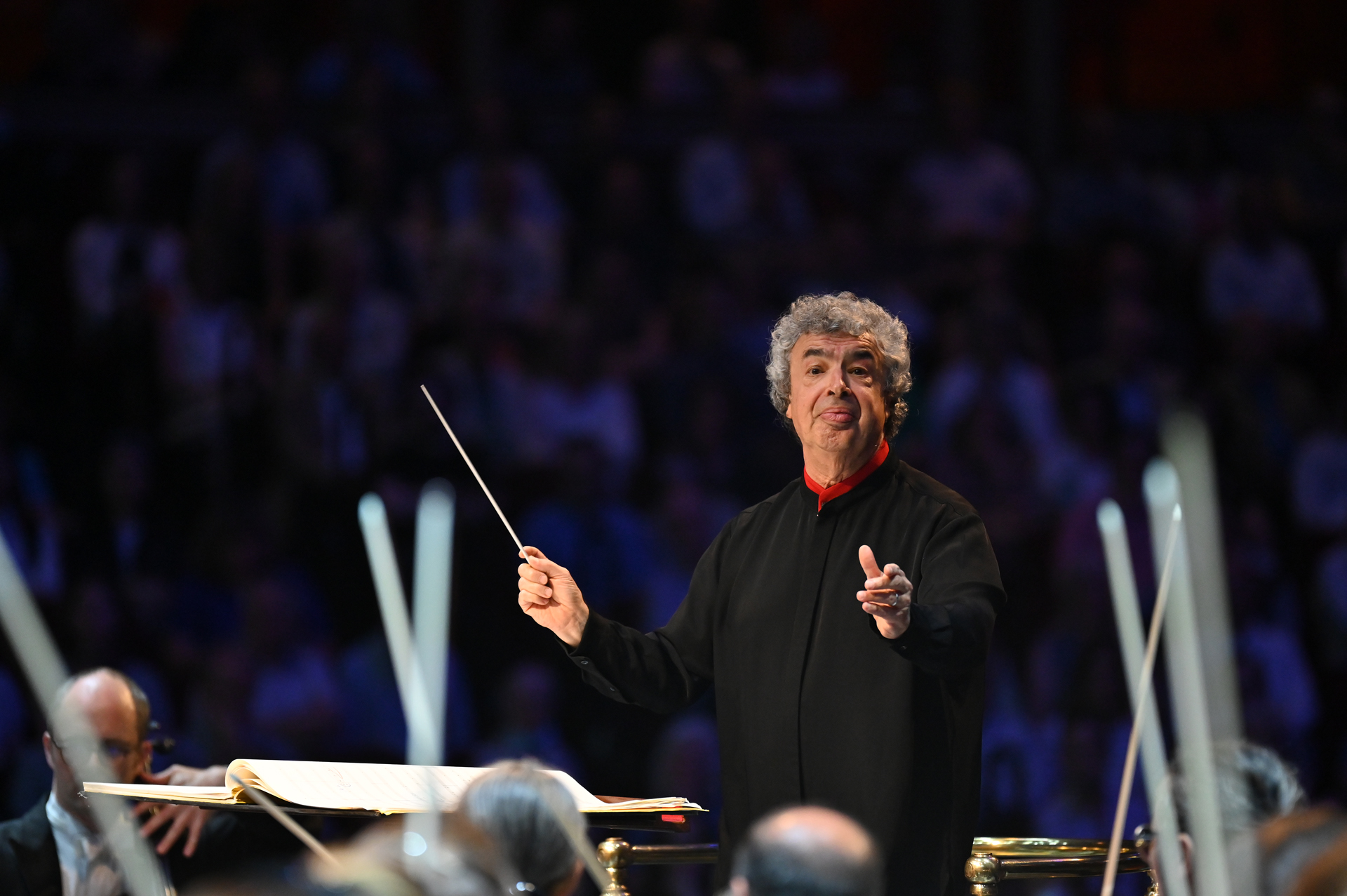
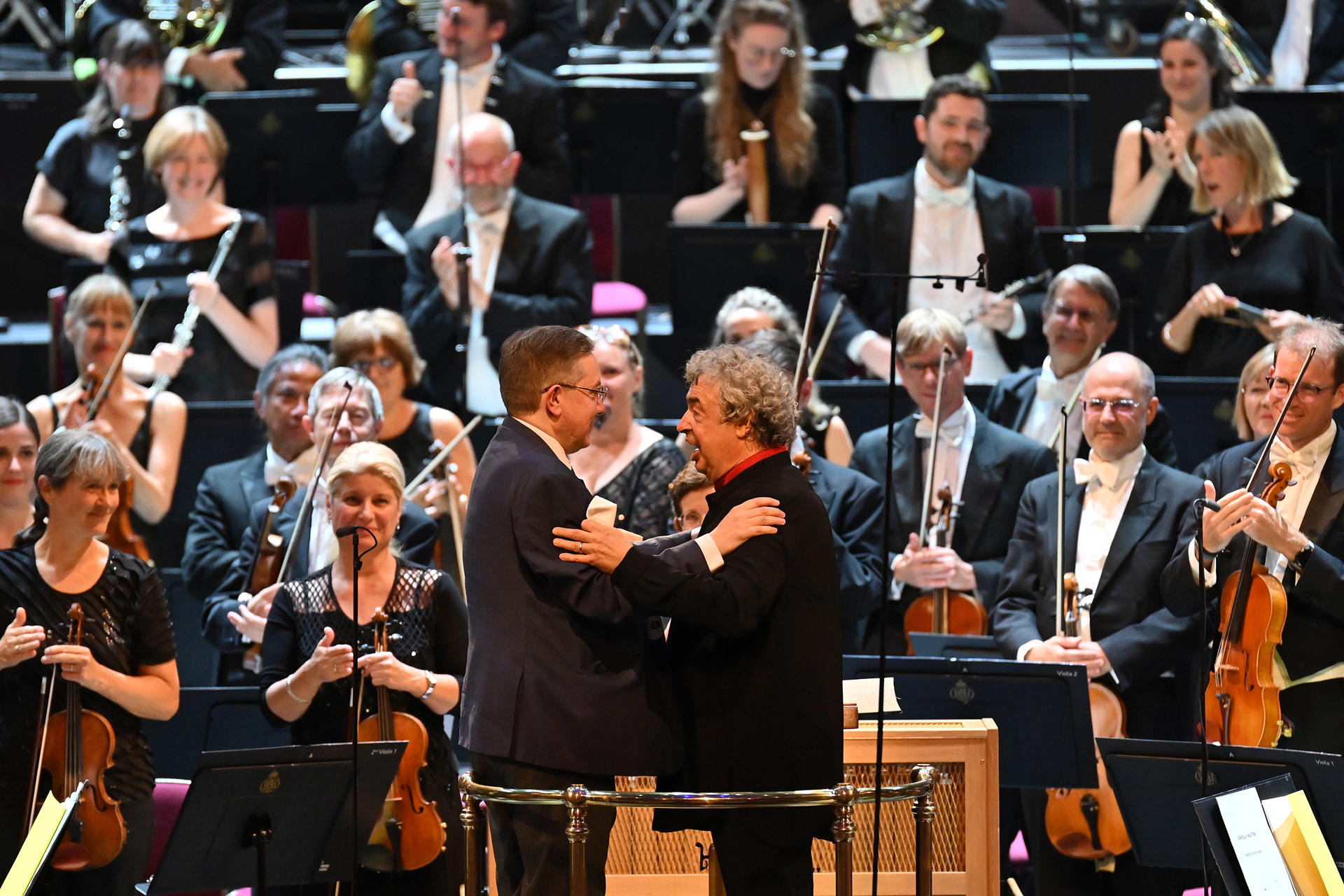
Tchaikovsky and Bruckner might not be the likeliest coupling, but this evening’s programme by the City of Birmingham Symphony Orchestra juxtaposed two works of less than a decade apart to arresting and even thought-provoking effect under the baton of Mirga Gražinytė-Tyla.

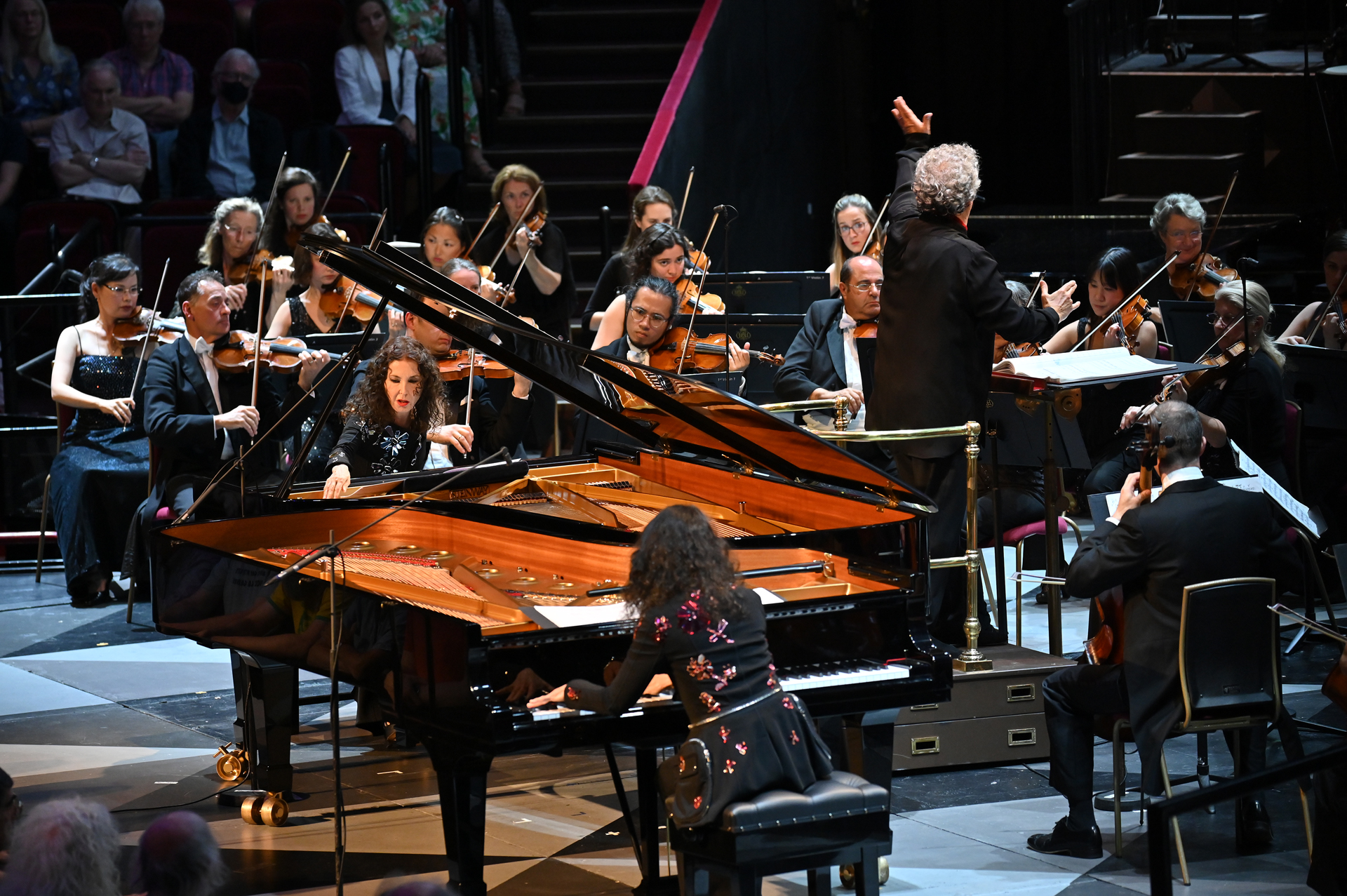
Gabriela Montero can almost always be relied upon to ring the changes in standard repertoire, as it proved in this account of Tchaikovsky’s First Piano Concerto. Its introduction opulent if not unduly grandiloquent, the opening movement proceeded securely and often imaginatively – Montero unafraid to tackle the orchestra head on in this most elemental confrontation, even while her tone was not free of clatter on occasion. Powerfully shaped and incisively rendered, the cadenza brought forth a spontaneous response to this composer at his most imaginative.

At less than half the length of their predecessor, the remaining movements can feel almost an afterthought, though Montero had the measure of the Andantino with its winsome main theme (elegantly phrased by flautist Marie-Christine Zupancic) with its capricious central section incisively fleet of foot. Heading straight into the final Allegro con fuoco (mention of which was omitted from the programme), she duly balanced pianistic fireworks with tangible pathos on the way to an apotheosis with piano and orchestra at one in conveying the music’s unchecked elation.

From the outset of her career, Montero has advocated the almost lost art (with pianists if not organists) of improvisation, and her encore duly took the title-theme from Ennio Morricone’s score to Cinema Paradiso as basis for an engaging workout along the lines of a Bach fugue.

It was Bruckner’s Sixth that MG-T should have conducted (replaced by Omer Meir-Wellber) at what proved the CBSO’s last ‘home’ concert prior to the corona virus ushering in the first lockdown. Good she has been able to reschedule it, even if the overall result was inconsistent. The initial Majestoso was mostly well judged, even if her modification of tempo between its first and second themes then her hairpin crescendos towards the apexes of the development and coda – the latter being one of Bruckner’s finest inspirations – impeded formal continuity. No such issues affected the Adagio, its ineffable expanse guided with assurance and no little insight towards those climaxes supporting the structure as though pillars of an ecclesiastical edifice – the coda ensuring a benediction whose repose remained after this music had ceased.

Nor was there anything to take issue in a Scherzo whose outer sections had all the requisite verve and wit, with the insouciance of its trio ideally judged. A pity when things rather fell apart in the Finale – its genial second theme just avoiding sentimentality at this halting pace, but whose development unfolded at so inhibited a tempo as to become parenthetical to the movement overall. By the time the coda emerged, any consistency of pulse had long been sacrificed so not even the splendour of the CBSO’s collective response could save the day.

Hopefully MG-T will be able to tackle this recalcitrant work again soon, though tomorrow sees the Tchaikovsky paired with Brahms’s Third Symphony. The CBSO then embarks on another European tour before returning for a History of Soul event at the end of this month.

For more information on the CBSO’s 2021/22 season, visit their website, and for details on the newly announced 2022/23 season click here. Meanwhile for more information on the artists, click on the names to access the websites of Gabriela Montero and Mirga Gražinytė-Tyla

Online concert – English Symphony Orchestra / Kenneth Woods: Composer Portrait – Walter Arlen

Walter Arlen
Songs of Songs (1955)
The Poet in Exile (1991)

Anna Huntley (mezzo-soprano), Gwilym Bowen (tenor), Thomas Mole (baritone), BBC National Chorus of Wales, English Symphony Orchestra / Kenneth Woods

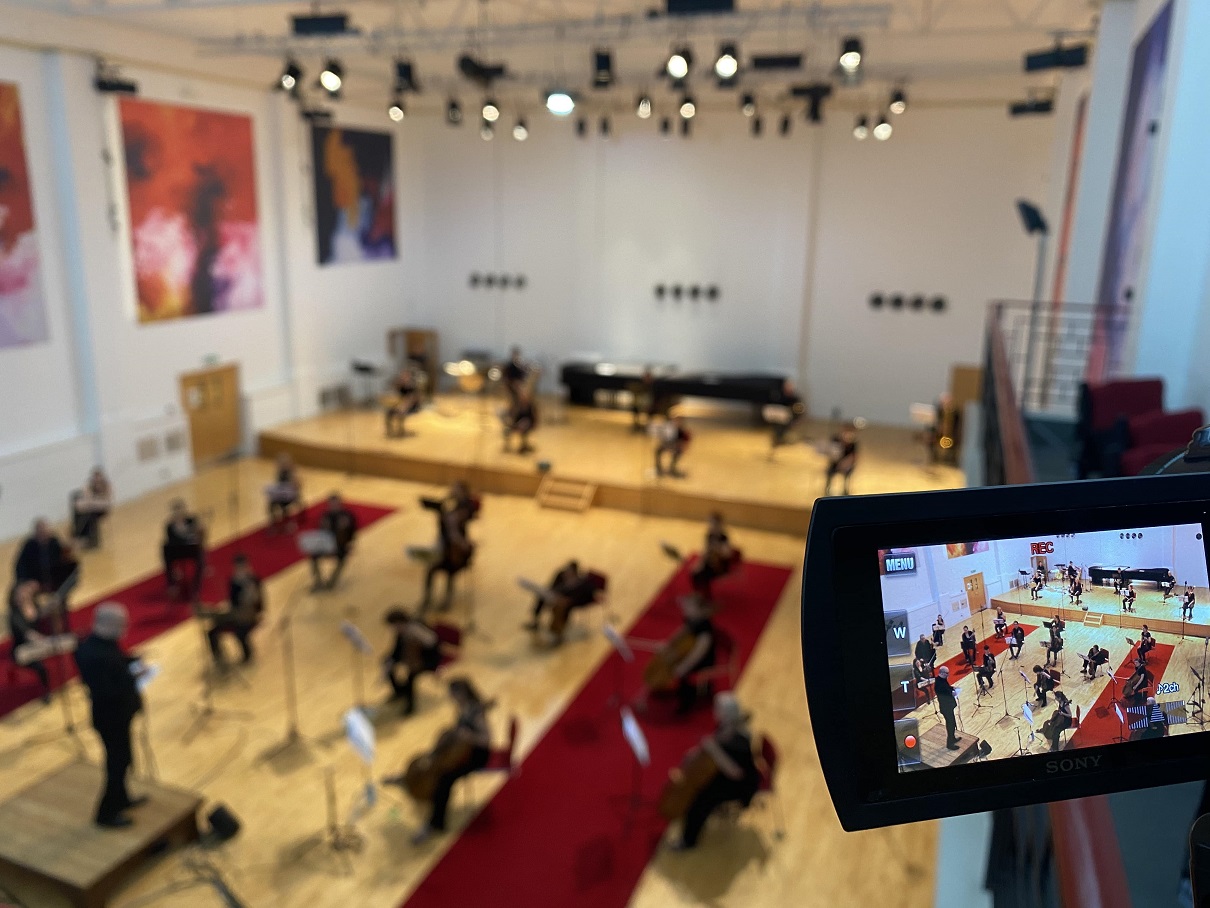
Studio recording at BBC Hoddinott Hall, Cardiff, 17-20 February 2022

by Richard Whitehouse

Although he is likely best known by his trenchant music criticism for the Los Angeles Times, Vienna-born Walter Arlen has made a distinguished contribution to music administration and is increasingly being recognized as a composer. Several releases of his songs and piano music can be heard on the Gramola label, and this latest of the English Symphony Orchestra online concerts provides a welcome introduction to two of his works that feature orchestra – the one drawing on ancient Jewish sources with the other on poems from a leading modern author.

Whether The Song of Songs is indeed harbinger of monogamy in the Judeo-Christian moral code, it contains some of the eloquent expression in either of the Biblical testaments and has long provided a potent inspiration for musical treatment. In just under 30 minutes, Arlen’s ‘dramatic poem’ takes in the main narrative – the lively opening chorus features much sub-divided writing for female chorus underpinned by incisive orchestral textures. As the piece unfolds, it becomes evident that emotional emphasis is placed upon the solo contributions – whether those of King Solomon as sung with burnished warmth by Thomas Mole, those of the Shepherdess rendered with winsome poise and not a little insouciance by Anna Huntley, or those of the Shepherd which Gwilym Bowen here projects with no mean virility but also tenderness. Nor is the BBC National Chorus of Wales found wanting in passages with textural intricacy and intonational accuracy at a premium. If the final resolution does not bring the expected closure, the direct and unaffected appeal of this setting certainly warrants revival.

Yet the real discovery is The Poet in Exile, a song-cycle to texts by the Polish-American author and cultural eminence Czesław Miłosz. For all its undoubted depth and profundity, these texts are not easily rendered in musical terms, and it is to Arlen’s credit that he goes a considerable way towards elucidating them thus. As the latter states, these poems ‘‘dealt with situations echoing my own remembrance of things past’’; a quality which holds good from the trenchant rhetoric of ‘Incantation’, via the sombre rumination of ‘Island’ then the whimsical elegance of ‘In Music’ and controlled fervour of ‘For J.L.’ (with its distinctive obligato for harpsichord), to the confiding intimacy of ‘Recovery’. Inquiring listeners may already have heard these songs with piano on one of the Gramola releases with Christian Immler accompanied by Danny Driver (GRAM98946), but this version – as orchestrated by Kenneth Woods after an arrangement by Eskender Bekmembatov – makes for a richer and wider-ranging context for a vocal line projected with real assurance by Thomas Mole.

Throughout these works, the musicians of the ESO are heard to advantage in the spacious acoustic of Hoddinott Hall and are directed by Woods with sure sense of where to place the emotional emphasis – especially important in conveying the meaning of the songs. If not a major voice, Arlen’s output is always approachable and often thought-provoking. Anyone who has encountered it will enjoy getting to know his music on a larger scale and hearing it played so persuasively: a worthy present for the composer in advance of his 102nd birthday.

These works are available for free public viewing from 13-17 May on the English Symphony Orchestra website

For further information on Walter Arlen, click here – and for the appropriate Gramola Records link click here. Meanwhile click on the names for more on Czesław Miłosz, the English Symphony Orchestra and Kenneth Woods

In concert – Daishin Kashimoto, CBSO / Kazuki Yamada: Prokofiev, Bruch & Mendelssohn

kazuki-yamada-2

Prokofiev Symphony no.1 in D major Op.25 ‘Classical’ (1916-17)
Bruch
Violin Concerto no.1 in G minor Op.26 (1866-8)
Mendelssohn
Symphony no.3 in A minor Op.56 ‘Scottish’ (1829-42)

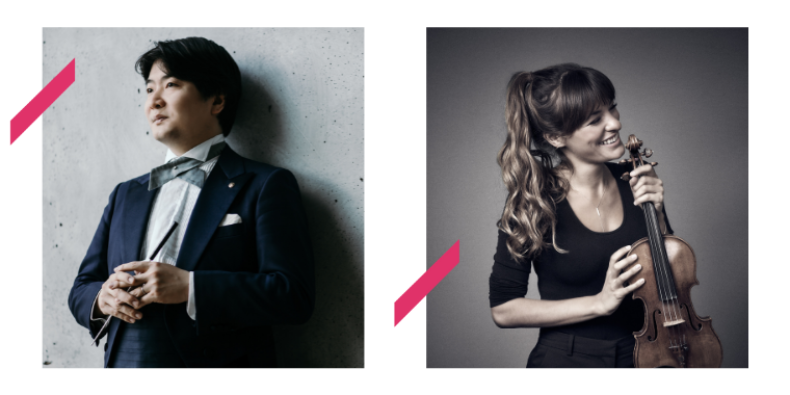
Daishin Kashimoto (violin, below), City of Birmingham Symphony Orchestra / Kazuki Yamada (above)

Symphony Hall, Birmingham
Wednesday 4 May 2022, 2.15pm

Written by Richard Whitehouse

Just under a year before he becomes chief conductor, Kazuki Yamada was back with the City of Birmingham Symphony Orchestra for a programme of well-established favourites, which no doubt accounted for the gratifyingly full house that duly greeted his arrival on the podium.

There was humour aplenty in this account of Prokofiev’s Classical Symphony – not least with Yamada almost acting out the initial Allegro’s whimsical second theme, but the highlight was a Larghetto whose sometimes disjunct episodes came together effortlessly. The outer sections of the ensuing Gavotte seemed a little too mannered to be convincing, but the Finale found conductor and orchestra at one in conveying the scintillating wit but also winsome pathos of its main themes, with a pointing of incidental detail then audible ‘lift off’ to the closing bars.

His decade as first concert-master of the Berlin Philharmonic likely accorded him less profile as a soloist, but his take on Bruch’s First Violin Concerto confirmed Daishin Kashimoto as a force to be reckoned with. Determined not to undersell the Prelude, he and Yamada brought out this music’s sombreness as keenly as its lyricism and, at its climax, a tempestuous energy that found the CBSO at its collective best. Nor was there any lack of emotional gravitas in the Adagio, Kashimoto drawing out its rapturous lyricism without neglecting those more intimate asides which resonate long after the music ceases. Emerging with real anticipation, the final Allegro had no lack of underlying impetus and, in its second theme, a high-flown eloquence that set the seal on this movement, and this piece overall, going into the decisive closing bars.

If the second-half performance of Mendelssohn’s Scottish Symphony was not so consistently satisfying, it reaffirmed just why this work (and this composer) has remained a favourite of Birmingham audiences over the decades. Many latter-day accounts tend toward a decidedly Classical brusqueness, but Yamada chose never to rush the opening movement such that the poignancy of its introduction (rightly) persisted through those agitated contrasts of its main Allegro – the absence of an exposition repeat barely detracting from the music’s emotional weight. Effervescent without being overdriven, the scherzo provided ideal contrast between this and an Adagio whose alternate fervour and rhetoric never skirted that sentimentality as was once all too familiar – with Yamada ensuring clarity through even the densest textures.

As in the Bruch, this performance adhered to the ‘attacca’ indications by which Mendelssohn helps to maintain long-term cohesion. That into the finale launched this movement in bracing fashion and if impetus marginally faltered over the latter stages, the pathos at the outset of its coda made for an ideal transition into the peroration which, uplifting or grandstanding as one hears it, ensures a rousing conclusion that seldom fails to bring the house down. Which it did at the close of a reading that found the burgeoning CBSO/Yamada partnership in fine fettle.

Yamada will be back with this orchestra for the start of the 2022/23 season (details of which have just been announced), while next week brings the season’s last appearances with Mirga Gražinytė-Tyla for a brace of programmes that feature Tchaikovsky, Bruckner and Brahms.

For more information on the CBSO’s 2021/22 season, visit their website, and for details on the newly announced 2022/23 season click here. Meanwhile for more information on the artists, click on the names to access the websites of Kazuki Yamada and Daishin Kashimoto

Online concert – English String Orchestra / Kenneth Woods: Elgar Festival Highlights 2 – Elgar’s Strings

elgar-festival-2

Truscott Elegy for Strings (1944)
Tippett Little Music for Strings (1946)
Elgar Serenade in E minor, Op. 20 (1892)
Chambers The Tall-Eared Fox and the Wild-Eyed Man (1994)

English String Orchestra / Kenneth Woods

Live performances at Guildhall, Worcester, Friday 29 October 2021

A further highlight from last year’s Elgar Festival, in the guise of an attractive miscellany that drew on the abundant body of music for strings, and which was persuasively rendered by the English String Orchestra that has been associated with this repertoire across several decades.

Interesting its principal conductor Kenneth Woods should have proposed a moratorium on the ESO’s performances of Elgar’s Serenade, as the three-year break evidently worked in favour of a piece here emerging as fresh and unjaded – whether in the capering motion of the initial Allegro as was ‘pleasurable’ indeed, the soulful intensity of a Larghetto centred on one of its composer’s most affecting melodies, or a final Allegretto which combines thematic elements with the deftest precision. 130 years on and this piece exhibits no signs of losing its appeal.

eso-woods

Sir Michael Tippett’s Little Music for Strings does seem to be gaining performances, which is only to the good of music as characteristic and accessible as this. Woods was rightly intent on imparting unity to the whole – tempering the rhetoric of the Prelude so it segued into the Fugue with its accumulation of textural weight and expressive intensity, before infusing the Air with a plaintiveness to which the vigorous Finale provided a natural foil. ESO performances in the presence of the composer need not detract from the excellence of its present-day incarnation.

The highlight, however, had come at the start with a revival of the Elegy by Harold Truscott. If the 22 piano sonatas are his greatest achievement, this is surely the piece to make his name more widely known – most likely his expression of acute regret over a failed relationship, and music that went unheard and unacknowledged in his lifetime. The ESO projected its questing tonal trajectory (redolent of later Nielsen) and plangent eloquence with unfailing conviction, so reinforcing its evident claim for a place near the heart of the repertoire for string orchestra.

A relative easing of emotional tension across this programme was made manifest by the final piece. Little known this side of the pond, Evan Chambers is widely respected as a composer and teacher – the present piece evincing his enthusiasm for Irish traditional music through its interplay of jigs which duly underpin the heady evocation that is The Tall-Eared Fox and the Wild-Eyed Man. That inspiration came from an encounter on the west coast of Wales serves to point up the playful irony of music such as strings and conductor alike attacked with relish.

An enjoyable piece, then, with which to round off a recital that was engaging and absorbing by turns. The ESO can be heard in further highlights from last year’s Elgar Festival towards the end of May – by which time, the 2022 edition will be only a few days away from starting.

This concert is available to view on the English Symphony Orchestra website from 29 April – 3 May

For further information on the 2022 Elgar Festival click here. For more on composer Harold Truscott click here, and for more on Evan Chambers click here. For more on the English String Orchestra, click here – and their conductor Kenneth Woods, click here

In concert – Mahan Esfahani, CBSO / Ludovic Morlot: A Journey Through Time

Mahan Esfahani (harpsichord), City of Birmingham Symphony Orchestra / Ludovic Morlot

Ravel Le Tombeau de Couperin (1914-17, orch. 1919)
Sørensen Sei Anime (2020) [CBSO Centenary Commission: UK premiere]
C.P.E. Bach Harpsichord Concerto in D major, H421 (c1745)
Stravinsky Pulcinella – Suite (1922)

Symphony Hall, Birmingham
Thursday 28 April 2022

Written by Richard Whitehouse

A concert with a difference this evening from the City of Birmingham Symphony Orchestra, featuring harpsichord concertos ‘ancient and modern’ alongside two staples of the chamber-orchestra repertoire from the early 20th century in a programme as balanced as it was equable.

His final major work for solo piano, Ravel’s Le Tombeau de Couperin (or at least four of its six movements) is more often heard in the orchestral transcription that accentuates its mood of searching pathos. Not least the Prélude, its liquid motion unerringly conveyed, or in the astringent humour of the Forlane. The Menuet featured a melting oboe contribution from Oliver Nordahl, then in the final Rigaudon Ludovic Morlot avoided an unduly rapid tempo – vividly characterizing the outer sections while drawing confessional intimacy from its trio.

Harpsichordists are infrequent visitors to orchestral concerts, so credit to Mahan Esfahani (above) for tackling two very different yet strikingly complementary works – including the first hearing in this country of another CBSO Centenary Commission. Inspired by matters mundane and metaphysical, the six short movements of Sei Anime have been likened by Bent Sørensen to a French Suite in its expressive contrasts. Unforced alternation of (relatively) slow and fast dances drew an always inquisitive response from the soloist, heard in the context of reduced yet diverse forces that included a range of percussion adeptly handled by Adrian Spillett and the ethereal tones of an accordion played by violinist Kirsty Lovie. By turns enchanting and disquieting, the piece raised many more questions than could be answered at a first hearing.

Esfahani was on familiar ground after the interval with a Harpsichord Concerto in D major by C.P.E. Bach (which this reviewer recalls last hearing at a 70th birthday concert by George Malcolm). If not among his more exploratory works in the medium, this certainly ranks among his most appealing – its three movements perfectly balanced as to form and content such that the lively interplay between soloist and strings in the initial Allegro is complemented with the urbanity and poise of its central Andante, the final Allegro maintaining a scintillating onward motion though to its close. Music such as this most engaging of present-day harpsichordists rendered with unceasing clarity and verve, not least in those cadenzas where the figured-bass writing brought an extemporization whose immediacy never drew attention from the music at hand.

Having proved the deftest of accompanists, Morlot presided over a sparkling account of the suite Stravinsky took from his ballet Pulcinella. Again, it was the lucidity of the woodwind that really came through – not least in the plaintive Serenata or the elegant Gavotta with its two graceful variations. Nor was there any lack of robustness in the opening Sinfonia or, thanks to trombonist Richard Watkin, deadpan humour in the Duetto. An eloquent take on the ensuing Menuetto prepared ideally for the Finale to bring about the uproarious close.
A rewarding concert which deserved a bigger attendance than it received. Those deterred by this ‘journey through time’ will no doubt feel on safer ground next Wednesday, when future chief conductor Kazuki Yamada directs a programme of Prokofiev, Bruch and Mendelssohn.

For more information on the CBSO’s 2021-22 season, click here

Meanwhile for more information on composer Bent Sørensen, click here – and for the artists, click on the names to access the websites of Mahan Esfahani and Ludovic Morlot