In concert – London Sinfonietta / Edmon Colomer: A Catalan Celebration

london-sinfonietta-catalan

Gerhard Libra (1968)
Figuera
Faula (2017)
García-Tomás
Aequae (2012)
Illean
Januaries (2017)
Gerhard
Leo (1969)

London Sinfonietta / Edmon Colomer

Queen Elizabeth Hall, London
Wednesday 1 December 2021

Written by Richard Whitehouse

A celebration of Catalan music, this concert by the London Sinfonietta also commemorated the fiftieth anniversary of the death of Roberto Gerhard – which, falling in January last year, had augured a number of events substantially curtailed by the COVID-19 pandemic and its attendant lockdowns. At least it had been possible to reschedule this programme – Gerhard’s work framing three recent pieces by contemporary composers whose music, if by no means beholden to that of their predecessor, was demonstrably influenced and even enhanced by it.
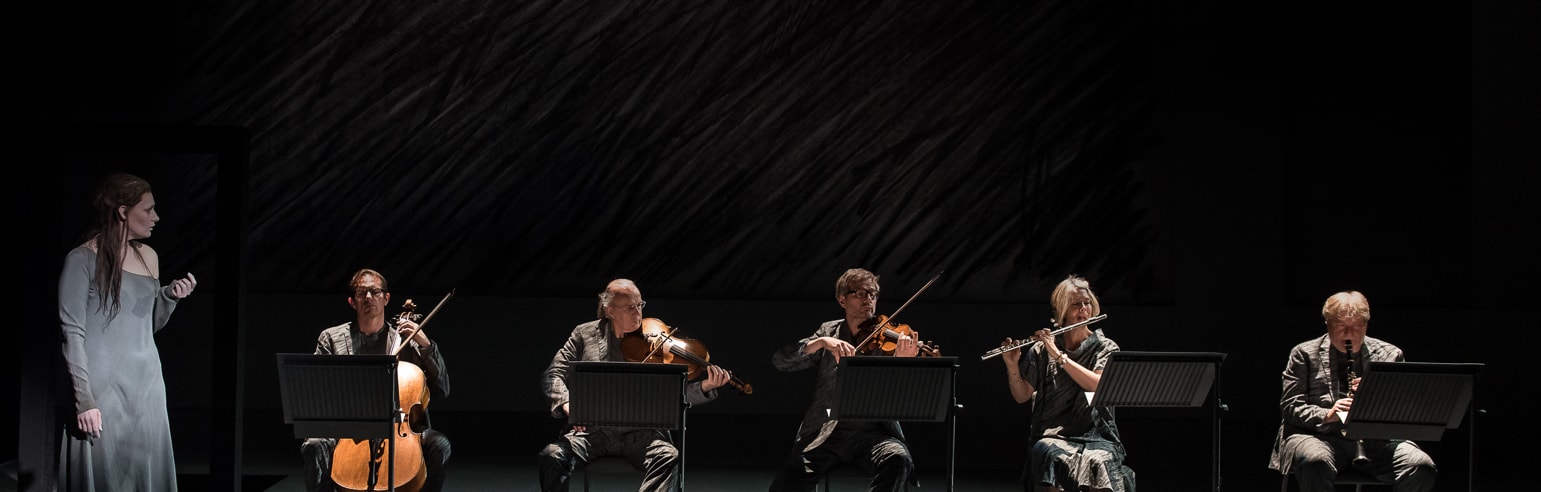
Of these three composers, Joan Magrané Figuera (b1988) was most audibly in the modernist lineage. Faula (Fable) unfolds continuously, its four strands of material being akin to levels of activity – exuding a nervous anticipation, ferocious interaction, static intoning, and a deft animation – present in varying combinations for a process which did not so much evolve as play out across its allotted time-span. More arresting was Aequae (Equal) by Raquel García-Tomás (b1984) – its ‘equality’ embodied in six parts, each of two-minute duration, that drew variety as well as ingenuity of response from its ensemble – with a subtle emphasis on those similarities arising unbidden from the emergence of identical motifs in differing contexts. By comparison, Januaries by Lisa Illean (b1983) felt relatively moribund with its concentration on a continuity that, if not static in its timbre or texture, evoked an atmosphere which started then ceased as though a photographic image not susceptible to real change or intensification. The phrase ‘monotonously beautiful or beautifully monotonous’ inescapably came to mind.

Qualities that could never be applied to Gerhard’s output in general or that of his final decade in particular. Works for ensemble are numerous from this time, yet it made sense to focus on those Astrological pieces which, written in the wake of his masterly Fourth Symphony, were also the last he completed. Both are structured as continuous entities alternating between the extreme of stillness and movement common to the music from his maturity. In the case of the ‘chamber concerto’ that is Libra, the concept of balance feels everywhere apparent – not least its six players interlocking in a range of sub-groups that attain equilibrium on both formal and expressive levels. While it pursues a similar trajectory, the ‘chamber symphony’ that is Leo is intentionally less cohesive in design – the confrontation within its larger forces pushing such constraints to, but never beyond their limits. Both works, moreover, feature an epilogue that, with their gently undulating motion and focus on a folk-inflected melody of exquisite poise, bring into accord their musical concerns as surely as those star-signs of Gerhard and his wife.

Music which has lost none of its affective capacity during the more than half-century since it appeared, and how apposite they should be played by the ensemble that gave their world and European premieres respectively. The London Sinfonietta sounded no less committed than its forebears on pioneering accounts with David Atherton – for which Edmon Colomer, his long-time advocacy heard in numerous performances and recordings, can take due credit. One can only hope it does not take another 50 years for this music’s intrinsic worth to be recognized.

For further information on the concert, click here For more information on the composers, click respectively for Roberto Gerhard, Joan Magrané Figuera, Raquel García-Tomás and Lisa Ilean. For more on Edmon Colomer, click here

In concert – Vilde Frang, BBC Symphony Orchestra / Sakari Oramo: Beethoven Violin Concerto & Dora Pejačević Symphony

Sakari Oramo

Beethoven Violin Concerto in D major Op.61 (1806)
Pejačević
Symphony in F# minor Op.41 (1916-17, rev. 20)

Vilde Frang (violin, below), BBC Symphony Orchestra / Sakari Oramo

Barbican Hall, London
Friday 26 November 2021

Written by Richard Whitehouse. Pictures (c) Mark Allan

The latter-day uncovering of music from the past two centuries by female composers has not always been determined by its intrinsic quality yet, on the basis of this evening’s account by the BBC Symphony Orchestra, the Symphony by Dora Pejačević was certainly worth revival.

Born in Budapest and growing up within the Croatian nobility, Pejačević (1885-1923) early on evolved an idiom whose pivoting on the cusp between late-Romanticism and Modernism was well suited to those large-scale instrumental and, latterly, orchestral works that dominate an output curtailed by her death – from kidney failure – at just 37. Certainly, there is nothing at all cautious about her Symphony in F sharp minor, composed during the later stages of the First World War and a piece audibly indebted to though never merely beholden to its times.

The BBC Symphony Orchestra conducted by Sakari Oramo with Vilde Frang on violin perform Ludwig van Beethoven’s Violin Concerto and Dora Peja?evi?: Symphony in F-sharp minor, op. 4 in the Barbican Hall on Friday 26 Nov. 2021. Photo by Mark Allan

Surprisingly, the opening movement is in most respects the weakest – its main Allegro failing to sustain the impact of its impressive slow introduction (Brahms’s First Symphony the likely precursor), in terms of questing harmonic trajectory or purposeful momentum, once the lyrical if rather flaccid second theme has taken hold. The development relies more on rhetoric than motivic ingenuity over its too brief course, followed by an awkwardly modified reprise then a coda whose glowering intensity reveals an intermittent tendency to overscore for the brass.

Such failings are largely absent from what follows. Centred on a soulful melody given to cor anglais, the Andante builds methodically while irresistibly to its pathos-laden climax before subsiding into the lower reaches of the woodwind; while the Scherzo (better placed second in context) utilizes tuned percussion to underpin a progress whose rhythmic vitality is unusual in symphonies from this era. The final Allegro revisits the first movement’s emotional angst, but its relative succinctness on the way to an ultimately cathartic peroration feels securely judged.

Such, at any rate, was the impression left by this performance – the BBCSO responding with alacrity to Sakari Oramo’s belief in music scored, for the most part, with no little imagination for forces including triple woodwind, six horns and four trumpets. If not the masterpiece some might like to believe, Pejačević’s Symphony is evidently worth revival as frequently as, say, that by Korngold – a potent of what this composer would surely have gone on to create. That she enjoyed only a short-lived maturity need not detract from extent of her legacy as it stands.

The BBC Symphony Orchestra conducted by Sakari Oramo with Vilde Frang on violin perform Ludwig van Beethoven’s Violin Concerto and Dora Peja?evi?: Symphony in F-sharp minor, op. 4 in the Barbican Hall on Friday 26 Nov. 2021. Photo by Mark Allan

Despite sustaining a hand injury, Vilde Frang took the stage in the first half for a reading of Beethoven’s Violin Concerto (replacing that by Stravinsky) as brought the genial and restive aspects of its expansive first movement into effortless accord; after which, the variations of the Larghetto were exquisitely delineated then the humour of the final Rondo shot-through with an incisiveness through to the emphatic close. Among the most astute of accompanists, Oramo drew felicitous playing from the BBCSO’s woodwind and a reduced string-section.

As encore, Frang gave an eloquent take on Gott erhalte Franz den Kaiser, Haydn’s theme for the variations in his ‘Emperor’ Quartet. Hopefully those still trying to reconcile the movement-headings of the Pejačević as given erroneously for the Beethoven were not unduly distracted.

For the repertoire in this concert, listen to the Spotify playlist below:

For further information on the concert, click here For more on Dora Pejačević, click here – and for more on soloist Vilde Frang, here

In concert – Soloists, Tonbridge Philharmonic Society / Naomi Butcher – Music by Fanny & Felix Mendelssohn, Vivaldi, Parry & Eugene Butler

tps

Parry I Was Glad (1902, revised 1911)
Vivaldi Gloria in D major RV589 (c1715)
Eugene Butler Song of Mine, Depart (unknown)
Fanny Mendelssohn Overture in C major (c1830-32)
Felix Mendelssohn Symphony no.3 in A minor Op.56 (1831-42)

Rebecca Milford (soprano), Katie Macdonald (mezzo-soprano), Tonbridge Philharmonic Choir and Orchestra / Naomi Butcher

Chapel of St Augustine, Tonbridge School, Tonbridge
Saturday 20 November 2021

Written by Ben Hogwood

There was a keen air of expectation in the regal surroundings of the Chapel of St Augustine at Tonbridge School. The pandemic has wrought havoc with choral and orchestral plans over the last two years, and as such this was the first opportunity for the Tonbridge Philharmonic Society to celebrate their 75th anniversary. They did so with a new music director, Naomi Butcher (below) at the helm – and she delivered a typically enterprising programme.

There could hardly have been a more appropriate way to start than with Parry‘s jubilant anthem I Was Glad, the choir singing the opening line as one. This was a terrific performance, the audience in spatial stereo as the sound of the organ, commandingly played at the south end by Julian Thomas, and the choir, at the north end, met in the middle. That both forces were so closely aligned said much for Butcher’s musical instincts.

The new music director – the Philharmonic Society’s first woman conductor – introduced herself, in the process revealing the enthusiasm and passion at the heart of her conducting. There was great musicality, too, evident throughout a vibrant and magnificently sung account of Vivaldi’s Gloria. The daring choice of a fast tempo for the Gloria itself was a challenge met head on by the choir, while the fugue of Cum Sancto Spiritu was given impressive authority by the spirited bass section.

The two soloists, soprano Rebecca Milford and mezzo-soprano Katie Macdonald, found the ideal balance with a reduced orchestra to fill the chapel in the arias. The Et in terra pax section was suitably darker in colour, prompted by Vivaldi’s minor-key harmonies, before Macdonald’s fulsome mezzo came into its own for the Qui sedes section. Meanwhile Milford’s clear soprano was the ideal foil for the sensitively played continuo group in the Domine Deus, giving full voice to Vivaldi’s inspiration.

To finish the first half we heard Eugene Butler’s Song of Mine, Depart, a setting by the prolific American composer of verse by Paul Verlaine. This made an attractive encore piece, its lilting refrain nicely phrased by the choir with melodic keyboard accompaniment.

Tonbridge Philharmonic concerts are known for their original repertoire selections, and the inclusion of Fanny Mendelssohn’s Overture in C major – her only known orchestral piece and seemingly a recent discovery – made for a bracing beginning to the second half. The orchestral writing is surprisingly full for its time, to these ears even pointing the way towards Tchaikovsky and Sibelius, but there was still room for the attractive melodies to make themselves known, especially the balletic second theme.

The Overture led straight into the Scottish Symphony by Fanny’s brother, Felix Mendelssohn – the siblings closely linked throughout their personal and professional lives. The Scottish, third of five in Felix’s symphonic canon, is one of the jewels in his output. Its craft and wholesome melodic invention were brought to the fore here, with tempo choices from Butcher (above) that felt just right. These included the solemn opening – where the woodwind choir deserve great credit for their phrasing – to the open-air scherzo, where the violins and solo clarinet (Amanda Curd) were especially good. The Scottish outdoors was painted vividly here, its fresh air palpable – as was also the case in a heartfelt slow movement where Butcher cajoled some lovely phrasing from the orchestra. The finale was a darkness to light experience, thoughtful to begin with but blossoming as the music moved into the major key and an ultimately triumphant conclusion.

It is worth allowing for the fact that many musicians may have lost the ability or even motivation to practice during the pandemic – but there was no evidence of standards having changed here. Rather, with passionate performances from choir, orchestra and conductor alike, Naomi Butcher has brought a breath of fresh air to the Tonbridge Philharmonic Society. Her next few concerts include Prokofiev, Rachmaninov, Duruflé and Sibelius, and if they live up to the standards set by this enticing opener they will be well worth catching.

For further information on the Tonbridge Philharmonic Society click here

In concert – English Symphony Orchestra / Kenneth Woods – Sibelius: Symphony no.7

english-symphony-orchestra-sib

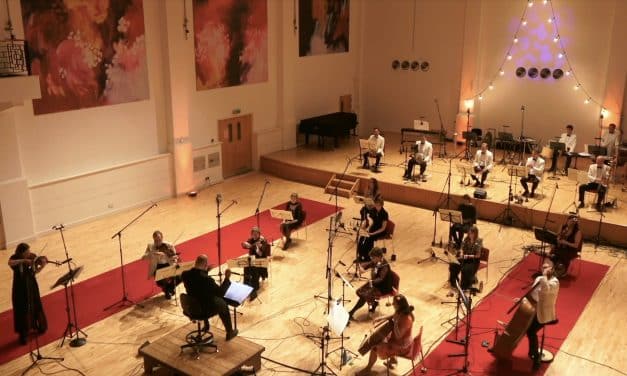
English Symphony Orchestra / Kenneth Woods

Sibelius Symphony no.7 in C major Op.105 (1924)

Recorded at Wyastone Concert Hall, Monmouth on 2 May 2021

Written by Richard Whitehouse

It is good to see that, despite resuming its live schedule this autumn, the English Symphony Orchestra has continued the Music from Wyastone online series as was such a boon over 18 months of lockdown. Moreover, this latest instalment begins the ESO’s most ambitious such project – the seven symphonies (with Tapiola) by Sibelius to run across the 65th anniversary of his death next year. Starting with the Seventh Symphony is certainly a provocative gambit, and it remains to be seen whether this cycle unfolds in strictly backward chronological order.

A decisive (but not simple) test in a performance of this work is how the overall trajectory is perceived. In almost all the most successful readings, the music evolves as if intuitively – the end being implicit in the beginning more than with any symphony before or since. This was certainly true of the ESO’s account, in which the formal constituents were hardly tangible as such until after the event. Sibelius may have distilled the thematic aspect to its essentials, yet in so fusing form and content he endowed this piece with an inevitability always evident here.

Following an expectant if not unduly tense introduction, Kenneth Woods built the first main section with unforced eloquence to a first statement of the trombone chorale as provides the formal backbone. His transition into the ‘scherzo’ was less abrupt than many, while picking up energy such that the chorale’s reappearance generated the requisite momentum to sustain the relatively extended ‘intermezzo’ with its felicitous interplay of woodwind and strings. If his approach to the chorale’s last emergence seemed a fraction cautious, the latter’s intensity carried over into the searing string threnody (much emulated but not equalled by generations since) that subsided into pensive uncertainty – from where the music gathered itself one last time for a magisterial crescendo which, rightly, did not so much end as merely cease to be.

A deeply thoughtful and superbly realized performance which launches the ESO’s Sibelius cycle in impressive fashion. A pity, though, that the end-credits should be accompanied with a repeat of music heard earlier. At the close of such a piece, the rest really should be silence.

Further information on the ESO’s current season can be found at their website

In concert – ESO Digital Black History Concert – The Art of the Rag

english-symphony-orchestra-rag

English Symphony Orchestra / Kenneth Woods

Joplin (arr. Schuller) Maple Leaf Rag (1899)
Europe
(arr. Schuller) Castle House Rag (1914)
Blake
(arr. Schuller) Charleston Rag (1917)
Morton
 Black Bottom Stomp (1925)
Joplin
(arr. Schuller) The Entertainer (1902)

Recorded at Wyastone Concert Hall, Monmouth on November 10th, 2020
First broadcast on October 28th, 2021

Written by Richard Whitehouse

Although recorded just over a year ago, the English Symphony Orchestra’s Art of the Rag made an ideal contribution to the most recent Black History Month – focussing on music by four of the most influential practitioners of the dance-form that became known as Ragtime.

He might not actually have attained his 100th birthday, but Eubie Blake remains among the most versatile of those composers who straddled the (apparent) divide between ragtime and jazz – Charleston Rag typical in its harmonic sideslips and rhythmic syncopation confidently rendered here. His contribution to the promoting of Black musicians, furthering the American war-effort, and creating specifically African-American music has overshadowed James Reese Europe’s compositions – Castle House Rag conveying an ambivalent jollity which was surely intended. Because he lived long enough to perform and record extensively, Jelly Roll Morton has no equals in evolving a jazz idiom – Black Bottom Stomp effectively codifying what was merely a dance craze into a musical template which was to have far-reaching consequences.

Framing these items were the two most popular rags by Scott Joplin. Among his earliest such pieces, Maple Leaf Rag was a success immediately on publication, while The Entertainer had chalked up a plethora of arrangements even before the ragtime revival of the early 1970s, but neither secured financial success for their hapless composer. They certainly responded well to dextrous and attentive playing from the ESO, ably directed by Kenneth Woods and given the benefit – as were most of these pieces – of stylish arrangements by the late Gunther Schuller.

An enterprising selection such as more than fulfilled its purpose in promoting music whose familiarity need not detract from its innovative qualities. Perhaps the ESO could yet mount    a concert or even a staged presentation of Joplin’s magnum opus – the opera Treemonisha?

Further information on the ESO’s current season can be found at their website