In concert – Vilde Frang, BBC Symphony Orchestra / Sakari Oramo: Beethoven Violin Concerto & Dora Pejačević Symphony

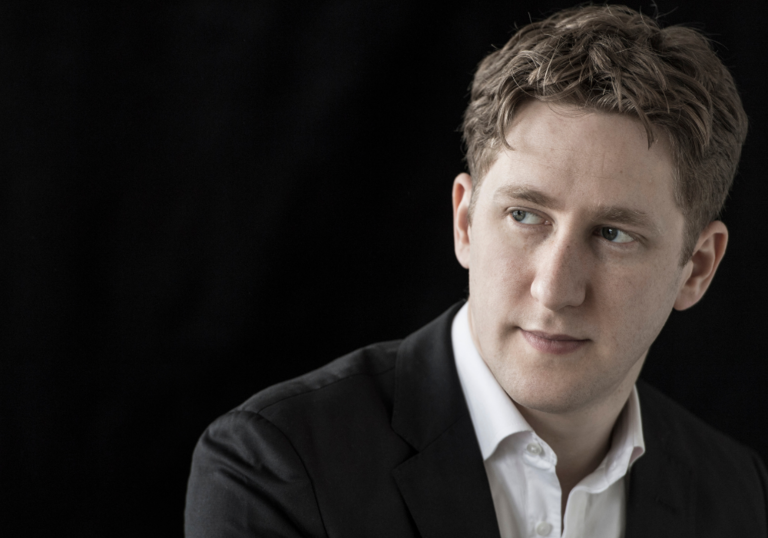
Sakari Oramo

Beethoven Violin Concerto in D major Op.61 (1806)
Pejačević
Symphony in F# minor Op.41 (1916-17, rev. 20)

Vilde Frang (violin, below), BBC Symphony Orchestra / Sakari Oramo

Barbican Hall, London
Friday 26 November 2021

Written by Richard Whitehouse. Pictures (c) Mark Allan

The latter-day uncovering of music from the past two centuries by female composers has not always been determined by its intrinsic quality yet, on the basis of this evening’s account by the BBC Symphony Orchestra, the Symphony by Dora Pejačević was certainly worth revival.

Born in Budapest and growing up within the Croatian nobility, Pejačević (1885-1923) early on evolved an idiom whose pivoting on the cusp between late-Romanticism and Modernism was well suited to those large-scale instrumental and, latterly, orchestral works that dominate an output curtailed by her death – from kidney failure – at just 37. Certainly, there is nothing at all cautious about her Symphony in F sharp minor, composed during the later stages of the First World War and a piece audibly indebted to though never merely beholden to its times.

The BBC Symphony Orchestra conducted by Sakari Oramo with Vilde Frang on violin perform Ludwig van Beethoven’s Violin Concerto and Dora Peja?evi?: Symphony in F-sharp minor, op. 4 in the Barbican Hall on Friday 26 Nov. 2021. Photo by Mark Allan

Surprisingly, the opening movement is in most respects the weakest – its main Allegro failing to sustain the impact of its impressive slow introduction (Brahms’s First Symphony the likely precursor), in terms of questing harmonic trajectory or purposeful momentum, once the lyrical if rather flaccid second theme has taken hold. The development relies more on rhetoric than motivic ingenuity over its too brief course, followed by an awkwardly modified reprise then a coda whose glowering intensity reveals an intermittent tendency to overscore for the brass.

Such failings are largely absent from what follows. Centred on a soulful melody given to cor anglais, the Andante builds methodically while irresistibly to its pathos-laden climax before subsiding into the lower reaches of the woodwind; while the Scherzo (better placed second in context) utilizes tuned percussion to underpin a progress whose rhythmic vitality is unusual in symphonies from this era. The final Allegro revisits the first movement’s emotional angst, but its relative succinctness on the way to an ultimately cathartic peroration feels securely judged.

Such, at any rate, was the impression left by this performance – the BBCSO responding with alacrity to Sakari Oramo’s belief in music scored, for the most part, with no little imagination for forces including triple woodwind, six horns and four trumpets. If not the masterpiece some might like to believe, Pejačević’s Symphony is evidently worth revival as frequently as, say, that by Korngold – a potent of what this composer would surely have gone on to create. That she enjoyed only a short-lived maturity need not detract from extent of her legacy as it stands.

The BBC Symphony Orchestra conducted by Sakari Oramo with Vilde Frang on violin perform Ludwig van Beethoven’s Violin Concerto and Dora Peja?evi?: Symphony in F-sharp minor, op. 4 in the Barbican Hall on Friday 26 Nov. 2021. Photo by Mark Allan

Despite sustaining a hand injury, Vilde Frang took the stage in the first half for a reading of Beethoven’s Violin Concerto (replacing that by Stravinsky) as brought the genial and restive aspects of its expansive first movement into effortless accord; after which, the variations of the Larghetto were exquisitely delineated then the humour of the final Rondo shot-through with an incisiveness through to the emphatic close. Among the most astute of accompanists, Oramo drew felicitous playing from the BBCSO’s woodwind and a reduced string-section.

As encore, Frang gave an eloquent take on Gott erhalte Franz den Kaiser, Haydn’s theme for the variations in his ‘Emperor’ Quartet. Hopefully those still trying to reconcile the movement-headings of the Pejačević as given erroneously for the Beethoven were not unduly distracted.

For the repertoire in this concert, listen to the Spotify playlist below:

For further information on the concert, click here For more on Dora Pejačević, click here – and for more on soloist Vilde Frang, here

In concert – Soloists, Tonbridge Philharmonic Society / Naomi Butcher – Music by Fanny & Felix Mendelssohn, Vivaldi, Parry & Eugene Butler

tps

Parry I Was Glad (1902, revised 1911)
Vivaldi Gloria in D major RV589 (c1715)
Eugene Butler Song of Mine, Depart (unknown)
Fanny Mendelssohn Overture in C major (c1830-32)
Felix Mendelssohn Symphony no.3 in A minor Op.56 (1831-42)

Rebecca Milford (soprano), Katie Macdonald (mezzo-soprano), Tonbridge Philharmonic Choir and Orchestra / Naomi Butcher

Chapel of St Augustine, Tonbridge School, Tonbridge
Saturday 20 November 2021

Written by Ben Hogwood

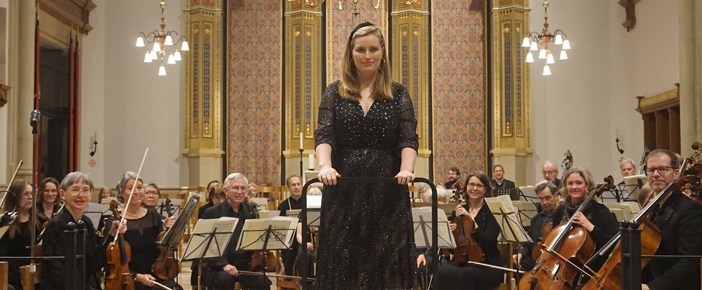
There was a keen air of expectation in the regal surroundings of the Chapel of St Augustine at Tonbridge School. The pandemic has wrought havoc with choral and orchestral plans over the last two years, and as such this was the first opportunity for the Tonbridge Philharmonic Society to celebrate their 75th anniversary. They did so with a new music director, Naomi Butcher (below) at the helm – and she delivered a typically enterprising programme.

There could hardly have been a more appropriate way to start than with Parry‘s jubilant anthem I Was Glad, the choir singing the opening line as one. This was a terrific performance, the audience in spatial stereo as the sound of the organ, commandingly played at the south end by Julian Thomas, and the choir, at the north end, met in the middle. That both forces were so closely aligned said much for Butcher’s musical instincts.

The new music director – the Philharmonic Society’s first woman conductor – introduced herself, in the process revealing the enthusiasm and passion at the heart of her conducting. There was great musicality, too, evident throughout a vibrant and magnificently sung account of Vivaldi’s Gloria. The daring choice of a fast tempo for the Gloria itself was a challenge met head on by the choir, while the fugue of Cum Sancto Spiritu was given impressive authority by the spirited bass section.

The two soloists, soprano Rebecca Milford and mezzo-soprano Katie Macdonald, found the ideal balance with a reduced orchestra to fill the chapel in the arias. The Et in terra pax section was suitably darker in colour, prompted by Vivaldi’s minor-key harmonies, before Macdonald’s fulsome mezzo came into its own for the Qui sedes section. Meanwhile Milford’s clear soprano was the ideal foil for the sensitively played continuo group in the Domine Deus, giving full voice to Vivaldi’s inspiration.

To finish the first half we heard Eugene Butler’s Song of Mine, Depart, a setting by the prolific American composer of verse by Paul Verlaine. This made an attractive encore piece, its lilting refrain nicely phrased by the choir with melodic keyboard accompaniment.

Tonbridge Philharmonic concerts are known for their original repertoire selections, and the inclusion of Fanny Mendelssohn’s Overture in C major – her only known orchestral piece and seemingly a recent discovery – made for a bracing beginning to the second half. The orchestral writing is surprisingly full for its time, to these ears even pointing the way towards Tchaikovsky and Sibelius, but there was still room for the attractive melodies to make themselves known, especially the balletic second theme.

The Overture led straight into the Scottish Symphony by Fanny’s brother, Felix Mendelssohn – the siblings closely linked throughout their personal and professional lives. The Scottish, third of five in Felix’s symphonic canon, is one of the jewels in his output. Its craft and wholesome melodic invention were brought to the fore here, with tempo choices from Butcher (above) that felt just right. These included the solemn opening – where the woodwind choir deserve great credit for their phrasing – to the open-air scherzo, where the violins and solo clarinet (Amanda Curd) were especially good. The Scottish outdoors was painted vividly here, its fresh air palpable – as was also the case in a heartfelt slow movement where Butcher cajoled some lovely phrasing from the orchestra. The finale was a darkness to light experience, thoughtful to begin with but blossoming as the music moved into the major key and an ultimately triumphant conclusion.

It is worth allowing for the fact that many musicians may have lost the ability or even motivation to practice during the pandemic – but there was no evidence of standards having changed here. Rather, with passionate performances from choir, orchestra and conductor alike, Naomi Butcher has brought a breath of fresh air to the Tonbridge Philharmonic Society. Her next few concerts include Prokofiev, Rachmaninov, Duruflé and Sibelius, and if they live up to the standards set by this enticing opener they will be well worth catching.

For further information on the Tonbridge Philharmonic Society click here

In concert – English Symphony Orchestra / Kenneth Woods – Sibelius: Symphony no.7

english-symphony-orchestra-sib

English Symphony Orchestra / Kenneth Woods

Sibelius Symphony no.7 in C major Op.105 (1924)

Recorded at Wyastone Concert Hall, Monmouth on 2 May 2021

Written by Richard Whitehouse

It is good to see that, despite resuming its live schedule this autumn, the English Symphony Orchestra has continued the Music from Wyastone online series as was such a boon over 18 months of lockdown. Moreover, this latest instalment begins the ESO’s most ambitious such project – the seven symphonies (with Tapiola) by Sibelius to run across the 65th anniversary of his death next year. Starting with the Seventh Symphony is certainly a provocative gambit, and it remains to be seen whether this cycle unfolds in strictly backward chronological order.

A decisive (but not simple) test in a performance of this work is how the overall trajectory is perceived. In almost all the most successful readings, the music evolves as if intuitively – the end being implicit in the beginning more than with any symphony before or since. This was certainly true of the ESO’s account, in which the formal constituents were hardly tangible as such until after the event. Sibelius may have distilled the thematic aspect to its essentials, yet in so fusing form and content he endowed this piece with an inevitability always evident here.

Following an expectant if not unduly tense introduction, Kenneth Woods built the first main section with unforced eloquence to a first statement of the trombone chorale as provides the formal backbone. His transition into the ‘scherzo’ was less abrupt than many, while picking up energy such that the chorale’s reappearance generated the requisite momentum to sustain the relatively extended ‘intermezzo’ with its felicitous interplay of woodwind and strings. If his approach to the chorale’s last emergence seemed a fraction cautious, the latter’s intensity carried over into the searing string threnody (much emulated but not equalled by generations since) that subsided into pensive uncertainty – from where the music gathered itself one last time for a magisterial crescendo which, rightly, did not so much end as merely cease to be.

A deeply thoughtful and superbly realized performance which launches the ESO’s Sibelius cycle in impressive fashion. A pity, though, that the end-credits should be accompanied with a repeat of music heard earlier. At the close of such a piece, the rest really should be silence.

Further information on the ESO’s current season can be found at their website

In concert – ESO Digital Black History Concert – The Art of the Rag

english-symphony-orchestra-rag

English Symphony Orchestra / Kenneth Woods

Joplin (arr. Schuller) Maple Leaf Rag (1899)
Europe
(arr. Schuller) Castle House Rag (1914)
Blake
(arr. Schuller) Charleston Rag (1917)
Morton
 Black Bottom Stomp (1925)
Joplin
(arr. Schuller) The Entertainer (1902)

Recorded at Wyastone Concert Hall, Monmouth on November 10th, 2020
First broadcast on October 28th, 2021

Written by Richard Whitehouse

Although recorded just over a year ago, the English Symphony Orchestra’s Art of the Rag made an ideal contribution to the most recent Black History Month – focussing on music by four of the most influential practitioners of the dance-form that became known as Ragtime.

He might not actually have attained his 100th birthday, but Eubie Blake remains among the most versatile of those composers who straddled the (apparent) divide between ragtime and jazz – Charleston Rag typical in its harmonic sideslips and rhythmic syncopation confidently rendered here. His contribution to the promoting of Black musicians, furthering the American war-effort, and creating specifically African-American music has overshadowed James Reese Europe’s compositions – Castle House Rag conveying an ambivalent jollity which was surely intended. Because he lived long enough to perform and record extensively, Jelly Roll Morton has no equals in evolving a jazz idiom – Black Bottom Stomp effectively codifying what was merely a dance craze into a musical template which was to have far-reaching consequences.

Framing these items were the two most popular rags by Scott Joplin. Among his earliest such pieces, Maple Leaf Rag was a success immediately on publication, while The Entertainer had chalked up a plethora of arrangements even before the ragtime revival of the early 1970s, but neither secured financial success for their hapless composer. They certainly responded well to dextrous and attentive playing from the ESO, ably directed by Kenneth Woods and given the benefit – as were most of these pieces – of stylish arrangements by the late Gunther Schuller.

An enterprising selection such as more than fulfilled its purpose in promoting music whose familiarity need not detract from its innovative qualities. Perhaps the ESO could yet mount    a concert or even a staged presentation of Joplin’s magnum opus – the opera Treemonisha?

Further information on the ESO’s current season can be found at their website

In concert – City of Birmingham Symphony Orchestra: A Covid Requiem

mirga-grazinyte-tyla

Adès O Albion (1994, arr. 2019)
Pärt
Fratres (1977, arr. 1991)
Purcell (arr. Britten)
Chacony in G minor Z730 (c1680, arr. 1948)
Barber
Adagio in B flat minor Op.11 (1935, arr. 1936)
interspersed with poetry readings by Casey Bailey
Fauré
Requiem in D minor Op.48 (1887-90, rev. 1893)

James Platt (bass), Casey Bailey (poet), CBSO Children’s Chorus, CBSO Youth Chorus, CBSO Chorus, City of Birmingham Symphony Orchestra / Tomo Keller (violin/director), Mirga Gražinytė-Tyla (conductor)

Symphony Hall, Birmingham
Saturday 6 November 2021

Written by Richard Whitehouse

Even if live music-making has gradually been returning to how it was, the (ongoing) legacy of Coronavirus could hardly be overlooked, thus a concert such as that given this evening by the City of Birmingham Symphony Orchestra was a necessary act of remembrance for all the many concertgoers to have been affected by the pandemic. As befitted such an occasion, no speeches or prefatory remarks were needed, with the darkening of the auditorium during the performance a simple but effective gesture which helped focus musicians and listeners alike.

Strings only were onstage in the first half – Tomo Keller directing a sequence as began with O Albion, Thomas Adès’s arrangement of the sixth movement from his quartet Arcadiana, whose gentle pathos made for the ideal entrée. Arvo Pärt has written numerous memorials and while Cantus might have been more appropriate in this context than Fratres, the latter’s sparing deployment of percussion as to underline its ritualistic emergence then withdrawal conveyed no mean eloquence. Surprising, perhaps, that Britten’s arrangement of Purcell’s Chacony is not heard more frequently on such occasions, its expressive intensification here informed by an acute rhythmic clarity. Barber’s Adagio is, of course, a staple at these times – the visceral emotion of its climax and subdued fatalism that ensues audibly conveyed here.

Interspersed between these pieces were poems by Casey Bailey, currently Birmingham Poet Laureate and whose readings were undeniably affecting in their sincerity – whether the heady reportage of 23.03.21 (a date no-one in the UK could hope to forget), the intimate evocation of Weight or graphic remembrance of Once. His appearances on stage were precisely judged as to segue into then out of the music either side and it was a pity when he did not take a call at the end of this first half, alongside the CBSO strings, given his contribution to proceedings.

Tomo Keller remained for the second half – adding ethereal counter-melodies to two of the sections in Fauré’s Requiem, whose 1893 version is without violins but with divided violas and cellos along with reduced woodwind and brass to make for a reading closer to the initial conception and certainly more apposite tonight. Her credentials in the choral repertoire well established, Mirga Gražinytė-Tyla conducted with a real sense of this work’s essential poise but without neglecting any deeper emotions. James Platt brought a ruminative warmth to the Hostias and Libera me, and it was an inspired touch to have the Pie Jesu sung in unison by the Children’s Chorus; its plaintiveness offsetting those richer tones of the Youth Chorus and CBSO Chorus, while opening-out the music’s textural and expressive range accordingly.

In one sense it would have been better had this concert not had to take place, given the legacy it commemorated (as was witnessed by the personal recollections occupying five pages of the programme) and yet, as those ethereal strains of the In Paradisum receded beyond earshot, a feeling of the Covid crisis having been recognized then overcome was palpable on the part of those present. Moreover, the CBSO’s next event is a performance of Janáček’s The Cunning Little Vixen – surely as transcendent and life-affirming an experience as could be hoped for.

Further information on the CBSO’s current season can be found at the orchestra’s website. For more on Casey Bailey, click here, for James Platt click here, and for Tomo Kellner here