

Simon Callow, Rodney Earl Clarke, Sara Kestelman, Helen McCrory (narrators), Gerard McBurney (creative director), Mike Tutaj (projection design), London Symphony Chorus and Orchestra / Sir Simon Rattle
Various composers The Genesis Suite (1945)
Bartók Concerto for Orchestra (1943)
Barbican Hall, London; Saturday 13 January 2018
Written by Ben Hogwood
Collaboration in classical music is rare. Pop music is full of it – many of the best songs and albums are co-written – but for composers to work together on a single work is nigh on unthinkable. Full marks, then, to Sir Simon Rattle and the London Symphony Chorus and Orchestra for reminding us of an instance when that did in fact happen – no fewer than SEVEN classical composers coming together in 1945, at the end of World War II, to write the Genesis Suite. The project was held together by Nathanial Shilkret, masterminding the project from Hollywood.
The Suite, of course, has nothing to do with the rock band. Yet it is fully progressive, telling the story of the first book of the Bible from creation through to the construction of the Tower of Babylon in the space of an hour, working its way from Schoenberg to Stravinsky via Shilkret himself, Alexandre Tansman, Darius Milhaud, Mario Castelnuovo-Tedesco and Ernst Toch.
Rattle and creative director Gerard McBurney collaborated on a series of moving images and audio clips to put the Genesis Suite in modern perspective. These were thought provoking and occasionally daring. The story of Cain and Abel (with surprisingly upbeat music from Milhaud) was played out to a Middle Eastern backdrop, Ronald Reagan and Margaret Thatcher were prominent during the story of The Flood (Noah and the Ark), while the construction of the Shard against Stravinsky’s music for Babel was a powerful allegory.
Unfortunately the music was overshadowed somewhat by the wordy text, taken directly from the King James Bible, and read as written. Nor was it helped by a lack of ensemble between the starry quartet of narrators. Simon Callow and Helen McCrory stood far left, Sara Kestelman and Rodney Earl Clarke far right – which meant for the audience it was a strain to hear two of the four speakers unless sat directly in the middle, despite the amplification. Some speakers were better versed than others in their delivery, too – and maybe because of my own seated position Kestelman and Clarke appeared to have greater emotional involvement.
The London Symphony Chorus, however, were as one in their powerful contributions, dressed in white to maximise their dramatic delivery. When the men came out into the stalls for the Stravinsky finale the Suite’s tension between creation and what man has done with it reached its ultimate, tense conclusion.
Musically the Suite was inconsistent. Schoenberg’s Prelude stood out for inventive orchestration and far reaching harmonic language, while in a dramatic sense Toch’s dramatic setting of The Rainbow (The Covenant) was a notable high. Creation itself, Shilkret’s contribution, felt hurried, the seven days of creation crammed into ten minutes.
Despite these reservations Genesis Suite made a lasting impression, especially following Rattle’s assertion that all composers except one wrote in exile. After the interval another such composer, the Hungarian Béla Bartók writing in America in 1943, was to light up the concert.
It is very easy to take the LSO’s virtuosity for granted, but in a performance like this they shone from every corner. Rattle challenged them to dig deep technically and emotionally and they delivered on every level, particularly in the work’s deeply felt heart, the Elegia. Rattle and McBurney opted to continue with images, which were slow moving or static this time, depicting the forests Bartók looked on during composition. However the gauze on which the images were shown did on occasion muffle the projection of the brass musicians sat under or behind the screen.
Ultimately this did not spoil a terrific performance, where sinewy strings and percussive outbursts were complemented by outstanding, colourful woodwind playing. The first of the two scherzos brought this out, with pairs of bassoons, flutes, clarinets and oboes outstanding in their delivery, balanced by the trumpets. The finale danced energetically, bathed in a luminous glow which proceeded to leave its spell on the audience.
Further listening
You can see Sir Simon Rattle talking about the Genesis Suite below:
The music from this concert, including Rattle’s own recording of the Concerto for Orchestra, can be heard on this Spotify playlist:
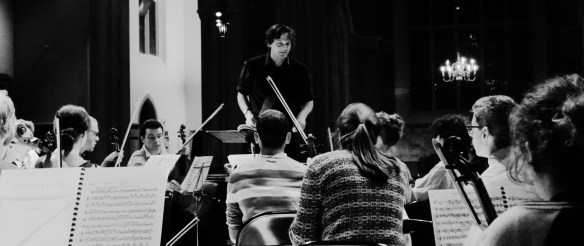

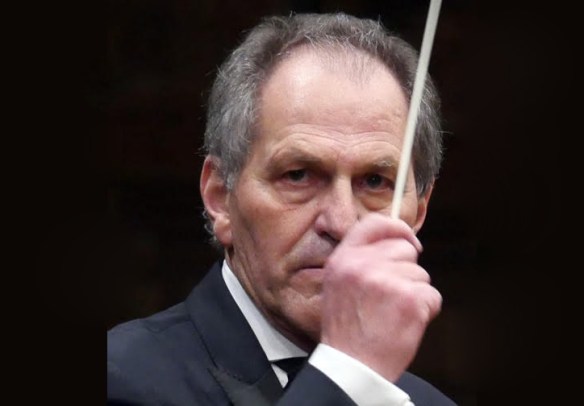 Both these works benefitted from the stylish and attentive accompaniment as secured, from a Royal Philharmonic Orchestra on excellent form, by Cristian Mandeal – assuredly the leading Romanian conductor of his generation. He began proceedings with Enescu’s First Romanian Rhapsody – a piece that, however much its composer might have deplored the fact, continues to represent his music to the public at large. If just a shade hesitant in the initial section, this account audibly hit its stride in a coruscating take on the breathless dance-music that follows.
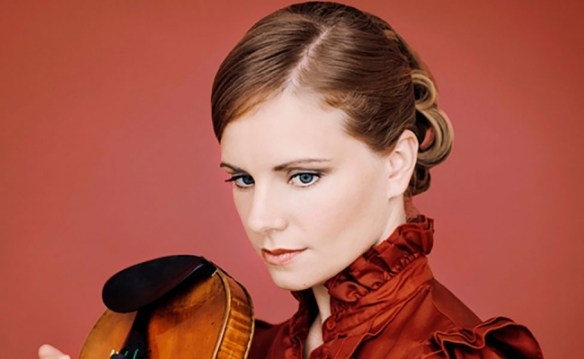 Even so, it was the first half that brought greater rewards. With its inspiration in a typically melodramatic story from Ivan Turgenev and breathing an aura of fatalistic dread, Chausson’s Poème has made a welcome return to the repertoire and has also found its ideal exponent in Julia Fischer – her warm and caressing though never over-wrought tone teasing out those expressive nuances which lurk beneath the surface of this emotionally all-enveloping score. Whatever else, its composer experienced the essential qualities of his music in graphic terms.
 Arcana.fm