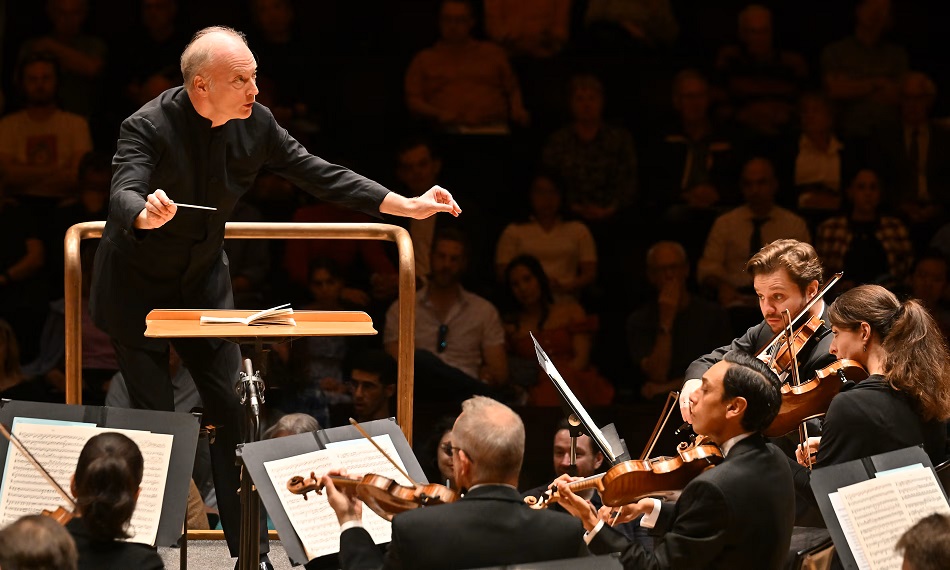
In concert – Chaka Khan’s Meltdown: Bruce Hornsby @ Royal Festival Hall

Bruce Hornsby (vocals, piano), Olivia Chaney (vocals, harmonium)]

Royal Festival Hall, London
Tuesday 18 June 2024

Reviewed by Ben Hogwood Photos (c) Ben Hogwood

Bruce Hornsby likes to challenge his audience. When I was fortunate enough to interview him for musicOMH, he went into some detail – with great feeling – about how the gig experience should not be a mere reproduction of his recorded output.

In reality, the opposite is the truth. While he presents his best-known material, he coats it in new clothes, pairing it in some cases with modern classical piano works. Ligeti, Webern, Elliott Carter and Schoenberg all make themselves known in the course of this solo piano set, their chromatic compositions a direct contrast to the pop songs with which they are juxtaposed.

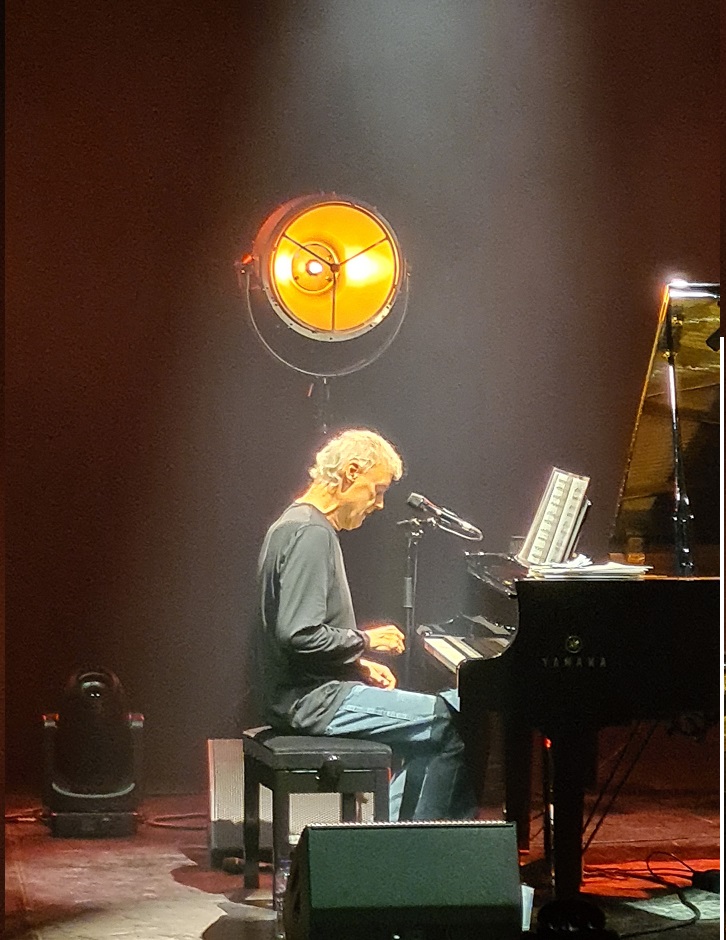
Hornsby is a natural raconteur in between, his stories told with a glint in the eye but also with a good deal of meaning and emotion. The piano is his closest relative, for sure – and the feeling is that not a day goes by without Hornsby spending at least a few hours seated at the keyboard. Watching this gig is akin to eavesdropping on a practice session in the room next door. Sure, there are some rough edges, but they are all part of the charm – moments where the voice has to travel higher than it might normally go, or where there are too many notes to fit into the available meter at the end of a particularly fulsome improvisation.

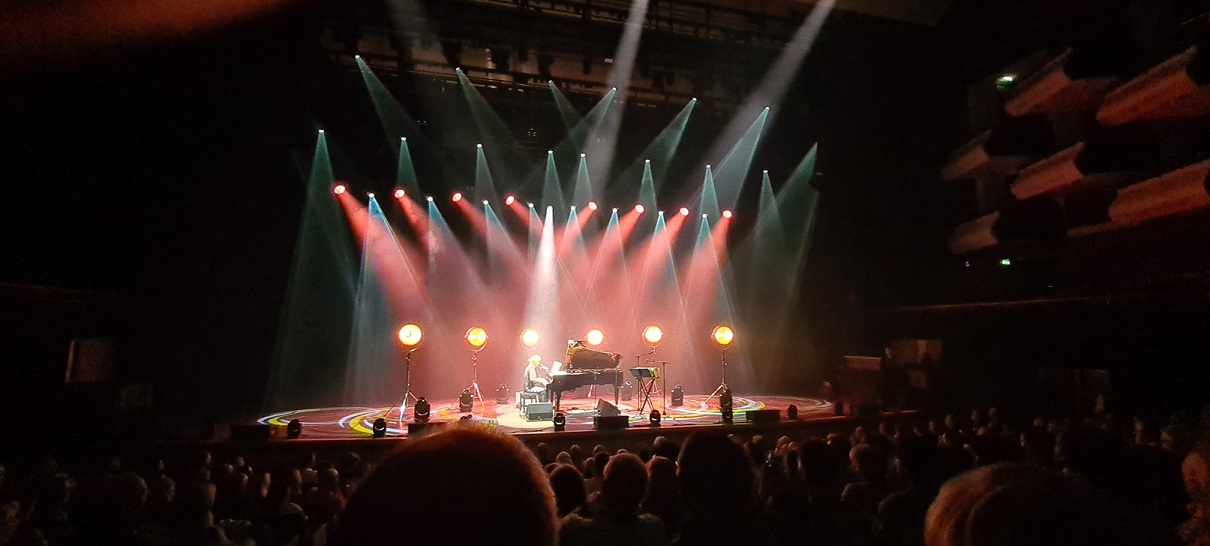
For these performances are very much in the moment, and for that the audience is grateful. The Royal Festival Hall stage is an oversized living room, the audience effectively sat around the fire as the host tells his musical stories. The narration is kept brief, as the generous host ‘only has 90 minutes’ in which to fit the music he wants to play.

Ten minutes in and we have already had our money’s worth, in the form of elegant versions of Days Ahead and Soon Enough. In these songs Hornsby uses the piano as a miniature orchestra, creating colours through the unusual density of the left-hand part but giving us memorable melodies and lyrics too. The voice is in good shape, the piano even more so.

Cast-Off is the first to showcase his more recent musical directions, the co-write with Bon Iver’s Justin Vernon a humourous tale of a man addicted to break-ups but one with a lingering sadness. The melodic profile is now angular, but the tunes still make sense, while the harmonies strain at the leash leaving their audience behind.

At times it seems Hornsby is determined to challenge and even rile the audience, with provocative one-liners and musical about-turns. The Way It Is now comes without its principal riff – but it still reaches deep into the soul, a moment for the audience to think and check themselves, assess their life direction even. It remains a special song, one of the ‘80s best, and the mark of a good song is that it can work in several guises. The same can be said for The End Of The Innocence, a Hornsby composition for Don Henley, which by its end inhabits the air of a Brahms intermezzo.

The co-writes are a source of constant surprise and wonder. There are songs written with Chaka Khan (the moving Love Me Still), performed with Sting, Eric Clapton and Bruce Springsteen (Halcyon Days), or with Elton John (Dreamland), where the piano line is recognisably the work of Hornsby.

He sings affectionately of his son’s dislike of school (Hooray For Tom) and ventures into ‘the curiously American genre of the murder ballad’ for the Pat Metheny collaboration Country Doctor, where wondrous things happen beneath the floorboards – aka the piano’s lowest register. This is the song with the most rhythmic drive.

At two points in his set Hornsby is joined by fellow singer-songwriter Olivia Chaney, who also plays harmonium. Their version of The PoguesFairytale In New York is on the quaint side, and feels under rehearsed, but works thanks to the musicianship on show, even if the harmonium is low in the mix. Balance is restored for Mandolin Rain, one of the best songs on show, where Hornsby’s deadpan emotional guard almost slips.

He is a true entertainer, able to get the crowd eating out of his hand while they marvel at the skill and guile of a performer who has not yet been fully appreciated in his time. Fifteen albums into his career, Hornsby is more adventurous on his approach to 70 than he ever has been, set to challenge his audience even further with time. More power to his elbow, for a great pianist such as him deserves this stage on a much more regular basis. The crowd, discussing a memorable night, would surely agree.

Published post no.2,214 – Wednesday 19 June 2024

In concert – Summer Music in City Churches: Tier3 Trio @ St Giles Cripplegate

Tier3 Trio [Joseph Wolfe (violin), Jonathan Ayling (cello), Daniel Grimwood (piano)]

Liszt arr. Saint-Saëns Orpheus
Tchaikovsky arr. Grimwood Andante non troppo (second movement of Piano Concerto no.2 in G major Op.44) (1880)
Arensky Piano Trio no.1 in D minor Op.32 (1894)

St Giles Cripplegate, London
Thursday 13 June 2024, 1pm

Reviewed by Ben Hogwood

‘Love’s Labours’ is the title of this year’s Summer Music in City Churches festival, based opposite the Barbican Hall in St Giles Cripplegate. The ten day-long enterprise is proving ample consolation for the much-missed City of London Festival, which once captivated audiences in the Square Mile for three weeks and offers music of equal range and imagination.

For the second year in succession the Tier3 Trio visited for a lunchtime recital, following up last year’s tempestuous Tchaikovsky Piano Trio with an attractive programme subtitled From Russia with Love. They began with a curiosity, playing Saint-Saëns’ little-known arrangement of Liszt’s symphonic poem Orpheus for piano trio. A highly effective transcription, it retained its dramatic thread in this fine performance, notable for its attention to detail and well-balanced lines when reproducing Liszt’s slow-burning music. Pianist Daniel Grimwood successfully evoked Orpheus’ lyre, while Jonathan Ayling’s burnished cello sound probed in counterpoint to Joseph Wolfe’s violin.

Tier3 was formed during lockdown, and in the same period when he was performing Tchaikovsky’s Piano Concerto no.2 in Germany, Grimwood realised the suitability of the work’s slow movement for trio. He rightly complemented ‘the extent to which Tchaikovsky was an experimenter in form’, a trait found in many works but at its inventive peak in the second concerto, whose slow movement is in effect a piano trio with orchestra. Here the arrangement was just right – balanced, elegant and fiercely dramatic towards the end. Clarity of line was secured through sensitive pedalling from Grimwood, the trio using the resonant acoustic to their advantage, while the individual cadenzas were brilliantly played.

These two notable curiosities linked beautifully into one of the best-known works of Anton Arensky, his Piano Trio no.1 in D minor. Arensky is not a well-known composer, fulfilling in part an unkind prophecy from his teacher, Rimsky-Korsakov. However that does not mean his music is without merit – far from it, as in his brief life of 45 years he wrote two symphonies, four orchestral suites, a substantial output of piano and high quality chamber music, of which the first piano trio is the pick.

Dedicated to the cellist Karl Davidov, it is equal parts elegy, drama and ballet – with a powerful first movement setting the tone. The balletic second movement Scherzo demands much of the piano, but Grimwood was its equal, sparkling passagework from the right hand dressed with twinkling figures for cello and piano. The emotional centre of the trio was in the slow movement, with a heartfelt tribute to Davidov in Ayling’s first solo, while the finale rounded everything up in a highly satisfying payoff, a return to the first movement’s profound theme capped with an emphatic closing section.

These were very fine performances from a trio at the top of their game, navigating the resonant acoustic of St Giles with power and precision. On this evidence, Rimsky-Korsakov would have had to eat his words!

You can read more about Summer Music in City Churches at the festival website – and you can listen to a Spotify playlist below, containing the music heard in this concert – with the original version of the Tchaikovsky:

Published post no.2,209 – Friday 14 June 2024

In concert – Katie Trethewey, University of Birmingham Voices, CBSO Chorus & Orchestra / Ludovic Morlot: John Luther Adams – Vespers of the Blessed Earth; Sibelius

Katie Tretheway (soprano), CBSO Chorus, University of Birmingham Voices, City of Birmingham Symphony Orchestra / Ludovic Morlot

John Luther Adams Vespers of the Blessed Earth (2021) [CBSO co-commission: UK premiere]
Sibelius Symphony no.2 in D major Op.43 (1901-02)

Symphony Hall, Birmingham
Thursday 9 May 2024

Reviewed by Richard Whitehouse

Almost eight years ago, the City of Birmingham Symphony Orchestra and Ludovic Morlot gave the UK premiere of John Luther AdamsBecome Ocean. Tonight they, with the CBSO Chorus and University of Birmingham Voices, gave that of his most recent large-scale work.

It may have been obliquely inspired by Monteverdi, but Vespers of the Blessed Earth is very much a humanist response to those ecological challenges of the present and, to this end, its texts have a concreteness and functionality which is wholly at the service of the music. Thus A Brief Descent into Deep Time sets words as depict the (reverse) geological evolution of the Grand Canyon, its emotional matter-of-factness in contrast to A Weeping of Doves with its unaccompanied setting of the call of the Papuan fruit dove in what is one of Adams’ most ravishing inspirations. Hardly less affecting is Night-Shining Clouds – an interlude, in the form of a chaconne, for strings that follows what the composer calls a ‘sub-harmonic’ series with its slowly spiralling descent to the depths for a graphic evocation of cloudly pollutants.

The fourth and climactic section, Litanies of the Sixth Extinction divides the choruses into four parts which between them chant the names of species in the process of or likely to face extinction – closing ominously with Homo Sapiens. It was here that an antiphonal placing of strings and percussion, along with choirs of woodwind and brass placed along either side of the upper circle, came into its own but, typically for Adams, the effect was one of cumulative if not intensifying emotion. Aria of the Ghost Bird followed with its transcribed rendering of the call from the now-extinct Kaua’i O’ō, tonight taken by Katie Tretheway (above) in what was a finale of the gentlest eloquence. It duly remained for offstage flute and chimes, here placed up in the grand tier, to see this inconsistent while always absorbing work to its wistful close.

In his thoughtful introductory remarks, Morlot spoke of the appositeness when juxtaposing Adams with Sibelius and the latter’s Second Symphony, which followed the interval, made his point admirably. Once the most popular such piece by Sibelius (and, indeed, of the last century), latter-day performances too often fight shy of its innate rhetoric or overt emotion. Without being disengaged, this account succeeded because of its methodical trajectory, not least a first movement whose restraint was never at the expense of its overall incisiveness.

With its stark contrast between conflict and consolation, the slow movement can easily fall into overkill but not here – Morlot evincing a keen sense of cohesion through to its baleful ending. The scherzo likewise secured keen cohesion from its alternate energy and raptness, then its surging transition into the finale brought an emotional frisson maintained through to an apotheosis whose grandeur never felt self-conscious or overbearing. Whether the triumph expressed is cultural or personal, the underlying essence of its affirmation was not in doubt.

It certainly set the seal on a memorable evening – one that confirmed the undoubted rapport between orchestra and conductor, while bridging the conceptual divide and almost 120 years between these pieces. Hopefully the CBSO and Morlot will be working together again soon.

Click on the link to read more on the current CBSO concert season, and on the names for more on soprano Katie Trethewey, conductor Ludovic Morlot, the University of Birmingham Voices and the CBSO Chorus. Meanwhile you can click on the name for more on composer John Luther Adams

Published post no.2,203 – Saturday 8 June 2024

In concert – Quatuor Danel: Shostakovich & Weinberg #5 @ Wigmore Hall

Quatuor Danel [Marc Danel & Gilles Millet (violins), Vlad Bogdanas (viola), Yovan Markovitch (cello)]

Shostakovich String Quartet no.7 in F# minor Op.108 (1959-60)
Weinberg String Quartet no.7 in C major Op.59 (1957)
Weinberg String Quartet no.8 in C minor Op.66 (1959)
Shostakovich String Quartet no.8 in C minor Op.110 (1960)

Wigmore Hall, London
Monday 3 June 2024

by Richard Whitehouse Photo (c) Marco Borggreve

Quatuor Danel’s interleaving of string quartets by Shostakovich and Weinberg arrived at its effective half-way point this evening with a programme featuring the seventh and eighth of their respective cycles: quartets that are as different from each other as are these composers.

His briefest and likely most ambivalent, Shostakovich’s Seventh Quartet is dedicated to the memory of his first wife from the vantage of the short-lived marriage to his second. Its three movements play without pause, their oblique formal and expressive circularity being potently realized here – whether those fugitive speculations of the opening Allegretto, wistful regret of the central Lento, or seething anger of a final Allegro whose fugal aggression pointedly heads back to the opening theme for a close of simmering unease. Music, then, which implies much more than could really be stated, as the Danel underlined throughout this perceptive reading.

Coming 11 years after its monumental predecessor, Weinberg’s Seventh Quartet might seem representative of a (necessary) lowered ambition in the late- and post-Stalin years. Subdued and even enervated, its opening Adagio never strays from a musing uncertainty the ensuing Allegretto (originally preceded by a vivid scherzo, subsequently withdrawn) offsets through its poise and charm. Neither predicts a finale as takes the precedent of that in Shostakovich’s Second Quartet to its logical extreme – these 23 variations on a sombre theme unfolding as a palindrome from sustained grandeur to seething energy, then back to the start for a glowering apotheosis. Undoubtedly one of the great such movements in the history of the string quartet.

Such music would usually mark the end of a programme but, following the trajectory of this double-cycle, it concluded the first half of a recital which continued with Weinberg’s Eighth Quartet. Once relatively familiar through its championing from the Borodin Quartet and, in the UK, the Lindsays, its single movement (reciprocally taken to a new level with the 13th Quartet of Shostakovich) builds from initial reticence to a dance-like section of pronounced Klezmer inflections. Affording a culmination of audible anguish, this duly subsides towards the mood of the opening for a conclusion of becalmed intimacy realized to perfection here.

It is worth recalling how much more frequently played, compared to the rest of his cycle, was Shostakovich’s Eighth Quartet even a quarter-century after its composer’s death. All credit to the Danel for investing it with a continual sense of (re-?) discovery – the pensive allusiveness of its initial movement yielding an anticipation brutalized by the violence of its scherzo then deflected by the quizzical repartee of its intermezzo. The fourth movement assuredly took no hostages to fortune in its graphic alternation between the confrontational and consoling, and it remained for the finale to restore emotional equilibrium with its resumption of the opening music – albeit now devoid of quotations as Shostakovich stands ‘naked’ before his listeners.

A gripping performance and one, moreover, that brought this first phase of the Danel’s cycle to a natural close. It resumes on October 16th with the Ninth and 10th Quartets by Weinberg alongside the Ninth Quartet by Shostakovich – a programme equally eventful and intriguing.

You can hear the music from the concert below, in recordings made by Quatuor Danel -including their most recent cycle of the Shostakovich quartets on Accentus:

For more information on the next concert in the series, visit the Wigmore Hall website. You can click on the names for more on composer Mieczysław Weinberg and Quatuor Danel themselves.

Published post no.2,200 – Wednesday 5 June 2024

In concert – Anne-Sophie Mutter, London Symphony Orchestra / Thomas Adès: Myth and Magic @ Barbican Hall

Anne-Sophie Mutter (violin), London Symphony Orchestra / Thomas Adès

Stravinsky Orpheus (1947)
Lutosławski Partita (for Violin and Orchestra) (1988)
Adès Air – Homage to Sibelius (Violin Concerto) (UK premiere) (2021-22)
Stravinsky Agon (1953-57)

Barbican Hall, London
Thursday 31 May 2024

Reviewed by Ben Hogwood Pictures (c) Mark Allan

This rewarding concert featured the imaginative programming of four works looking simultaneously backwards and forwards, with two great Stravinsky ballets framing shorter works for violin and orchestra.

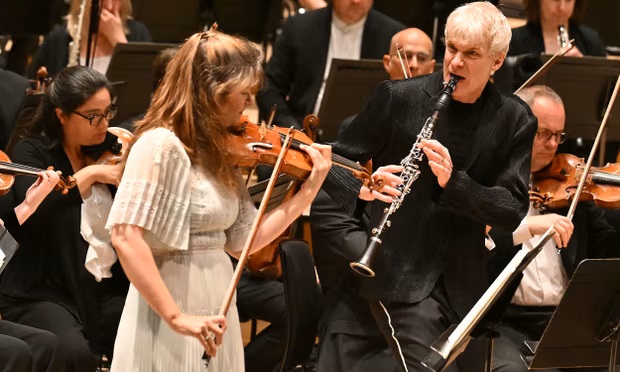
Anne-Sophie Mutter (below) has forged a pioneering path for contemporary music throughout her career, and added another dedication to an illustrious list that includes Lutosławski, Penderecki, Sir André Previn and Unsuk Chin. Air – Homage to Sibelius was written in the light of her admiration for Adès’ Concentric Paths, his Violin Concerto of 2005. It is a very different work indeed, an extended meditation based on a single melody written in the slow days of lockdown in 2021. In the execution Adès brought his music unexpectedly close to that of John Tavener or Arvo Pärt, the latter’s Cantus in memoriam Benjamin Britten recalled by the solemnly descending melody. Beginning on high with the orchestral violins, this was soon joined by Mutter’s silky-smooth tones. Now the piece developed with the soloist in charge, its serene progress tinged with longing. With no brass in the orchestra the textures were light, with tuned gongs suggesting a soft breeze, before the music gained weight on the gradual descent as though nearing the bottom of a mountain. The Sibelius homage could be determined in the line and structure of the piece, and also the rarefied light that it cast adrift.

Before the interval we heard Lutosławski’s Partita, written initially for violin and piano in 1984 but orchestrated for Mutter four years later. The word ‘partita’ is interpreted by Lutosławski in its 18th century form, and this work begins with a stern Allegro giusto that comes adrift when the soloist starts to use portamento, the melody travelling through microtones. Mutter’s control here was masterful, yet the feeling of dislocation was compounded. The central Largo was powerful indeed, the violin singing a darker song, before the closing Presto brought a terrific burst of energy, the colourful orchestration prompting and cajoling. Mutter’s voice, though, spoke the loudest.

The concert had begun with a relatively rare live account of Orpheus, the second of Stravinsky’s three Greek ballets. Thomas Adès directed a compelling performance of a work whose dynamic levels remain quiet for almost the entire half hour – yet contain music of acute description and poignancy. There is dread too, which Adès brought out in the scenes where Orpheus is surrounded by the Furies, then where he met his untimely demise at the hands of the Bacchantes. With the harp of Bryn Lewis treading a solitary, elegant line, Orpheus’ lyre remained as a ghostly presence right through to the end – in spite of the efforts of the Angel of Death, brilliantly voiced by violinist and orchestra leader Benjamin Gilmore.

The concert finished with the remarkable Agon, with which Stravinsky completed his Greek trilogy and indeed entire ballet output when premiered in New York in 1957. Even in his mid-70s the composer was pushing boundaries, this time in the direction of Schoenberg’s serial technique, without compromising his dramatic instincts. With no plot, Agon is essentially a celebration of movement, Stravinsky free to explore old dance forms through the prism of twentieth century harmony and melody, with remarkably imaginative instrumentation. This performance fully revealed its genius, the Renaissance and Baroque dances given a new lease of life with orchestration turned on its head. The colours were enhanced by mandolin (Huw Davies), harp (Bryn Lewis) and percussion (Neil Percy and Tom Edwards), not to mention the superb LSO brass, wind and string sections. Double basses got in on the act, playing high in the register, the weird and wonderful sounds given gruff harmonies and comedic punctuation as the ballet unfolded. Light and shade were exquisitely explored, the advantage of having a composer-conductor such as Thomas Adès at the helm meaning no stone was left unturned. This was a memorable interpretation, capping a wholly stimulating evening of music making.

You can find more information on further 2023/24 concerts at the London Symphony Orchestra website

Published post no.2,195 – Friday 31 May 2024