
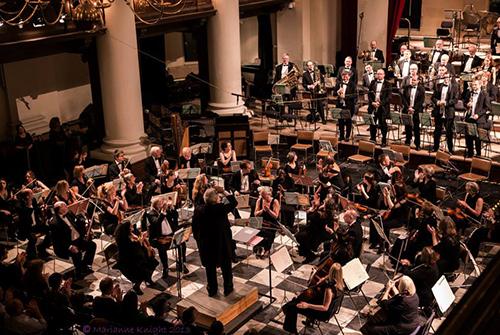
In concert – Josephine Lappin, Salomon Orchestra / Edmon Colomer – Gerhard’s Soirées de Barcelone, Falla & Turina

Josephine Lappin (piano), Salomon Orchestra / Edmon Colomer

Turina Ritmos Op.43 (1927)
De Falla Noches en los jardines de España G49 (1915)
Gerhard (ed. MacDonald) Soirées de Barcelone (1936-9, comp. 1995-6)

St. John’s, Smith Square, London
Sunday 21 May 2023

Reviewed by Richard Whitehouse

The Salomon Orchestra celebrates its 60th anniversary this season with three concerts of real ambition. The second saw a collaboration with Edmon Colomer, whose advocacy of Spanish music in general – and Roberto Gerhard especially – was evident throughout this programme.

His second ballet, Soirées de Barcelone was also Gerhard’s largest project before the collapse of Spain’s republican government forced him into exile. A piano suite from the 1950s was the only realized portion of a work otherwise known through an orchestral suite made soon after the composer’s death. At least until 1996, when musicologist Malcolm MacDonald finished the orchestration of the whole ballet and so enabled its broadcast during Gerhard’s centenary. MacDonald’s edition was duly receiving its first public performance in the UK this afternoon.

Set in the Pyrenees at the St John’s Eve festivities, with rituals of fire purification and fertility as its scenario, Soirées… falls into three substantial tableaux where the prevalence of Catalan folk songs and dances is imbued with a motivic density and orchestral virtuosity anticipating Gerhard’s maturity. The first of these, The Crowd, features three of the items from the suite and finds this score at its most immediate; the second, Eros contains the deepest and most imaginative music – notably the sombre initial Notturno and vividly evocative Apparition of Eros. Emotional intensity falters slightly in the third tableau, The Weddings, but there is no want of impetus as the work builds to its culmination in an eloquent Sardana that resolves scenic and musical issues, then a Coda which sees the piece through to its effervescent close.

At just over 50 minutes, Soirées… is a tough assignment for any orchestra, so all credit to the Salomon for rendering its many intricacies with unfailing commitment and no little panache. It helped to have Colomer at the helm, his understanding and empathy being evident through the care over phrasing and frequent textural finesse. Only on occasion were tempi marginally under-speed to accommodate the exacting rhythmic syncopation though, as he steered a fine reading to its close, there was little doubt as to the sheer power and imagination of this music.

A dependable pianist in the Gerhard, Josephine Lappin impressed as soloist with Manuel de Falla’s Nights in the Gardens of Spain, whose pervasive concertante writing often benefitted when heard from the rear of the platform. A steady yet flexible tempo for In the Generalife brought out some mysterious and even ominous undertones, while the alluring lilt of Distant Dance ensured this headed seamlessly into In the Gardens of the Sierra de Cordóba with its interplay of energy and eloquence before the performance ended in a mood of gentle rapture.

Few of Joaquín Turina’s orchestral works are revived these days, which seems more the pity as this composer was arguably the deftest Spanish orchestrator of his generation. Subtitled a ‘Choreographic Fantasy’, Ritmos made for a scintillating curtain-raiser – its six continuous sections demonstrating unforced musical logic as well as an appealing overall atmosphere. The Salomon players rendered it with infectious enjoyment, reminding one that such pieces – indeed, those in this concert as a whole – are all too infrequently heard in UK concert halls. Colomer provided an extensive spoken introduction to the Gerhard, hopefully a work he will yet record in its entirety. He rounded off this memorable concert with a breezy medley from the Zarazuela, notable for principal flautist Roy Bell taking the solo spot with his castanets.

You can read all about the 60th anniversary season and book tickets at the Salomon Orchestra website Click on the names for more on conductor Edmon Colomer and composer Roberto Gerhard – and for an article on this concert visit the composer’s publisher Boosey

In concert – CBSO / Robert Treviño – Mahler’s 10th symphony

City of Birmingham Symphony Orchestra / Robert Treviño

Mahler, ed. Cooke Symphony no.10 in F sharp major (1910)

Symphony Hall, Birmingham
Thursday 18 May 2023

Reviewed by Richard Whitehouse

The City of Birmingham Symphony Orchestra has a notable association with Mahler’s Tenth Symphony – realized by Deryck Cooke – having given memorable performances with Simon Rattle and more recently with Sakari Oramo. This evening’s account was to have been taken by Mirga Gražinytė-Tyla, but her indisposition brought American conductor Robert Treviño to the helm for what was a memorable performance that vindicated (if such were needed) this ‘performing edition’ and hinted at what might develop into a notable partnership in the future.

The quality of string playing these days means the initial viola melody no longer poses quite the risks it once did. Treviño went on to shape this opening Adagio with a sure sense of how its contrasting themes are drawn into an evolution whose unpredictability is informed by an emotional candour, heard at its most explicit in the climactic dissonance (evidently added at a late stage) such as makes the beatific coda the more affecting. Nor did he fail to tease out the underlying continuity of music shot through with the knowledge of its own dissolution.

Such an issue is more graphically present in the first Scherzo, its contrapuntal texture fitfully realized in the score but here achieved with a deftness making the trade-off between its polka- and ländler-like ideas the more potent. Not least during the later stages of a movement where these themes alternate with ever increasing frequency, as if in a stretto of activity, on the way to the most decisive and even affirmative conclusion found in Mahler’s late music. Treviño’s opting not to tone down those more unlikely percussive touches proved its own justification.

Almost Mahler’s shortest symphonic movement, the Purgatorio is yet crucial to the overall design – the ‘treadmill’ motion of its outer sections exuding acute irony, with the histrionics at its centre firmly held in check so their implications were made more than usually evident.

Performances of this work most often founder in the second Scherzo, but not here – Treviño launching it with anguished intent, while maintaining a persuasive balance between this and the more consoling element which informs its progress. The brief central interlude conveyed exquisite pathos, tension barely receding as the expression gradually and inevitably subsides into crepuscular activity with its fleeting intimations of what went before and what is still to come. Just one bass-drum stroke, surely, is needed to separate this movement from the finale.

That said, the unfolding of this latter left nothing to chance – whether in the sepulchral gloom of its initial bars, the poise of its indelible melody for flute, or a central phase of activity that here emerged as the natural consequence of what went before. Treviño (rightly) retained the additional percussion necessary to make the return of the first movement’s climax the more shattering – the sheer eloquence of what followed building to a rapturous culmination which, as with the closing emotional wrench, drew an unfaltering response from the CBSO strings.

A memorable performance, and one that met with an enthusiastic response. Treviño brought the soloists and sections to their feet, but might have started with trumpeter Jason Lewis and flautist Marie-Christine Zupancic – their contributions typifying the excellence of the whole.

You can read all about the 2022/23 season and book tickets at the CBSO website. For more on Robert Trevino, visit his website

In concert – Gramophone 100th Anniversary Concert @ Wigmore Hall

Reviewed by Ben Hogwood

There is a famous, unattributed quote that ‘writing about music is like dancing about architecture’. How, then, to interpret a concert in celebration of a magazine? The conclusion, when that magazine is 100 years old, is that surely its writers are doing something right!

The magazine is the esteemed Gramophone, formed in 1923 and reaching its centenary without a break, not even an issue missed during the Second World War. Gramophone has reflected the growth of the classical record industry, proving something of a bible for classical music listeners and buyers, with its recommendations of recordings and interviews / thought pieces to put them in context. Music old and new is covered, and not all of it classical – indeed, as we found out during James Jolly’s revealing and entertaining narration, the magazine reviewed pop music in the 1960s.

Jolly is the magazine’s Editor in Chief, and has been with the magazine since starting as editorial assistant in 1985. He gave a debt of gratitude to the Gramophone founder Sir Compton Mackenzie and the Pollard family, where the large part of the night’s story lay. Modestly, the magazine did not dwell on their current state, which would have been easy – for Gramophone is one of those rare things, a publication where subscription is done without the bat of an eyelid, and each issue read cover to cover – either physically or online, where you can enjoy the entirety of its archive in digital form.

How to celebrate such a publication in a concert? Choosing the Wigmore Hall was a smart move, honing resources and ensuring the celebrations were done with quality as well as quantity. The move did of course eliminate larger scale forms – opera and orchestral – but it retained the magazine’s sense of musical exploration through five centuries of music.

Violinist Alina Ibragimova and pianist Cédric Tiberghien began with a concentrated performance of Debussy’s Violin Sonata, completed just six years before the magazine’s first edition. This was a thoughtful and virtuosic performance, Ibragimova fully inhabiting each phrase while Tiberghien successfully harnessed Debussy’s coloristic effects and sleights of harmony. The spectre of war was close at hand – as it was in Gramophone’s early years.

Next up was countertenor Iestyn Davies, a late replacement for soprano Fatma Said. It was a privilege to hear his Purcell, refracted through the eyes of modern composers, showing how access to the composer’s music has boomed since Gramophone started. Davies had a particularly arresting delivery for Britten’s Lord, what is man, before a deeply passionate vocal in the Thomas Adès setting By beauteous softness, Malcolm Martineau phrasing its postlude with exquisite shaping. Britten reappeared for a jubilant I’ll sail upon the Dog Star.

In Gramophone’s tenure the guitar has established itself as a central part of the classical repertoire. We heard two very different soloists – Milos in Mathias Duplessy’s bluesy Amor Fati, which though originating in France seemed to be looking over the Spanish border on occasion. Its full bodied chords were brilliantly declaimed. Sean Shibe, meanwhile, cast his eyes further east as partner for tenor Karim Sulayman in three songs of Arabic origins. Here was a striking alliance, Shibe’s exquisitely quiet playing a match for the tenor’s husky delivery. The two finished each other’s sentences, reflecting a musical chemistry of unusual quality found on their recent album Broken Branches.

We also heard three very different pianists, dazzling with virtuosity but also showing impeccable control. Nearest to the edge was Jean-Efflam Bavouzet, whose compelling excerpts from Ravel‘s suite Miroirs revealed rougher contours. These suited the storm of Une barque sur l’océan, while Alborada del gracioso was rustic and danced at quite a pace, the pianist relishing its whirling figurations.

Martin James Bartlett showed a painter’s touch to a pair of Liszt arrangements – the composer’s keyboard paraphrase of his son-in-law Wagner’s Liebestod especially fine. Bartlett’s phrasing was immaculate, each tune clear as a bell in spite of the myriad accompanying colours. The Schumann transcription Widmung also retained a songful air, powerful at its climactic passages.

Bisecting the keyboard soloists was soprano Carolyn Sampson and regular partner Joseph Middleton. Sampson will shortly reach her 100th album release, a remarkable achievement in a discography adorned with Gramophone accolades. We heard a well-chosen and varied selection taking us from Purcell and Britten to Saariaho via Poulenc and Régine Poldowski, the latter composer indicative of record companies’ efforts to include more female composers at last. Daughter of Polish composer Henryk Wieniawski, Poldowski made a very strong impression with L’heure exquise, while Sampson gave a ringing endorsement for Saariaho’s Parfum de l’instant, due in a future recording. Here she was aided by a fountain of cascading treble notes from Middleton.

Finally we heard Bernard Chamayou in a tour de force account of Liszt’s Venezia e Napoli, an apt choice in its inclusion of the city of Naples, looking out to a former home of Sir Compton Mackenzie on the island of Capri. Liszt added the Venezia e Napoli triptych as a footnote to the second book of his cycle Années de Pèlerinage, reflecting the impact of his travels around Europe as a virtuoso pianist. Its music is far from trivial and Chamayou, who recorded the complete cycle in 2010 brought unusually clear definition to the undulating figures of Gondoleria. The Rossini-themed Canzone was deeply intoned, majestically voiced with a sense of wonder projecting right to the back of the hall. Finally the Tarantella was a virtuoso affair, but Chamayou never lost sight of the thematic material in the tempestuous surroundings.   

It was the ideal way to conclude a high-quality concert, though an encore saw the assembled artists sing ‘Happy birthday’ to the publication that has served them so well. Here’s to another 100 years, Gramophone!

List of repertoire

Debussy Violin Sonata in G minor (1917)

Alina Ibragimova (violin), Cédric Tiberghien (piano)

Purcell, realised Britten Lord, what is man (1945); Purcell, realised Adès By beauteous softness (2017); Purcell, realised Britten I’ll sail upon the Dog Star (1943)

Iestyn Davies (countertenor), Malcolm Martineau (piano)

Duplessy Amor Fatí (2022)

Miloš (guitar)

Ravel Miroirs: Une barque sur l’océan; Alborada del gracioso (1904-5)

Jean-Efflam Bavouzet (piano)

Trad arr. Sulayman & Shibe La prima vez; Arab-Andalusian Muwashsha arr. Shibe Lamma Bada Yatathanna; Sayed Darwish arr. Shibe & Sulayman after Ronnie Malley El helwa di

Karim Sulayman (tenor), Sean Shibe (guitar)

Wagner arr. Liszt Isoldens Liebestod (1867); Schumann arr. Liszt Widmung (1848)

Martin James Bartlett (piano)

Purcell realised Britten Sweeter than roses (c1945); Britten Fancie (1965); Poulenc Fancy (1959); Régine Poldowski L’heure exquise (1917); Saariaho Parfum de l’instant (from Quatre Instants) (2002)

Carolyn Sampson (soprano), Joseph Middleton (piano)

Liszt Venezia e Napoli S162 (1859)

Bertrand Chamayou (piano)

In concert – BCMG: T R E E Concert

Neue Vocalsolisten [Johanna Vargas (soprano), Truike van der Poel (mezzo-soprano), Martin Nagy (tenor), Guillermo Anzorema (baritone), Andreas Fischer (bass)]; Finchley Children’s Music Group, Birmingham Contemporary Music Group / Michael Wendeberg

Mason The Singing Tree (2020-3) [BCMG Sound Investment commission: World premiere]
Lachenmann Concertini (2005)

Town Hall, Birmingham
Friday 12 May 2023

Reviewed by Richard Whitehouse

Birmingham Contemporary Music Group’s final concert this season also saw the conclusion of Tree City, a 16-year project that has seen Birmingham’s tree coverage increased by some 10% and an occasion marked by this Sound Investment commission from Christian Mason.

Among the leading UK composers, Mason (b1984) has written ambitious works before but none more so than The Singing Tree, a cantata whose seven movements unfold to a suitably arboreal text by Paul Griffiths. Despite its inclusion as an enlarged format in the programme, this was not easily readable under concert conditions (as its author wryly remarked), but of greater concern was its inaudibility during the actual performance; the intricacy of Mason’s writing for solo voices, children’s choir and large ensemble rather offsetting any such clarity.

A pity when Griffiths’ text, growing from the word ‘Tree’ such that each part multiplies by four (thus 1-4-16-64-256-1024), pertinently evokes the growth process alongside temporal and experiential evolution. Not that balance between the five solo voices, positioned centre-right of the platform, a 13-strong choir arrayed in the organ gallery, and an ensemble rich in timbral or textural possibilities seemed at fault, yet any sense of the music gaining gradually in emotional intensity to complement that of its musical complexity felt intermittent at best.

Most absorbing were those movements when Machaut’s rondeau Puis qu’en oubli threaded through the texture with tangible expressive intent, bringing to mind passages of comparable immediacy in seminal choral works by Berio, Kagel or Pousseur. Mason is demonstrably in that European lineage, making it more regrettable when despite its laudable intent – plus the commitment of Neue Vocalsolisten, Finchley Children’s Music Group and BCMG under the assured direction of Michael Wendeberg – his new piece made only an equivocal impression.

What it lacked in overall impact was given context in the second half, with a performance of Concertini by Helmut Lachenmann. Once notorious for (supposedly) predicating the gestural quality of sound, the composer’s more recent larger works exude a determination to align this with a tangible organic development – as heard in those climactic passages when the disparate sources coalesce for music sustained and visceral in its intent. Comparisons with the ataraxic progress of the lengthy final movement from Mason’s work were not to the latter’s advantage.

Once again, BCMG responded with conviction and no little finesse to Wendeberg’s direction – not least in the last third of this piece which had previously seemed to lose focus, but here readily conveyed the ensemble coming together in an audible while, this being Lachenmann, decidedly oblique resolution. Whatever else, the present work confronts and then overcomes those formal and expressive challenges it encounters to a degree that intrigues, frequently provokes but always engages the listener: something that should never be taken for granted. BCMG: NEXT earlier took the stage – pianist Rob Hao evincing due sensitivity in extracts from Lachenmann’s Ein Kinderspiel and in the eddying resonances of Wiegenmusik, before joining with flautist Emily Hicks for the plaintiveness of Mason’s Heaven’s Chimes are Slow.

You can read all about future events at the BCMG website. For more on the composers, visit sites dedicated to Christian Mason and Helmut Lachenmann – and for more on the performers, click on the names to read about Neue Vocalsolisten, Finchley Children’s Music Group and Michael Wendeberg

In concert – Jörg Widmann, CBSO – Weber, Widmann & Beethoven 7th symphony

City of Birmingham Symphony Orchestra / Jörg Widmann (clarinet)

Weber (arr. Widmann) Clarinet Quintet in E flat major J182 (1815, arr. 2018)
Widmann Con Brio (2008); Drei Schattentänze (2013)
Beethoven Symphony no.7 in A major Op. 92 (1812)

Symphony Hall, Birmingham
Wednesday 10 May 2023

Reviewed by Richard Whitehouse

Jörg Widmann has enjoyed a productive association with the City of Birmingham Symphony Orchestra, having been Artist in Residence during the 2018/19 season, and tonight’s concert was typical with its playing to his strengths as composer, clarinettist and (by no means least) conductor.

Arranger, too, given this programme commenced with his take on Weber’s Clarinet Quintet. Most ambitious of its composer’s works for Heinrich Baermann, it demonstrably gains from receiving a concertante treatment. The interplay between clarinet and strings pointed up the acute contrasts of mood and motion in the initial Allegro, then transformed the Fantasia into an operatic ‘scena’ of sustained plangency. With its ‘capriccio presto’ marking and teasingly playful manner, no movement could be less like a Menuetto than the scherzo which follows; here and in the final Rondo, Widmann summoned a tensile virtuosity paying dividends in the latter’s impetuous course to a thrilling denouement. Having given us Weber’s ‘Third Clarinet Concerto’, maybe Widmann could add a Fourth by transforming the Grand Duo Concertant?

The stage was reset for Con Brio, most often played of Widmann’s orchestral works and (in other contexts) a curtain-raiser bar none. Commissioned to accompany Beethoven’s Seventh and Eighth Symphonies in a cycle by Mariss Jansons with the Bavarian Radio Symphony Orchestra, it alludes to both pieces while casting an ear – sometimes facetious, always provocative – over two centuries of European art-music. Whether Widmann hears this as running on borrowed time, the closing bars do not so much resolve as atrophy via a break-down of graphic intent.

A darkened stage greeted listeners after the interval, across which was placed the music for each of Widmann’s Three Shadow Dances. These combine extended clarinet techniques with engaging, often playful virtuosity – moving (right to left) from the deadpan jazz gestures of ‘Echo-Tanz’, through the submerged remoteness (with no electronic treatment) of ‘(Under) Water Dance’, to the uproarious routines of ‘Danse africaine’ where the instrument becomes its own percussion outfit as it bounds towards the ‘elephant calls’ that signify its conclusion.

It made sense to round off the evening with Beethoven’s Seventh Symphony, having already been anticipated in the first half. In his opening remarks, Widmann spoke of the life-changing effect this work had at first hearing, and he duly threw caution to the wind with a reading that brimmed over with the excitement of new discovery. Surprisingly, he chose not to divide the violins right and left, as this would have emphasized their dizzying antiphonal exchanges in the outer movements. Having set a challengingly fast tempo for the scherzo, which the CBSO met with assurance, he might profitably have held back marginally for the greater part of the finale – enabling the coda to ‘take off’ with a frisson as could only be inferred here. This was otherwise a performance that conveyed the music’s visceral essence with thrilling immediacy.

It set the seal on an impressive showing for Widmann and this orchestra, who will hopefully be working together again in a future season. Next week sees the CBSO reunited with Mirga Gražinytė-Tyla for a performance of Mahler’s decidedly non-valedictory Tenth Symphony.

You can read all about the 2022/23 season and book tickets at the CBSO website – and for specific information on Mirga conducting Mahler, click here. There are several sites to visit for more info on Jörg Widmann – click here for his official site, here for his profile at publisher Schott Music, and here for information from his management at HarrisonParrott