
by Ben Hogwood
In this interview, the affable pianist talks about his new album of Bach, Mozart and Britten works for piano and orchestra, delighting in the opportunity he had to record it in Salzburg, and giving insight into the performance, recording and instrument he played.
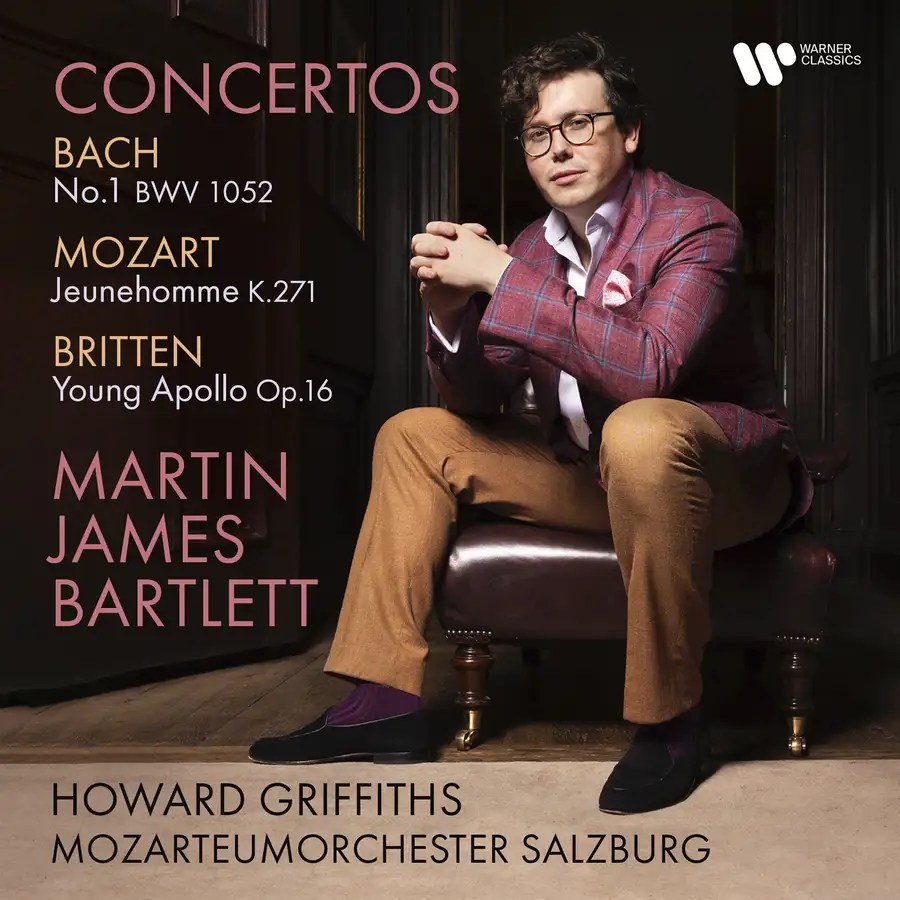
Pianist Martin James Bartlett has joined Arcana to talk about his cleverly programmed new album of concertos. Bartlett, who won the BBC Young Musician of the Year competition in 2014, has since earned a regular contract with Warner Classics, recording themed solo albums, Rhapsody with the London Philharmonic Orchestra, and now an album of works by J.S. Bach, Mozart and Britten, made with the Salzburg Mozarteum Orchestra and conductor Howard Griffiths.
When we speak, Bartlett has already had the pleasure of giving two enthusiastically received concerts at London’s Wigmore Hall in 2026 – a solo recital and a piano duo concert with his friend and label mate Mariam Batsashvili.
“It has been wonderful – twice in two months – but I’m not going to be there every month! John Gilhooly has invited me back again, but in 2029 – because they book so far ahead. There’s a great song history of the Wigmore Hall, which is fabulous, because you go into the backs and you see all the photos of pianists and singers!” He confesses to being more than a little unnerved by the pictures. “It’s terrifying! You’re warming up backstage in the room where there is a picture of Artur Rubinstein, and it is quite imposing because you are stepping onto hallowed ground. In the end, it comes down to thinking, “I love this music, and I know the audience are there to have a good time. People don’t buy tickets unless they want a good evening out, and you’ve just got to enjoy it and have fun with it, even in spite of the pressure from the previous greats who have trod the boards.”
Does he think he might venture onto record with Batsashvili, in the form of some two-piano repertoire? “Well, it would be lovely to do it”, he says. “It’s one of those ones where there can often be so much red tape about who you can record with. It really helps that we’re both with Warner Classics, and the lovely thing is that they came along to see us both at the Wigmore concert. I’m sure we would have a great time working together if the opportunity arose.”
Bartlett’s new album is a clever and sprightly walk through works that initially appear to have little in common, but which all enjoy a youthful disposition. That by Johann Sebastian Bach is the substantial Keyboard Concerto in D minor, BWV1052, and it is refreshing to hear this work back on the piano. “It’s one of those things”, says Bartlett, “that when you look back at the great composers they were all in favour of the progression of the instrument as well as the art form. Liszt himself was trying out all of these new instruments, and Bach was interested in cultivating the future form of the instrument. Whenever you record something that is a ‘period piece’, it’s always a choice of how historically informed you want to be, and how modern and individual you wish to make it. For me, playing on the piano is an amazing thing, because I have no doubt that Bach would have really loved the piano as well. I love the harpsichord too, and that’s the nice thing – I love all forms of today’s instrument. I love the clavichord, where you can do vibrato on each note because it holds the string. I love the organ works of Bach, too – it just so happens that I’m a pianist, so that’s the instrument I use!”
The versatility of Bach is a key helping factor, too. “You could play Bach on a hollowed-out carrot, and it would still move you! That music transcends everything, and when the intention is so strong, you can do what you like with it. There are so many recordings of people singing the First Cello Suite, and there’s the wonderful singer Angélique Kidjo, who has worked with Alexandre Tharaud – they do Bach together, and it works so brilliantly.”
The youthful thread through the album is enhanced by Mozart’s Piano Concerto no.9, the young composer’s first notable piano concerto success – and a daring piece of music for its time. Bartlett agrees. “It’s the piece that helped Beethoven’s Fourth Piano Concerto come along, and that idea of there not being a huge opening ‘tutti’. The piano interrupts almost precociously, which would not be surprising given that it’s Mozart. I loved when I was thinking about the album how these pieces pushed classical music forward. Bach’s piece is one of the first keyboard concertos, and it takes so much from the past. It’s quite evidently inspired by Vivaldi – however it’s also pushing forward. That’s exactly the same with the Mozart, which really is such a beautifully conceived work.”
He goes into more detail. “I read some theories about the last movement, and the confusion around the name Jeunehomme. It was apparently misunderstood from Jenamy, the surname of the pianist Victoire Jenamy, and because Mozart had the most ghastly French accent, it had been noted down incorrectly! Her father was a choreographer, and ground breaking in the dance world. I surmise that’s why Mozart puts that minuet in the last movement, because it is ‘Presto’, and it’s moving quickly, and then suddenly there’s that breath of fresh air which is this little Minuet. I have no doubt it was written for her, or as side note to gain some favour with her father, who would have appreciated it. There is so much of a story in this music.”
The last movement, in fact, is almost a concerto in itself. “It has all those interlocking cadenza passages that get you back to that main theme that’s possibly bustling with energy. You have so many choices of what you can do there, and I just love that sort of creativity. It’s spontaneous music, written down!”
Was it helpful working with the experience of conductor Howard Griffiths? “I met Howard a couple of years back, and before we came up with this project, I was lucky enough to work with him in the Tonhalle in Zurich, and we did a beautiful concert where we played this concerto. It’s one of those relationships that you don’t come across very often, with artistic connection that is so easy. There are no laborious discussions about how to do something because you come to music from a similar perspective, and way of feeling it. That’s what I felt when I first worked with Howard.”
The rapport extends well beyond Mozart. “With the Bach concerto, how many different speeds is it possible to use to play the first movement well? You’ve got Glenn Gould on one hand, the slowest side, and then you have these harpsichord recordings, which are far more nippy and sprightly. Howard asked me to play the first beat, and he said “Brilliant, I was just hoping we would be able to move through it. For me the speed of these pieces dependent on the harmonic progression, and how quickly the harmonies change indicates the feel you want from it. Howard and I were on the same page, thank goodness!”
The pair were clearly having fun with Britten’s impetuous Young Apollo, too. “It’s interesting,” says Martin, “to choose a piano for an album like this. There are very different characteristics you might require for all three pieces, but this piano was just a dream. We got it from Bösendorfer, and I went to try it in Vienna. This one stood out to me, as it’s got such a beautiful tone – individual and characterful. I got a very nice message from Benjamin Grosvenor the other day, who had listened to the Bach, and he noted it was a Bösendorfer. It goes to show it has such an individual sound, that worked perfectly for this! What surprised me was I tried the beautiful bits of the Mozart and some of the sprightly bits of the Bach, and I thought, “Will it have the monumental sheer power to illuminate the sun god, Apollo? And my goodness, it did! When I crashed down on the bottom ‘A’ I thought it had was something of a ‘beautiful beast’, with the beauty and the power to work the Britten.”
His enthusiasm is contagious. “It has a capacity to do that “pearls on a string”, Rembrandt-esque thing, where you can see every facet of everything. At any speed, this piano provides the most gloriously rich sound in every note.” This works especially in the Mozart, with the dance being played out – to which the orchestra respond. “The perspective with Howard was that this was chamber music. Gone are the days where you have Mozart concertos that have a huge orchestral introduction but it is mismatched with the piano. We wanted it to feel like a piece of spontaneous chamber music where everybody is active in the production, and listening.”
The start of the Britten is indicative of this, with its bright colours. “It’s one of those works where I understand it musically very well, but I don’t understand the mystery behind it. It’s shrouded in mystery a bit for me, the love affair he had with this young German boy, and then Peter Pears. I only read recently that the man to whom it is dedicated, Wulff Scherchen, was discovered to be alive until very recently, and had been married 70 years – but still had all this incredible correspondence between him and Britten.”
The album’s tracklisting acknowledges the old form classical album, with full works and a linked programme, but also the new, where music streaming is key, and record labels look to release singles ahead of album release. “Again, it helps to have the versatility of Bach – that first movement especially. Playlisting is a double-edged sword – it’s wonderful, as it puts our music out there to so many more people. As an artist, though, I want my music to be on the ‘Wake Up’ playlist rather than the ‘Go To Bed’ one! I would rather my music thrill someone rather than put them into a lengthy snooze! However, when I think about the Bach first movement, it is perfect study music, because it is relentless in the way the harmony evolves. We came to this album from a slightly old-fashioned point of view, making it because it has incredible music – which hopefully means it will be on some playlists, which the first movement of the Bach already is, happily!”
The album was enjoyable to make, too. “The recording process for me was incredibly special, because I’ve never recorded anything in a different country to England. All of my albums so far have been recorded in London, but recording in Salzburg, where Mozart spent his youthful career working, was very special. To be able to get up every day, staying in the centre of Salzburg in those beautiful, crooked streets with cobblestones, get out of bed and know you’re going to record Mozart, walking down the streets that he would have walked himself, and in the snow too – it was so Romantic! If not a little hazardous and evocative.”
Bartlett immersed himself in the city. “I went into these wonderful restaurants, where they serve specialities like boiled dumplings. You feel close to being his friend, with a couple of hundred years in between! Then at the other end, the only place that was open late at night was a kebab shop across a river, across an icy bridge, about a 40-minute walk from my hotel. That brought me back to reality sharply!”
He is enjoying travelling after a concentrated period of work in England, with another visit to Bösendorfer in Vienna where the album was launched, “nestled into the Musikverein”. Thinking back to the Young Musician competition, was this what he hoped might happen as a result? “Every time something new comes up, it somewhat surprises me, as mentally I feel like I’m still the same person as when I was doing Young Musician! I feel incredibly grateful, especially with Warner Classics, who have allowed me to record whatever repertoire I want, and have really been on board when I’ve come with themes of Love and Death, you know? I’ve had such a wonderful opportunity, working with the London Philharmonic Orchestra for my Rhapsody, with their symphonic excellence, and now, with the Salzburg Mozarteum Orchestra, the most incredible chamber experience. To have that contrast has been wonderful, and it’s what I love about music. My albums are widely different to each other, as I’m a glutton for this amazing music! As Rachmaninov said, “Music is enough for a lifetime, but a lifetime isn’t enough for music!” That’s how I feel, especially being a pianist!”
You can listen to clips from Martin James Bartlett’s new album, and purchase the recording, at the Presto Music website. You can read more about Martin at his website
Published post no.2,852 – Thursday 9 April 2026


