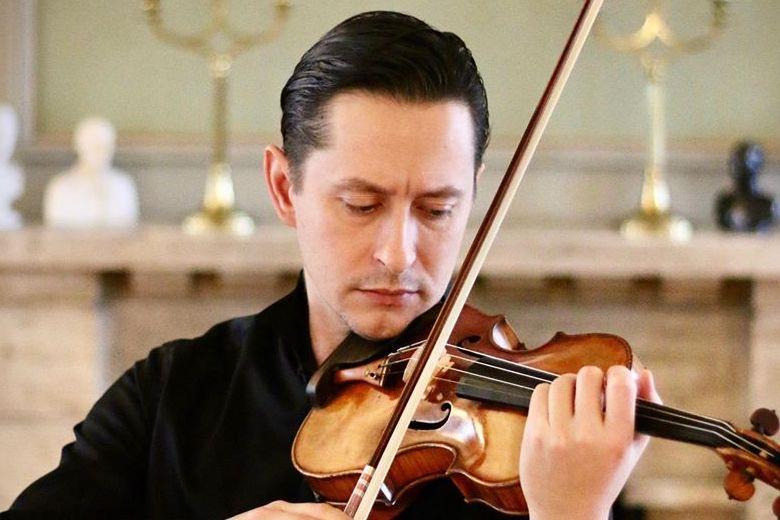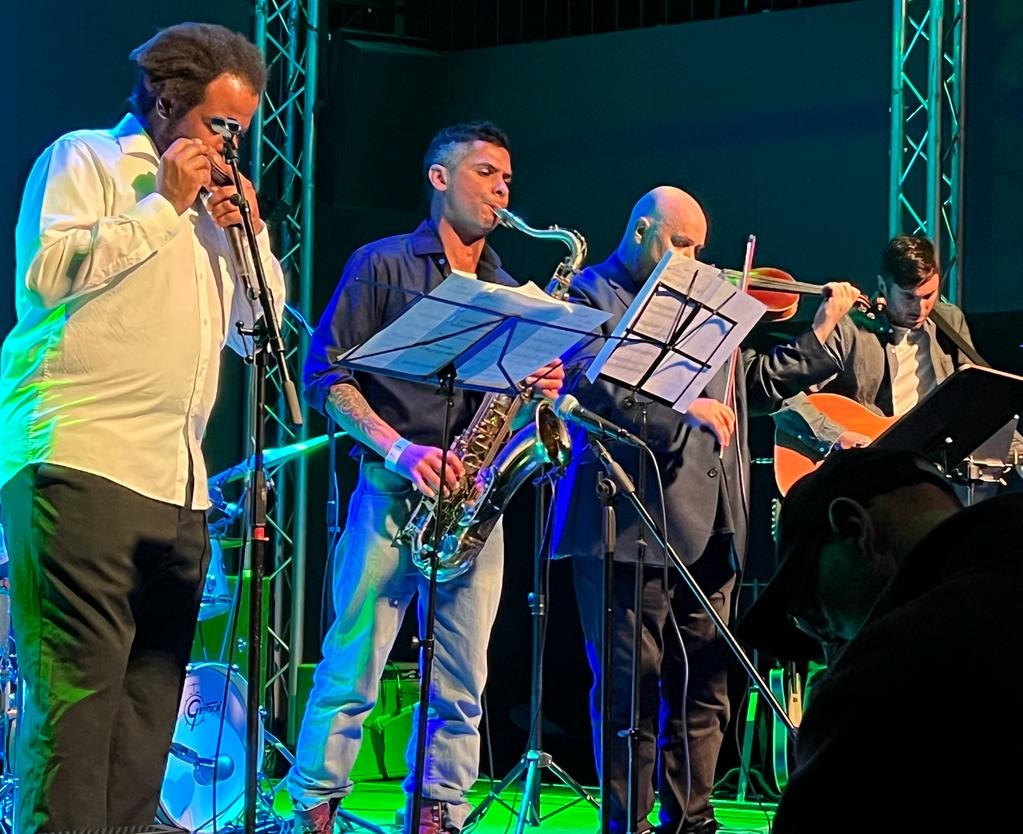
In concert – Binker Golding @ The Forge

Binker Golding (saxophone)

The Forge, Camden, London
Thursday11 May 2023

Reviewed by John Earls. Picture (c) John Earls

I once spoke to jazz saxophonist Binker Golding last year just after he had performed a blistering set at London’s Rough Trade East, promoting his excellent Feeding the Machine album with drummer Moses Boyd (very different but exciting musical fare). I told him I’d seen him at Ronnie Scott’s (with a quintet doing some new tunes for a forthcoming album) just as we were coming out of the Covid-19 pandemic. “Oh?” he said, “It was all right, yeah?” I assured him it was. But was quite surprised he felt he had to ask.

This gig at The Forge in Camden with a superb seven piece band was testimony to what a great foundation that Ronnie’s gig was. Right from the off this outfit grabbed the evening and ripped up a storm.

The set mostly comprised of material from last year’s wonderful (and superbly titled) album Dream Like a Dogwood Wild Boy. It’s a great collection of tunes traversing across jazz, Americana, country and blues.

Opening with (Take Me To The) Wide Open Lows we get the mix of melody and solo virtuosity that is a feature throughout the evening whereby the band including Benet McLean (violin), Billy Adamson (guitars) and Daniel Casimir (bass) get to show what they can do collectively and individually. Philip Achille (harmonica) was a particular stand out for taking his instrument to places you didn’t know it could go. 

I have to confess I was more than a little disappointed when I found out that Sarah Tandy and Sam Jones were not going to be performing (as originally advertised). Tandy’s thrilling piano and Jones’ relaxed but sharp drumming – both of which are not only a feature of the album but were a considerable part of a performance at Southbank Centre’s Purcell Room in November 2022 for the London Jazz Festival – were something I was particularly looking forward to.

However, Deschanel Gordon – on organ rather than piano – and Zoe Pascal on drums offered a different but equally compelling dimension to the proceedings.

All Out Of Fairy Tales was a brilliant closer (as it is on the album). A beautifully wistful number.

I love the musicians that Binker Golding puts around him, what he does with them and what he lets them do. They seem to love it too.

Whether he thinks it or not (we didn’t get the chance to speak afterwards this time) this concert was a stunning display of what an assured composer, performer and band leader Binker Golding is. And if he’s reading this, it was more than all right.

John Earls is Director of Research at Unite the Union and tweets at @john_earls

You can listen to the Binker Golding album on Spotify below:
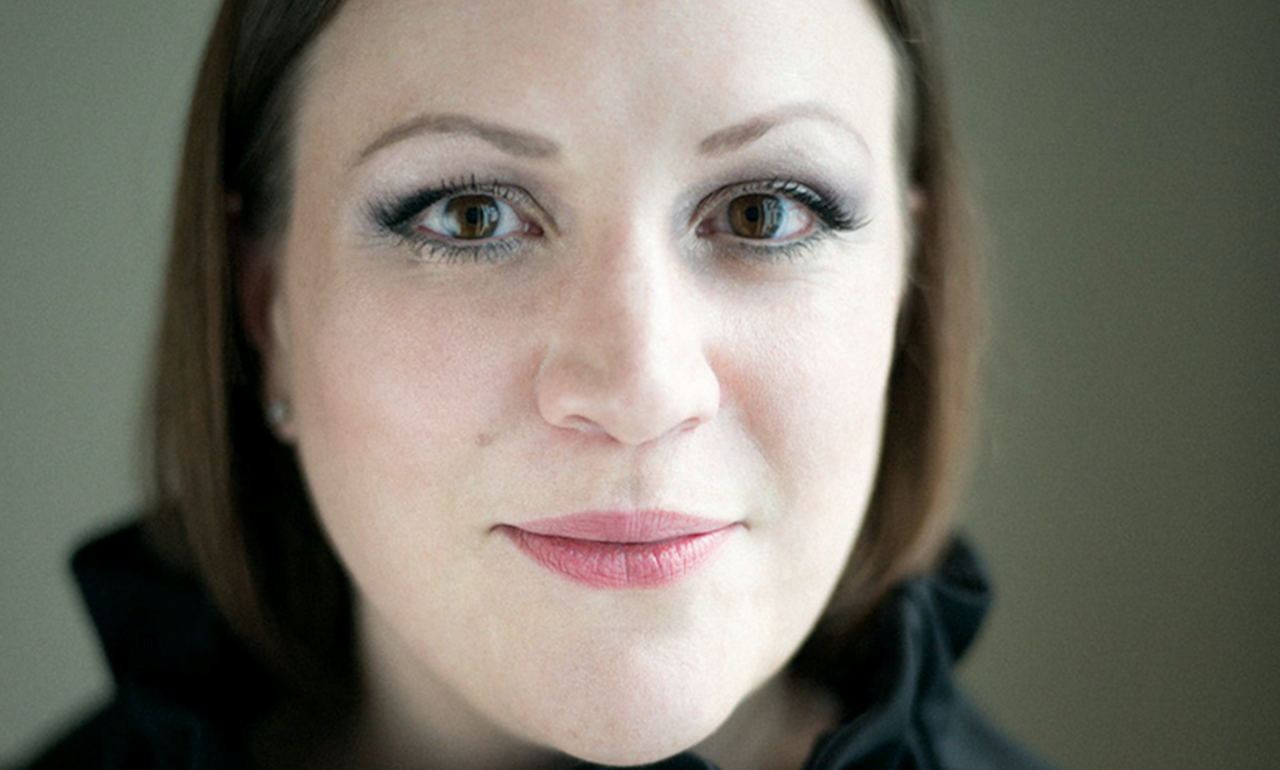
In concert – Jennifer Johnston, Royal Liverpool Philharmonic Orchestra / Vasily Petrenko – The Divine Poem

Jennifer Johnston (soprano, above), Royal Liverpool Philharmonic Orchestra / Vasily Petrenko (below)

Deutsch Phantasma (2022) [RLPO co-commission: UK premiere]
Mahler Lieder eines fahrenden Gesellen (1884-5)
Scriabin Symphony no.3 in C minor Op.43 ‘The Divine Poem’ (1902-4)

Philharmonic Hall, London
Thursday 4 May 2023

Reviewed by Richard Whitehouse

He may now be the orchestra’s conductor laureate, but the 15-year partnership between Vasily Petrenko and the Royal Liverpool Philharmonic Orchestra was always tangible in this evening’s concert – its refreshingly different programme summoning the best from both orchestra and conductor.

Co-commissioning music by Bernd Richard Deutsch was an astute move – the Vienna-based composer now in his mid-40s and among the leading composers of his generation. Taking its cue from the Beethoven Frieze which Gustav Klimt devised for the 14th Vienna Secessionist Exhibition in 1902, this 15-minute piece takes a pointedly dialectical route as it evolves from the fractured uncertainty of yearning and suffering, via the cumulative intensity of a struggle against hostile forces, to the attainment of happiness through poetic creation. To what degree this might be a commentary on Beethoven’s Ninth Symphony (as embodied in the three parts of Klimt’s opus) is uncertain, but the motivic ingenuity and orchestral virtuosity of Deutsch’s response can hardly be doubted – not least in a performance as assured and committed as this.

If the indisposition of Adela Zaharia meant the regrettable omission of Strauss’s rarely heard Brentano-Lieder from tonight’s concert (though Petrenko has scheduled them with the Royal Philharmonic next season), hearing Jennifer Johnston in Mahler’s Gesellen-Lieder was by no means a hardship. The four songs, to the composer’s own texts, comprise an overview of his preoccupations (creative and otherwise) in his mid-20s with numerous anticipations of what became his First Symphony. Outlining a delicate interplay of pensiveness and wistfulness in the initial song, Johnston was no less attentive to its successor’s mingling of innocence with experience, and if the surging histrionics of the third song bordered on the melodramatic, the fatalistic procession of the final number felt the more affecting for its restrained eloquence.

Petrenko (above) set down a highly regarded cycle of Scriabin Symphonies over his tenure with the Oslo Philharmonic, and if the RLPO lacked any of that orchestra’s fastidious poise, the sheer verve and energy of its playing more then compensated. Not least in an opening movement whose unfolding can seem longer on ambition than attainment, but which was held together with unforced conviction – the most often prolix development duly emerging with a tautness to make it more than usually emblematic of this work’s metaphysical Struggles as a whole.

Outwardly more compact, the remaining movements require astute and cumulative handling such as these received here. The alternately enchanting and ominous Delights melded into an enfolding yet never amorphous entity, out of which the more animated motion of Divine Play gradually brought together earlier ideas on its way to an apotheosis whose amalgam of the work’s principal themes yielded grandiloquence without undue bathos. Scriabin’s cosmic aspirations thereby seemed the more ‘real’ for being the expression of purely musical forces. An expanded RLPO (its nine horns arrayed across the upper tier of the platform) was heard to advantage in the ambience of Philharmonic Hall, contributions by trumpeter Richard Cowen and leader Thelma Handy enhancing what was an authoritative and memorable performance.

You can read all about the 2022/23 season and book tickets at the Royal Liverpool Philharmonic Orchestra website. Click on the artist names for more on Jennifer Johnston and conductor Vasily Petrenko, and for more on composer Bernd Richard Deutsch – who also has a dedicated page at his publisher Boosey

In concert – Birmingham Contemporary Music Group: Blossoming In Birmingham

Oliver Janes (clarinet), Philip Brett, Stefano Mengoli (violins), David BaMaung (viola), Arthur Boutillier (cello), Birmingham Contemporary Music Group / Otis Lineham, Kazuki Yamada (conductors)

Illean Januaries (2017)
Fujikura Perpetual Spring (2017)
Ligeti String Quartet no.2 (1968)
Hosokawa Blossoming (2007)
Fujikura Secret Forest (2008)

BCMG NEXT [George Blakesley (clarinet), Anna Vaughan (violin), Alma Orr-Ewing (viola), Finley Spathaky (cello), Rob Hao (piano)

Fujikura Scion Stems (2010)
Illean Février (2019)
Fujikura Halcyon (2011)

CBSO Centre, Birmingham
Saturday 29 April 2023 (7pm and 9pm)

Reviewed by Richard Whitehouse

Spring may have arrived tardily this year, but Birmingham Contemporary Music Group was certainly in full bloom with this judiciously balanced and absorbing programme that featured one post-war classic and two pieces by one of the leading composers from the present time.

First, though, the welcome opportunity to hear a work by Lisa Illean, whose understated and fastidiously realized music conceals more than is evident on initial hearing. Such is true of Januaries, inspired by memories of holidays in Queensland together with descriptions of the Australian landscape. Its innate subtlety finding a direct parallel in this composer’s drawing of often ethereal yet always evocative timbres and textures from her 12-strong ensemble; and throughout which BCMG responded with due commitment to the direction of Otis Lineham.

The first of two pieces this evening by Dai Fujikura, Perpetual Spring drew inspiration from the Japanese Garden in Portland (US), notably the idea of growth as a process both ongoing and inexorable. Heard from this vantage, the clarinet represented a conceptual and expressive focal point; around which the string quartet weaved its dense if never claustrophobic texture with audible dexterity. Here, too, the music implied considerably more than was ever stated – no doubt in accord with the ‘‘power of ‘quiet’ nature’’ its composer took as his starting-point.

Although it now tends to be overshadowed by its predecessor, Ligeti’s Second String Quartet remains one of his most significant works – its five movements a compendium of his musical practice during the late 1960s, but with a formal and expressive focus that amply sustains the 20-minute whole. It was a measure of this account that a cumulative impetus carried through not merely to the explosive fourth movement, but also a finale whose textural mirage took in allusions to what went before: the music not so much ceasing as dispersing beyond earshot.

The string quartet was also Toshio Hosokawa’s chosen medium for Blossoming. Taking the image (and most probably its mythical association) of a lotus as its starting-point, the piece opened out in music typical of this composer for its unforced elegance and felicitous aura.

Considerably more engrossing an all-round experience, Fujikura’s Secret Forest is among the most impressive of his ensemble works and not least for its visceral conception. Placed centre-stage, the string nonet was balanced with groups of woodwind and brass either side, and above the auditorium. It was the ensuing interplay between the spatially arrayed sound-sources, strings intense in their eloquence and winds hieratic in their intangibility, that the conductor shaped over its course – not forgetting the solo bassoon, seated in the auditorium, who became a human figure plotting a course through this sonic landscape. The piece was directed with conviction by Kazuki Yamada and promises much for the Fujikura commission Wavering World, which he will premiere with the CBSO in Symphony Hall on January 17th.

A pity not more punters remained for the post-concert performance by musicians of BCMG NEXT, which featured two more works by Fujikura. Scion Stems took string trio as the basis for a wide-ranging discussion of textures made even more immediate by its brevity, whereas Halcyon pursued a more circumspect yet never disengaged interplay between clarinet and string trio. In between, Février found Illean’s writing at its most sensuous in its sequence of exchanges between clarinet, cello and piano to which these players likewise did full justice. The current NEXT line-up performs its final concert on June 11th, while BCMG itself returns to Birmingham Town Hall on May 12th for its TREE Concert featuring a new commission by Christian Mason alongside one of the most impressive compositions by Helmut Lachenmann

For more on future BCMG events, click on the link to visit their website. For more information on the composers featured, click on the names to read about Dai Fujikura, Lisa Illean and Toshio Hosokawa, while you can read about the conductors by clicking on Kazuki Yamada and Otis Lineham

In concert – Hanna Hipp, Tiffin Boys Choir, Philharmonia Chorus, RPO / Vasily Petrenko – Mahler: Symphony no.3 @ Royal Albert Hall

Hanna Hipp (mezzo-soprano), Tiffin Boys Choir, Philharmonia Chorus, Royal Philharmonic Orchestra / Vasily Petrenko

Mahler Symphony no.3 in D minor (1895-6)

Royal Albert Hall, London
Thursday 27 April 2023

Reviewed by Richard Whitehouse Photo of Vasily Petrenko (c) Ben Wright

The Royal Philharmonic Orchestra series of those Mahler symphonies featuring voices came to its conclusion this evening with the Third Symphony, the longest and most encompassing of his cycle with its trajectory ranging from the awakening of life to its divine transcendence.

The first part, comprising Mahler lengthiest purely orchestral movement, presents a stern test in terms of its overall pacing and characterization. Vasily Petrenko had its measure right from the opening fanfare, as powerfully intoned by eight horns in unison, via graphic depictions of inanimate nature (its trombone recitative balefully rendered by Matthew Gee) and its march-like reawakening, to the forceful expressive contrast Mahler invests into this extended sonata design as it advances to a joyous peroration that was superbly controlled and projected here.

Although the published score makes no mention, Mahler evidently favoured a lengthy pause before going into the second part. By allowing barely a minute to elapse, Petrenko arguably left insufficient breathing-space (for the audience if not the musicians) and so undersold the effect of what ensues. Not that this Tempo di Menuetto lacked for poise or insouciance – its chamber-like orchestration exuded a confiding intimacy, with the lingering regret at its close deftly implied. No less persuasive was the third movement, a scherzo whose capricious outer sections found purposeful accord with episodes where the offstage post-horn solos (elegantly delivered by Toby Street) unfolded without hint of indulgence; Petrenko mindful to inject a degree of danger into the final return of the opening music as this heads to its fractious close.

Once again, a slightly longer pause than Petrenko allowed might have given listeners time to settle before the closing three movements – (rightly) played without a break. Not that Hanna Hipp, in situ at stage-left, was other than assured in her contribution to the setting of (part of) Friedrich Nietzsche’s Mitternachts-Lied with its presentiment of eternal life; such unforced eloquence abetted by the hushed intensity of the RPO’s playing. The brief if pertinent setting of Es sungen drei Engel offered the necessary contrast, Hipp sounding a note of uncertainty or even doubt in the context of animated singing from the combined children’s and women’s voices. Here, too, Petrenko’s decision to use actual rather than tubular bells added greatly to the aura of child-like though never merely coy innocence with which this music is infused.

On to the finale – an adagio drawing on precedents from Beethoven and Bruckner, and which crowned this performance in all respects. If the flowing tempo that Petrenko adopted initially seemed a little passive, the seamlessness with which conflicting elements were drawn into the discourse, together with the preparation for and the shaping of each climax, on the way to its apotheosis left no doubt as to his identity with this movement. Neither was there any hint of bathos as striding timpani underpinned those closing bars with their intimations of sublimity.

A memorable performance, then, which brought out the sheer scale and ambition of Mahler’s conception while underlining the all-round excellence of the RPO near the end of its second season with Petrenko. Hopefully there will be further Mahler to come from this partnership.

You can read all about the 2022/23 season and book tickets at the Royal Philharmonic Orchestra website. Click on the artist names for more on Hanna Hipp, Tiffin Boys Choir, Philharmonia Chorus and conductor Vasily Petrenko

In concert – Strings of the CBSO / Eugene Tzikindelean: Four Seasons

Strings of the City of Birmingham Symphony Orchestra / Eugene Tzikindelean (above)

Schubert arr. Mahler String Quartet no.14 in D minor D810 ‘Der Tod und das Mädchen’ (1824, arr. 1896)
Vivaldi Le quattro Stagioni Op.8 nos. 1-4 (1718-20)
Piazzolla arr. Desyatnikov Cuatro Estaciones Porteñas (1965-9, arr. 1996-8)

Town Hall, Birmingham
Saturday 22 April 2023

Reviewed by Richard Whitehouse

Acoustically transformed following its refurbishment some 15 years ago, a commendably full Town Hall proved to be the ideal venue for this judiciously balanced programme featuring the strings of the City of Birmingham Symphony Orchestra with its leader Eugene Tzikindelean.

Mahler never fully completed his arrangement of Schubert’s Death and the Maiden quartet, but this has enjoyed not a few hearings since its realization by David Matthews with Donald Mitchell four decades ago. Tzikindelean presided over a brisk, incisive opening Allegro (its exposition-repeat not unreasonably omitted), and if the 30-strong ensemble had not quite the tonal depth or dynamic range that Mahler likely envisaged, there was no lack of immediacy – at least until momentum faltered slightly in the later stages of the reprise then into the coda.

No such uncertainty affected the Andante (the only movement elaborated by Mahler), whose variations on Schubert’s earlier song exuded a cumulative intensity up to the theme’s soulful reappearance toward the close. Nor did the Scherzo lack for truculence over its brief yet vital course, assuaged by the trio’s wistful elegance, while the final Presto unfolded as a tarantella as agile as it was malevolent. Tzikindelean kept his players on a tight if never inflexible rein through to a coda that brought this (for the most part) powerful reading to its decisive close.

Tzikindelean having vacated the leader’s chair for centre-stage, the second half consisted of Vivaldi’s The Four Seasons interspersed with Astor Piazzolla’s take on the seasons from the perspective of Buenos Aires. Brought together a quarter-century ago (at the behest of Gidon Kremer for his group Kremerata Baltica) by Leonid Desyatnikov, with numerous references to the Baroque master, the outcome is a provocative amalgam between ‘ancient’ and ‘modern’ which the CBSO strings rendered with alacrity. Among the highlights from the Vivaldi might be mentioned the plaintive eloquence of the Largo from Spring, the coursing impetus of the Presto from Summer, alternation of the robust and poetic in the initial Allegro of Autumn, or that discreetly alluring interplay of legato and pizzicato writing in the Largo from Winter.

Heard in the sequence ‘Summer-Autumn-Winter-Spring’, the tangos by Piazzolla offer any number of anticipations whether melodic or textural. A significant feature of Desyatnikov’s arrangement is the prominence accorded to the leaders from each section which were seized upon gratefully – not least by cellist Eduardo Vassallo, whose Piazzolla recordings with his ensemble El Ultimo Tango are a masterclass in performance from the chamber perspective. While each of the present pieces is more than the sum of its parts, surely the most arresting instance is that towards the close of ‘Spring’ when the harpsichord (ably taken by Masumi Yamamoto) emerges with an allusion to Vivaldi’s opening theme – a coup de théâtre that is seldom less than spellbinding, and duly worked its magic as part of tonight’s performance.

An impressive showing, then, for the CBSO strings and Tzikindelean – who will hopefully be making further appearances both as soloist and director in the coming season. Certainly, the repertoire for string orchestra is one whose exploration should prove well worthwhile.

You can read all about the 2022/23 season and book tickets at the CBSO website. You can read more about Eugene Tzikindelean here, and more about El Ultimo Tango here