In Concert – Pavel Haas Quartet @ Wigmore Hall: Haydn, Prokofiev & Haas

Pavel Haas Quartet [Veronika Jarůšková, Marek Zwiebel (violins), Karel Untermüller (viola), Peter Jarůšek (cello)

Haydn String Quartet in G major Op.76/1 (1979)
Prokofiev String Quartet no.2 in F major Op.92 (1941)
Haas String Quartet no.2 Op.7 ‘From The Monkey Mountains’ (1925)

Wigmore Hall, London
Thursday 24 November 2022

Reviewed by Ben Hogwood

The Pavel Haas Quartet often cause a stir on their visits to the Wigmore Hall, and this concert was no exception for the Czech ensemble.

Many of Haydn’s mature string quartets begin with a trio of chords effectively designed to hush the audience and guide their ears towards the performance getting underway. The first in his crowning set of six quartets published as Op.76 is no exception, though in this red blooded account the Pavel Haas Quartet pinned the audience back in their seats, such was the vigour with which this performance began.

There were some ragged edges to their interpretation, and less evidence of the genial Haydn that makes himself known with the conversational melody of the first movement. We did however get more exposure to his experimental side, through an interpretation pointing the music forward towards middle period Beethoven. The quickstep third movement, very much a scherzo rather than a minuet, pointed up Haydn’s daring harmonic excursions and dalliances, as did the finale, based mostly in the minor key and featuring a number of brisk about-turns. Stemming the tide was the second movement Adagio, a reverent account with a solemn air to its central section in particular.

There followed a superbly played account of Prokofiev’s String Quartet no.2. This attractive work is not often heard in concert, which is a shame for it has a good deal of spice and charm through its investment in folk tunes from the Northern Caucausian region, where the composer was evacuated in 1941. Encouraged by his new neighbours, Prokofiev achieved a very satisfying blend of the original tunes with spiky good humour and scrunched up harmonic dissonances, always in thrall to the highly melodic content.

The first movement revelled in the abundance of good tunes, bringing the Pavel Haas Quartet’s Slavonic instincts into play. The mood softened for a heartfelt cello solo from Peter Jarůšek, setting a thoughtful and delicately nostalgic tone for the Adagio. Here more time was taken for reflection, with a noticeable chill running through Prokofiev’s writing.

Within the folk references it is possible to discern the worrisome mood of the time, with World War Two underway. The third movement however felt like a show of resolution in the face of this threat, laced with humour that in this performance could have been exploited to greater effect. It was however a fine performance, with terrific ensemble playing.

The main event of the concert was undoubtedly a performance of music from the quartet’s namesake. Pavel Haas, born in Moravia, studied with Janáček between 1920 and 1922, completing his String Quartet no.2 three years later. Tragically in 1941 he was deported to the Theresienstadt concentration camp, and died in Auschwitz three years later. Much of his work lay in neglect but has in the last thirty years enjoyed an extremely welcome renaissance, led by a number of enterprising recordings made in the 1990s, not least that of this work for Decca’s Entartete Musik imprint in the 1990s by the Hawthorne String Quartet. Since then the second quartet has gone on to gain a welcome foothold in the concert hall.

It would be difficult to contemplate a better performance than this one from the Pavel Haas Quartet. Led assertively by Veronika Jarůšková, they showed what an assured and imaginative piece it is, a travelogue giving the listener a tour of the sights and sounds of the famous Monkey Mountain range in Moravia.

The musical language is a curious but highly engaging hybrid of influences, drawing on the music of Dvořák and Smetana but in compressed melodic pockets of heightened intensity. Janáček, too, is an influential voice, but Haas’s unusual phrasing and distinctive rhythms make for a unique and enjoyable style.

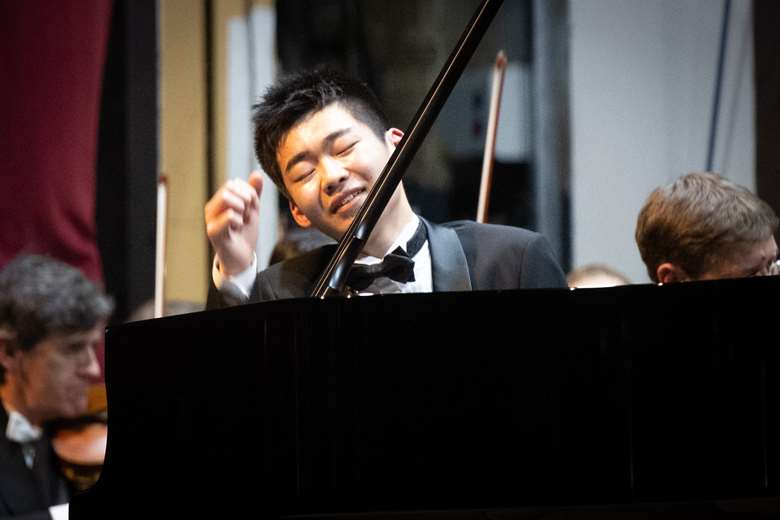
The Pavel Haas Quartet enjoyed it greatly, the first two movements (Landscape and Coach, Coachman and Horse) enjoying the rarefied outdoor air and some crisply secured dance rhythms. The third movement, subtitled The Moon and I, was much colder to the touch, the muted strings taking time for introspection and creating some striking colours along the way. Their beautifully poised playing set up a riotous Wild Night finale where they were joined by percussionist Owen Gunnell (above), whose battery of instruments were expertly marshalled to bring the sounds of 1920s jazz into the fray.

The riotous closing pages brought the swaying Moravian dances and jazz rhythms to the foundations of the Wigmore Hall, brilliantly played and ideally balanced. So good was this section that the five performers gave us a quick reprisal as an encore, reminding us in the process of the fiercely original writing from a composer whose resurgence is to be greatly welcomed.  

In concert – Music For Youth Proms 2022 @ Royal Albert Hall

Review and photos by Ben Hogwood

There is a justified amount of doom and gloom in the arts at present, with organisations striving for increases in attendance figures while clinging to the hope that their funding will not fall through the trapdoor, as it effectively has done in the recent Arts Council England announcements for English National Opera, Britten Sinfonia and London Sinfonietta, to name just a few.

Art forms are nothing if not resilient though, especially when powered by raw talent, enthusiasm and hard work – as this night of Music For Youth Proms clearly was. How inspiring it was to see hundreds of young performers create their own bookmark experiences at the Royal Albert Hall, delivering performances of power, confidence and poise, fuelled by a clear and sheer enjoyment of music.

There was no evidence of stage nerves as performers ranging from aged six to 25, from Gwent to Ukraine (via London) united together in music, each and every one of them doing themselves proud under the Music For Youth umbrella. The registered charity works, in its own words, ‘to provide young people aged 21 and under across the UK with free, life-changing performance and progression opportunities, regardless of background or musical style’.

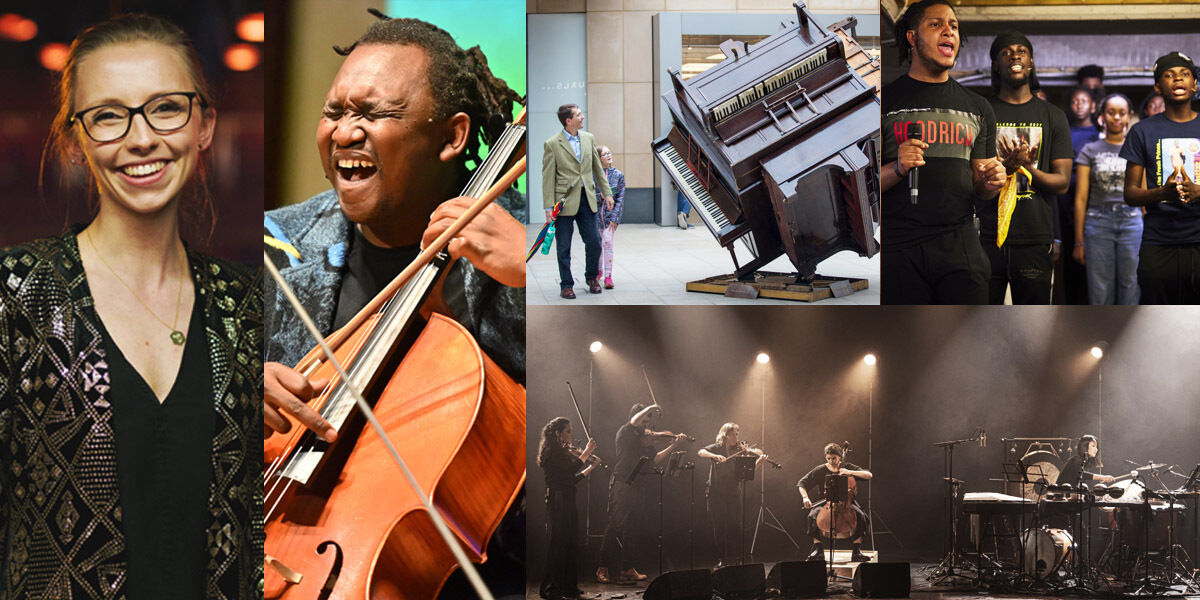
The range of musical styles here was testament to this approach, creating an environment where genres can be celebrated rather than restrictive. The word ‘Proms’ may still conjure images of seated classical concerts, with a smattering of world music maybe, but here it stood for hip hop, soul, brass band, solo vocals, choir, classical for small and large orchestras and even jazz fusion bands.

To pick out a single performer would be unfair, as each one was fully deserving of their moment in the spotlight. For raw, upfront sass, the Sedgehill Academy Rap Collective from Lewisham excelled, especially when three soloists came forward to take the game to the audience, their sparky wordplay in original compositions making the Girls Rap Collective a thrilling live experience.

Illustrating the breadth of this country’s music, an affecting performance of Vaughan WilliamsFantasia on a theme of Thomas Tallis followed from Musica Youth Strings, the Huddersfield-based ensemble giving true depth of feeling in their cleverly abridged account.

Cantilena from the Abbey Junior School in Reading were next, utterly charming as they sang The Puzzle and Silver Moon. They were complemented in the second half by the remarkably accomplished singing of the Northamptonshire County Youth Choir, whose accounts of music by Bob Chilcott (The Isle is Full of Noises) and Ola Gjeilo (Northern Lights) were breathtaking in both accuracy and emotion.

The brass players excelled, too – Gwent Youth Brass Ensemble in 3 Brass Dances by Ryan Linham, and the Mountbatten Big Band bringing exuberant lines to their Brooklyn medley. That the ensemble made such a big impression after No Trixx, a London fusion band of formidable musical capability, said much for their spirit.

The lasting image of the first half was provided by Ukrainian students from LPMAM (The London Performing Academy of Music, above), cleverly working Queen’s The Show Must Go On into the torch song Melody, from Ukrainian composer Skoryk. The students are on permanent placements at LPMAM, thanks to an initiative headed by conductor Stefania Passamonte, whose initiative and drive continues to bring more funding to enable more students to come over and base themselves in London. Judging by this performance they are revelling in the experience – typified by oboist Lola Marchenko, whose solos in both songs stayed long in the memory.

The second half of the Proms was similarly spectacular, with hundreds of singers and orchestral players forming the Lincolnshire Massed Ensemble (above). They delivered a Beyoncé medley of eye-opening power and positivity, headed by a group of girls whose vocals and dance moves showed just what a positive influence the former Destiny’s Child singer has exerted on them. As a celebration of 30 years of the Boston Music Centre, this took some beating.

From hundreds to just two, and the Emeli Sandé-influenced duo Chris and Baaba, whose intimate odes to friendship struck a very different but equally affecting chord, drawing the audience in closer to the round of the Albert Hall. We then heard remarkably assured solos from the York Music Forum Youth Jazz Ensemble, their Blue Matter a collection of cultured solos. A bracing account of the Overture to Hérold’s opera Zampa followed, given an excellent account by the City of Belfast Youth Orchestra. Finally, The Spy Game brought us full circle back to rap with Wag1Fam, a Stormzy-esque anthem to which the group bounced across the stage, never missing a note or a word.

The finale, a specially composed song Back Together, united all artists in a celebratory mood, a show of resolve and unexpected defiance.

Clearly this country – in the face of apparent efforts from on high to downplay the importance of music education – continues to nurture music making of astounding ability and refreshing confidence. Music For Youth is the ideal platform from which these artists can grow – but what needs to happen now is for them to get the ongoing support their talent craves and deserves. Politicians take note – music is a force for so much good and should be treated as such.

In concert – Clara-Jumi Kang, CBSO / Elena Schwarz: Dukas, Prokofiev & Dvořák

Dukas L’apprenti sorcier (1897)
Prokofiev Violin Concerto no.2 in G minor Op.63 (1935)
Dvořák Symphony no.8 in G major Op. 88 (1889)

Clara-Jumi Kang (violin), City of Birmingham Symphony Orchestra / Elena Schwarz

Symphony Hall, Birmingham
Tuesday 15 November 2022 2.15pm

Reviewed by Richard Whitehouse

This afternoon’s concert by the City of Birmingham Symphony Orchestra followed the once customary format of overture, concerto and symphony for what was a compact but cohesive programme which duly highlighted the considerable conducting prowess of Elena Schwarz.

It may be a ‘symphonic scherzo’ rather than overture, but Dukas’s The Sorcerer’s Apprentice after an early ballade by Goethe makes for an ideal curtain-raiser and if Schwarz stressed its purely musical rather than evocative qualities (there being little sense of Fantasia goings-on), the piece still packed a fair punch. Other accounts might have brought out more of that sense of teetering on the brink of disaster during its climactic stages though, a couple of awkward transitions and premature entries aside, this was rarely less than gripping as a performance.

So, too, was Clara-Jumi Kang in Prokofiev’s Second Violin Concerto. Long a staple of the repertoire, the work’s appeal can often be undermined by an emotional disengagement over its course. There was no chance of that here – Kang alive to the opening Allegro’s interplay of ambivalence and eloquence as were barely resolved by the terse closing pay-off. Nor was there any absence of expressive poise in the Andante, Kang’s often astringent tone pointing up that uneasy lyricism such as characterizes so much of the composer’s music at this time.

Kang entered fully into the final Allegro’s bracing if often sardonic spirit. The main theme’s rhythmic undertow, accentuated by castanets on its returns, likely indicates no more than a generalized Spanish-ness rather than any Civil War premonition, but it does add an edginess to the music’s course right through to its peremptory signing-off. This was a performance to savour, and Kang responded to its warm reception with an encore – the soulful Grave from Bach’s Second Violin Sonata (BWV1003) – which seemed entirely appropriate in context.

Although this was her debut with the CBSO, Schwarz clearly found no mean rapport with the musicians, as was evident in Dvořák’s Eighth Symphony. Not all those tempo changes in the opening Allegro were equally well handled, but the unbridled verve with which the composer handles his material was sustained through to the effervescent coda. With its deft alternating between wistfulness and pathos, the Adagio is surely as finely achieved a slow movement as Dvořák wrote and such qualities were as evident here as was the raptness of its closing bars.

The other movements might represent a marginal falling-off of invention, but the Allegretto’s gentle lilt was delightfully inflected with its unexpected breezy coda made all of a piece with the foregoing. Similarly, the variation format of the final Allegro can easily become a formal strait-jacket – yet with a delectable response from the CBSO woodwind and Schwarz pacing its eventful progress ideally through the ruminative latter variations and on to a scintillating close, it rounded off this performance with no less conviction than was evident at the outset.

From a relatively traditional programme to one much freer – next week’s CBSO concert is devised and directed by Pekka Kuusisto, and features music by Sibelius, Vaughan Williams and Rautavaara as part of an ingenious sequence centred on the concept Birds of Paradise.

You can read all about the 2022/23 season and book tickets at the CBSO website. Click on the artist names for more on Elena Schwarz and Clara-Jumi Kang

In concert – Kate Trethewey, CBSO Youth Chorus, CBSO / Martyn Brabbins: Vaughan Williams at 150: Scott of the Antarctic

Vaughan Williams
Scott of the Antarctic (1948)
Directed by Charles Frend
Music by Ralph Vaughan Williams
Presented by Big Screen Live

Kate Trethewey (soprano), CBSO Youth Chorus, City of Birmingham Symphony Orchestra / Martyn Brabbins

Symphony Hall, Birmingham
Friday 11 November 2022

Reviewed by Richard Whitehouse

The City of Birmingham Symphony Orchestra’s commemoration of the 150th anniversary of Vaughan Williams’s birth concluding this evening in a showing, with live orchestral accompaniment, of Scott of the Antarctic which proved to be the composer’s most ambitious cinema project.

Directed by Charles Frend (who presided over several UK films in the 1940s and ‘50s, before having an equally prominent role in television) and released in November 1948, the film was a commercial success not least owing to the expressive scope and richness of its music. This extended to some 80 minutes, but Vaughan Williams was more than happy for it to be edited as required and was so in accord with Ernest Irving (director of music at Ealing Studios) that he dedicated to him his Sinfonia Antartica, evolved from the original score, four years later.

It was this close synchronization between image and music that Tommy Pearson (director of Big Screen Live) was intent on capturing when he prepared the film for concert presentation (and the background to which was described in entertaining detail in the programme for these concerts). Suffice to add while the overhauled soundtrack, consisting of dialogue and sound-effects, was all too evidently recorded in mono so that it is easily obscured by the music, the visual component has an opulence and immediacy as transcends its more than seven decades.

Occupying a space equivalent to the lower half of the organ in Symphony Hall, the screen was less dominant in a venue of this size than it would have been even in larger cinemas, but any wider or wrap-round treatment would doubtless have raised many technical obstacles and the print had, in any case, a clarity evident from the rear of the stalls. Much the same could also be said of the orchestra’s contribution, even if its seating on a level platform meant certain of those more intricate details and textures seemed less prominent than under concert conditions.

There can be little but praise for Martyn Brabbins’s direction. A Vaughan Williams exponent of stature (the latest instalment in his traversal of the symphonies has recently been issued on Hyperion), he has an instinctive feel for the emotional highs and lows of this music along with its myriad instrumental subtleties. That divide between what was retained for the soundtrack and what became the composer’s Seventh Symphony is greater than is often supposed, yet the degree to which the former effects and enhances one’s experience of the film is considerable.

This is not the place for any detailed overview of the film itself, though it is notable just how restrained and even absent is the music from the latter stages when Robert Scott and his team head towards oblivion the further they seem to be heading on their return journey. This might have been more to do with Frend or even Irving, but the resulting psychological dimension – beholden neither to inter-war expressionism nor wartime realism – was ostensibly new in a cinematic epic of this kind and makes the film historically as well as artistically significant.

The singing of Katie Tretheway and the CBSO Youth Chorus left nothing to be desired, but many attendees having stocked up on liquid refreshment beforehand saw a steady coming and going over much of the two hours: something that would not be tolerated in a concert, so why here?

You can read all about the 2022/23 season and book tickets at the CBSO website. For more information on the artists, click on the names of Kate Trethewey, Martyn Brabbins and the CBSO Youth Chorus

In concert – Roderick Williams, CBSO Chorus, CBSO / Michael Seal: Vaughan Williams at 150: 5 Mystical Songs, Symphony no.5

Vaughan Williams
The Wasps – Overture (1909); Towards the Unknown Region (1906-07); Five Mystical Songs (1906-11); Symphony no.5 in D major (1938-43)

Roderick Williams (baritone, above), CBSO Chorus, City of Birmingham Symphony Orchestra / Michael Seal

Symphony Hall, Birmingham
Thursday 10 November 2022

Reviewed by Richard Whitehouse

The City of Birmingham Symphony Orchestra’s mini-series devoted to Vaughan Williams continued this evening with the overture from his music to Aristophenes’ satire The Wasps, paced by Michael Seal (below) so its animated and soulful themes complemented each other perfectly.

Judicious was no less true of this first half with its overview of the composer’s music across the first decade of the last century. Its premiere at the Leeds Festival bringing a first taste of national acclaim, his ‘song for chorus and orchestra’ Toward the Unknown Region sets Walt Whitman with assurance and imagination in its evocative opening section, and if the ensuing peroration feels a little contrived – the journey proving more memorable than the destination – that was no fault of the CBSO Chorus whose contribution was sensitively attuned throughout.

As it was with those Five Mystical Songs in which the composer gave full vent to his love for the Metaphysical poets and George Herbert in particular. A curiously hybrid conception, the chorus is very much secondary to the baritone soloist throughout much of the first three songs – a congregational presence in the processional Easter and then underpinning the emotional intimacy of I Got Me Flowers or confiding profundity of Love Bade Me Welcome, before falling silent in The Call. Roderick Williams was eloquence itself in this latter setting and a forthright presence in the preceding, before sitting out the Antiphon with its pealing bells and mounting exultation. Williams has recently given the rarely heard version of these songs with piano but hearing them with such burnished splendour as here was its own justification.

Is the Fifth Symphony unduly exposed nowadays? The composer’s most characteristic and culturally significant such piece might risk palling with too much repetition, but there was no chance of that here. Seal (above) set a flowing if not too swift tempo for the Preludio, pointing up the radiant tonal contrast between its themes – the second of them capping the movement to thrilling effect towards its close. Its rhythmic pitfalls ably negotiated, the Scherzo had the requisite deftness and mystery while taking on a degree of malevolence over its later stages. The Romanza then emerged surely yet unforcedly through glowing chorales and plaintive soliloquy (CBSO woodwind at its most felicitous) to a heartfelt culmination before subsiding into a hardly less enveloping serenity – its inspiration in John Bunyan tacitly acknowledged.

Enough had wisely been kept in reserve for the final Passacaglia – its initial stages evincing an almost nonchalant gaiety as only clouded towards its centre with the recollection of earlier ideas. By making it the work’s emotional highpoint, moreover, Seal ensured that the epilogue capped not just this movement but the work overall – its transcendence (hopefully) speaking as directly to listeners today as those at the premiere almost 80 years ago. Certainly, it would be a real misfortune were this music ever to be viewed solely from the perspective of the past.

An absorbing performance, then, that reaffirmed the greatness of this music to an enthusiastic audience. Vaughan Williams at 50 concludes tomorrow evening with the CBSO providing a live soundtrack to the composer’s most ambitious cinematic project – Scott of the Antarctic.

You can read all about the 2022/23 season and book tickets at the CBSO website. For more information on Scott of the Antarctic, click here – and click on the artist names for more on Roderick Williams, the CBSO Chorus and Michael Seal