In concert – Quatuor Danel: Shostakovich & Weinberg @ Wigmore Hall

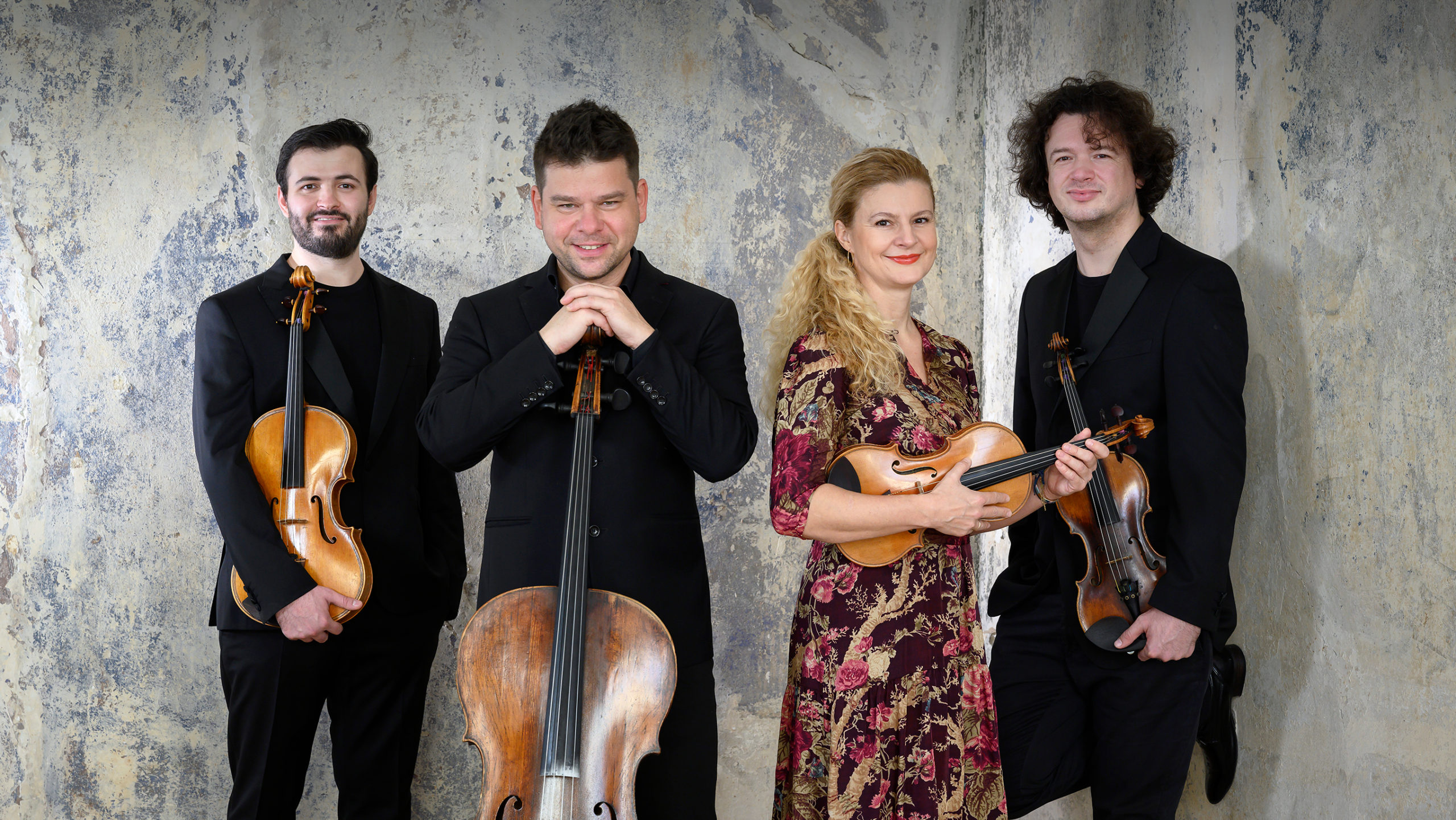
Quatuor Danel [Marc Danel & Gilles Millet (violins), Vlad Bogdanas (viola), Yovan Markovitch (cello)]

Shostakovich String Quartet no.1 in C major Op.49 (1938)
Weinberg String Quartet no.1 in C major Op.2/141 (1937, rev. 1985)
Shostakovich String Quartet no.2 in A major Op.68 (1944)

Wigmore Hall, London
Monday 13 November 2023

Reviewed by Richard Whitehouse. Photo (c) Marco Broggreve

No-one could accuse the Quatuor Danel of bowing to circumstance. Having had to abandon its cycle of the combined Shostakovich and Weinberg string quartets some three-and-a-half years ago owing to the COVID pandemic, the ensemble has commendably started again and from scratch. Tonight accordingly saw the first instalment in this survey of 32 quartets, with an evening such as traced the beginnings of what promises to be an enterprising and, above all, rewarding series of recitals from musicians with a palpable empathy for both composers.

A more unassuming start could scarcely be imagined than with Shostakovich‘s First Quartet. Not only did the composer leave it relatively late until tackling this genre, but the result is as understated a debut as could be imagined. Perhaps in its trying to up the emotional ‘ante’, the Danel sacrificed some of the opening movement’s wistful elegance, but the ensuing variations on a Mussorgskian melody were ideally poised, with the quicksilver scherzo and rumbustious finale reinforcing the infectious charm as well as technical mastery of this ingratiating debut.

The most obvious criticism of Weinberg’s First Quartet is that it bears little resemblance with what was to follow. Yet given its indebtedness to Bartók and Szymanowski, the initial Allegro pursues its doggedly eventful course through some torturous chromatic harmonies and dense textures, while the central Andante evokes a tense and even ominous atmosphere enhanced by its being muted throughout. Only with the final Allegro does the future composer come to the fore, its driving rhythms and folk inflections as Weinbergian as is the teasing evanescence of those closing bars. Now that Daniel Elphick’s reconstruction of the original version has been performed publicly, the revision is more clearly one of ‘less is more’ afforded by hindsight – which does not make this teenage effort, or the Danel’s rendering of it, any less impressive.

As the last in a sequence of large-scale chamber works, Shostakovich’s Second Quartet has tended to be overshadowed by his Piano Quintet and Second Piano Trio, but that it does not want for stature was underlined by the Danel’s reading. The fervent while formally lop-sided Overture responded audibly to this trenchant and forthright approach, its modally inflected plangency carried through to the Recitative and Romance in which Marc Danel‘s impulsive take on those florid first violin solos was ably complemented by the fraught interplay toward its climax. Nor was there any lack of purpose in the Waltz and its ominous revisiting of the composer’s past, before the closing Theme with Variations evinced inexorable momentum on route to an implacable restatement of that theme for a warning pure though hardly simple.

Given such music and music-making it might have been churlish to expect an encore, yet the Danel duly provided an additional few minutes in the guise of an Improvisation and Rondo Weinberg wrote around 1950 but which was only premiered 69 years later. More is the pity, as the former proved as affecting as the latter was appealing in melodic directness. January 12th sees the second instalment, with Shostakovich’s Third preceded by Weinberg’s Second and Third Quartets, of a series which one fervently hopes will now run its intended course.

You can read all about the next concert in the series at the Wigmore Hall website – and click on the name to read more about Quatuor Danel.

Published post no.2,011 – Thursday 16 November 2023

In concert – Musicians of the English Symphony Orchestra / Kenneth Woods: Blown Away – Doolittle, Gál & Dvořák

Musicians of the English Symphony Orchestra / Kenneth Woods

Doolittle Woodwings (2018, arr. 2021)
Gál Divertimento for Wind Octet, Op. 22 (1924)
Dvořák Serenade in D minor, B77 (1878)

Henry Sandon Hall @ Royal Porcelain Works, Worcester
Saturday 14 October 2023 (4pm)

Reviewed by Richard Whitehouse

Entitled Music for Humans, the coming season from the English Symphony Orchestra promises a wide array of pieces such as focus on what can be achieved through the art of communication and, conversely, what can result when that communication breaks down. This afternoon’s concert enabled the ESO woodwind (along with some of its brass and a couple of its strings) to come into its own with a varied programme as featured music from a regular ESO collaborator, one whom the orchestra has often championed and one who ranks among the greatest of any era.

It may have originated as a wind quintet, but Woodwings by Emily Doolittle (from Halifax, Nova Scotia and now based in Glasgow) proved no less effective when recast for 10-strong wind ensemble (with cello and double-bass) – songs and calls of nine Canadian birds heard over five characterful movements. These range from the playfully assertive Bobolink, via the inwardly plaintive Hermit Thrush and the quizzically engaging Winter Wren, to the cumulatively arresting Snow Goose then a Night Owls finale whose freeform evolution makes for an intriguing and enticing pay-off. First played by the ESO in Kidderminster just over two years ago, it once again provided an appealing concert-opener and certainly bodes well for the 2024-25 season, when Doolittle becomes the ESO’s Composer-in-Association.

The success of his Divertimento was a notable marker for the burgeoning career which Hans Gál enjoyed during the earlier inter-war period, and it remains among the most personable of his chamber works. ‘Intrata’ affords a keen indication of what is to come with its juxtaposing of the martial, hilarious and confiding, proceeded by the capricious exchanges of Pagliazza (inspired by the eponymous tower in Florence?) then the wistful interplay of Cavatina with Gál’s handling of wind sonority at its most beguiling. The mood turns towards the whimsical in the by no means genteel humour of Intermezzo grazioso, before the piece is rounded off with those varied character-portrayals of Pifferari – its title alluding to a group of itinerant musicians playing upon a variety of pipes, and thereby bringing matters to a diverting close.

Although less often performed than its earlier counterpart for strings, Dvořák’s Serenade for Winds (plus cello and double-bass) is arguably more indicative of where his genius lay. The martial theme of its opening Moderato is leavened by a ruminative poise that comes into its own with the minuet-like successor, its felicitous contours duly finding contrast through the animated gaiety of its Presto trio-section. The ensuing Andante is undoubtedly this work’s emotional heart – its eloquence redolent of Mozart in its understatement but also intimation of more ambivalent emotion in the ominous central stage or bittersweet fatalism at its close. From here the final Allegro steers an impulsive but also lilting course through to a climactic restatement of the march theme, then on to a coda that ends the work in exhilarating fashion.

In this judiciously balanced selection, ESO woodwind was heard at its most stylish in music whose appeal belies its technical challenges for individuals and ensemble alike. Next month the orchestra heads to Malvern for an imposing double-bill of Tchaikovsky and Shostakovich.

To discover more of the English Symphony Orchestra’s 2023/24 season, head to the English Symphony Orchestra website. Meanwhile click on the names for more on conductor Kenneth Woods, composers Emily Doolittle and Hans Gál, and the Royal Porcelain Works venue

Published post no.1,980 – Monday 16 October 2023

Online Concert: Chouchane Siranossian, Leonardo Garcia Alarcón, Balázs Máté @ Wigmore Hall – Bach, Schmelzer, Farina & Walther

Chouchane Siranossian (violin), Leonardo Garcia Alarcón (harpsichord), Balázs Máté (cello)

J.S. Bach Violin Sonata in G minor BWV1021 (1732-5)
Farina Sonata quinta detta ‘La Farina’ (pub. 1626)
J.S. Bach Violin Sonata in C minor BWV1024: Adagio; Fugue in G minor BWV1026 (before 1712)
Walther Passacaglia from Sonata no.7 (pub. 1688)
Krikor Naregatsi Improvisation on Havun Havun
Locatelli Sonata in D minor for solo violin Op.6/12 (pub. 1737)
Schmelzer Violin Sonata ‘Victori der Christen’ (c1683-4)

Wigmore Hall, Monday 5 June 2023 1pm

by Ben Hogwood

This attractive programme of works for wind ensemble began with a rarity.

September is a prominent line in the sand in the course of the classical music year. The Proms ends, everyone else gears up for the start of an Autumn season, and a fresh wave of creativity begins.

The resumption of the BBC Radio 3 Lunchtime Concert on Mondays at the Wigmore Hall is always a prominent part of the changing of the guard, and the choice to begin the new season with violinist Chouchane Siranossian, harpsichordist Leonardo Garcia Alarcón (both above) and cellist Balázs Máté was an inspired one.

The trio gave a recital based on their Bach Before Bach album of November 2021, bringing forward some of the master’s work for violin and harpsichord but putting it in the context of contemporaries Walther and Schmelzer, as well as some inspired earlier choices.

Bach himself began the programme, the Violin Sonata in G major BWV1021 featuring some effortlessly stylish playing. Siranossian has a particularly beautiful tone and a sense of ornamentation that fits this music instinctively. The same can be said for the fluent harpsichordist Alarcón, an expressive player of exceptional balance, complemented by the burnished tones of cellist Máté. A songful Adagio gave way to an enormously enjoyable, quickfire Vivace, which itself led to a tasteful, florid Largo, led by legato harpsichord. An attractive Presto finished an uplifting account.

We then had a rare opportunity to hear the music of Carlo Farina, whose work is not often heard in concert. With performances like these he deserves much better, for the Sonata quinta detta featured lively passagework and darker colours, the music glinting at the edges as the violin became prone to passionate outbursts over rich harmonies. Siranossian selected a shorter bow for this music, playing to the snappy, playful interjections.

Two Bach movements followed, cleverly linked – a deeply profound Adagio, given great depth and character by the violinist, then a virtuosic Fugue, a very tricky proposition given Bach’s writing but brilliantly played. Walther’s Passacaglia, meanwhile, was a fiery complement, setting out the main theme in relatively polite tones but then liable to explosive outbursts of virtuosity.

After all this activity came the brilliantly timed Improvisation on Havun, Havun, from 10th century Armenian monk Krikor Naregatsi. This introduced a remarkable stillness to the concert, time standing still as the violin turned ornamental phrases over a drone from the cello’s open A and D strings. Siranossian segued straight into the Locatelli, a solo sonata with daring feats of virtuosity here but retaining some of the bird-like qualities found in the Naregatsi. Her impeccable intonation and bow control were striking, but the music reached a truly exalted level in the fifth movement Capriccio ‘prova dell’intonazione’, the sky truly the limit for the violin’s highest register!

There was also a bold opening to Schmelzer‘s pictorial sonata Victori der Christen, with multiple stopping and very descriptive writing, especially in the slow and sorrowful sections. To complement the drama of the Schmelzer, Siranossian introduced the first movement of the Sonata in D major from Georg Muffat. This was another excerpt from the trio’s disc, but one whose sunny countenance was the perfect foil – and which put the seal on a remarkable concert with playing of an exceptional standard.

You can listen to Bach Before Bach via Spotify below:

For more livestreamed concerts from the Wigmore Hall, click here

In concert: Pavel Haas Quartet at Wigmore Hall – Suk, Martinů & Korngold

Pavel Haas Quartet [Veronika Jarůšková, Marek Zwiebel (violins), Šimon Truszka (viola), Peter Jarůšek (cello)]

Suk Meditation on an old Bohemian Chorale (St Wenceslas) Op.35a (1914)
Martinů String Quartet no.2 (1925)
Korngold String Quartet no.3 in D major Op.34 (1944-45)

Wigmore Hall
Monday 12 June 2023 1pm

by Ben Hogwood

An unusual and intriguing program from the Pavel Haas Quartet contained music by two fellow Czech composers (Suk and Martinů) and one (Korngold) born in Moravia before moving to America.

The quartet began with a moving piece by Suk, his Meditation on an old Bohemian Chorale (St Wenceslas). This poignant pre-war utterance carried an air of deep profundity right from the first phrase of Simon Truszka’s viola, its elegiac tone enhanced by relative lack of vibrato. The air of solemnity carried throughout, though there was considerable strength in depth as the music grew in stature.

Though a Czech composer, Martinů spent a good deal of time overseas – largely out of necessity. By his early 30s he was in Paris, studying with Roussel, bringing a neoclassical language and tidiness to his music. The String Quartet no.2, though, is a curiously lopsided work, very front heavy with its first movement a combination of substantial slow introduction and quick section. There were close links to the St Wenceslas Chorale here, too, found in the solemn intonations of the Andante. This was the spiritual heart of the piece, dark and uncertain at times and contrasting greatly with the thoughtful but lightly coloured manner in which the quartet began. A resolute first movement found a mood that Martinů reprised in the closing Allegro, a propulsive dance number with a spring in its step. There was an undeniable French flavour to the music here, which the Pavel Haas Quartet brought forward, its elegance at odds on occasion with the rustic dance tunes.

There was tension in the final work, too, though this was undeniably the making of a mature composer. The String Quartet no.3 was Erich Korngold’s last published chamber piece, adjacent in publication to the Violin Concerto, with which it shares the same key of D major. The Pavel Haas Quartet gave a superb account of the piece, exploring its unusual musical language through music that would have presented considerable technical challenges.

The awkward but compelling violin melody in the first movement was brilliantly negotiated by Veronika Jaruskova, who conveyed its uncertainties through sweet tones and phrases. In spite of a convincing and full bodied outburst from all four players, the movement was dominated by this figure, which left a question in the mind. The Scherzo went some way to answering this, a black and white film scene easy to conjure up in the mind as the furtive darting of the main theme ensued. Again this was brilliantly played, as was the heart melting trio, its big tune (from the recently completed score to Between Two Worlds) full of tender longing and given appropriate glissando for expression.

The silvery slow movement flickered in the half light like a candle burning low, but with the flame essentially undimmed. The quartet’s sense of purpose was key here, with burnished lower string tones as viola and cello often combined, a notable cushion on which the searching violin melodies (using material from The Sea Wolf) could rest. Romance was in the air but although some of the music was borne of Hollywood, its intimate confines gave the music a deeply personal air. The atmosphere was heightened as a thundercloud hovered over the Wigmore Hall.

The motorised finale brought conviction and a strong sense of homecoming, not dissimilar to its equivalent movement in the Violin Concerto. Although emphatic in its resolution there were moments where the quartet moved into a different tempo or unexpectedly distant harmonies, Korngold momentarily distracted by edgier thoughts until his focus returned.

The Korngold string quartets have had something of a renaissance of late, with several new recorded versions and a marked increase in performance. On this very cultured evidence it would be no surprise if the Pavel Haas Quartet committed their version to disc soon – but it is to be hoped the other works will join it, for this was a fine concert indeed.

For more livestreamed concerts from the Wigmore Hall, click here

In concert – CBSO Centre Stage: Bobbie-Jane Gardner & Tchaikovsky

Eugene Tzikindelean, Kirsty Lovie (violins), Adam Römer, aDavid BaMaung (violas), Eduardo Vassallo, aArthur Boutillier (cellos)

Gardner True Self (2023) [CBSO Centenary Commission: World Premiere]
Tchaikovsky String Sextet in D minor, Op. 70, ‘Souvenir de Florence’ (1890)a

CBSO Centre, Birmingham
Thursday 8 June 2023 (2pm)

Reviewed by Richard Whitehouse

This last of the City of Birmingham Symphony Orchestra’s Centre Stage programmes for this season brought together the most heard work for the relatively limited medium of string sextet with a Centenary Commission for string quartet by a composer born and based in Birmingham.

Best known for her diverse arrangements of African-American classics taking in Odetta and Alicia Keys, Bobbie-Jane Gardner has also written extensively for classical ensembles; most recently Up on the Toes (the slippery stair dance) for brass quintet (recorded by Onyx Brass), and now True Self. Taking its cue from the Buddhist virtue of absolute happiness, this latter unfolds along an ‘innocence to experience’ trajectory prior to a new awakening – the whole piece founded on a motif whose ‘childlike’ innocence is pervaded by its own vulnerability.

Harmonically subtle and rhythmically agile, True Self received what sounded a committed reading from the CBSO players – notably in the opening section when the music stirs gently but insistently into life, and towards the close when it touches on a resolution not so much tentative as anticipatory. Maybe these nine minutes could yet prove the first stage of a large-scale work or series of pieces? At any rate, it left a thoughtful and affecting impression, and will hopefully be taken up by other quartets seeking a worthwhile addition to the repertoire.

Souvenir de Florence has never been out of its respective repertoire, and this performance gave it its due – not least an impetuous opening Allegro as made the most of Tchaikovsky’s frequently dense part-writing, with a thrillingly climactic lead-back to the reprise, followed by an Adagio whose emotional build-ups were never indulged or overbearing. Even so, the speculative central interlude (with its edgy sul ponticello exchanges) might have benefitted from a touch more ambivalence to set the expansive sections either side into greater relief.

There was no doubting the trenchancy of the Allegretto, outwardly an intermezzo but with a scherzo-like capriciousness across its trio, while the unabashed rhetoric of the final Allegro was finely controlled as this movement reached a close of suitably breathless exhilaration.

You can read all about the 2023/24 season for Centre Stage at the CBSO website. Click on the composer name for more information on Bobbie-Jane Gardner, or visit her Soundcloud page