
JACK Quartet – Xenakis day at the Wigmore Hall

jack-quartet

JACK Quartet [(Christoper Otto, Austin Wulliman (violins), John Pickford Richards (viola), Jay Campbell (cello)]

Saturday, 25 February 2017, Wigmore Hall

Written by Ben Hogwood

Xenakis Ergma (1994), Embellie (1981), Mikka (1971), Kottos (1977), Hunem-Iduhey (1996), ST/4-1, 080262 (1956-62)

As part of its enterprising commitment to contemporary music, the Wigmore Hall ‘composer days’ are key, giving audiences a chance either to try something new or to further an admiration of an established figure.

Xenakis day, honouring the Greek composer, architect, civil engineer and burgeoning computer programmer Iannis Xenakis, concentrated on his works for strings on a small scale. The lunchtime concert, an hour in length but packed with six intriguingly titled pieces, showed just how adventurous Xenakis was in stretching the boundaries of the instruments he wrote for.

That said, the opening Ergma was a little more conventional in its grouping of the conventional string quartet – two violins, viola and cello. However it stipulated they should concentrate on chords containing the major seventh (nearly a perfect octave but not quite) and this created music of ear-bending tension. The JACK Quartet played with great freedom but also keen virtuosity, responding like athletes that had been set a physical challenge. Xenakis’ powerful and often confrontational sound world had been set.

The contrasting solo pieces that followed were effectively programmed, showing the great lengths Xenakis went to in finding new and interesting sounds for familiar instruments. Embellie, a substantial piece for solo viola, was brilliantly played by John Pickford Richards, who found unexpected if brief moments of contemplation amongst the abrasive chords he was asked to play. The use of microtones – notes in between the conventional twelve of a conventional Western scale – created once again the unique brand of tension Xenakis’ music holds.

Following this was the elusive Mikka – elusive because Christopher Otto’s violin line slid all over the place restlessly, like a fast moving fish evading capture. The sounds were genuinely funny at times, possibly not an intention of the composer but again showing how original sounds from familiar sources can get a reaction, whether a laugh or a frown. Both reactions were clear here!

The cello had its moment too, in the form of the brilliantly played Kottos, Jay Campbell at the absolute peak of his technical craft. This was the most accessible piece, using harmonics and a technique of bowing the actual bridge of the instrument itself to create eerie sounds. Xenakis uses sustained drones on the instrument, and these effectively accompanied the melodies, and they took on a religious connotation in their profile. Later on, folk tunes came to the fore and the energy of the piece built, Campbell finishing with a flourish.

The brief and rather caustic march Hunem-Iduhey (its title a reverse of the name Yehudi Menuhin) was an obstinate aside, before we heard one of the first pieces written as the result of a computer program. ST/4-1, 080262 – a deliberately non-catchy title – was ‘written’ after Xenakis mastered a program on what was thought to be the only IBM computer available in France. Scored for string quartet, the piece was filled with randomly generated incident to begin with, as though the computer had been trying too hard to fill in every possible outcome from the four instruments, but as the piece progressed the music became more spacious and easier to digest. There was no sense of ‘home’ here particularly, save some repeated, bell-like notes plucked by Austin Wulliman’s second violin, but that gave the listener a feeling of distance from the music itself, making an appreciation of the performance the main reaction.

There was abundant proof in this concert that Xenakis was one of the most original composers of the second half of last century, and as an introduction to his music it was perfectly weighted. There is a sense that we have not yet fully appreciated the Greek composer’s genius and originality, partly due to the confrontational nature of his music, but it was great to have it brought to the fore here. The JACK Quartet performed athletically and passionately, and it made a lasting impact.

Wigmore Mondays – Van Kuijk Quartet: Schubert & Ravel

van-kuijk-quartetVan Kuijk Quartet [Nicolas Van Kuijk, Sylvain Favre-Bulle (violins), Emmanuel François (viola), François Robin (cello)]

Schubert String Quartet in E flat major D87 (1813)

Ravel String Quartet in F major (1902-3)

Listen to the BBC broadcast here

Written by Ben Hogwood

There are a great many young string quartets on the concert circuit, but from this evidence the Van Kuijk Quartet, winners of the 2015 Wigmore Hall International String Quartet Competition, are among the finest.

Formed in Paris, the quartet are members of the BBC Radio 3 New Generation Scheme, which gives them a regular platform at some of the UK’s finest venues. For their Wigmore Hall lunchtime debut they brought Schubert and Ravel to life with playing of enthusiasm, wit and panache.

Starting with early Schubert was a good move. Even by his sixteenth birthday the composer had racked up nine string quartets, and for his tenth he drew heavily on the ability to write charming and humourous music.

The Van Kuijk Quartet brought into that fully, enjoying the abundance of good tunes from the outset (1:54 on the broadcast link) while also relishing the bursts of energy and snappy rhythms felt in the second movement scherzo (12:50). This they countered with a darker, contrasting theme. The Adagio (15:11) was affectionately played, while the finale, marked Allegro (from 21:45) threw back the curtains and drew parallels with the energy of Beethoven’s early string quartets, written twelve years before.

Ravel’s single published String Quartet has claims to be the most popular of all in the form. Even though it is heard a lot, the Van Kuijk Quartet gave it fresh impetus here, setting the springlike mood with the opening phrase (from 32:22). The second theme was not so successful, for despite the beauty of the tune itself from violin and viola the cello was very low in the mix. The second movement sprang forward though (41:49), with its distinctive, vigorous pizzicato (plucking).

By contrast the slow movement was a dreamy lullaby (49:03), especially enjoyable for the muted viola tone played so beautifully by Emmanuel François. And so to the finale (58:42), misunderstood by its dedicatee Fauré but full of energy here, each syncopation and complexity of harmony revealed by a quartet playing in complete unity.

To complete an excellent concert the Van Kuijk Quartet gave an arrangement of Les Chemins de l’amour, a song by Poulenc, as their encore.

Further listening

The Van Kuijk Quartet have recently released an album of Mozart String Quartets, which can be heard on Spotify and previewed on YouTube below:

For more Ravel, this superb album from Chantal Juillet, Truls Mørk and Pascal Rogé includes pieces for violin and piano alongside the vibrant Sonata for Violin and Cello:

Wigmore Mondays – Kathryn Rudge & James Baillieu: English song

kathryn-rudge

Kathryn Rudge (mezzo-soprano), Gary Pomeroy (viola) & James Baillieu (piano, below)

Howells Come sing and dance (1927)

Quilter Go, lovely rose (1922), Now sleeps the crimson petal (1897), Music, when soft voices die (1926)

William Charles Denis Browne To Gratiana, dancing and singing (1913)

Howells Peacock Pie Op.33 (1919)

Ivor Gurney Sleep (1914); Most holy night (1920); The Fields are full (pub. 1928); By a bierside (1916)

Bridge Three songs with viola [Far, far from each other; Where is it that our soul doth go?; Music when soft voices die] (1903-06)

Listen to the BBC broadcast here

Written by Ben Hogwood

Kathryn Rudge has a special affinity with English song, and in particular the music of Herbert Howells. I remember an especially moving account of his most famous song King David at the Wigmore Hall a few years back, and here she and pianist James Baillieu enjoyed the open-air sonorities of his song Come sing and dance (from 1:26 on the broadcast).

Howells is one of several English composers who excelled in the form of song, but who are not heard often in concert programs, so it was gratifying to see these two BBC Radio 3 New Generation Artists trying something different.

Roger Quilter was the most celebrated song composer of the five here, and the selection of three of his most famous songs was lovingly performed. Go, lovely rose (from 6:02), Now sleeps the crimson petal (9:08) an Music, when soft voices die (11:38) all showed off his melodic craft and subtly rapturous word settings, not to mention flowing piano accompaniment that was superbly played by Baillieu.

Most striking of all those here was the biggest rarity, a song by William Denis Browne, who was killed in the First World War. He left a tiny output of music, dying at the age of 27, and this song – To Gratiana dancing and singing (from 13:47) – left a lasting impression with its strong melody and bold, grand piano part.

james-baillieu-clive-bardaAfter the war English composers were attracted to the simple poetry of Walter de la Mare, and Howells delivered a short, six-part song cycle Peacock Pie, setting verses for children. Here it was oddly enchanting, especially the story of Tired Tim (19:37), who took an age to get up the stairs, the strangely charming figure of Mrs MacQueen or the lumbering profile of The dunce (25:35), a kind of march gone wrong. Rudge could perhaps have used more variety in her portrayal of the characters here, but Howells’ invention and distinctive harmonies shone through, especially in the magical Full Moon (26:45).
On to the tragic figure of Ivor Gurney, much of whose output remains unpublished after his tragically early move to the asylum. The quartet of songs here were dramatic in the extreme though – a resigned Sleep (30:51), a protective Most Holy Night (33:50) the heady, summer stillness of The fields are full (39:49) – vividly caught by both performers – and finally the terrible truth of By a bierside. Written in the trenches in France, its coda (43:20) sings of how ‘it is most grand to die’. This was the loudest and most painful music of the concert, but Baillieu’s response was magical, subtly moving the music through the keys to reach a less painful finish.

Finally we heard songs by Britten’s teacher and friend Frank Bridge, a masterful viola player who wrote his own instrument into these three songs, written between 1903 and 1906. In this performance they were highly charged, and could perhaps have done with more light and shade from singer and viola, but these minor gripes were outdone by the enjoyment of Bridge’s turbulent writing in Far, far from each other (47:10), the resignation of Where is it that our soul doth go? (from 51:00) and finally the warmer heart of Music, when soft voices die (54:45).

As an encore Rudge and Baillieu chose perfectly, opting for Alan Robert Murray’s song I’ll walk beside you (58:33), uncannily sharing a wish for a better, more inclusive world.

Further listening

Kathryn Rudge and James Baillieu made their debut album as a partnership for Champs Hill Records in 2014 – and it complements the songs in this concert perfectly.

Live: Jörg Widmann & Mitsuko Uchida at the Wigmore Hall

jorg_widmann_clarinet_040_c_marco_borggreve_crop

Jörg Widmann (clarinet, above – photo by Marco Borggreve) & Mitsuko Uchida (piano, below)

Wigmore Hall, Thursday 9th February, 2017

Brahms Clarinet Sonata in F minor Op.120/1 (1894)

Berg 4 Pieces for Clarinet and Piano Op. 5 (1913)

Widmann Fantasie for solo clarinet (1993)

Schubert Impromptu in C minor D899/1 (1827)

Widmann Sonatina facile (2016, UK première)

Schumann 3 Fantasiestücke Op.73 (1849)

Written by Ben Hogwood

The sound made by the clarinet is surely one of the most beautiful in classical music.

Yet, as Jörg Widmann reminded a packed Wigmore Hall when playing his Fantasie for solo clarinet, the instrument’s qualities extend far and wide. Widmann explored multiphonics – playing more than one note at once – and also used the clarinet to evoke a lilting Alpine dance, some outrageous Gershwin-style slides and baleful, shy asides as though he was the only performer in the room.

Widmann has been chosen as the Wigmore Hall’s Composer in Residence for 2017-18. It is a chance to appreciate his versatility, for clarinet pieces are one side of a substantial catalogue. He has written for solo piano, but although Mitsuko Uchida’s UK premiere performance of the Sonata facile was superbly characterised, it was not as successful musically. Widmann takes Mozart’s Piano Sonata in C major, K545, as a starting point, but he effectively screws up the pages of the work, distorting and fragmenting so that they did not quite add up to a meaningful whole.

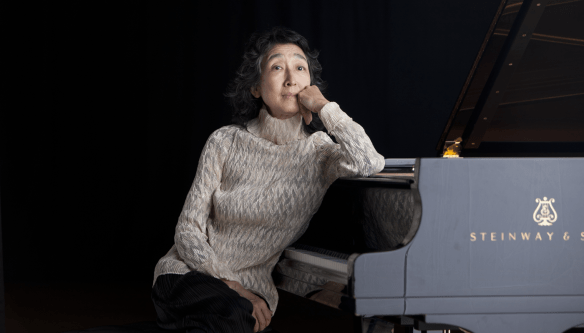
mitsuko-uchida-240815Far more purposeful was Uchida’s performance of Schubert’s first published Impromptu, where we explored the composer’s very heart through an interpretation that had the hall on the edge of their seats. The repetitive march theme was darkly coloured, but the transition from minor key to major brought brilliant shafts of light under Uchida’s quick fingers.

When the two musicians played together the results were electric. In spite of a mobile phone that rang for more than a minute, and a hearing aid that shrilled in close proximity to the pitch of Widmann’s clarinet, their Brahms was beautifully poised. The Clarinet Sonata in F minor Op.120/1 is a late, nocturnal treasure, its tension giving way to an autumnal glow in exchanges between the instruments that behave as though they are old friends. This performance caught that intimacy, especially in the slow movement, and enjoyed the dance of the finale with a spring in its step.

Schumann’s 3 Fantasiestücke faired similarly, closing the program wreathed in smiles, despite the occasional furrowed brow in the first piece. Here the interaction was again on the most intimate of scales, Widmann’s control exquisite in the slower music and matched by Uchida’s voicing of the individual parts.

Even better was the duo’s performance of Berg’s 4 Pieces for Clarinet and Piano, a relatively early publication from 1913 that explores the outer limits of tonality. The mysterious second piece had an extraordinary inner tension, fully released in a flurry of notes, while the last piece, also slow, hung on the air for an age.

Widmann’s control here was almost superhuman, and although he admitted to being out of breath after the Schumann, he and Uchida gave a substantial encore by the 14-year old Mendelssohn. The graceful second movement from his Clarinet Sonata sounded like the work of a much older man, and was lovingly played.

Gould Piano Trio play Schubert at the Wigmore Hall

gould-trio

Gould Piano Trio [l-r Lucy Gould (violin), Benjamin Frith (piano), Alice Neary (cello)]

Wigmore Hall, Tuesday 31st January, 2017

Schubert Notturno in E flat, D897 (c1826); Piano Trio No. 1 in B flat, D899 (c1826-7); Piano Trio No. 2 in E flat, D929 (1827)

schubert

Franz Schubert (1797-1828)

Written by Richard Whitehouse

That the Gould Piano Trio shared its 25th anniversary with Schubert’s 220th birthday made it all but inevitable that these musicians marked the event with a recital of his music. The exact order of the piano trios may be debatable, but what is never in doubt is their stature on a level with those other chamber works – the final String Quartet and the String Quintet – as among the crowning achievements of the composer’s last years. Equally evident were those subtle but pronounced contrasts in form and expression between works written just months apart.

If the B flat Trio is indeed the earlier of the two, this is reflected in its looking back – albeit obliquely – to the more relaxed manner of Schubert’s music up to 1820. Not that there is any lack of gravitas in this music – witness the stealthy momentum accrued in the initial Allegro’s eventful development, impressively maintained here; in contrast to those tenser emotions of the E Flat Trio’s Allegro with its more angular themes and combative development, whose intensifying reprise then agitated coda might have been realized here with greater impetus.

Arguably the highlights in both these performances were the Andante slow movements. In that of the B flat, the Gould searched out the music’s bittersweet eloquence (here, surely, the way in which this work’s ostensible backward glances should be understood) as also its more tensile evolution. While the ensemble never lost focus during the slow movement of the E flat Trio, where an unassuming Swedish song is transformed over the course of one of Schubert’s journeys into uncertainty, there could have been a more graphic sense of the ominous towards its outcome.

It is in the two scherzos where Schubert’s antecedents are most evident. The Classical poise and lucidity in that of the B flat Trio is audibly that of Mozart, overtly so in that of its suave trio, though in this instance the Gould was more successful in its teasing out the equivocal asides of the E flat Trio’s third movement – its ‘scherzando’ marking, with all the edginess that implies, yielding a Beethovenian intent that was amply brought out here. In such music, moreover, is Schubert heard at his most provocative and hence at his most contemporary.

The brace of finales brought these contrasted pieces, and their (for the most part) contrasted interpretations, to their head. The outwardly clear-cut rondo of the B flat Trio unfolded with its deft eliding into unexpected keys drawn into a powerful sense of resolve. If ensemble here was notably more secure than in the finale of the E flat Trio, rendering what is formally the most intricate and expressively the most inclusive among all these movements would be a tall order for any group, and there was little doubting the Gould’s insight over its diverse course.

Including the teenage composer’s Sonatensatz as an encore would likely have been gratuitous in context, though it made sense to open the evening with the Notturno written alongside the two mature trios and was most likely a rejected slow movement for the B flat. With its soulful melodic content and energetic central section, it could be a forerunner of the slow movement for the String Quintet – a reminder that nothing went to waste during Schubert’s feverish final months, with that striving quality once again to the fore in what was another fine performance.

For more information on the Gould Piano Trio visit their website