Wigmore Mondays – Gli Incogniti and Amandine Beyer play Vivaldi

gli-incogniti-clara-honorato

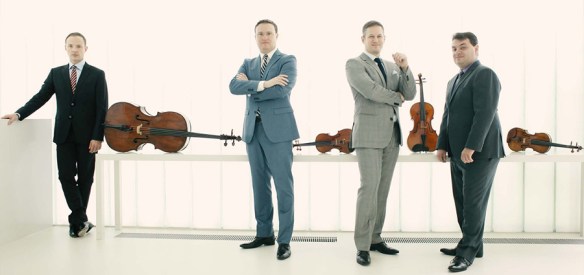
Gli Incogniti / Amandine Beyer (above, photo Clara Honorato)

Wigmore Hall, London, 13 June 2016

written by Ben Hogwood

Audio (open in a new window)

http://www.bbc.co.uk/programmes/b07f6nvn

Available until 12 July

What’s the music?

Vivaldi Sinfonia from L’Olimpiade, RV725 (1733) (6 minutes)

Violin Concerto in F, RV282 () (11 minutes)

Violin Concerto in G minor, RV322 (1728) (10 minutes)

Concerto in G for violin ‘in tromba marina’, RV313 () (7 minutes)

Ballo Primo from Arsilda, regina di Ponto, RV700, & Giga, RV316 (1716) (4 minutes)

Violin Concerto in D, RV228 (c1720-30) (9 minutes)

Spotify

In case you cannot hear the broadcast, Gli Incogniti have recorded all the Vivaldi music played in this concert, and it can be heard here:

About the music

Vivaldi wrote a vast amount of music, a lot of it functional. Yet through the duty of being a court composer there was always the spirit of invention in his music, especially when certain restrictions were imposed, such as for the concerto written for a violin ‘in tromba marina’, where Amandine Beyer plays an instrument where she has virtually destroyed the bridge to give an unusually distorted sound.

The G minor violin concerto, RV322, has been reconstructed by Beyer herself, while the Ballo Primo and Giga is a nice combination of three movements that effectively make up a concerto. The third of these is actually by Bach, but based on a work of Vivaldi.

Finally the group and Beyer play one of the composer’s ‘Dresden’ concertos, which Vivaldi wrote for the Dresden Hofkapelle, whose army of forty or more players made it one of the largest orchestras at the time.

Performance verdict

Gli Incogniti exhibit pure enjoyment when they play the music of Vivaldi, and the concert here was full of the enthusiasm they bring to his music. Because of this there was plenty of energy on display, with the solo violinist and conductor Amandine Beyer responsible for some gravity defying solo virtuosity.

She also had to battle against the elements, for her instruments seemed determine to go out of tune – a hazard for all period instrument groups – but she battled with the elements with impressive ease.

What should I listen out for?

Sinfonia

1:38 – the Sinfonia starts like the wind in the branches of a tree, with repeated notes (tremolandi) on the strings creating momentum. The music is lively and quite ceremonial.

3:49 – for the bittersweet slow movement Vivaldi turns to a minor key, and the violins take a reflective tone.

6:25 – a perky fast movement to complete a typical three-movement format. The lower parts are much more active than the upper this time.

Violin Concerto in F major RV282

8:37 – quite a cheeky start to the first movement concerto, with a breezy main theme. Eventually the music winds up so the soloist can show their mettle, and the violin’s bright tone dominates proceedings from here on.

13:12 – as is customary for a concerto in a major key (F major in this case) Vivaldi uses what is known as the ‘relative minor’, that is the minor key closest related to F major – which is D minor. It is suited for the sombre and relatively stern mood that the music takes. Again the violin leads proceedings.

15:28 – the carefree mood is resumed with another bright and breezy tune from the strings, the violin taking over at 16:07.

Violin Concerto in G minor, RV322

20:28 – the serious tones of the opening lessen a little as the music becomes more energetic, but there is still a darker atmosphere around this music. The violin takes over early on, and you may be able to hear the metallic glint of the harpsichord behind it.

24:49 – staying in G minor, Vivaldi slows the tempo almost to a complete stop. This is an especially poignant movement, the textures quite sparse with a searching melody given to the solo violinist.

27:47 – the third movement feels like a statement of defiance after the sorrow of the slow movement. It has the characteristic Vivaldi energy, whether in the bold strings or the tricky solo part. It ends with impressive gusto.

Concerto in G for violin ‘in tromba marina’, RV313

The violin for this has been adapted by Amandine Beyer so that it rattles when she plays the strings, so it might sound a bit unconventional!

32:07 – the rasp of Beyer’s instrument can be heard as part of the powerful thrust that begins this piece. At times the distortion sounds almost electronic, but is put in context by the steady accompaniment by bass section and harpsichord.

34:50 – a rather beautiful but stark tone from Beyer’s instrument as the music moves into the slow movement.

37:05 – a vigorous, scrubbing motion brings in the music of the third movement, after which we hear Beyer in a solo capacity again, with what sounds like some really tricky passage work!

Ballo Primo and Giga

41:15 – quite a gentle, lilting piece of dance music in triple time, with an attractive colour to the violins.

43:08 – staying in triple time, the next movement is a quicker one, harder on the hips I suspect!

44:07 – the tempo is even faster for the ‘giga’, the violins playing a distinctive three-note motif that takes over the whole dance.

Violin Concerto in D major RV228

47:20 – a brisk theme begins the violin concerto with a sense of purpose on the part of the ensemble, which the solo violin takes up at 47:48.

50:13 – the textures change for the slow movement, as the violins adopt use plucking in the background. The soloist becomes really elaborate in her playing, with some emotive trills and turns to the melody, complemented by some colourful harmonies from the cello and harpsichord. This all takes place in B minor, the ‘relative’ minor key of the concerto’s key of D major.

52:21 – a rush of melodies from the violins return the mood back to one of optimism. There is a highly virtuosic cadenza for the soloist from 54:40.

Encore

58:45 – as fresh as a spring day, this encore (the slow movement from a Violin Concerto in B flat major, RV372a) again uses plucked violins before the solo violin arrives with an expressive and endearing simple melody over the top.

Further listening

As a complement to their Vivaldi, here is another album from Gli Incogniti and Amandine Beyer, concentrating on his French contemporary François Couperin:

Wigmore Mondays – Lars Vogt plays the Bach Goldberg Variations

lars-vogt

Lars Vogt (piano)

Wigmore Hall, London, 6 June 2016

written by Ben Hogwood

Audio (open in a new window)

http://www.bbc.co.uk/programmes/b07dkdt8

Available until 4 July

What’s the music?

J.S. Bach Goldberg Variations, BWV 988 (1742) (55 minutes)

Spotify

In case you cannot hear the broadcast, Lars Vogt has recorded the Goldberg Variations which can be heard here:

About the music

The Goldberg Variations have an intriguing genesis. The generally accepted account is that they were written by Bach for performance by Johann Gottlieb Goldberg, who needed something to play to pass the time when his master, Count Keyserlingk – the Russian ambassador to the court of Dresden – was unable to sleep.

Bach wrote the variations for him and published them in 1742, though their lack of a dedication coupled with a few other factors have led some to doubt their authenticity as a work for Goldberg.

That is a minor aside, though, for the Goldberg Variations are one of the pinnacles in keyboard music. Lasting almost an hour, they are a huge set of variations on an Aria, which is a three-minute, self-contained unit in itself. Throughout the duration Bach reaches profound emotional depths, especially in the minor key variations, while in the more exuberant fast music he explores complex but extremely positive music. They are a tour de force for any keyboard player, and are perhaps the work by which the legendary Canadian pianist Glenn Gould is best remembered.

Performance verdict

Lars Vogt clearly has a great deal of admiration and affection for this music, for this was a spellbinding performance of one of the great cornerstones of the keyboard repertoire. The Goldbergs make great demands on the versatility of an artist, exposing any limitations in their technique – but where Vogt was concerned, there did not appear to be any.

It was helpful that he paused after some of the bigger variations, allowing Bach’s revelations in the minor key in particular to sink in. Others he linked very closely together, so that there was a natural ebb and flow between the fast music and the slow.

This was an incredibly assured performance, after which Vogt simply raised the music itself to the audience – a gesture that spoke volumes for the stature in which the work continues to be held.

What should I listen out for?

1:23 – the Aria, which is a slow Sarabande. It is heavily ornamented – by which it is meant the right hand of the piano decorates its melodies. Yet there is a sense of time standing still as Bach announces the main theme for his variations.

5:02 – Vogt moves straight into the lively Variation 1, where Bach builds up a fluid momentum.

5:54 – the bright Variation 2, a little quieter and beautifully poised with discussion of the melodies between both hands (or ‘counterpoint’ as it is commonly known!)

6:41 – Variation 3, a Canon – where one part shadows the other throughout. Again Bach gives this a totally natural appearance, in a lilting triple time.

8:32 – the more rigid Variation 4.

9:34 – the quickfire Variation 5, with a rapid figuration of semiquavers as the music hurtles forwards.

10:17 – Variation 6, the second Canon in the variations and one that explores some advanced harmonic movements.

11:28 – a detached profile to the melody of Variation 7, with a detached and staccato nature that gives it a French flavour.

12:14 – the busy eighth variation brings the two hands close together on the keyboard, and streams forward, leading straight into…

13:08 – the ninth variation, a slower, poised affair, and the third of Bach’s Canons.

14:43 – Variation 10, a ‘fughetta’ – by which you can hear each part entering individually with Bach’s new theme. The counterpoint builds in a compact statement.

15:28 – Variation 11 is quicker, and tricky to execute.

16:24 – Variation 12, and Bach’s fourth canon, is a stately and expansive affair.

19:24 – Variation 13 is a Sarabande, the first to fully evoke the spirit of the Aria and to behave in a similar, decorated way.

21:38 – the reverie is burst by Variation 14, a brisk affair that has some striking, jumpy rhythms in the right hand. Legendary pianist Glenn Gould compared this variation to Scarlatti.

22:38 – Variation 15, the fifth canon. It has some adventurous chord progressions, moving mysteriously through the minor key as it becomes progressively more anguished. Gould says this would not be out of place in Bach’s St Matthew Passion, as a genuine piece of mourning. A period of silence at the end only heightens the impact.

26:18 – the flavour of a French Ouverture runs through Variation 16, which has a ceremonial air, with some florid statements from both hands. It opens out into a faster section.

28:57 – a virtuosic Variation 17

29:56 – the dance returns for Variation 18, which is another canon, the parts dancing in a calculated but surprisingly breezy near-unison.

31:19 – Variation 19, and Bach still as prodigiously inventive as he was at the beginning. This is a relatively gentle, triple time dance.

31:58 – Variation 20 quickens the pace again, with quick interaction between the hands.

32:58 – for the seventh canon, Variation 21, Bach moves back to the minor key and a solemn exchange of melodies.

35:23 – back to the major key for 22, where Bach often fills out the texture to four parts.

36:05 – a bright Variation 23, where the hands are higher up the keyboard, exchanging some florid ideas.

36:59 – another canon, the eighth, for Variation 24, a triple time dance with an attractive lilt.

39:47 – the third and last minor key variation, 25, is a darker turn after the positivity of the previous one. It is also a lot slower, with time seemingly coming to a halt towards the end of Bach’s discourse. Because of its emotional impact it has been described as ‘the black pearl’ of the set.

43:23 – after the depths of the minor key, Variation 26 sounds like a frivolous thought, with a burbling idea exchanged between the two hands.

44:27 – Variation 27, a little stern in its set canon but with a strong air of positivity.

46:29 – Variation 28 is higher up the keyboard, with repeated figures that Bach moves around a harmonic sequence. There is a lot of hand crossing for the pianist here.

48:13 – in Variation 29 the tempo is still quick and the hands stay close together, though the right one does run off alone at times.

50:16 – Variation 30, the last one, is given the title of Quodlibet, a kind of improvised work. Here Bach really lets his invention go, using the melodies of a couple of folksongs as he strays far from the original.

52:01 – a note for note repeat for the Aria from the start, closing the entire Goldberg Variations.

Further listening

Rather than another set of variations, the recommended further listening is for a set of shorter Bach pieces played on the piano. These can be heard in a stylish album from Alexandre Tharaud, who has incidentally also recorded the Goldberg Variations. Here he focuses on some of Bach’s works with an Italian flavour, including the Italian Concerto among others:

Wigmore Mondays – Till Fellner plays fantasies by Beethoven and Schumann

TF_photo_Monika_Groser2

Till Fellner (piano)

Wigmore Hall, London, 30 May 2016

written by Ben Hogwood

Audio (open in a new window)

http://www.bbc.co.uk/programmes/b07cyk0n

Available until 27 June

What’s the music?

Beethoven – Piano Sonata in E flat major Op.27/1 Quasi una fantasia (1800-1801) (16 minutes)

Schumann – Fantasy in C major, Op.17 (1836-1839) (32 minutes)

Spotify

In case you cannot hear the broadcast, recordings of the music played can be found on the Spotify playlist below. Till Fellner has not yet recorded either of the works, so recommended alternative versions have been used:

About the music

The subtitle for Beethoven’s Piano Sonata no.13 gives him permission to stray from the norm. By this time he had twelve piano sonatas already published, and so it would seem to be a reasonable time for experimentation. This is the first of two works bearing the subtitle Quasi una fantasia, the second of which is one of Beethoven’s most famous compositions, the Moonlight sonata. That should not overshadow this piece though, which is – as with all of Beethoven’s 32 sonatas – a very fine work.

Schumann’s Fantasy in C was meant to be dedicated to Beethoven as part of a memorial to the composer in Bonn, but as it turns out is an outpouring of love for his wife to be Clara. It is a kind of reverse of Beethoven’s ‘sonata like a fantasy’, being a ‘fantasy with the form of a sonata’. Despite the outpouring for Clara it is officially dedicated to Liszt, who was tasked with organising the memorial.

Performance verdict

Arcana was not present in the Wigmore Hall for this concert. However even on the radio it is clear that Till Fellner has great empathy with this music. While he is not massively demonstrative he plays with great clarity and a really impressive sense of melodic line, so that even in the most crowded of textures that Beethoven and Schumann employ, the tunes can still clearly be heard.

The link between the two pieces is a fascinating one and makes for a thoroughly rewarding program, whether in Beethoven trying to escape his formal constraints, or Schumann applying them to a loose-limbed fantasy.

What should I listen out for?

Beethoven

1:46 The first movement begins softly, with an Andante tempo marking (at a walking pace). Gradually the intensity grows, but the sudden jump to Allegro in C major at 4:26 still comes as a big surprise. The music returns to the mood of the beginning.

6:37 The second movement is in C minor, a kind of modified Scherzo that actually sounds quite stern.

8:42 A slow third movement in A flat major, which brings back a few memories of Beethoven’s earlier Pathetique sonata, which had a slow movement in the same key. This one is expressive and thoughtful but with more forward movement than in that piece.

11:52 – a transition from the slow movement takes place without a break, moving into a positive and much quicker finale. Beethoven writes this in a ‘rondo’ form – which means we hear the main theme (‘A’) a lot – but we also hear the theme from the slow movement again (‘C’). The form is A-B-A-C-A-B.

Schumann

19:55 – few pieces for piano start with quite the immediate flow of the Schumann, which has a torrent of notes to begin with, a sea of romantic thought. Gradually the ardour cools a little, but around 25:40 it returns, and the continuous, unbroken stream of Schumann’s inspiration is clear. The movement ends softly, seemingly lost in thought.

33:03 – a triumphant march for the second movement, one of Schumann’s most positive musical thoughts – and set in the key of E flat major, home of Beethoven’s Eroica symphony and, later on, Schumann’s own Rhenish symphony – which this movement seems to anticipate. It is a proud, noble piece of music.

41:19 – the third and last movement starts with cool arpeggios, back in the key of C major, before an ardent tune heard from 41:46 in the right hand, one of the staples of the movement. There follows a long and slow build towards 46:15, where Schumann makes a grand statement, before retreating to more reflective music again. The same happens at 49:57, by which time Schumann has worked his way back to C major. Here the music stays in peace and harmony, one of the composer’s most settled states of mind.

Encore

53:24 More Schumann, this time a brief excerpt (1:40) from Carnaval, his short series of postcard portraits of masked revellers for the piano. This one is the fifth of 21, Eusebius – reflecting the composer’s ‘calm, deliberate side’ according to Wikipedia.

Further listening

The obvious next port of call from the Beethoven is his next piano sonata, also with the title Quasi una fantasia – which is of course the Moonlight. Here it is on Spotify played by Emil Gilels, the last three tracks of a superbly played trio of Beethoven sonatas:

From Schumann’s Fantasy there are two hugely enjoyable next steps – the first a set of eight Fantasiestücke published as Op.12, and another set of eight pieces called Kreisleriana, which end on a haunting note. They can both be heard as part of an Alfred Brendel Schumann collection below:

Wigmore Mondays – Pekka Kuusisto & Nicolas Altstaedt: Music for violin and cello

kuusisto-altstaedt

Pekka Kuusisto (violin), Nicolas Altstaedt (cello)

Wigmore Hall, London, 23 May 2016

written by Ben Hogwood

Audio (open in a new window)

http://www.bbc.co.uk/programmes/b07c3r1b

Available until 23 June

What’s the music?

J.S.Bach – Two part inventions (c1720-23) interspersed with Widmann – Duos for violin and cello (2008) (24 minutes)

Ravel – Sonata for violin and cello (1920-22) (23 minutes)

Spotify

In case you cannot hear the broadcast, recordings of the music played can be found on the Spotify playlist below where available. Not all of the Widmann pieces have been recorded yet, but where possible good alternative versions have been used:

About the music

As the Wigmore Hall programme writer Gerald Larner notes, the combination of violin and cello is a surprisingly scarce one in classical music. There are hardly any recognised works for the pairing, the two most notable being duos by Ravel and Kodály, but just recently the German composer and clarinettist Jörg Widmann (b1973) has shown real creativity in his 24 duos.

They make an ideal contrast with the Bach Inventions, which transcribe seamlessly from keyboard to violin and cello, the violin taking the right hand part and the cello the left. In doing so they bring out the counterpoint behind the music. Widmann’s pieces are more about instrumental colour, but they have melody too – and he enjoys sending up particular dance forms and such, especially when he includes a James Bond theme in the final piece!

Even a composer as accomplished as Ravel did not find the combination of violin and cello an easy one. He began the Sonata in 1920 as a tribute to Debussy, but did not finish it for another year and a half, distracted by a house move and fuelled by the need to give his music a new austerity. Despite the use of only two lines the composer’s flair for harmonic movement still comes through, though the piece does still sound impressively modern.

Performance verdict

A wholly enjoyable concert, thanks to the chemistry between two performers who clearly enjoy their craft. Pekka Kuusisto has always been a charismatic violinist but Nicolas Altstaedt more than matched him here, and because they were in close proximity on the Wigmore Hall stage it was easy to see them as one instrument rather than two.

The interpolation of Bach and Widmann was a clever one, because the music of the former was notable for clean lines and impeccably worked out counterpoint, while the latter concentrated on colours, feelings and dance forms. Moving between the two extremes was a constant source of musical stimulation, and was brilliantly performed – especially in the final Widmann piece, a real tour de force.

The Ravel was superb, helped by the ability of these performers to project while playing incredibly quietly. Because of this the slow movement was the most searching of the four emotionally, potentially a tribute to the departed Debussy. The faster movements were thrilling, showing Ravel’s close relationship with differing dance forms but also the many and varied ways in which he extracts instrumental colour.

The encore, Sibelius’ first published piece, was inspired in its simplicity.

What should I listen out for?

Bach / Widmann

1:38 Bach Invention no.1 in C – there is a beautiful simplicity about Bach’s writing as the violin takes what would have been the right hand of the keyboard, and the cello the left. The counterpoint (i.e. the intertwining of melodies between the instruments) is immaculate.

3:19 Widmann Duo no. XIV Capriccio­ – Widmann’s coloristic effects include snapped pizzicato (plucking) and sudden, jarring phrases, as though the instruments are having a bit of a bout.

5:06 Bach Invention no.4 in D minor­ – after the outbursts of the Widmann it is almost a surprise to return to the clean tonality of the Bach, but it works well – and again the cello part finds itself in exact imitation of the violin

6:10 Widmann Duo no. XVI Petit ballet mécanique (Pas de deux) – a short and shady duo this, with short phrases and implied moods that never fully establish themselves.

7:10 Bach Invention no.6 in E – again Bach’s simplicity is all that matters here. The key of E major makes for a nice, open sound as the strings play with little vibrato.

11:17 Widmann Duo no. XXII Lamento – here Widmann is casting his mind back to the Baroque period, and the strings play close together with no vibrato – a stark sound

13:48 Bach Invention no.8 in F – a much quicker invention that works well in its string arrangement, the rapid movement of Bach’s figures passed between the instruments

14:41 Widmann Duo no. XXI Valse bavaroise – an exaggerated form of pastiche from Widmann here, with scratchy discords and long notes flying between the instruments, not to mention some pretty outrageous glissando passages from the cello!

16:46 Bach Invention no.14 in B flat – a quieter, more reverential piece.

18:38 Widmann Duo no. XIII Vier Strophen vom Heimweh – another slow Widmann piece, using a lot of double stopping so that it sounds more like a string quartet. Again the sound is cold, due to the use of mutes and the almost complete lack of vibrato.

20:48 Bach Invention no.15 in B minor – a solemn mood hangs over this invention, which again is played with very little vibrato – though the players do allow themselves a few liberties with variations of speed and volume.

22:31 Widmann Duo no. XXIV Toccatina all’inglese – a tour de force of virtuosity, this is the first of the Widmann pieces to be an obvious display vehicle for the two players, who rush up and down the fingerboard. There is an extended passage of plucking that briefly gives the music a Far Eastern feel, and there is a tune – where can you spot On her Majesty’s Secret Service?

Ravel

29:00 The first movement has shadowy beginnings, emerging as though from the mists – with the violin and cello very close together as they exchange musical thoughts. The clean timbres are a result of the players using harmonics – where the string is very lightly touched with the fingers on the left hand rather than pressed.

35:05 A faster movement that begins with both instruments plucking, and finds Ravel exploring a great many colours and combinations from this seemingly limited instrumental pairing. The sparse texture is a challenge for him, and sometimes he enhances it with scratched phrases and an almost complete lack of sustain, as in the passage from 36:10 onwards, with the cello’s furious chords.

39:08 The slow movement, a bleak utterance – and it is tempting to think it might owe its inspiration to the recently finished First World War. It takes a long time for the mood to rise above anything other than grim contemplation, but when it does there is a passionate piece of writing in the centre of the movement. Ravel, though is ultimately a positive composer, and this can be heard in the last phrases, which effectively shift the music from darkness to light.

46:04 The last movement reasserts a positive frame of mind with a vigorous jig, the two instruments playing with plenty of energy and rhythmic punch. The tune is catchy too! Ravel is the master of using instrumental effects for colour rather than for their own sake, and that is very much the case here, with harmonics, pizzicato, double stopping and different bowing techniques giving him a wide variety of shades. It is partly what makes this duo such compelling listening.

Encore

54:40 The fascinating encore is Water Droplets, the first published piece by the eight year old Jean Sibelius. It is incredibly simple – played entirely in pizzicato – but is all the more effective for that, as it paints such a vivid picture in its minute-long duration!

Further listening

Having mentioned the Kodály Duo for violin and cello it makes sense to include that as the extra listening here – on the same album as a substantial work for the combination by Erwin Schulhoff:

Meanwhile the video clip below gives an introduction to Jörg Widmann’s music for string quartet:

Wigmore Mondays – Jerusalem Quartet play Beethoven & Bartók

jerusalem-quartet

Jerusalem String Quartet (Alexander Pavlosky and Sergei Bresler (violins), Ori Kam (viola), Kyril Zlotnikov (cello)

Wigmore Hall, London, 16 May 2016

written by Ben Hogwood

Audio (open in a new window)

http://www.bbc.co.uk/programmes/b07b28t8

Available until 14 June

What’s the music?

Beethoven – String Quartet in G major, Op.18/2 (1798-1800) (25 minutes)

Bartók – String Quartet no.6 (1939) (32 minutes)

Spotify

In case you cannot hear the broadcast, recordings of the music played can be found on the Spotify playlist below. The Jerusalem Quartet have recently recorded Beethoven’s first published set of string quartets – of which this concert’s work is the second, while the Bartók appears here in a recording made by his fellow compatriots, the Takács Quartet:

About the music

Beethoven took a little while before letting himself on the string quartet discipline. This was in part due to Haydn’s formidable example, but also because he was writing in other forms of chamber music beforehand, such as the string trio, piano trio and wind quintet. When he did finally arrive at the quartet it was with a set of six pieces that gradually challenged several aspects of Haydn’s string quartet model. Perhaps the most obvious was the use of a scherzo (a more witty movement) over the minuet, an approach Haydn was moving towards but which Beethoven perfected.

The sixth and last of Bartók’s ground-breaking string quartets is viewed as the composer’s response to the onset of war. It is a deeply profound work, especially as the composer begins each of the four movements with a slow and sorrowful introduction. In the second and third movements this gives way to energetic Hungarian dance music, with a considerable strength of feeling that on occasion is tinged with bitterness. Once the final movement arrives the slow music has taken over to such an extent that it runs throughout, providing a profound final statement for a fine if occasionally difficult work.

Performance verdict

The Jerusalem Quartet have been playing the music of Bartók for some time now, culminating in a recording to be released in the Autumn. It showed clearly in this performance, for the Sixth String Quartet made a very strong impact. Their cohesion in the slow introductions was admirable, particularly in the power of the viola and cello solos, while the sardonic dance forms accessed by the composer in the middle movements were crisp in their rhythmic execution.

The Bartók made an ideal contrast with the Beethoven, which was good humour personified – with some nice jokes around the edges and a few more brusque statements that gave clues for the master’s future development. Again the quartet have spent a lot of time with Beethoven’s early work, and they clearly enjoyed the high spirited tunes and the poised dialogue that goes with them.

As an encore we had more Bartók, the pizzicato movement from his String Quartet no.4 – and again ensemble and execution were impeccable.

What should I listen out for?

Beethoven

1:21 –  A fresh, genial start. Very polite and charming – with a first section repeated at 3:14. Beethoven then develops his ideas from 4:59 and a slight shadow appears, the music now in the minor key. This does not last long, mind, for Beethoven returns to his original material in exceptionally good humour.

9:22 – The slow movement, an equally bright and positive piece of work. The tune itself is straightforward but memorable. At 11:35 Beethoven presents a much faster interlude, but just a minute later we return to the safety of the slow movement.

15:34 – even compared to the first two movements this one – the Scherzo – has a big smile on its face, and the quartet are huddled closely together, seemingly in discussion. At 17:27 the music takes a new direction, harking back a little to the slow movement – and then at 19:15 Beethoven cleverly works things back around to the main tune.

20:38 – the last movement is again a genial piece of music, though this time there is more of the characteristic Beethoven cut and thrust.

Bartók

28:33 – a slow and sad elegy from the viola begins the Sixth Quartet, the instrument alone for some time before the others join – and from there on the mood is one of restlessness and anguish. Bartók uses some strikingly dissonant chords, but the ensemble is kept close together – and each of the four instruments has its turn to speak. The harmonic language is complex but not without a key centre.

36:59 – this time the sad melody is assigned to the cello, and takes place over an unsettling rustle of tremolos from the other three instruments. Then at 38:23 a sudden change in mood as Bartók introduces a ‘recruiting dance’ (or Verbunkos in Hungarian) – which is the music played during military recruiting. It has a bitter edge but also touches of humour on the edges. Then around 40:50 a passage of extraordinary intensity, where the piercing higher register of the cello completely takes the lead in a striking tune. The movement continues in a fraught mood.

45:30 – the quartet unite in the sadness that begins the third movement, and each movement finds these periods of reflection getting longer. When the focus changes at 47:15 it is to a ‘Burletta’ – and at 47:26 you can hear the first and second violins playing the same melody – almost – as they are separated by just a quarter tone. There is a plaintive, folksy feel to some of this music, while the louder passages have a much more aggressive stance.

53:27 – a fourth slow introduction, and this one is probably the saddest of all in mood and concentrated in feeling. The quartet is close together throughout, at times speaking with one voice.

Further listening

If the Op.18 set of Beethoven appeals then I strongly recommend the Jerusalem Quartet’s new recording of all six works – fresh and vividly recorded.

Recommending a piece to complement the Bartók is very difficult, but it makes sense to explore another work written in 1939 by the composer for strings – his well-loved Divertimento, part of a disc recorded by Pierre Boulez and the Chicago Symphony Orchestra: