Robin Rimbaud, aka Scanner, writes on his Bandcamp site:
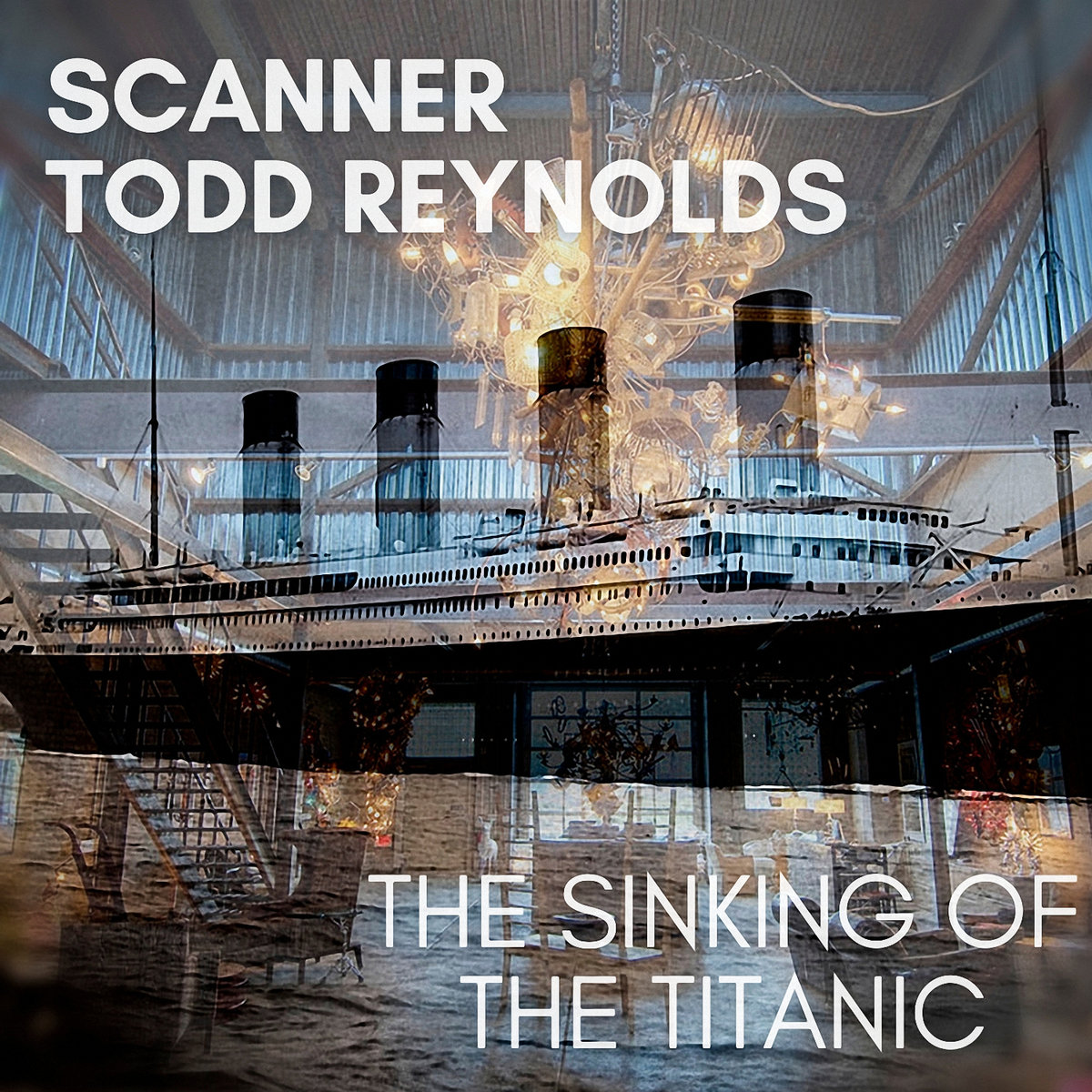
Back in February 2007, I was invited to perform with my friend Todd Reynolds for the opening of the new season for Peregrine Arts in Philadelphia. It was a low key event, as I was about to present my museum performance/installation work, The Order of Things, at the Wagner Free Institute of Science in the same city in the following days.
Bahdeebahdu is an eclectic establishment in Philadelphia, PA that offers a unique blend of art, design, and creativity. It was an extraordinary space, filled with sculptures constructed almost entirely from everyday objects that the owner Warren Muller collected on regular pilgrimages to flea markets, junk stores and so on.
Todd and I set up in this remarkable space and performed an intimate interpretation of the classic work from British composer Gavin Bryars, The Sinking of the Titanic.
For years Todd has been violinist of choice for contemporary artists such as Steve Reich, Meredith Monk, and Bang on a Can, and he’s also a founder of the string quartet known as Ethel. He’s also collaborated with artists like Yo-Yo Ma, Todd Rundgren, Joe Jackson, Mark Mothersbaugh, and even Bruce Springsteen!
It has been remixed and remastered for this 2025 release. Purchase options are below:
On September 12th, Sony Classical releases Fortissima, the new double album by cellist Raphaela Gromes with the Deutsches Symphonie-Orchester Berlin (DSO), conducted by Anna Rakitina and featuring Julian Riem on piano:
The album is a compelling collection of numerous world premiere recordings featuring works by neglected women composers. Their remarkable life stories can also be discovered in the book by Raphaela Gromes and Susanne Wosnitzka, published simultaneously in German by Random House. Fortissima is an inspiring musical document celebrating strong women figures who pursued their dreams under adverse conditions and refused to be held back by prescribed societal roles.
“Fortissima is about role models, for everyone, but especially for young women,” states Raphaela Gromes. “The stories of these artists are about personal integrity, the longing for freedom, and irrepressible creativity. It’s not just about outstanding music, but deeply inspiring personalities.”
Raphaela Gromes has been researching the music of women composers for more than five years. Her successful 2023 album ‘Femmes’ was already a result of this work. “In my education and career, I hardly ever came into contact with the music of female composers, and yet there is so much extraordinary music to discover,” explains Raphaela Gromes. “I want to help make these works more widely known and hope they will one day become part of the standard repertoire.”
The first half of the double album is dedicated to compositions for cello and piano by Henriëtte Bosmans, Victoria Yagling, Emilie Mayer, Mélanie Bonis, and Luise Adolpha Le Beau, complemented by an arrangement of All I Ask by Adele. The second half features cello concertos by Maria Herz and Marie Jaëll, a ballade for cello and orchestra by Elisabeth Kuyper, two newly composed orchestral works Femmage I and Femmage II by Rebecca Dale plus an orchestral arrangement of P!NK’s Wild Hearts Can’t be Broken.
Raphaela Gromes was inspired to record Maria Herz’s cello concerto by the composer’s grandson, Albert Herz, who contacted her following a radio programme about her 2023 album ‘Femmes’, which placed women composers firmly in the spotlight. Maria Herz, born in Cologne in 1878 into the Jewish textile dynasty Bing, was forced to flee Nazi Germany and initially lived in England, later in the United States. She left her grandson a large box full of compositions, letters, and pictures, in which the forgotten cello concerto was found. Gromes was instantly captivated upon first browsing the score: the cello leads through an exciting movement with virtuosic solo cadenzas, dense harmonically complex passages, and a jubilant final stretta that evokes the Jewish dance ‘Freylekhs’. Herz began composing after the birth of her four children and, following the death of her husband, sometimes published under a male pseudonym.
The struggle to gain recognition as a female musician and composer was shared by contemporaries Marie Jaëll, born 1846 in Alsace as Marie Trautmann, and Elisabeth Kuyper, born 1877. Although Marie Jaëll was hailed as a musical prodigy and toured across Europe as a child piano virtuoso, a career as a composer largely eluded her. She received private tuition from César Franck and Camille Saint-Saëns and, as personal secretary to Franz Liszt, edited and completed several of his works. Liszt aptly summarised her situation: “A man’s name above her music, and it would be on every piano.” Her virtuosic and moving cello concerto is considered the first such work by a woman and is dedicated to her late husband. Elisabeth Kuyper became the first woman to win the Mendelssohn Scholarship (1905) and was appointed composition lecturer in 1908 in Berlin, another first. Yet a lasting career as a composer and, especially, conductor, was denied her. She subsequently founded several women’s orchestras – in Berlin, London and the USA – all of which eventually failed due to lack of funding. Kuyper died impoverished and forgotten in Ticino. Many of her works are considered lost, including her Ballade for Cello and Orchestra, which Julian Riem reconstructed from a surviving piano score.
Emilie Mayer, born in 1812, and Luise Adolpha Le Beau, born in 1850, were fortunate to gain recognition as composers during their lifetimes. Mayer’s works were performed at the Konzerthaus Berlin, including for King Friedrich III. She had to finance both the performances of her works and their publication herself, which was only possible thanks to an inheritance from her father. The Sonata in A major for Piano and Cello is one of ten surviving cello sonatas. Luise Adolpha Le Beau was supported early on as a pianist by her parents and received lessons from Clara Schumann. She was the first woman to study composition under Josef Rheinberger in Munich and first gained attention for her compositions in 1882 with her Five Pieces for Violoncello Op. 24. The cello sonata Op. 17, recorded by Raphaela Gromes, was even recommended by an all-male jury as a “publishable enrichment.” Henriëtte Bosmans, born in 1895, also received some recognition as a composer in her homeland of the Netherlands, although she was better known as a pianist and, after the war, as a music journalist. Due to her Jewish heritage, she was forced to go into hiding during the Nazi regime and succeeded in rescuing her mother, who had been deported to a concentration camp. Her cello sonata was originally commissioned for the cellist Marix Loevesohn and was composed after the First World War.
Many of the early female composers were initially instrumentalists – a description that particularly applies to Victoria Yagling, a true star cellist. Born in 1946 in the Soviet Union, she studied with Rostropovich and won major competitions. Censorship in the USSR hindered her creative work, and it was only in 1990 that she was able to emigrate to Finland, where she became a highly respected professor. In an era when, in some circles, working as a female musician was equated with prostitution, Mélanie Bonis, born in 1858 in Paris, had to fight even for piano lessons. Exceptionally talented, she was eventually admitted to the Paris Conservatoire at the age of twelve to study with César Franck. Oppressed by her parents and forced into marriage, she suffered from severe depression during the final 15 years of her life. Yet it was during this period that she composed the delicate piece Méditation, which her granddaughter discovered in 2018 in an attic.
Three contemporary works are included on ‘Fortissima’: Femmage I and II were composed especially for Raphaela Gromes by British composer Rebecca Dale (b. 1985). In the reflective, cinematic ‘She walks through History’, Dale places a sweeping melody at the centre to highlight the vocal expressiveness of Raphaela Gromes’ cello playing. In ‘Meditation’, Dale unfolds a harmonically fascinating sound spectrum, with the cello solo rising from its lowest register to extreme heights. The adaptation of Adele’s ‘All I Ask’ pays tribute to one of the greatest soul voices and songwriters of our time, while P!NK’s ‘Wild Hearts Can’t be Broken’ holds special personal significance for Raphaela Gromes. The lyric “My freedom is burning, this broken world keeps turning, I’ll never surrender, there’s nothing but a victory. This is my rally cry.” could also serve as a motto for the women composers featured on the album.
As part of the album’s production, three new sheet music editions were also created: Henriëtte Bosmans’ cello sonata will be published by the renowned Henle Verlag. Marie Jaëll’s cello concerto, now including a newly discovered second movement recorded for the first time on this album, will be published in an edition by Julian Riem at furore Verlag. Elisabeth Kuyper’s Ballade for Cello and Orchestra, whose original score is lost, has been newly orchestrated by Julian Riem and Raphaela Gromes from the surviving piano version and will be published by Boosey & Hawkes.
‘Fortissima’ is released on September 12th by Sony Classical.
TRACKLIST:
CD 1 (feat. Julian Riem, piano)
1. – 4. Henriëtte Bosmans: Cello Sonata in A Minor
5. Victoria Yagling: Larghetto
6. – 9. Emilie Mayer: Cello Sonata in A Major
10. Mélanie Bonis: Méditation
11. – 13. Luise Adolpha Le Beau: Cello Sonata in D Major, op. 17
14. Adele: All I ask
CD 2 (feat. Deutsches Symphonie-Orchester Berlin, conductor: Anna Rakitina)
1. – 4. Marie Jaëll: Cello Concerto in F Major
5. – 11. Maria Herz: Cello Concerto Op. 10
12. Elisabeth Kuyper: Ballad for Cello and Orchestra, op. 11
13. Rebecca Dale: Femmage I – She Walks Through History
14. Rebecca Dale: Femmage II – Meditation for Cello & Orchestra
15. P!NK: “Wild Hearts Can’t Be Broken”
Published post no.2,644 – Thursday 4 September 2025
Thomas de Hartmann is a composer whose profile has soared in recent years, thanks to well timed album releases from Wyastone and Pentatone, and a recent Proms debut where the Violin Concerto was performed by Joshua Bell, with the BBC Symphony Orchestra under Dalia Stasevka.
Today Pentatone make a small but meaningful addition to their discography. Cellist Matt Haimovitz has already recorded the composer’s Cello Concerto, but now he adds a meaningful extra in the solo work La Kobsa, composed by de Hartmann in exile in 1950.
The press release writes, “While the recording was made at Skywalker Sound in California, the emotional core of this project lies in Haimovitz’s four-city tour of Ukraine with the Odesa Philharmonic in May 2024, made possible by a grant from the U.S. State Department. During his journey, he performed impromptu sets in public squares and for wounded soldiers, accompanied by a documentary film crew, and brought de Hartmann’s music to his homeland for the very first time.”
What’s the music like?
Running in two short movements, La Kobsa begins with a deeply felt utterance, a profound piece from the cello:
The second part is more playful and optimistic, a dance with a rustic edge, which finds Haimovitz in exuberant but poignant form:
Listen / Buy
You can listen and explore download options from the Pentatone website
Award-winning US pianist and composer Dustin O’Halloran releases new single Red – the second single taken from his forthcoming The Chromatic Sessions EP, to be released on 8 October on Splinter Music. An improvised piano piece recorded in a single take in his Reykjavík studio; it’s a rather beautiful private moment to make up the second of three tracks forming The Chromatic Sessions’EP.
It’s been a productive couple of years for O’Halloran. Late last year he scored two films, including Scarlett Johansson’s directorial debut Eleanor the Great, which premiered at the Cannes Film Festival in May. His ambitious 2024 album 1 0 0 1, released on Deutsche Grammophon, was an immersive concept album that asked questions about the place of human consciousness in the age of AI.
Red is a partner piece to Gold – released last month – with a final chromatic track titled Blue set to follow. The theme of colours emerged organically during the process of writing and recording. “It wasn’t something pre-planned,” says Dustin. “I was improvising on the piano every day, and I realised I was always thinking about colours as I wrote. When you have the mic set up and you’re recording, it puts you into deep focus. There’s something about that red light being on that really pulls you into the moment.”
O’Halloran has long experienced synaesthesia – a mingling of the senses that may sound familiar to many. It can be something as simple as a taste snapping us back to a place we’ve been, a familiar scent triggering a powerful emotional flashback, or – in Dustin’s case – a certain sound evoking the feeling of a colour. “I believe that people are more synesthetic than they realise,” he says. “It’s something that you can tune into. All sensations are ultimately translated in the brain — and I think you can learn to connect different parts of those sensations together.” Such connections are a theme that runs through ‘The Chromatic Sessions’ – including the connection between Dustin and his audience.
Each of the three singles that form ‘The Chromatic Sessions’ EP come with downloadable sheet music when bought on Bandcamp, allowing listeners to play the music themselves. It’s a gesture born of O’Halloran’s heartfelt wish to forge a closer relationship with his listeners. “Releasing music digitally feels so distant and disconnected,” he says. “And I think we’re all looking for connection. When people get involved in playing the music, it becomes part of them in a different way. It becomes communal. It becomes theirs.”
In a changing, unpredictable and turbulent world, something we can always rely on is a new Orb album, with the next holiday-for-the-head never far away. On what is quite possibly the millionth longplayer helmed by electronic lifer Alex Paterson; partnered with the now firmly-entrenched boy wonder Michael Rendall; the inspirationally productive outfit yet again deliver the goods, with one of their best yet.
“I was having a dream, and in this dream was an escalator descending out of the clouds, upon which were Buddhists and hipsters travelling downwards, and beckoning me down from the top, was Roger Eno. When I woke up, I had a text from him, asking if we fancied more collabs, so he’s on the record, amongst other friends.
New single Under The Bed, the second track to be taken from forthcoming album Buddhist Hipsters sees long-time Orb cohort Andy Falconer, whom Alex calls “an ambient god”, join forces with Alex, and the pair go so many fathoms deep that they aren’t merely out of their pit, but Under The Bed, and it displays all the awe of the cosmos like a planetarium from heaven. As the press release says – it is nearly ten minutes of pure, easy, hot-weather ambience.
“Recording the album and playing recent gigs have been comfortable, happy, and therapeutic experiences, largely due to Michael Rendall, who’s a genius that picks up anything he turns his hand to. We have a wonderful, simpatico relationship on record and on stage. Overall, the length, arc, and energy of Buddhist Hipsters energy mirrors one our fans’ faves, U.F. Orb.”Alex Paterson
Spontaneously Combust kicks off in fine style, with Steve Hillage’s unmistakeable guitar, Miquette Giraudy on vintage EMS synth, plus blue roomy bass, backwards vocals, and gentle dream house grooves. It features a top-secret sample, suggested to Alex by shopkeeper-par-excellence Michael King, taken from his mythical basement vaults at West Norwood’s Book and Record Bar.
A recent live set starter, P~1 slowly builds into firing cosmic D&B cyclones, whilst the bleeped-up late 70s synth of Baraka is an ode to a famous Kenyan blind rhino, who, tellingly is known as a symbol of resilience. Already a firm live favourite, A Sacred Choice is prime leaping reggae skank, with Youth on bass, Paul Ferguson on drums, Andy Falconer on atmospherics, and vocals by Eric Von Skywalker.
The title of the eastern influenced, orchestral drama of hip hop banger Arabebonics is a word invented by rapper Rrome Alone, who lends vocals to the track, with added BVs and strings from Violeta Vicci.
Elsewhere, prog-throbber It’s Coming Soon features Andy Cain’s dulcet tones, that grace this plaintive-arpeggiated-prog-throbber, on which Alex manages to smuggle a nod to his aunties Rose and June into the lyrics, before the dusty nostalgic vibes of Doll’s House glows and pulsates in all the right ways, scattering sound beams like a planet sized disco ball.
With Alex having met lovers rock legend Trevor Waters and discovering his classic Love Me Tonight, Rendall isolated the vocal using Logic, transforming the original into the pinnacle of the LP’s house music passage. Newly titled The Oort Cloud (Too Night) and aided by cult Manchester disc jockey Dr D, they embark on a classic NYC deepside journey, for a moment of dancefloor ecstasy.
Elsewhere, Andy Falconer joins forces with Alex on Under The Bed, while the delightful Khàron, named after the sister planet of Pluto, conjures a universe alive with light and celestial beings, largely aided by Roger Eno’s stunningly sparing piano. Finishing on a high, it bids us a warm goodnight.
Buddhist Hipsters is released on October 10th via Cooking Vinyl and will be available on CD with a 6 panel fold out sleeve, black double LP vinyl with a gatefold sleeve and limited-edition rust red, pink marble and yellow marble vinyl.




 Arcana.fm