Let’s Dance – Detroit Love 4 mixed by Mirko Loko (Detroit Love / !K7)

by Ben Hogwood

What’s the story?

Carl Craig’s Detroit Love mix series moves onto a fourth instalment under the watchful eye of Mirko Loko, who Craig recruited for the Detroit Electronic Music Festival back in 2001. With such a longstanding attachment to the city and its techno heritage, the Swiss DJ is a natural choice and takes the chance to say thank you to Detroit and its cultural legacy. He does so in the form of a 22-track mix including homegrown talent but also casting an eye further afield to show off the influence of the city.

What’s the music like?

This is a really fine set, mixed with impressive fluidity by Mirko Loko. From the start he creates a good deal of space, Fred P’s Vision In Osaka setting the scene beautifully before Loko’s own excellent Detroit Love Mix of It’s Like, with persuasive vocals from Ursula Rucker. As the mix proceeds Loko moves between quite minimal tracks and bigger, expansive moments like Chaos In The CBD’s Comfort Zone, or the blissful Aos Si of Takuya Yamashita.

However the real high point comes with Derrick May’s appearance on Loko’s Mentors Heritage, a mix made especially for the compilation. The booming voice and percussion are an ideal match, especially when segueing into the bare bones of the piano in Laurent Garnier’s mix of Gilb’R’s Pressure.

From then the mix rolls on, taking in the propulsive Madness of Temo Howard before an excellent finish from Mirko Loko and Stacey Pullen with Tronic Illusion – another exclusive mix – and Lady B’s Cruising Around Motor City.

Does it all work?

It does indeed. Well paced, structured and full of subtly euphoric moments uniting past and present in an effortless blend.

Is it recommended?

Yes – a very strong addition to what is proving to be an extremely collectable series.

Stream

Buy

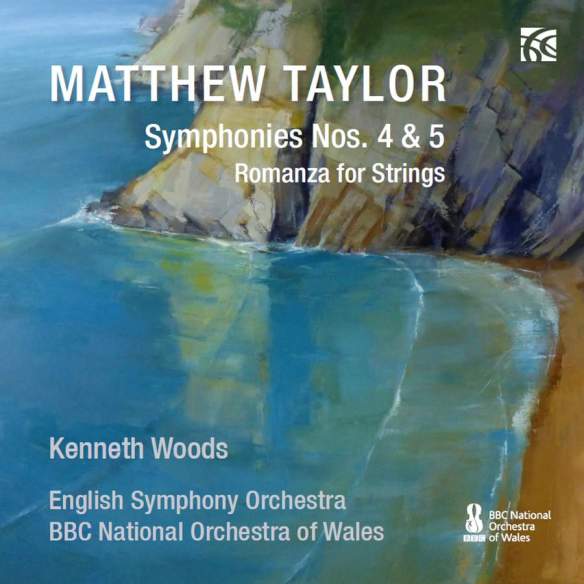
On record – Matthew Taylor: Symphonies nos.4 & 5 (BBC NOW / Woods) (Nimbus)

Matthew Taylor
Symphony no.4 Op.54 (2015-6)
Symphony no.5 Op.59 (2017-8)
Romanza for strings Op.36a (2006-7)

BBC National Orchestra of Wales (Symphonies), English Symphony Orchestra / Kenneth Woods

Nimbus Alliance NI6406 [63’56”]

Producer Simon Fox-Gál
Engineers Simon Smith, Mike Cox (Symphony no.4)

Recorded 8 June 2019 at St. Jude-on-the-Hill, London (Romanza); 14 January 2020 at Hoddinott Hall, Cardiff (Symphonies)

Written by Richard Whitehouse

What’s the story?

A new release of music by Matthew Taylor, including the Fourth and Fifth Symphonies, that means all of the composer’s works in this genre have now been commercially recorded (the First and Third on Dutton Epoch CDLX7178; the Second on Toccata Classics TOCC0175).

What’s the music like?

Symphonism goes back almost to the start of Taylor’s composing, his Sinfonia Brevis having been finished when he was 21, and symphonies have continued to appear at regular intervals across his output. Written respectively to mark the 50th anniversary of Kensington Symphony Orchestra, and as the third instalment within the English Symphony Orchestra’s 21st Century Symphony Project, these two pieces feel typical not least as regards their absolute contrasts of form and expression; while being equally unmistakable as the music of just one composer.

An in memoriam to composer John McCabe – dedicated to his widow Monica – the Fourth Symphony falls into three continuous movements. The first, marked Giubiloso, maintains its energy across distinct shifts of dynamics and activity (the evocative writing for woodwind and harp redolent of Tippett); subsiding from its impassioned climax into an Adagio where strings take the foreground in music of textural richness and emotional depth. Beginning at a decided remove from what has gone before, the Finale buffa exudes a nonchalant humour (reminiscent of Arnold), complemented by a deftly scored episode that cannily prepares for the denouement. This is purposefully controlled through to a climax that recalls the work’s opening theme before an ending as feels the more decisive for its literally coming to a halt.

Heard as an interlude between two imposing statements, the Romanza could hardly be better placed. An arrangement of the second movement of Taylor’s Sixth Quartet (Toccata Classics TOCC0144), it testifies to the suffused lyricism evident in this composer’s writing for strings.

The Fifth Symphony is only Taylor’s second such work in four movements, but its formal and expressive emphasis differs greatly. Indeed, the initial Allegro is unprecedented in his output for sheer volatility (not unlike that of Beethoven’s ‘Serioso’ Quartet), its driving impetus and explosive culmination creating a momentum which is pointedly left unfulfilled by the ensuing intermezzo-like Allegrettos. The first (a tribute to composer and teacher Cy Lloyd) is as terse and equivocal as the second (a tribute to Angela Simpson, wife of composer Robert Simpson) is poised and wistful. It thus remains for the final Adagio (a tribute to the composer’s mother Brigid) to secure that eloquent apotheosis towards which the whole work had been headed, as this moves with sustained power toward its plangent twin climaxes then on to a resigned coda.

Does it all work?

Indeed. In all three pieces, Kenneth Woods secures a dedicated response from the players so Taylor’s exacting yet practicable writing is heard to advantage, not least in acoustics whose immediacy emphasizes this music’s rapt inwardness as keenly as its untrammelled energy.

Is it recommended?

Yes, and not least for a booklet that features informative commentaries by both composer and conductor, and striking artwork by Andrea Kelland. An introductory portrait by James Francis Brown mentions Taylor as having written six symphonies: hopefully, no mere slip of the pen!

Listen & Buy

You can listen to clips from the recording and purchase, either in physical or digital form, at the Presto website

Read

You can discover more about Matthew Taylor by heading to his own website

On record – Lysander Piano Trio: Mirrors – 21st Century American Piano Trios (First Hand)

Cohen Around the Cauldron (2016)
Moya
Ghostwritten Variations (2015/16)
Higdon
Love Sweet (2013)*
Belimova
Titania and Her Suite (2014)
Cooper
An den Wassern zu Babel (2010)
Ciupinski
The Black Mirror (2013/14)

Lysander Piano Trio (Itamar Zorman (violin), Michael Katz (cello), Liza Stepanova (piano) with *Sarah Shafer (soprano)

First Hand Records FHR111 [71’26”]

Producer & Engineer Ryan Streber, *Paul Griffith

Recorded 2 & 3 January 2018 at Oktaven Audio, Mount Vernon, New York; * 21 February 2018 at Performing Arts Center, Athens, Georgia

Written by Richard Whitehouse

What’s the story?

An enterprising and finely realized collection of recent works for piano trio (all of them first recordings) by the Lysander Piano Trio, an ensemble now well established on the American recital circuit, which here gets to display its versatility and conviction in abundant measure.

What’s the music like?

As varied as the composers featured. Senior among them, Jennifer Higdon (b1962) contributes in Love Sweet a song-cycle very different from the extrovert orchestral works for which she is best known; the unusual yet effective combination of soprano and piano trio affording a deft characterization of these five poems by early twentieth century author Amy Lowell that trace the fateful unfolding of a relationship with ruminative poignancy. Following directly, Titania and Her Suite by Sofia Belimova (b2000) is a disarmingly assured miniature by a composer then in her early teens – its animated and unpredictable take on the figure from Shakespeare’s A Midsummer Night’s Dream having a maturity and assurance as to put into the shade efforts by other more recent prodigies. Where its composer goes from here should prove fascinating.

Either side of these works, Ghostwritten Variations by Reinaldo Moya (b1984) draws on four seminal novels of the post-war era in four variations on a theme whose understated eloquence is ideally suited to the respectively searching, agitated, insouciant and disembodied treatments which follow – so making for an trajectory enhanced by this theme’s audible presence at each stage. As its title suggests, An den Wassern zu Babel by William David Cooper (b1986) draws on Psalm 37 not only as text but also the melody found in a setting contemporaneous with the German translation by Martin Luther; from which emerges a continuous set of six variations whose contrasts are permeated (never slavishly) by the spirit of German expressionism from the early twentieth century, and in what becomes a ‘mirror’ as revealing as it is disconcerting.

With its influences ranging from prog rock to klezmer, Around the Cauldron by Gilad Cohen (b1980) opens the programme with a vividly evocative sequence inspired by the three witches (also known as the weird sisters) from Shakespeare’s Macbeth; these seven tightly contrasted vignettes taking in a Witches Waltz of glinting irony then culminating in Sacrificial which is hardly less chilling than the Third Ear Band’s score for Roman Polanski’s (in)famous film rendering. Concluding this collection, The Black Mirror by Jakub Ciupinski (b1981) takes up procedures associated with Baroque painter Claude Lorrain – the piece slowly emerging from tentative piano phrases and string harmonics to a climax whose etherealized intensity could not be better described than by the composer’s description of ‘‘an explosion in slow motion’’.

Does it all work?

Yes – inasmuch that there are no also-rans among the pieces featured and, even if there were, the unwavering commitment of the musicians would likely be more than compensation; not least Sarah Shafer, whose singing adds much to the affecting aura of the Higdon song-cycle.

Is it recommended?

Indeed. The sound presents an often difficult medium to best advantage, while credit should be given to the booklet which features succinctly insightful notes on each piece along with biographies of each of the composers and artists – not to mention those five Lowell poems.

Listen and Buy

You can discover more about this release at the First Hand Records website, where you can also purchase the recording.

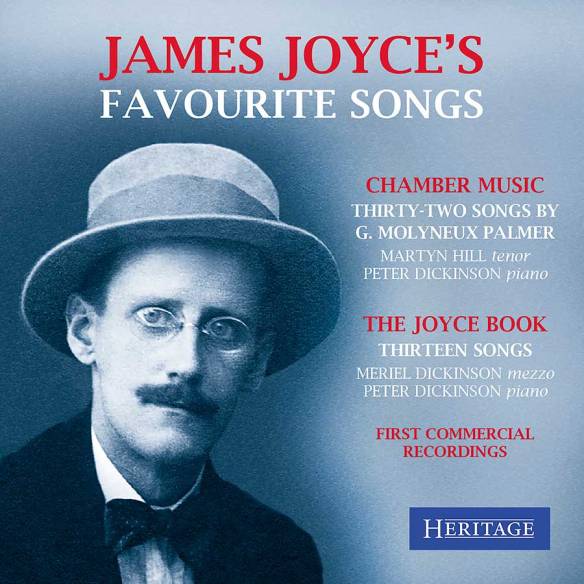
On record – Martyn Hill, Meriel Dickinson & Peter Dickinson: James Joyce’s Favourite Songs (Heritage)

Chamber Music: Thirty-Two Songs by G. Molyneaux Palmera The Joyce Book: Thirteen Songs, by Moeran, Bax, Roussel, Hughes, Ireland, Sessions, Bliss, Howells, Antheil, Carducci, Goossens, C. W. Orr and van Dierenb

bMeriel Dickinson (mezzo-soprano), aMartyn Hill (tenor), Peter Dickinson (piano)

Heritage HTGCD175 [71’28”]

Producer Jillian M. White
Remastering Engineers John Marsden, Peter Newble

Recorded 7 December 1981, BBC Broadcasting House, London (The Joyce Book); 18 November 1986, St. George’s Brandon Hill (Chamber Music)

Written by Richard Whitehouse

What’s the story?

Heritage further expands its Peter Dickinson discography with these song-cycles in which he appears as pianist, setting poems from James Joyce’s two collections of verse; both heard in recordings which were first broadcast in the 1980s and now rescued from the BBC archives.

What’s the music like?

The major rediscovery here is an almost complete traversal of Chamber Music by Geoffrey Molyneaux Palmer (1992-1957), English born but long resident in Dublin where he worked as church organist and composer. Despite the author’s enthusiastic endorsement, Palmer was never to finish the project, despite his leaving blank pages for those four poems (Nos. 12, 29, 32 and 33) still awaiting music. Through the tenacity of Myra Teicher Russel, the manuscript was located at Southern Illinois University in 1981 with a studio broadcast on BBC Radio 3 seven years later (preceded, as this author recalls, by a fascinating introduction on the Music Weekly programme). Thanks to the foresight of BBC producer Jillian White, that broadcast was subsequently archived and can finally enjoy a welcome if belated commercial release.

In stylistic terms, Palmer settings are very much ‘turn of the century’ in their melding of an inherently English lyricism with harmonic subtleties redolent of Fauré or early Debussy. As ordered by Joyce’s brother Stanislaus, these 36 poems pursue an ‘innocence to experience’ trajectory via a relationship which is tentatively envisaged before being passionately lived then regretfully abandoned. Throughout the sequence, Palmer is acutely attentive to those flights of fancy with which Joyce opens out his poems’ expressive potency – tailoring his response to the intricacies of the text at hand while running several songs together so as to accentuate cumulative intensity overall. A pity the climactic XXXIII remained unset, but    the composer’s response to the stark seascape of XXXVI yields a suitably plangent close.

Also included is The Joyce Book, 13 settings taken from Joyce’s subsequent collection Pomes Penyeach which was published in Paris in 1927 and accorded musical treatment thanks to the prompting of Irish editor Herbert Hughes. That the resultant settings included two American, a French and an Italian composer confirms the international standing Joyce by then enjoyed; further underlined by the deluxe edition with which this collection was issued in 1933, a year after its public premiere in London. Stylistically the settings are as diverse as the composers represented: among the most distinctive are the lilting wistfulness of Hughes’s She weeps over Rahoon, easeful rapture of Arthur Bliss’s Simples and suffused ecstasy of Bernard van Dieren’s A Prayer on which both this ‘cycle’ and Joyce’s collection reach their close.

Does it all work?

It does, given the expressive consistency of Palmer’s settings as also the diversity of those in the later miscellany. Martyn Hill was among the leading lyric tenors of his generation, with Meriel Dickinson seldom equalled for her conveying of the emotional sense behind the text.

Is it recommended?

Indeed, not least when Peter Dickinson is an insightful accompanist and provides the detailed commentaries, while the sound has come up well in remastering (the latter collection a shade reverberant). Required listening, not only for admirers of Joyce or the English song tradition.

Listen

Buy

You can discover more about this release at the Heritage Records website, where you can also purchase the recording.

Read

You can read about Peter Dickinson at his website

Let’s Dance – Róisín Murphy: Róisín Machine (Skint / BMG)

Róisín Murphy – Róisín Machine (Skint / BMG)

reviewed by Ben Hogwood

What’s the story?

A new Róisín Murphy album is always a cause for celebration – whether it has been with her band Moloko or, in more recent times, a solo record in collaboration with a number of electronic music luminaries. This time around Róisín Machine, her first long player in four years, sees her working once again with Crooked Man aka Richard Barratt.

As if the new album was not enough Murphy has been busy making visual complements to the music under lockdown.

What’s the music like?

It is difficult to imagine a more stylish artist than Róisín Murphy. Even with Moloko it felt like her expressiveness matched the music in an effortless way, which made the finished result even more stylish and cool. Little has changed under her own name, though if anything the music is more dance based and the vocals even more meaningful.

Róisín Machine tells a story, threaded beautifully from start to finish, and as a result it works best when heard in a complete span. There are many telling lyrics, but the opening gambit, “I feel my story’s still untold, but I make my own happy ending”, sets the scene perfectly, after which Murphy and Barratt concoct a persuasive, loping groove.

Questions are asked as the album progresses. Kingdom Of Ends finds the singer “waking up every morning, thinking what the hell am I doing?”, while even during the cool chic of Shellfish Madamoiselle, with its bumpy beats and warm synthesizers, she feels that “I shouldn’t be dancing at a time like this”.

Difficult, though, when the music is so persuasive. The groove and vocal of Something More are a perfect match, the stylish slow disco-house brilliantly done. The same, too, goes for the effortless groove of Incapable. For the last two tracks, Narcissus and Jealousy, the tempo quickens and the pulse rate too, Róisín more obviously on the dancefloor.

The most compelling stories are told in Murphy’s Law, however, where she sings of how “I’d rather be alone than making do and mending”, but finds her instincts are pulling her in different directions.

Does it all work?

Yes – either as a single whole or as individual tracks, Róisín Machine is brilliantly worked through. The singer sounds completely at home, but at the same time there are thought provoking lyrics and feet-provoking grooves.

Is it recommended?

Wholeheartedly. This is an album that embodies the saying ‘Style never goes out of fashion’. Róisín Murphy remains one of our finest vocalists, and like a fine wine is just continuing to improve with age. Richard Barratt proves the ideal match in the production department, and together the two have made one of the best pop albums of the year.

Stream

Buy