In which Steve Spacek goes back to basics. House music has always been at the heart of his musical thinking, but he feels it has been a long time since he indulged himself in a 4/4 beat. He does so through a long player made solely with iPhone and iPad apps, in Spacek’s words using technology to join the past with the present.
What’s the music like?
Spacek can never really sit still, which is a helpful quality to have in house music! Because of that he is always subtly creating and innovating.
In this case the past is still relatively recent – Detroit techno – but he adds his own welcome quirks to the mix, bringing in vocals to point towards soul and even experimental jazz. His own vocals are as distinctive as ever, while the resultant style is one that purposely includes UK rave music in a kind of transatlantic fusion.
As far as that translates to individual tracks, Tell Me is a really nice hybrid of deep house and UK garage, the latter diffused through its bassline. There are some nice bumpy beats and bass to African Dream which gets bigger perspective through faint keyboards. Song Life is really nice, deep and smooth with a good mix of polish and instinctive writing, which typifies the album. Love 4 Nano is great, with a cosmic synth and serrated bass sound twisting and turning among the chopped up and clipped vocals. The agile bassline of first track Rawl Aredo should not be forgotten either!
Does it all work?
Very much so. Spacek is ever inventive, and Houses works on a deeper level while providing energy through its beats. With four bonus tracks it clocks in at a generous 75 minutes, but thanks to Spacek’s subtly inventive ways through house music it never outstays its welcome.
Is it recommended?
Yes. If you’re a fan of Matthew Herbert’s house exploits you will find yourself close in style to Steve Spacek. Yet the application of his falsetto voice and the UK concessions bring individuality to Houses, in what turns out to be a really fine and invigorating album.
Franck Zaragoza’s sixth album as Ocoeur comes with a plea. It is about getting people to restore their communication to a more direct level of humanity, rather than spending all the time gazing at devices, heads down.
With a wish that we engage with ‘Everything’ around us, Zaragoza gets to work on a broad, ambient canvas, producing an album of six rather beautiful tracks. The one-word titles speak of the simplicity he is searching for in his music.
What’s the music like?
Everything is a beauty. With it Zaragoza manages to suspend conventional feelings of time. Setting out its scope with the Jean Michel Jarre leanings of Ascent, laden with melancholy, it presents a simple, tonal musical language that evolves beautifully.
The title track introduces a kick drum as punctuation, though the appearance of any drums is relatively rare. Current has icy percussion around the edges as it unwraps a chilly, watery scene. Glow also uses shards of rhythm to accompany its luminous keyboards, unfolding at a natural pace.
It is however the closing pair of Dawn and Dusk that leave a lasting mark. At 20 minutes between them, they have an easy, natural progression across space and time in direct opposition to the busy digital environments around us. There is very little to anchor either production to the ground, but the floated motifs work really well.
Does it all work?
Yes. The softly reflective nature of this music makes it ideal for either end of the day, and Ocoeur’s slow yet measured progressions take place through sounds the listener can dive into.
Is it recommended?
Wholeheartedly. Its sentiment is spot on, but so is the feeling you get after 40 minutes spent in Ocoeur’s company. A cleansing and subtly uplifting experience.
Stream
Buy
Everything is released on Friday February 28 on n5MD
The Olympic Peninsula in Washington state is a world away from downtown New York, but the two link Eric Phillips’ first album as Kennebec. Suffering from the sensory overload that many can experience in one of the world’s most vibrant cities, Phillips and his friends were looking for an escape, and their time in the Northwest gave them not just solace but musical impetus.
Phillips is now based in Portland Oregon, but Departure will serve as a musical diary of his Washington sojourn.
What’s the music like?
Departure is the result of two years’ musical endeavour, but rather than sounding like a long, laborious piece of work, it is notable for its freshness. The wide open textures speak of pure musical and mental freedom, while the rich selection of instruments and textures suggest a complete lack of restrictions. The musical language is open too – with electronica as a loose base, Phillips and friends explore Western musical forms but are open to inclusion and variety.
In the course of its 35 minutes Departures makes good and imaginative use of Mirabai Peart’s violin and viola, with a silvery tone the base for Kalahari and some nice, multiple string work on A Monsoon. Phillips also uses the ngoni and kalimba in the course of his musical explorations, as well as classical guitar – all of which he plays himself. They give tracks like Pipe Dreams and As We Grow Older a rarefied air.
Add to this some imaginative studio-based rhythms and you have a flexible style of music that rewards several approaches.
Does it all work?
Yes. Departure works from several musical angles. Electronica lovers will enjoy its fresh approach and freely cast rhythms, while traditional music fans will appreciate the sensitive blending of different styles. This is fusion of genres at its best, done in a way that needs no labelling at all.
Emotionally the music is very open, reflective on occasion but imbued with a fresh energy at others, as though the creator has emerged from a particularly good and invigorating night’s sleep. Spend more time with it and it will have a similar effect on you, the listener!
Is it recommended?
Very much so. Departure works at either end of the day and provides the opportunity of a clean and clear mindful state for its listeners. Think of it as a palette cleanser and a fresh approach, and you will take plenty from its charms.
Recondite has been criticised for sounding the same between albums – as recently as the last few days – but when your output is as beautifully set up as his it would seem churlish to change your style unless you feel a strong conviction to do it. Real name Lorenz Brunner, he also recognises that his devoted fanbase thrive on his ability to continue doing what he does so well – and Dwell is the result of those endeavours.
What’s the music like?
Introverted but rhythmic. Dwell stays on the darker side where harmonies and atmospherics are concerned but there is a strong element of comfort to its vibes, a nice balance of warmth and cold.
Nobilia and Black Letter are two of the best tracks, both with starry flickers. In spite of the delicate drum tracks there is still a good deal of movement too. Mirror Games explores some rather lovely effects that are the sonic equivalent of dancing light patterns, refracting out over a bigger perspective. Moon Pearl is dubby, with light and shade, while Interlude 2 and Surface also explore a slower tempo to good effect. Wire Threat is extremely deep, the muffled kick drum and held bass a bed for slowly shifting, twinkling keyboards to move over.
Does it all work?
Yes. Brunner’s music reveals more than you think it might on first listen, describing a picture the listener can create for themselves. It is darkly shaded and nocturnal, but is ultimately a strong companion to have around. Turn the music up and it works well in a small club space too.
Is it recommended?
Yes. Our perception might be that Recondite may not be challenging himself overly, but it takes great craft and invention to keep interesting in electronic music. Dwell is full of good things, and provides proof that Brunner is still producing some beautiful music. Those who already love his output will see no reason to hesitate here.
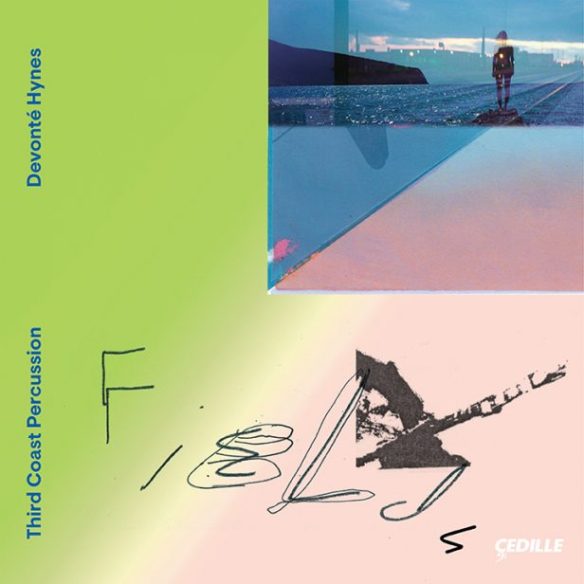
Devonté Hynes
For All Its Fury
Perfectly Voiceless
There Was Nothing
Devonté Hynes and Third Coast Percussion
Cedille Records CDR 90000 192 [60’49”]
Producer Jesse Lewis
Engineer Kyle Pyke
Recorded 17-20 July 2018, Chicago Recording Company & 13-14 October 2018 (Electrical Audio)
Written by Ben Hogwood
What’s the story?
It has become quite a challenge keeping track of Devonté Hynes’ musical activities of late. While releasing a mixtape of quality offshoots from his Blood Orange project (reviewed on Arcana here), he has also released the soundtrack to Queen & Slim. With those in the can, there was always a danger this set of compositions, his most ‘classical’ opus to date, would fall below the radar. Indeed it did on its release in October – but Arcana decided to pick it up and write about it!
There are three pieces here – the substantial For All Its Fury and two shorter pieces, Perfectly Voiceless and There Was Nothing. Hynes wrote them on a Digital Audio Workstation, sending them to Third Coast Percussion for arrangement and orchestration, before meeting up with them to record the works in the second half of 2018. All three pieces have their roots in dance, and were originally written for choreography by the Hubbard Street Dance Chicago company.
What’s the music like?
Accomplished, stylish and with a few surprises in store – but Hynes’ music needs the chance to establish itself. Those familiar with his language might expect his forays into longer compositions to be relatively simple in content, but Fields shows that not to be the case. Instead he takes his lead from the shorter form songs for Blood Orange, picking motifs and textures with the flexibility to blossom into something more substantial.
Reach and Blur, the first two movements of For All Its Fury, set out a picture of cloudy ambience, reminding us of Hynes’ love of Debussy. Only in Coil does the music really begin to flex its muscles. This takes place through a deceptively simple marimba riff that Hynes takes through a number of settings and developments. The murky ambience returns, with warm synthesizer chords, and the music – though sonically attractive – threatens to lose its direction.
Gather, the seventh section, restores the momentum with busy xylophones and chimes, creating a lovely space with bowed marimbas, after which the music floats and creates an enchanting world with the chimes of Tremble. Those chimes spill over into the treble-rich Cradle, before Hynes starts to work in the lower reaches and rich sonority of the marimba sound. This section – Press – generates the most energy, before evaporating into the ambient wash of Fields itself, which then builds to a substantial and satisfying finish.
The other two pieces are self-contained. Though their titles indicate they will be lacking, Perfectly Voiceless and There Was Nothing do have some appealing music. The former busily gets on with creating loops and developing them, though doesn’t quite break free of the influence of Philip Glass. The instrumental colours are again really attractive, and the surrounding musical ambience is rather beautiful, with the shrill treble of chimes complemented by rich, lower marimba writing. There is a sense of petering out at the end, however.
There Was Nothing starts with more soft, starry-eyed ambience, the colours familiar from the other pieces, but there is more evidence of electronic manipulation here with a warm backdrop to the fluttering marimba figures. There is a less obvious shape to this piece – inevitably, given the title – but it has a broader set of textures which are charming on headphones.
Does it all work?
Most of the time. On occasion it feels as though Hynes’ music loses its sense of direction, but given the context of the pieces they serve their brief well. Fields is certainly an appealing album to listen to for its warm colours and consonant harmonies, and Hynes shows enough technique in his mastering of percussion instruments to suggest there is a lot more potential here.
Is it recommended?
Yes. If you’ve followed Hynes’s various pseudonyms, but especially Blood Orange, you will enjoy the warm colours presented by Fields. Hynes’ understated and poignant vocals may be missing, as well as an electronic drum kit, but his next level of expression – analogue percussion instruments – serve him well.
There is however the nagging feeling that these are works in the early stages of progress, but that in itself is intriguing. It will be very interesting to follow where Hynes goes next, and how his obvious talents are harnessed.
Listen
Buy
You can read more about Fields at the Cedille website, together with options for purchasing on analogue and digital formats




 Arcana.fm