
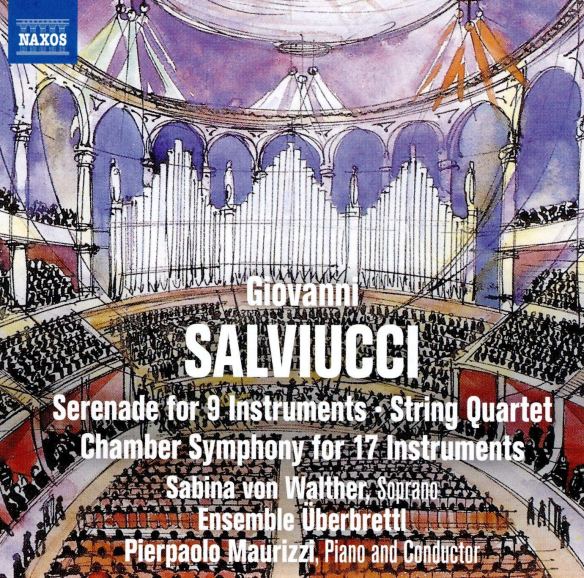
On record – Salviucci: Serenade, Chamber Symphony & String Quartet (Naxos)

Salviucci
Cinque Pezzi (1930)*
Pensiero nostalgico (1931)*
String Quartet in C major (1932)*
Salmo di David (1933)*/***
Sinfonia da camera (1933)**
Serenata (1937)**

***Sabina von Walther (soprano); Ensemble Überbrettl / Pierpaolo Maurizzi (piano)
***Latin text and English/Italian translation.

Naxos 8.574049 [83’05”]

Producer Giovanna Salviucci Marini
Engineer Tommaso Tacchi

Recorded *23-25 July 2017 at Sala dei Concerti di Palazzo Chigi Saracini, Sienna and **4-7 October 2018 at Teatro degli Atti, Rimini

Written by Richard Whitehouse

What’s the story?

Naxos continues its inestimable series devoted to Italian music of the twentieth century with this disc of mainly first recordings by Giovanni Salviucci (1907-1937) – a largely forgotten composer, whom his contemporary Goffredo Petrassi once referred to as ‘‘the best of us all’.

What’s the music like?

Although his composing career lasted barely a decade, Salviucci left several notable works across most major genres. Of those pieces included here, earliest is the Five Pieces for violin and piano – appealing if expressively unvaried music, from which only the lively Alla Festa hints at his later rhythmic ingenuity. Each of them, though, would make an attractive encore; as too would Nostalgic Thought for cello and piano, or Psalm of David for soprano and piano – verse from Psalm 61 with its roots in a modality also drawing on French and Italian sources.

Just before this latter piece, Salviucci achieved something of a breakthrough with his String Quartet. The fast-slow-fast trajectory may yield no obvious surprises, but beneath the intently contrapuntal surface of its outer movements is a quixotic handling of tonality that offsets any risk of predictability. The highlight (in every sense) is the slow movement, an Adagio whose suffused eloquence and finely wrought rhetoric transcend Salviucci’s earlier music. That the piece is unpublished is something this excellent recording should go some way to remedying.

The other two pieces have previously been recorded, which hardly makes them familiar. Its scoring for 17 instruments suggests that the Chamber Symphony may have been conceived with knowledge of Schoenberg’s eponymous work, even though Salviucci’s approach to the balance between wind and strings is less combative and more pragmatic. Outer movements combine rhythmic incisiveness with a harmonic lambency redolent of Vaughan Williams, while the heartfelt Adagio and piquant scherzo confirm an ongoing process of maturation.

A process culminating in the Serenade that was Salviucci’s last completed work. Scored for nine instruments, its textural clarity and harmonic astringency suggest increasing familiarity with the composer’s inter-war contemporaries (Italian and otherwise), and if the lively outer movements are almost too succinct for their motivic ingenuity fully to register, the Canzona elides between soloistic and ensemble writing with deft mastery. The Venice premiere, four days after Salviucci’s death, must surely have rendered the loss of such potential more acute.

Does it all work?

For the most part. Salviucci’s earlier music may be notable more for fluency of technique, but the composer’s idiom evolved apace over his few remaining years, so that one is left only too aware of what he might have gone on to achieve in the very different cultural climate of post-war Italy.

The performances by the excellent Ensemble Überbrettl leave little to chance, with Pierpaolo Maurizzi as astute in direction as he is a pianist. Sound is just a little confined in the chamber works, while Giordano Montecchi’s notes provide a valuable biographical overview.

Is it recommended?

Indeed. Salviucci was already a composer to reckon with, and this generous selection makes an ideal introduction to his music. Hopefully Naxos will now turn to the handful of orchestral works that he completed: in the meantime, the present release should be acquired forthwith.

Stream

Buy

For more information on this release and to purchase in multiple formats visit the Naxos website
Happy National Album Day…

Last year saw a very successful first run for National Album Day, where we were all encouraged to listen to our favourite album in full at 3.33pm. (I listened to Radiator by the Super Furry Animals in case you ask!)

The sequel is already here today – the year of Don’t Skip. This is to encourage us back to the idea of listening to a single body of work from one musical source rather than a playlist, and to lengthen our attention spans as we do so.

This return to album-playing first principals, warts and all, may well mean taking in some of those puzzling instrumental interludes or hidden tracks (especially if you like progressive rock like I do!) but equally it will offer the chance to marvel at those tracks buried in albums that were quite clearly singles in waiting.

For lovers of classical music, National Album Day should also be heartily encouraged. The classical album might be more of a movable feast than its pop counterpart, but the same principles apply, and Arcana has decided to humbly offer up a few favourites that fit the album format.

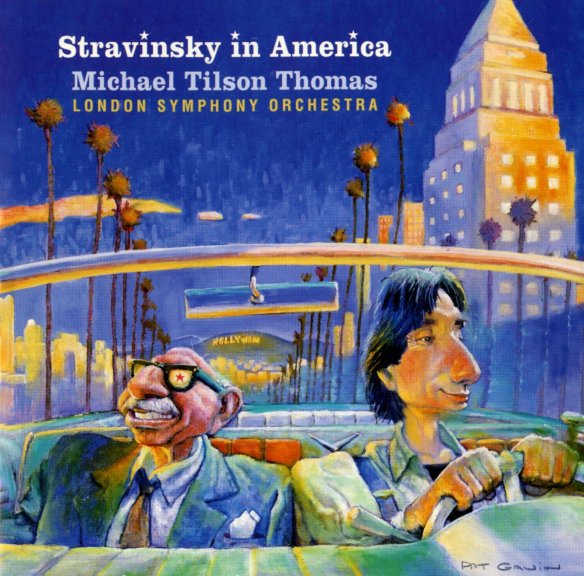
One successful way to produce a classical album is to focus in on the music of a particular country. Even better, you can follow the brief of Michael Tilson Thomas and the London Symphony Orchestra, focusing on a particular composer in exile or relocated from home. This example is a thoroughly engrossing look at Stravinsky’s time in America. With brilliantly played pieces short and long, serious and humorous, it is an album to which I return often:

English music fits perfectly into this way of thinking too. Recently the BBC Philharmonic Orchestra and Rumon Gamba have been looking at the world of British Tone Poems for Chandos – and the recently-released second volume is a gem, with works from diverse sources such as Dorothy Howell, Vaughan Williams and John Foulds:

Another point of departure is the inspiration of a particular artist. On this disc from BIS featuring works inspired by the clarinettist Benny Goodman, Martin Fröst revels in the delights of music by Copland, Hindemith and Malcolm Arnold:

Alternatively if you are a classical performer, you can go for works written for your own performance. The great cellist Mstislav Rostropovich was one of the first artists to carry this one through – and this 1975 combination of concertos for cello and orchestra by Dutilleux and Lutoslawski is a winner:

If you are a singer, you can bring the words into play. Language or poetry can form the inspiration for a record, as it does with this wonderful collection from Anne Sofie von Otter and Bengt Forsberg. La Bonne Chanson was the first record of song I bought, and it stays with me today:

It is interesting to see how newer classical artists have approached the format. Sheku Kanneh-Mason offered something for everyone on Inspiration, his first release, catering for both the newcomer to the cello or the established listener. Either will surely enjoy the Shostakovich Cello Concerto no.1, but also his arrangement of Bob Marley‘s No Woman No Cry:

Finally I offer up two of my own favourite classical albums, both from the ECM label – which celebrates its 50th anniversary next month. The first is composer-themed, an introduction to the haunting sound world of Estonian composer Arvo Pärt in definitive performances, including a magical version of Fratres for twelve cellos:

The second is led by organist Christopher Bowers-Broadbent, and includes a dazzling account of Dance IV by Philip Glass, the culmination of an album including works by Pärt and Sir Peter Maxwell Davies. Listen and be enthralled:

All that remains is for me to wish you a happy National Album Day, whatever you end up listening to – and if you do, please share them below!

Ben Hogwood

On record – Jürgen Bruns conducts Hanns Eisler’s Leipzig Symphony (Capriccio)

Eisler
Leipziger Sinfonie (1959-62: compl. 1998 Medek)*
Trauerstücke aus Filmpartituren (1961/2: arr. 2015 Bruns/Fasshauer)*
Nuit et brouillard (1955: original film score)**

*MDR Sinfonieorchester Leipzig, **Kammersymphonie Berlin / Jürgen Bruns

Capriccio C5368 [63’22”]

Producers *Stefan Antonin, **Gideon Boss
Engineers *Martin Staffe and Robert Baldowski, **Stefan Haberfeld and Regine Kraus

Recorded **9 November 2015 at Konzerthaus, Berlin; *15-16 August 2018 at MDR Studios, Leipzig

Written by Richard Whitehouse

What’s the story?

An important disc of orchestral works from Hanns Eisler (1898-1962), each a first recording and confirming the continued distinctiveness of his music over his final years in (then) East Berlin, when more ambitious plans were constantly thwarted by the East German authorities.

What’s the music like?

Eisler essayed symphonic pieces across his output, notably the Deutsche Sinfonie that is his largest concert work.

The Leipzig Symphony was commissioned by that city’s Gewandhaus orchestra but, at the time of Eisler’s death, consisted of a folio of sketches and memos given definition by Tilo Medek (1940-2006) to commemorate the composer’s centenary. Drawing mainly on film scores (as Eisler had done in his six orchestral suites), these four movements make for a quirky yet compelling entity: unfolding from the pungent contrasts of the initial Prelude and Idyll, via a restive slow movement then a sardonic scherzo both entitled Con moto, to a closing March without Words whose bracing impetus is typical of Eisler at all stages of his career. Some aspects – notably a percussive onslaught at the end of the second movement – are likely interventions by Medek (briefly a pupil of Eisler), though overall the expressive content and formal follow-through have an authentic quality such as makes this piece a necessary addition to the Eisler catalogue and one that warrants repeated exposure.

The other two works are both film scores. In the instance of Funeral Pieces of Motion Picture Scores, its nine miniatures were extracted by Jürgen Bruns and Tobias Fasshauer from music for two films about the Holocaust. The moods may be consistently subdued, but the motivic repetition Eisler threaded ingeniously through these scores has enabled a cohesive sequence whose end returns deftly or without contrivance to its beginning. Given that both films were forgotten soon after being made, this arrangement constitutes a worthwhile act of restitution.

Night and Fog presents a rather different proposition. This half-hour piece is in fact the entire score to a documentary about Auschwitz shot (partly on location) by Alain Renais and whose acclaim facilitated his subsequent film career. This is now available on DVD and mandatory viewing, yet Eisler’s contribution is entirely viable on its own terms. Its 13 numbers (lasting between 30 seconds and five minutes) again opt for understatement.

Peter Deeg’s insightful booklet note indicates how the studio musicians seemed nonplussed by Eisler’s insistence on emotional restraint, but the resulting music is its own justification; whether in more ominous episodes (not least one entitled Herr Himmler), or the final movement that encapsulates its subject in a threnody of Mahlerian anguish. Never was Eisler’s ‘commitment’ more explicit.

Does it all work?

Absolutely. It helps that the playing of both MDR Symphony and Berlin Chamber Symphony orchestras feels unerringly attuned to the angularity yet also plangency of Eisler’s expressive ambit, ably guided by the versatile Jürgen Bruns so all three pieces leave a lasting impression.

Is it recommended?

Indeed. To get the measure of Eisler, the collection of (mainly) Berlin Classics recordings – now available on Brilliant Classics – is an essential purchase, but the present disc is a vital supplement and a further significant release from the always enterprising Capriccio label.

Stream

Buy

For more information on this release and to purchase in multiple formats visit the Capriccio website

Switched On – Kompakt: Total 19

reviewed by Ben Hogwood

What’s the story?

Cologne label Kompakt is one of the cornerstones of electronic music and techno. Around this time every year they dip in to the catalogue for a Total collection of exclusives, an annual occurrence for nearly two decades now – and as important as it ever has been for main man Michael Mayer, who oversees this selection.

He goes for a mixture of old and new, established and just setting out – all offering a rich variety of nearly three hours’ music. The aim, as Mayer says, it to ‘reinforce the bond between artists and listeners. They’re like your favourite restaurant round the corner’.

What’s the music like?

Mayer serves up plenty on the Kompakt menu. The first act of the double concentrates on the label’s staple acts, the likes of Jürgen Paape, Jörg Burger and Voigt & Voigt, the brothers delivering reliably strong techno.

Perhaps the two best tracks of the first part are Tom Demac’s Serenade, a really broad and lovely piece of piano-led, richly textured electronica – and the Albert Luxus track In Den Arm Bitte!, remixed with warm colours by Julian Stetter. DJ Balduin’s expansive E.W.B.A. is a fine piece of work, broken beats and big textures. Rex The Dog’s Vortex makes a strong impression too, as does Jonathan Kaspar’s fluid effort Renard.

Arguably it is the second part of newer material that makes the stronger impression, though it does get a bit more samey with its monotone minimal tracks towards the end. Fahrland makes an especially good contribution with Yesterday, darkly dramatic and with elements of Chicago house from Mz Sunday Luv, while the growling lower end bass of Extrawelt’s Pink Panzer gets the complement of some extra acidic tweaking up top. Patrice Baumel gives attitude with Grace, ANNA lets loose at the sharp end of techno with Remembrance, while Raxon proves a driving force with Dark Light.

Does it all work?

In the majority, yes. From the warmth and vulnerability of Weval’s opening track Are You Even Real to the final flourish of Gui Boratto’s 618, via the Kölsch mixing desk, this is a set of tracks that Mayer has clearly spent some time over. The high level watermark remains.

Is it recommended?

Yes – Kompakt are still on their game on this release, and the appearance of Total in the calendar is a reassuring reminder that their high quality thresholds are unlikely to dip any time soon.

Stream

Buy

Switched On – Carter Tutti Void: Triumvirate (Conspiracy International)

reviewed by Ben Hogwood

What’s the story?

This is the third and sadly final volume in which the trio of Chris Carter, Cosey Fanni Tutti and Nik Colk Void join forces – Carter and Tutti being half of Throbbing Gristle, and Void from Factory Floor. The interchangeable trio can operate as solo artists in their own right, but when they unite improvisation is the watchword of the day.

There is a distinct lack of ceremony to their work together, the six tracks on this collaboration referred to as simply T 3.1 and so on. They are not quite presented in order, suggesting the improvisation runs to the album sequence as well as the music itself.

What’s the music like?

Dark and propulsive, like a lumbering machine. With rolling bass and low slung rhythms T 3.2 comes in like the machine cranking into life, sporting a mid-tempo and slightly dubby profile that sounds superbly moody. It sets a guide for the rest of the album, which proceeds with similarly dark colours but is a compelling listen.

T 3.5 is the sort of track that would benefit from visuals, like the soundtrack to a game or movie yet to be written. Again there is a dark presence in the music, but the effects, disembodied voice of Cosey and fulsome beats combine to make an incredibly descriptive piece of work.

T 3.3 is slightly more acidic and industrial, powered again by an insistent rhythm, the machine now in fine form – and it continues to work well in T 3.1 through a chugging beat that sounds a little like mid-period Orb. The foreground features all kinds of metallic flashes and flickers, as though the trio are welding their music live, and the longer the track goes the more mischievous the interventions become.

Finally T 3.6, monotone like many of the others, plays effective games with its sonic perspective and builds rich layers of sounds that are slate-like in colour.

Does it all work?

Yes, Triumvirate offers an incredibly solid counterpoint to the first two releases, and goes about its business in a refreshingly direct way. There is something thrilling about the music’s construction, its industrial sounds that love to reference the thrill of early dub-infused house as their metallic profiles take shape. It would doubtless be brilliant live.

Is it recommended?

Yes. Heavy and brooding it may be, but the construction of Triumvirate is fascinating to take in, glinting in the darkness and working its magic to great effect on headphones.

Stream