
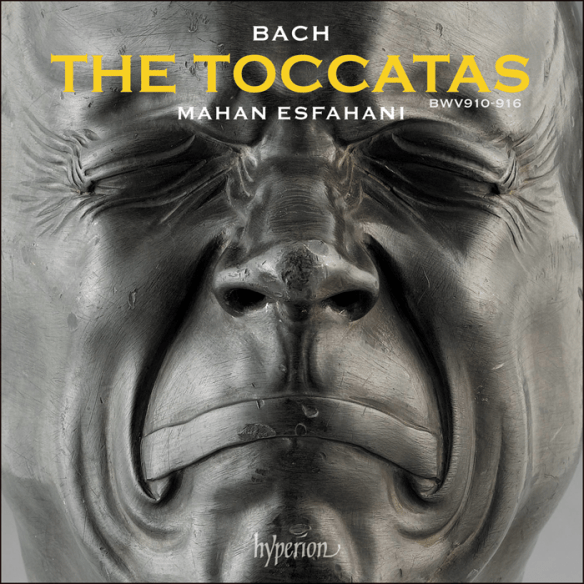
On record – Mahan Esfahani: J.S. Bach – Toccatas (Hyperion)

J.S. Bach
Toccata in F sharp minor BWV910
Toccata in C minor BWV911
Toccata in D major BWV912
Toccata in D minor BWV913
Toccata in E minor BWV914
Toccata in G minor BWV915
Toccata in G major BWV916

Mahan Esfahani (harpsichord)

Hyperion CDA 68244 [76’54”]

Recorded August 2019 at St. John the Baptist, Loughton, Essex

Producer Sébastian Chonion
Engineer David Hinitt

Written by Ben Hogwood

What’s the story?

Mahan Esfahani has been playing a lot of J.S. Bach lately. With a series of the composer’s complete keyboard works ongoing at the Wigmore Hall, and with a well-received account of the Goldberg Variations in the bag from his stint at Deutsche Grammophon, now would seem the ideal time to document his thoughts on some of Bach’s most extrovert and unpredictable works for harpsichord, the Toccatas.

What’s the music like?

Exuberant and even flamboyant. Those are two words you might not readily apply to Bach, certainly in the wrong performance, but this is the sort of recording to remind you that not only was Johann Sebastian a master of the more theoretical processes in music, he could write music of breathtaking originality too.

The Toccatas are the work of a young man looking to experiment and explore, and also to entertain. Esfahani really captures that spirit of freedom from the first to last notes, the Toccata in G major setting us down in a crumpled heap around 76 minutes later.

It helps to have the performer’s accompanying notes on the works, and how difficult it is to arrive at a scholarly direction on how they should be played. What matters as much is the performer’s input, and – as he acknowledges – the producer and engineer, to whom he expresses heartfelt thanks as his own ‘therapists’.

Does it all work?

Emphatically, yes. This feels like just the right stage in Esfahani’s career for him to tackle these works, and his response is stylish and reverent, outgoing too – so that the more overtly display-dominated items are real audience pleasers, and the telling pauses or slow passages are delivered with gravitas and great feeling.

For there is music of great theatre and occasion here. Presented in catalogue order, we begin with the Toccata in F sharp minor BWV910, which begins with a thrilling rush of the right hand, before dance figures take over. A stern central section leads to a rediscovery of its positive stance towards the end.

The Toccata in C minor BWV911 follows, its fugue deliberately paced to start with and then allowed to pick up its natural momentum. Esfahani, so assured in his playing, brings each part in with a firm inevitability as the closing pages approach before signing off emphatically.

The Toccata in D major BWV912 features some really impressive, florid passage work, while the D minor work, BWV813, feels like an answer with its stern, imposing contours. This work really springs forward in Esfahani’s hands around the 3:30 mark, before a superb, authoritative finish, with the pleasure of hearing the keys released at the end.

The instrument’s lower register really sings in the Toccata in E minor BWV914, notable for its bold lines, before an extremely descriptive episode that is so strongly characterised it feels like a scene from a play. When the big rush of counterpoint comes later, Esfahani again exerts close control.

The Toccata in G minor BWV915 starts with a sense of occasion, a cascade in the right hand before a nimble dance and a flourish, before the final Toccata in G major BWV916, a solo concerto in all but name. This has a celebratory air, its descending motif in clumps of chords rather like a peal of bells. Then a slow, thoughtful movement in E minor (the closest relative key of G) provides a reflective episode before a lively return home for an upbeat finale.

Complementing these seven impressive utterances are an ideal harpsichord sound and recording, the church chosen by Hyperion offering just the right amount of depth to the recorded sound, so we hear the clarity of Bach’s writing but also its ambitious scope.

Is it recommended?

Without hesitation. If you tend towards the organ works when listening to Bach played on the keyboard, this is just the disc to show you what you are missing on the harpsichord side of the equation.

Mahan Esfahani plays these works with formidable technique and with passion too, taking every opportunity to bring Bach’s flourishing works to life. What a cover, too!

Buy

For more information on this release and to purchase in multiple file formats, you can visit the Hyperion website

On Record – Various Artists: Sunny Side Up (Brownswood)

reviewed by Ben Hogwood

What’s the story?

After the huge success of last year’s documentation of young jazzers in London, We Out Here, Gilles Peterson’s Brownswood label up sticks to the other side of the world for a similarly themed presentation from Melbourne.

Sunny Side Up – as its name suggests – is a celebration of a scene free from musical constraints, happy to take its stimulus from soul, jazz or club culture as the label’s detailed notes proclaim.

What’s the music like?

As free as the preamble suggests it should be. The nine tracks were all recorded at The Grove, a studio housed in the northern district of Coburg, glued together by engineer Nick Herrera and musical director Silentjay.

Phil Stroud’s Banksia begins with shimmering textures bolstered by a dubby bass, before urgent swirls cut to low slung grooves in Dufresne’s Pick Up / Galaxy. Soft breathed sax and heady vocals work well in Kuzich’s There Is No Time, while Audrey Powne makes clever use of micro tones to up the tension for a trumpet solo in Bleeding Hearts.

Zeitgeist Freedom Energy Exchange use broken beats, drum fills, piano and flute for the energetic Powers 2 (The People), then Laneous’ Nice To See You brings a rush of positivity with a series of heady chord progressions and vocal couplets. Silentjay himself works a long melody over samba-infused beats to find Eternal / Internal Peace, while Horatio Luna’s The Wake-Up starts with dreamy, keyboard-led meandering but moves to smooth club grooves.

Finally Allysha Joy’s Orbit makes a powerful impact with its richly scored orchestration and soothing but heady vibes.

From all those descriptions you get an idea of the compilation’s open minded approach but also its careful planning and sequencing.

Does it all work?

Yes – a rich variety of talent that works well in sequence. The different approaches and musical styles are ideal for those looking for something a little different – and fans of the label’s Bubblers series will find plenty here to enjoy.

Is it recommended?

For sure. Brownswood have some serious talent on their hands here, and Sunny Side Up is its ideal platform. The musicians featured seem set for great things in the future if this is anything to go by.

Stream

Buy

On Record – House And Land – Across The Field (Thrill Jockey)

reviewed by Ben Hogwood

What’s the story?

House And Land are from North Carolina, and Across The Field is their second album. The duo – guitarist and instrumentalist Sarah Louise Henson and fiddle / banjo player Sally Anne Morgan – present traditional folk music recast into today’s world.

What’s the music like?

Deceptive. If you listen to the first minute or two of Across The Field it is easy to underestimate the emotions House And Land are capable of conveying, but by the time you get to the rippling guitar of Rainbow Mid Life’s Willows you will have fallen hook, line and sinker for the duo’s fresh faced vocals and imaginative instrumental responses.

That song in particular hits the sweetest spot of emotion, with Morgan’s double-stopped fiddle the perfect foil to Henson’s vocal and 12-string acoustic guitar. It is a rich tapestry of colours, but these orchestrations never get in the way of the song’s message.

House and Land “Across the Field” Album Trailer from Thrill Jockey Records on Vimeo.

The heart of their music is Appalachia, the duo creating their landscape with delicate shades and colours, but some of their music draws from across the Atlantic. Blacksmith shows the duo’s homage to the great Shirley Collins, a close harmony duet over a drone which is then dressed with glockenspiel. There follows a powerful instrumental track Carolina Lady, from past Madison resident Dillard Chandler, which features earthy guitar and Morgan’s fiddle rising through the textures as it takes on an improvised air.

Collins is again the source for the final Ca The Yowes, and here Henson’s alto recorder sets the evocative scene, while Morgan’s banjo shadows the vocals. It is a haunting yet curiously uplifting coda to the album.

Does it all work?

Across The Field is a powerful and deeply personal piece of work. It may be that the voices are on occasion too shrill for headphone listeners, but that’s more a question of the listener acquainting themselves with the tones than the singers needing to compromise. The songs themselves retain their traditional heart but updated for today are very emotive and winningly sung. The inventive and constantly rewarding instrumentation is a treat, always responsive to the substance of each song.

Is it recommended?

Yes, and I speak as very much an occasional listener to folk music. Across The Field inhabits a rarefied space few albums are able to reach.

Stream

Buy

Switched On – Georgia Anne Muldrow – VWETO II (Mello Music Group)

reviewed by Ben Hogwood

What’s the story?

VWETO II is the sequel to Georgia Anne Muldrow’s 2011 album. Like that release it is an instrumental piece of work, an intriguing melting pot of hip hop, jazz, R&B and soul. Its colourful artwork offers clues to the author’s inspiration and the mood of the album, for although it is largely down tempo VWETO II is positive in mood.

What’s the music like?

Subtly inventive. Nothing here is routine, but nor is it too challenging as Muldrow finds a really fertile ground between experimenting and producing really good, solid grooves. Often her rhythms are syncopated and this means they can stumble slightly, a practice used on first track Almost Trendy which actually ends up depicting a natural walk along the street.

This establishes the mood and tempo of the record, which is a lot of fun and always has something of interest. The enjoyable inventions with beats and colours include the wonky bass and general weirdness of Something Fun, the undulating piano and oblique chord progressions of Brokenfolks and the cool vibraphone and piano of Bass Attack Bap.

After the pleasingly brassy CV Jam Number 2, Emo Blues opens up darker hues, nicely led by its acoustic bass, and later on Mary Lou’s Motherboard explores the macabre side of Muldrow’s thinking.

Does it all work?

Yes – VWETO II is consistently rewarding. While it is a shame not to hear Muldrow’s memorable voice in full flow her rate of output means it will surely not be long before that happens again. In the meantime we have this set of irresistible instrumentals, which work as well on the morning after as they do on the night before.

Is it recommended?

Yes, wholeheartedly. The range of beats and colours on VWETO II is very strong and original, turning over stones aplenty in its quest for original voices and memorable grooves. In the course of the album Muldrow hits both of those goals repeatedly and with ease.

Stream

Buy

Switched On – Cocoon Compilation S (Cocoon)

Various Artists: Compilation S (Cocoon)

reviewed by Ben Hogwood

What’s the story?

Each year Cocoon release an additional ‘letter’ in their compilation series, which has incredibly reached its 20th instalment. Once again it is house music with a sound blend of experience and promise, presented in unmixed form. A dozen tracks with both eyes on the dancefloor.

What’s the music like?

As always with this series, consistency is the key, with quality intersections between house and techno – and a few big names delivering the goods.

Talaboman (John Talabot and Axel Boman) present one of the big draws in Big Room Anthemic Groovy Pounding Trance Dub Bomb. Music that delivers exactly what it promises! There is a superb track from Emmanuel Satie, Planet XXX offering a strong breakdown, while Mark Broom offers a lively, retrospective track with Jaded, its bell effects standing out. Edward’s End Days has a metallic edge, as does the more acidic Tering from Egbert, which brings a heady rush, but the one that burns brightest is Keep Changing Basslines from Dino Lenny. This is a brilliant collision of mood swings with the tag line ‘stay on the dancefloor’ the most memorable hook of the twelve.

Does it all work?

Yes, and in their 20th year it offers further proof of why Cocoon are at the top of their particular game. Sven Väth’s label has strength in depth, and a high quality threshold. Business as usual, in effect!

Is it recommended?

Yes – fans will know exactly what is in store here, a dozen tracks that push all the right dancefloor buttons. No need to hesitate for the converted or the new arrival.

Stream

Buy