Switched On – Haiku Salut: The General (Secret Name)

What’s the story?

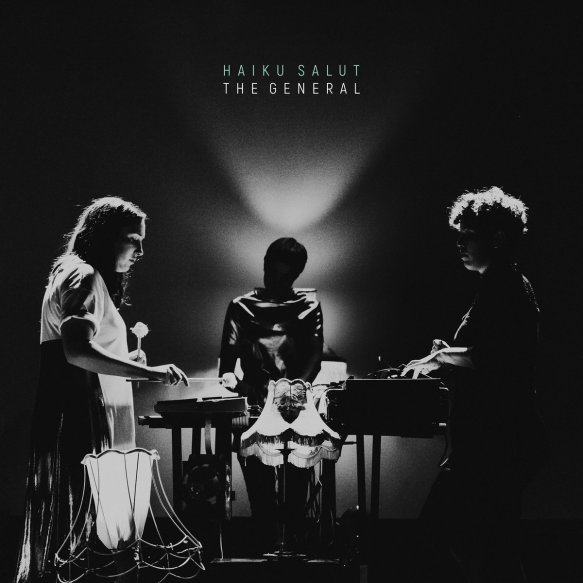
This is a really intriguing proposition, in which instrumental trio Haiku Salut are invited to score The General, the silent Buster Keaton film of 1926. The group have until now built their reputation with three intricate and intimate instrumental albums, all containing music that translates well to a memorable live experience of subtle imagination. This would seem to be an ideal opportunity for expansion, for the band to show their talent for the bigger screen. The soundtrack runs for the whole film, clocking in at an ambitious 79 minutes.

What’s the music like?

Much more varied than regular listeners might expect. That’s not a criticism of previous albums, more an observation that it is easy to mistakenly pigeon hole a band! If like me you had them down as pedalling intricate electronica, building on small melodic loops to more expansive effect, you would be pleased to note the number of different styles Haiku Salut naturally work in to the fibre of this record.

Initially the pairing of graceful piano and subtle electronics is familiar, and is typically effective, but the sighing motif in the main theme of Start has a sinister undertone and is unsettling. In the centre of the soundtrack, Cannon plays some brilliant sonic tricks with its massive reverb and a held drone chord, expanding the band’s sound considerably, while Train Steal produces big beats to go with the depiction of the crime itself.

This wide range of moods continues to Chopping Wood, where solemn keyboard chords intone like thoughtful brass, or Hide, where a four to the floor beat gives softly voiced energy. ‘Reunited’ conveys its emotion simply through piano, with a watery accompaniment, Firewood crackles with an energetic if subtle beat, while Obstructions has the friendly chatter of loops. The final number of the 23, Finish, returns us to the same outlook as the opening – but that slightly sinister undertone has still not gone away.

Does it all work?

Yes, and without the moving pictures there is still a strong narrative thread running through this music, which leaves a lasting impression. While the subtleties are still on show, Haiku Salut show really impressive ambition and a taste for bigger and more imaginative sounds. The potential is clearly there for the trio to score a lot more films in the future, given the thought and imagination applied here. Their style will continue to win a lot of friends through its melodic approach and interesting textures.

Is it recommended?

Yes. The General continues to impress in subsequent hearings, either in fragments or in a listen to the whole picture.

Stream

Buy

On record – Clare Hammond, Swedish Chamber Orchestra / Nicholas McGegan: Mysliveček: Complete Music for Keyboard (BIS)

Clare Hammond (piano), Swedish Chamber Orchestra / Nicholas McGegan

Josef Mysliveček (1737-1781)
Keyboard Concerto no.1 in B flat major (late 1770s)
Six Easy Divertimenti for Harpsichord or Piano-forte (1777)
Keyboard Concerto no.2 in F major (late 1770s)
Six Easy Lessons for the Harpsichord: Sonatas 1-6 (1780)

BIS BIS-2393 [74’22”]

Producer and Engineer Thore Brinkmann

Recorded March 2018 at the Örebro Concert Hall, Sweden

Written by Ben Hogwood

What’s the story?

Not many composers could claim to have influenced one of the greatest composers to have lived, but Il Boemo (The Bohemian) could do just that. Josef Mysliveček, to whom the nickname was applied, was a Czech composer of rare standing and a mentor to Mozart in the 1770s. He had a life of eyebrow-raising but ultimately tragic events, culminating with his death in great poverty in Rome in 1781, having nearly lost his nose a couple of years earlier to a botched operation.

Clare Hammond’s interview for this site puts more musical detail onto his fascinating tale. More importantly this disc for BIS serves notice of Mysliveček’s standing as an important musical figure and prodigiously talented composer. If you like Mozart, his music is a natural but essential step for further exploration.

What’s the music like?

Really enjoyable. The Piano Concerto no.1, where Hammond is joined by the Swedish Chamber Orchestra conducted by Nicholas McGegan, has a sparky personality, with plenty of vigour in its fast outer movements and elegance in the softly voiced central slow movement. There is an economy of thought, too – it finishes quickly with the minimum of fuss.

Clare Hammond clearly loves this music, and she plays with poise but also enjoys the instinctive nature of Mysliveček’s writing. The solo works are notable for their compressed construction, never threatening to outstay their welcome and on occasion producing unexpectedly dark undercurrents.

She is alive to these and handles the technical challenges really well. The Six Easy Divertimenti sound anything but unless they are in her hands! She makes the most of their tendencies to surprise, as in the mysterious pauses on some pretty exotic chords in the fifth piece.

The Piano Concerto no.2 has some notable syncopations in its first movement, as well as some adventurous harmonic diversions, before slipping into the minor key for a profound slow movement. Some of the music is contrary, staying away from big technical displays when you might expect them, but the third movement has a spring in its step nonetheless.

The Six Easy Lessons (again sounding pretty difficult!) bring parallels with the keyboard music of Domenico Scarlatti, and receive crisp and characterful performances. The second movement of the First Lesson reminds of the Czech composer’s tendency to spice up his melodies with chromatic movement, and this is one of many good tunes to be found throughout these spirited pieces.

Does it all work?

Yes. The structure of Mysliveček’s output from Hammond gives an ideally balanced disc, with the concertos complemented by the solo works. The clarity of her performance ensures it can be heard in the best possible light, and recording from the BIS engineering team is ideal.

Is it recommended?

Yes, and it fills a gap in the 18th century discography. Here is an important figure on whom the spotlight so rarely shines – and we are grateful to Hammond and McGegan for directing it to the right place.

Stream

Buy

You can buy this release directly from the BIS website

Switched On – GLOK: Dissident (Bytes)

What’s the story?

Ride’s Andy Bell has pulled together all his solo recordings to date under the GLOK alias. GLOK – the German word for ‘bell’ with a crucial letter missing – has been an undercover enterprise until now, an anonymous project brought to life by Bytes chief Joe Clay, a Ride fan himself.

As this story suggests Bell is modest about his side project, but now he has been ‘outed’ as a one-man band, expect to hear a lot more of this music as the year progresses, even allowing for a new Ride album due in August.

What’s the music like?

Dissident unwittingly taps into the success of recent TV series such as Deutschland 83 and 86, where the pleasures have been as much about the music as they have been the plot. Yet as Bell looks back to the 1980s and further, he brings in the influence of Krautrock luminaries such as Can, Neu! And Bauhaus. He does this without compromising his own skills as a guitarist and his credentials as a much-loved ‘shoegaze’ producer.

Keith Tenniswood has remastered the whole album, which unfolds at a very natural pace. The title track clocks in at nearly 20 minutes, but is one of those productions you can completely lose yourself in, the main riff turning away in the background while running through a series of filters, the drum beats receding and then coming back with extra depth.

Bell expands his outlook with the subtle groove of Kolokoi (the Russian word for ‘bell’) and the airy textures and firm kick drum of Pulsing, which has a tempo suitable for dub-infused house. Cloud Cover adds a reminder of his first known discipline as a guitarist – a nice acoustic meander here – while the closing Exit Through The Skylight introduces chattering beats and a more processed feel.

Does it all work?

Yes. Bell has equal headspace for the past and the present, setting the mood perfectly with tracks that are suitable for both ends of the day. ‘Dissident’ on its own shows he can master big structures with durable ideas, while the shorter tracks teem with melodies, subtle humour and a refreshing lack of pretence. The album repays both foreground and background listening, preferably in a hotter climate!

Is it recommended?

Yes. Ride fans will love it, but the recommendation extends to anyone with a love of instrumental music and synthesizers.

Stream

Buy

On record: Leila Josefowicz, Soloists, Finnish RSO / Hannu Lintu – Zimmermann: Violin Concerto & Die Soldaten (Ondine)


Leila Josefowicz (violin); Anu Komsi, Jeni Packalen (sopranos), Hilary Summers (contralto), Peter Tantsits (tenor), Ville Rusanen (baritone), Juha Uusitalo (bass), Finnish Radio Symphony Orchestra / Hannu Lintu

Zimmermann
Violin Concerto (1950)
Die Soldaten – Vocal Symphony (1963)
Photoptosis (1968)

Ondine ODE1325-2 [73’45”]

Producer Laura Heikinheimo
Engineers Enno Mäemets, Anna-Kaisa Kamppi (Photoptosis), Jari Rantakaulio (Violin Concerto), Antti Pohjola (Die Soldaten)

Recorded June 2016 (Photoptosis), May 2018 (Violin Concerto), live in September 2018 (Die Soldaten) at Helsinki Music Centre, Helsinki

What’s the story?

A belated though most welcome addition to those releases marking the centenary of the birth of Bernd Alois Zimmermann (1918-70), the Cologne-based composer whose singular music has gradually gained in recognition during the almost half-century since his untimely demise.

What’s the music like?

One of Zimmermann’s earliest successes, the Violin Concerto emerged out of a Violin Sonata from two years earlier. Most distinctive is the central Fantasia, whose rapt intensity (notably in its closing pages) is thrown into relief by the movements either side – a vehement opening Sonata with antecedents in Hindemith and Hartmann, then a final Rondo whose element of rumba duly adds to the heady abandon. Leila Josefowicz (who gave a memorable account of the Sonata at Wigmore Hall – reviewed by Arcana here) touches all the expressive bases for this impressive reading.

It was with his opera Die Soldaten that Zimmermann fully came into his own as a composer. Its gestation (1957-65) was a protracted one, during which the dramatic concept was radically overhauled without diluting the music’s emotive power. Intended to demonstrate the latter’s practicability (along the lines of Berg’s Lulu Symphony a quarter-century before), this Vocal Symphony comprises scenes from the first two of four acts in which the ultimately tragic fate of merchant’s daughter Marie at the hands of a brutal military class is set in motion.

Among the six soloists, Anu Komsi and Hilary Summers stand out for their security in the acrobatic vocal lines, while without eschewing more tangibly human expression. Yet it is in the purely orchestral episodes where Zimmermann’s increasing radicalism comes fully into focus – the Preludio with its melange of competing textures over the remorseless tread of drums; then the Intermezzo during Act Two – the simultaneity of action onstage mirrored by a layering of musical events with Zimmermann’s trait of timbral contrast rendered at its most visceral.

By the time of the ‘prelude for large orchestra’ that is Photoptosis, the composer’s idiom had found even greater power and concentration – evident in the textural stratification of its outer sections as they build from fugitive unease to assaultive violence. Between them, an interlude of half-remembered quotations and allusions ranges from the provocative to the inane – as if to confirm that remorseless ‘closing-in’ of the musical past on that of the present, and thereby denying any purpose for a creative future such as overcame Zimmermann in his final years.

Does it all work?

Yes, and not least when the performances are as perceptive as they are here. Both the Violin Concerto and Photoptosis have been recorded several times, not least by Thomas Zehetmair (ECM) and Karl-Heinz Steffens (Capriccio), though these new accounts would now be first choices. The Soldaten-Symphony has had no previous commercial recording (live readings by Hiroshi Wakasugi in 1978 and Peter Hirsch in 2014 can be heard on YouTube), making this an essential addition to the Zimmermann discography aside from its artistic excellence.

Is it recommended?

Indeed. Hannu Lintu draws a committed response from his Finnish Radio Symphony players, recorded with unstinting clarity and the programme afforded context by a thoughtful booklet note from Mark Berry. An impressive release with which to mark Zimmermann’s centenary.

Further listening

You can listen to this new release on Spotify:

Further reading

You can read more about this release on the Ondine website

On record: BBC Scottish Symphony Orchestra / Martyn Brabbins – Sir Michael Tippett: Symphonies nos. 3 & 4; Symphony in B flat (Hyperion)


Sir Michael Tippett
Symphony no.3 (1970-2)
Symphony no.4 (1976-7)
Symphony in B flat major (1932-3)

Rachel Nicholls (soprano, Symphony no.3), BBC Scottish Symphony Orchestra / Martyn Brabbins

Hyperion CDA68231/2 [two discs, 120’40”]

Producer Andrew Keener
Engineer Simon Eadon
Recorded 3-5 February 2018 at City Halls, Glasgow

Reviewed by Richard Whitehouse

What’s the story?

Martyn Brabbins and the BBC Scottish Symphony Orchestra follow their release of Sir Michael Tippett’s first two symphonies (reviewed here on Arcana) with his succeeding two such pieces, along with a first recording for the Symphony in B flat originally intended to be his ‘Opus 1’.

What’s the music like?

Commenced in the wake of Beethoven’s bicentenary, the Symphony no.3 is Tippett’s most ambitious in concept – its four movements falling into two parts such as interrogate without abandoning the formal archetype. Brabbins emphasizes its initial contrast between stasis and dynamism, in the process highlighting unexpected detail, though without the visceral impact of Sir Colin Davis (Decca) or Richard Hickox (Chandos). The Lento is night-music of profound inwardness tellingly realized here, albeit eschewing the ultimate intensity at the climax of the central string threnody. The scherzo that launches Part Two again predicates clarity ahead of impetus: the ensuing blues numbers – respectively soulful, capricious and plaintive – seem a little low-key, but this is no fault of Rachel Nicholls; her singing more accurate than Heather Harper (Davis) and far more insightful than Faye Robinson (Hickox) here or in that extended scena where Tippett confronts then embraces the Beethovenian tenet of compassion. Brabbins rightly ensures its final antagonism between discord and pathos is left hanging in the balance.

Although yet to regain its former eminence, the Symphony no.4 is still the most frequently heard of this cycle and here brings out the most in Brabbins’s Tippettian instincts. Expansive without becoming sluggish and considered without being turgid, it sustains the expressive arc of this single-movement design with no mean conviction – not least in the eruptive climax at its centre which forms this work’s formal and emotional fulcrum, emphasizing its centrifugal rather than centripetal trajectory (unlike Sibelius Seven, to which the present work is often if erroneously compared). Closer in its unforced momentum to Tippett’s account (NMC) than that by Georg Solti (Decca) who premiered it, Brabbins never undersells the music’s forceful persona for all that its introspective qualities are primary. One aspect of this ostensible ‘birth to death’ piece he realizes more convincingly than any predecessor is the human breathing at key moments in its progress – achieved by the subtle deployment of recent technology so the closing bars, in particular, convey an evanescing of life which the composer surely intended.

It is a fair jolt stylistically to go from here into the Symphony in B flat. This latter had at least three hearings and was several-times revised until being discarded in 1944. Received wisdom suggests a reliance on Sibelius but though its formal processes are overtly Sibelian, its sound is much less so if not yet that of Tippett. The first movement is an eventful yet gauche sonata design – its themes intensified in a fusion of development and reprise then framed by a limpid introduction that returns sombrely at the close. What follows is less a slow movement than an intermezzo in which modal and chromatic elements alternate to ambiguous effect, then a final rondo of pronounced folk inflection that builds toward an apotheosis whose hopeful optimism speaks touchingly of the ‘confidence of youth’. Brabbins finds a committed response in music where lambent harmonies and tricky if untypical rhythms go some way to offsetting any lack of melodic profile. Whatever else, the composer’s trustees were right to sanction revival of a piece that offers fascinating insight into Tippett’s creativity before it began falling into place.

Does it all work?

As on the previous release, Brabbins secures excellent playing from the BBCSSO that does not always render Tippett’s exacting rhythms with quite the clarity or impetus required. Not that this undermines too seriously the idiomatic feel of these readings, abetted by the depth and perspective of the recorded sound. At its best (during parts of the Third and most of the Fourth Symphonies), it would certainly be first choice for those coming to the pieces afresh; still, the door remains open for a Tippett cycle that gets to the heart of this inspiring music.

Is it recommended?

Yes, but for the Third Symphony seek out a live 1976 account by Raymond Leppard and the BBC Symphony, with Josephine Barstow a magisterial soprano (BBC Classics). Notes are by Oliver Soden, whose Tippett biography has recently been published (Weidenfeld & Nicolson).

You can read more about this release on the Hyperion website, while for more on Sir Michael Tippett, visit the Tippett foundation. The BBC Scottish Symphony Orchestra can be found here, while more on Martyn Brabbins can be found here