
by Ben Hogwood
“I had never heard anyone deal with music or language in that way, turning language into music that had political content. I was completely floored by it” – sculptor and artist Richard Serra on hearing Come Out for the first timeq (from Steve Reich: Conversations)
Background
“I had to like open the bruise up and let some of the bruise blood come out to show them.”
As Reich details in his Writings on Music, this is the voice of Daniel Hamm…one of the six boys arrested for murder during the Harlem riots of 1964. After a beating taken in Harlem’s 28th precinct police station, Hamm and the boys were about to be “cleaned up” – but the police were only taking those with visible bleeding. Since Hamm had no open bleeding, he proceeded to open a bruise on his leg to ensure he was taken to hospital. This article on Pitchfork provides valuable political background to the piece.
Reich took a loop of the words quoted above, “recorded on both channels. First the loop is heard in unison with itself. As it begins to go out of phrase, a slowly increasing reverberation is heard. This gradually passes into a canon or round for two voices, then four voices and finally eight.”
Listen
Thoughts
After an eye-opening encounter with It’s Gonna Rain, there is less of a surprise element when listening to Come Out. And yet its impact is even more profound, sinister even, within a piece that once again stands as a blueprint for future sonic innovations. The protest made by Reich’s treatment of the musical speech elements is unswerving, and uncomfortable, with an urgency to the work demanding immediate action.
After an exposition of Hamm’s material, the speech works its way into the tight canon Reich describes, the process anticipating the work of acts such as Cabaret Voltaire a decade or two later. Looking further ahead, as the canons get more complicated, the breakdowns of big, euphoric rave numbers from the late 1980s onwards are clearly set out. Landmark tracks such as M|A|R|R|S’ Pump Up The Volume are also anticipated. If you put Reich’s manipulations to a techno beat now, few people would be any the wiser!
Yet considering the original music made in 1966, how stark this is – and what a powerful statement it makes, its relevance running all the way through to Black Lives Matter and beyond.
Quotes / Legacy
Stephen Sondheim, from Conversations… “What you do quite often, particularly with the speech pieces, is that by looping them and working with them, sounds come out of them that aren’t part of the actual language. And what happens is the listener’s ear mixes the sound. That’s exactly, of course, what (Georges) Seurat was doing with colour. He was making the eye mix the colour instead of making it on the palette. I thought that’s another thing you and I have in common, is that you have the ear-mix and Seurat has the eye-mix.”
Recordings
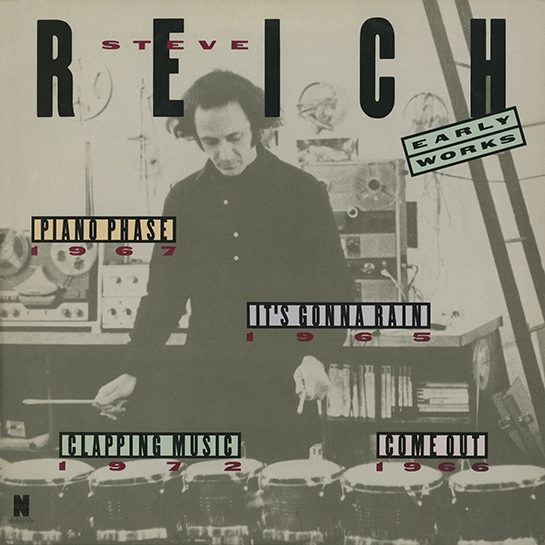
Again, just the one – part of the 1987 collection Early Works (Nonesuch)
Also written / released in 1966 Ennio Morricone The Good, the Bad and the Ugly; Stravinsky Requiem Canticles; The Beach Boys Pet Sounds
Next up: Melodica (1966)
Published post no.3,048 – Thursday 15 October 2026

