NightjaR is described as ‘the nom-de-plume and smudged rainbow constellation of collaborative copy-and-paste sound-wrangling and hip-hop from Jimi Goodwin’. The Goodwin in question is the frontman and singer of Doves, whose considerable popularity as a guitar-led band over the last two decades has rather masked the fact that their members are pretty prolific in their solo concerns.
For Mala Leche Goodwin has used his contact book and social media to book an intriguing set of collaborators, picking hip hop artists that he likes. These include an intriguing pairing of UK (SonnyJim) and US (Quelle Chris), Pan Amsterdam, Homeboy Sandman, Sleaford Mods’ Jason Williamson, Pruven, Vast Aire & Burgu all together on one track, and Guilty Simpson.
What’s the music like?
This is a big melting pot of styles, put together in a way that feels low budget and home made but which makes for an expansive and logical concept album, as Goodwin explores a huge variety of beats, thoughts and moods.
On occasion the anger spills over, like the observation from Pruven, Vast Aire and Burgu on Piano Heights that “Joni Mitchell never lied…and Boris Johnson’s a motherfucking Russian spy.” Jason Williamson, never one to hold back, delivers a cameo of typically descriptive storytelling in Blood Red Dead. Baby Don’t explores a compelling chemistry between SonnyJim and Quelle Chris, while Mala Leche takes a ‘leak’ at the news with roughed up chimes from Big Ben and Guilty Simpson in tow.
Meanwhile Sylvester sounds like an offcut from a detective movie, and Smashing Little Boat casts the musical net far and wide in its magical mystery tour. Finally Glove Department, the second cut to feature Pan Amsterdam, is a mere eight-and-a-half minutes of jazz-infused beatmaking and storytelling.
Does it all work?
Pretty much. Some of the loose ends are pretty ragged but to be honest it is part of the album’s lasting appeal, that it keeps some rough edges and a patchwork feel.
Is it recommended?
It is, enthusiastically. Goodwin’s album rails with anger against some elements of today’s society, but makes sure to have a lot of fun while doing so. With grooves aplenty, and fresh lyrical insights to match, it should go far.
For fans of… The Streets, Audio Bullys, Jamie T, Plan B, Sleaford Mods
George Lloyd Aubade (1971)a; Eventide (1989)a; The Road Through Samarkand (1995)a; The Lily-leaf and the Grasshopper (1972)b; The Transformation of that Naked Ape (1972, rev. 1987)c; Lullaby ‘Intercom Baby’ (1975, arr. 1987)c; An African Shrine (1966)c; The Aggressive Fishes (1972)c; St. Antony and the Beggar (1972)c. The Road Through Samarkand (1972)c
Kathryn Stott (b), Martin Roscoe (c) (pianos) Anthony Goldstone and Caroline Clemmow (a) (piano duo)
Lyrita SRCD.2423 (two discs, 70’16” and 77’55”) Producers bcHoward Devon, aAnthony Goldstone and Caroline Clemmow with George Lloyd Engineers bcHoward Devon, aAnthony Goldstone and Caroline Clemmow with George Lloyd
Recorded b2 June 1987 at Henry Wood Hall, London; c18 & 19 June 1987 at St. Barnabas, North Finchley, London; a4 & 5 November 1996 at St. John the Baptist, Aldeburgh
Reviewed by Richard Whitehouse
What’s the story?
Lyrita continues its ‘Signature Edition’ of music composed (and conducted) by George Lloyd with his works for one and two pianos, admirably performed here by a line-up of international stature including those pianists who recorded his concertos for this instrument (SRCD.2421).
What’s the music like?
As Lloyd himself recounted, training as a violinist rather prejudiced his writing for the piano, despite his wife’s prompting. It was hearing the young John Ogdon in the early 1960s that led to Scapegoat, this first piano concerto being followed by three others and several other works for piano over the ensuing decade. For all their diversity of inspiration, they have in common a determination to avoid wanton virtuosity in favour of a technical precision as never inhibits their composer’s aim to realize his musical intentions – whether idiomatically or individually.
This is evident in Lloyd’s earliest and arguably finest work for solo piano, An African Shrine. Written for Ogdon, who played it regularly and recorded in his 1970 EMI anthology Pianistic Philosophies, this takes in several sections – the vividness of whose expressive contrasts are balanced by the seamlessness with which they merge into an unbroken formal continuity. As an evocation of mindless violence, it is highly affecting and its cohesion as a one-movement ‘sonata’ makes for an indispensable addition to British piano music during the post-war era.
Lloyd followed this with the even more expansive Aubade, composed for Ogdon and his wife Brenda Lucas. Described as a ‘fantasy’, its eight sections outline a dream-like scenario which takes in charcoal burners, tin soldiers, a song then dance for two lovers, a medley of bells and chants, then moths; framed by an Introduction and Finale as set the scene thematically then sum it up unerringly. Enticingly realized for its medium if too diffuse overall, this would likely enjoy wider exposure if it were shortened and orchestrated as the ballet it cries out to become.
The year 1972 saw Lloyd immersed in the solo piano. Among these shorter pieces, The Road Through Samarkand is the most directly appealing with its amused if never sarcastic send-up of Krishna adherents in central London with many taking the journey from Calais to Calcutta, though whether the outcome is one of utopianism or disillusionment is left unanswered by the peremptory close. St Anthony and the Beggar is a direct corollary to the Biblical parable, here with an outcome of demonstrable catharsis, while The Aggressive Fishes evokes the allure yet danger of certain tropical species in music alternately atmospheric and ominous. Inspired by a citing from the banks of the Avon, The Lily-Leaf and the Grasshopper is a subtler interplay of contrasts – the insect’s quizzical demeanour emerging out of then back into a rapt waterscape.
The most substantial of these later pieces is The Transformation of the Naked Ape. Taking its cue from Lloyd’s consideration of the essential difference between animals and humans, these six movements (each longer than the last) deftly outline a progression from external to internal properties – hence from Her Hair, via those of Tongue, Eyes, Brain and Mind, to Her Soul – though any inference of increasing spirituality is scotched by the capricious final number of this highly diverting sequence, in which pleasure and provocation have been pointedly elided.
Lloyd wrote little more for piano in either medium, though his arrangement of the violin-and-piano Intercom Baby 12 years on as Lullaby turned one of his most ingratiating shorter pieces into this ideal encore – wistful and playful by turns. Drawing on a carol written when he was just ten (then used extensively in his opera John Socman), Eventide emerges as a fantasy on this tune such as adumbrates a journey from innocence to experience of deceptive simplicity and has enjoyed greater exposure in a no less effective arrangement for brass band two years on. Finally, The Road Through Samarkand makes its reappearance arranged for two pianos – the inherent virtuosity of its writing more equably realized in this medium if, as is suggested here, those elements of struggle and assumed repose more potently realized by the original.
Does it all work?
Almost always. There is a sense of this music (rather its composer) fighting against precedent as regards idiomatic piano writing, for all that the outcome feels never less than effective and often much more so. The performances are highly sympathetic and often inspired – particularly Kathryn Stott with her contributions, though Martin Roscoe affords no mean insight and lucid pianism with his larger selection. The duo of Anthony Goldstone (much missed) and Caroline Clemmow is heard to impressive effect, but sound here could do with rather greater definition.
Is it recommended?
It is. Paul Conway’s annotations feature many pertinent observations, while the solo items are recorded with ideal clarity and spaciousness. Not the first port-of-call for those new to George Lloyd, maybe, but a collection where several items warrant inclusion in the modern repertoire.
Mahler Symphony no.1 in D major (1887-8, rev, 1898) Mahler arr. Schoenberg Lieder eines fahrenden Gesellen (1884-5, arr. 1920) Mahler Blumine (1884, rev. 1889)
Colorado MahlerFest 195269164287 [79’02”] Live performances on 18 May 2019 (Lieder eines fahrenden Gesellen), 19 May 2019, Macky Auditorium, Boulder, Colorado
Reviewed by Richard Whitehouse
What’s the story?
Recorded representation of the current MahlerFest era continues to grow with this release on CD (previously available as a download) of the First Symphony with related pieces, given at its 32nd edition and what was the fourth such event with Kenneth Woods as artistic director.
What’s the music like?
What was doubtless intended to inaugurate a chronological traversal began in 2019 with this performance of the First Symphony, the first to be heard in the critical edition published that year by Breitkopf & Härtel. Woods has written about this extensively at his website [Ken on the Great Mahler Debate of 2019 | Kenneth Woods – conductor]: suffice to add the numerous corrections and textural amendments enhance that fuller and more stratified orchestral sound such as Mahler favoured in 1899 when compared with earlier versions from 1889 and 1893.
Interpretatively, this performance is a satisfying one with few overt surprises but no obvious idiosyncrasies. Any lack of atmosphere during the first movement’s mesmeric introduction is offset by its easeful if never uneventful continuation – thus a subtly differentiated exposition repeat, then stealthy marshalling of expressive tension to a coda whose joyousness is rightly kept within limits. The scherzo is robust yet propulsive and the trio even finer in its unforced suavity, while the funeral march never over-inflects its Klezmer elements unfolding from the ominous and ironic, via gentle repose, to a closing fatalism. Woods succeeds better than most in holding together the unwieldy finale, allowing due emotional space for the recall of initial ideas that is its sure highlight, and the ensuing apotheosis lacks nothing in blazing affirmation.
Included as an encore is Blumine, the ‘romance’ salvaged from earlier incidental music which formed part of this symphony until being jettisoned in 1894 – here emerging with its elegance and pathos devoid of wanton sentiment. The actual concert continued with Korngold’s Violin Concerto then Beethoven’s Third Leonora Overture reorchestrated by Mahler, but the present release opens with a performance from the previous day’s concert of Lieder eines fahrenden Gesellen. This is heard in a chamber arrangement as supervised by Schoenberg for the 1920 season of his Society for Private Musical Performances, its textural transparency underlining the soulfulness then buoyancy of its opening two songs. If the (over-wrought?) drama of the third song is under-projected, the wistful radiance of its successor comes across unimpeded.
Does it all work?
Indeed it does, overall. Mahler symphonies may have been performed and recorded by a host of international orchestras, but that of the Colorado MahlerFest lacks nothing in commitment or tenacity; any lack of atmosphere and finesse owes more to the clear if confined acoustic of Macky Auditorium than absence of quiet playing or overriding of dynamics. Joshua DeVane is a thoughtful exponent of the song-cycle, at his best in the restrained inwardness of its outer numbers, while the ensemble drawn from the CMO makes a persuasive case for this reduction.
Is it recommended?
It is. The orchestral playing may have grown in conviction with each new instalment, but this is a notable statement of intent for MahlerFest under Woods’s direction. That the 33rd edition had to be scaled down then presented online had little effect on the resolve of those involved.
Buy
For further purchase options, visit the MahlerFest website – and for more information on the festival itself, click here. Click on the names for further information on conductor Kenneth Woods and soloist Joshua DeVane
George Lloyd Royal Parks (1982/4) Diversions on a Bass Theme (1986) Evening Song (1989. arr. 1991) H.M.S. Trinidad (1941, arr. 1991) English Heritage (1987) A Miniature Triptych (1981)
John Foster Black Dyke Mills Band / David King; Equale Brass [John Wallace and John Miller (trumpets), Michael Thompson (horn), Peter Bassano (trombone), John Jenkins (tuba) (A Miniature Triptych)]
Lyrita SRCD.425 [75’52”] Producers Paul Hindmarsh with George Lloyd, Engineer Harold Barnes
Recorded 5 & 6 July 1991 at Town Hall, Dewsbury at Wyastone Leys, June 1987 at Monmouth (A Miniature Triptych)
Reviewed by Richard Whitehouse
What’s the story?
Lyrita continues its ‘Signature Edition’ devoted to the music of – while mostly conducted by –George Lloyd with this collection of almost all his output for brass instruments and a further reminder that, however belated his commitment to a specific medium, it was then in earnest.
What’s the music like?
Despite (or perhaps because of) his experience as bandsman in the Royal Marines during the Second World War, Lloyd turned to this medium relatively late on and then obliquely via the brass quintet. Written for members of the Philharmonia Orchestra, A Miniature Triptych has a depth hinted at by the movement-titles – the plangency of its preludial Lost followed by the more emotionally varied Searching, then the mounting resolve of Found sees this sequence to a decisive but not wholly affirmative close. An intriguing addition to an appealing medium.
The brass band was at the forefront of Lloyd’s thinking over the next decade, starting with the suite Royal Parks composed for the European Brass Band Championships. Here the airborne evocation of Dawn Flight, and the genial animation of Holidays, frame an In Memoriam written for orchestra two years earlier to commemorate the bandsman murdered in a bombing at Regent’s Park by the Provisional IRA – making it one of the composer’s most personal and affecting statements. English Heritage was written for the Historic Buildings and Monuments Commission and later used as test-piece for the National Brass Band Championships of Great Britain – its technical virtuosity matched by formal dexterity, with the spontaneity of Fanfare allayed by the repose of Largo and Finale combining these motifs into a rousing peroration.
Composed just before the latter work, Diversions on a Bass Theme ranks among Lloyd’s most ingenious pieces in any medium – the range of ideas emerging in its earlier stages functioning as variations in search of a theme as duly emerges with not a little laconic humour toward the close. The remaining items are both arrangements – Evening Song being that of the two-piano work Eventide two years earlier, its luminous elaboration of a carol composed by the ten-year -old Lloyd sounding arguably even more idiomatic and atmospheric when rendered by brass. By contrast, the march HMS Trinidad was arranged half-a-century after being composed for orchestra – and it is a measure of Lloyd’s prowess that he throws the ‘march and trio’ format off-kilter by juxtaposing their varied reappearances to such unexpected and appealing effect.
Does it all work?
It does. As Paul Conway surmises in his informative notes, any reticence on Lloyd’s part in writing for brass band likely derives from his wartime traumas – which does not make those works he eventually wrote any less idiomatic or distinctive. Not least as David King gets so laudable a response from the then John Foster Black Dyke Mills Band; also, Equale Brass in a recording seemingly left ‘in the can’ the past four decades. As with composers such as John McCabe, Edward Gregson or John Pickard, one overlooks Lloyd’s band music at one’s peril.
Is it recommended?
It is. Note that the original release predates Lloyd’s last such work – 1993’s King’s Messenger given by Eikanger-Bjorsvik Musikklag on Doyen (DOYCD047), with 1987’s Forest of Arden for wind band recorded by City of London Wind Ensemble on LDR Records (LDRCD1001).
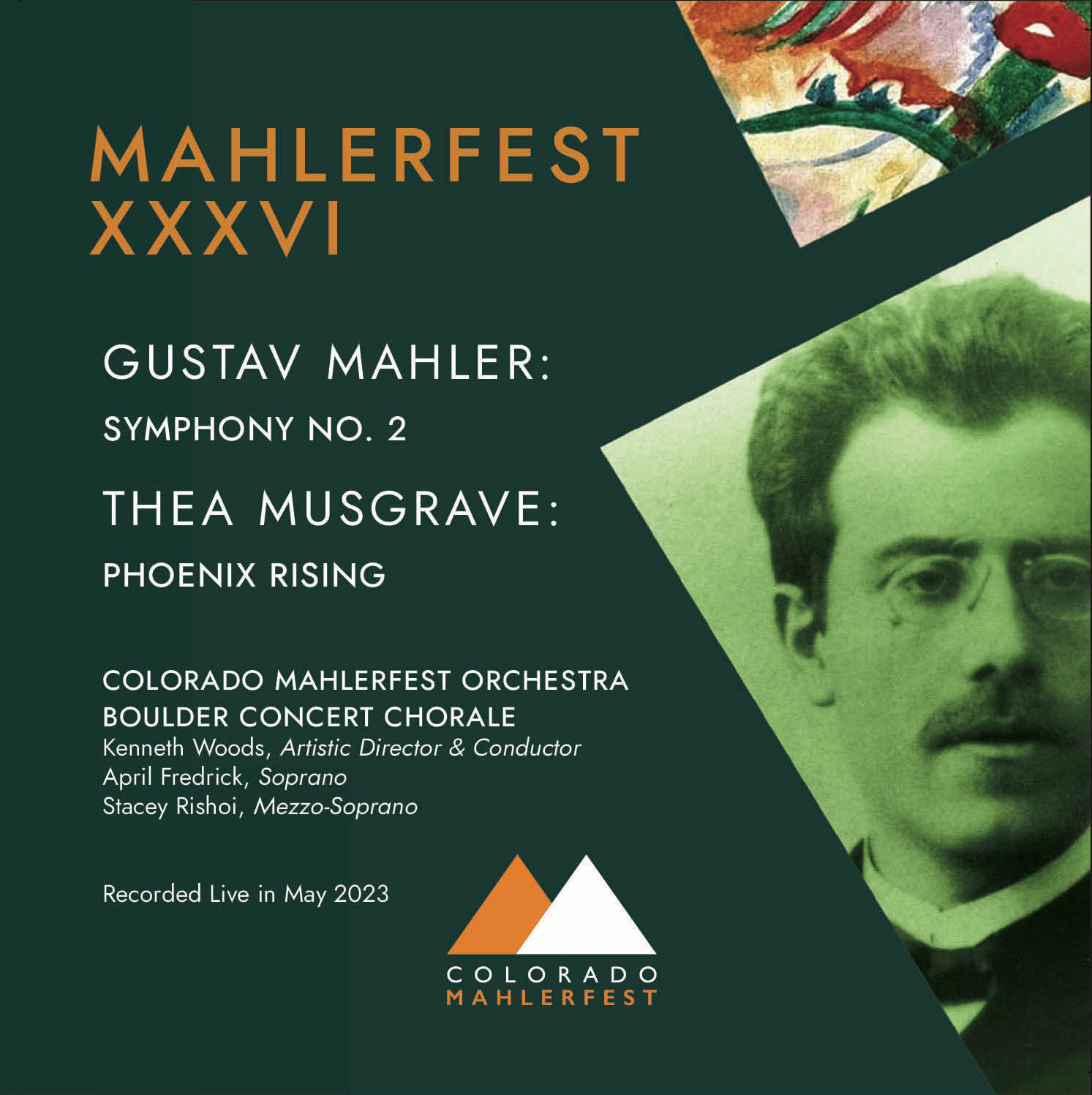
Musgrave Phoenix Rising (1997) Mahler Symphony no.2 in C minor ‘Resurrection’ (1888-94)
Colorado MahlerFest 195269301194 [two discs, 104’02”] Live performances on 21 May 2023, Macky Auditorium, Boulder, Colorado
Reviewed by Richard Whitehouse
What’s the story?
Last year’s edition of MahlerFest continued its latest, not-quite-chronological traversal of the symphonies with the Second – appropriately coupled on this release (as in the concert) with a work such as considers ‘resurrection’ from a very different while no less relevant perspective.
What’s the music like?
Six years in the writing, Mahler’s Second Symphony fairly laid the basis for his reputation as a composer at its Berlin premiere in 1895. It is a measure of this performance that it captures something of the shock or excitement no doubt in evidence back then, not least in an opening movement with Kenneth Woods notably more interventionist tempo-wise as compared to that of the Third Symphony a year before. What emerges is imposing but never diffuse, at its most gripping in that baleful lead-in to a development whose terseness duly accentuates its impact, with the pathos of the second subject on its reprise making the coda’s sardonic recessional the more acute. After which, the second movement feels the more enticing through its alternation of warm sentiment with capering animation while heading to a conclusion of beatific repose.
There is no lack of incident in a scherzo whose glancing irony is leavened yet not lessened by its trios, the first as soulful with its lilting trumpets as the second is ominous in its import; but not before Stacey Rishoi has characterized the Urlicht setting with rapt inwardness. What to say about the finale other than, while this may not be the most overwhelming take on its vast fresco, it is matched by relatively few as regards an organic unfolding that sees the movement whole. Its contrasting elements here fuse with unforced cohesion to a fervent rendering of the chorale episode then on to a surging Toten-marsch – the kinetic momentum carried through to a methodical reprise of earlier ideas, then a rendering of Klopstock’s text (much altered by the composer) as only grows in intensity before the majestic affirmation of its closing pages.
As the ‘first half’, Thea Musgrave’s Phoenix Rising provides an ideal complement. The much esteemed (latterly more in the US than the UK) nonagenarian has written often for orchestra, but seldom with such immediacy than in a piece whose formal and expressive trajectory feels nothing if not symphonic in its progress. Comparison with the 2016 studio recording by BBC National Orchestra of Wales and William Boughton (Lyrita SRCD372) confirms that, passing tentativeness in ensemble excepted, Woods’s reading demonstrably makes more of this aspect.
Does it all work?
Yes, pretty much always. As on previous releases in this ongoing Mahler cycle, the Colorado MahlerFest Orchestra punches appreciably above its weight in music which should never fall prey to wanton virtuosity. The unyielding acoustic of Macky Auditorium is less an issue than before, with the finale’s offstage brass adeptly managed. April Fredrick brings her customary eloquence to bear on this movement, and the Boulder Concert Chorale – as prepared by Vicki Burrichter – rises to the occasion with notable fervency as this work reaches an ecstatic close.
Is it recommended?
It is. There have been too many superfluous Mahler cycles, but this traversal is shaping up as one of the most worthwhile and more than the memento of a memorable occasion. Hopefully such standards will be maintained by the Sixth Symphony as part of next year’s 37th edition.




 Arcana.fm