On Record – April Fredrick, Thomas Humphreys, ESO Chorus, English Symphony Orchestra / Kenneth Woods: Sawyers – Mayflower on the Sea of Time (Nimbus)

April Fredrick (soprano), Thomas Humphreys (baritone), ESO Chorus, English Symphony Orchestra / Kenneth Woods

Sawyers Mayflower on the Sea of Time (2018)

Nimbus NI6439 [58’57’’]
Producer and Engineer Tim Burton Engineer Matthew Swan
Live recording, 17 June 2023 at Worcester Cathedral

Reviewed by Richard Whitehouse

What’s the story?

Philip SawyersMayflower on the Sea of Time was to have been launched with performances in Worcester Cathedral four years ago, but the pandemic inevitably derailed this. Happily, the composer’s largest work so far was finally heard last June in the venue as originally intended.

What’s the music like?

Commissioned to mark the 400th anniversary of the sailing of the Mayflower from Leiden to Plymouth, this is an oratorio in concept but equally a choral symphony in design. Its libretto, mainly by the artist Philip Groom, features set-pieces for various Old and New World figures largely for soprano and baritone alongside summative passages for chorus. Self-deprecating about his literary abilities, Groom yet achieves a viable balance between the characterization of individuals as part of a continuous and cumulative trajectory relating that of ‘the journey’.

There are four continuous parts: Persecution and Journey, a sonata design which informs the Pilgrims’ flight from religious persecution and their decision to cross the Atlantic; Arrival in the New World, a slow movement charting their arrival then tentative initial interaction with native cultures; Survival and Making our Community, a brief scherzo in which the Pilgrims’ industriousness and idealism all too soon becomes its own justification; and Our New World, a sizable rondo-finale whose looking to the future is framed by choruses of growing fervour.

Sawyers’ writing for the chorus is expert and resourceful, not least when this elides between a depiction of Pilgrims or Natives with that of a more abstract commentary, while solo sections allow his lyrical impulse free reign – not least towards the end of the second and fourth parts, closing with luminously ecstatic choruses that accentuate an essentially affirmative message. Worth noting is the poignant incorporation of a motet by Thomas Tomkins into its fourth part, which also sets lines by Walt Whitman with a tangible understanding of its expressive syntax.

Does it all work?

Almost always, and not least owing to the persuasiveness of this performance. April Frederick and Thomas Humphreys (the latter after a slightly strained start) can hardly be faulted in their commitment or insight, while the new-founded ESO Chorus evinces a power and immediacy abetted by Worcester Cathedral’s spacious acoustic to belie its modest forces. The ESO gives its collective all throughout, conveying the textural intricacy and the emotional heft of music whose overall formal integration is fully conveyed through Kenneth Woods’ astute direction.

The initial performances might have fallen through, but the associated educational project did go ahead and enabled several hundred youngsters to experience the piece at first hand. This is worth remembering given Mayflower should have a ready appeal for those who know little of the historical background or, indeed, contemporary music. That it can be rendered by around two-dozen singers ought to commend it to enterprising choral societies able to muster the 45 musicians, especially when Sawyers’ writing for both is often exacting but always practicable.

Is it recommended?

Very much so. The sound captures the resonance of its acoustic with no loss of definition, and there are detailed notes by composer, author and conductor. A pity the actual text could not be included, but that this can be scanned via a QR code is another incentive for younger listeners.

Listen & Buy

You can listen to sample tracks and purchase on the Wyastone website. For further information on the artists, click on the names for more on April Fredrick, Thomas Humphreys, the English Symphony Orchestra and their conductor Kenneth Woods. Click on the name for more on composer Philip Sawyers

Published post no.2,157 – Tuesday 23 April 2024
On Record – Jeremiah Fraites: Piano Piano 2 (Mercury KX / Dualtone Records)

by Ben Hogwood

What’s the story?

The Lumineers co-founder Jeremiah Fraites has poured a great deal of his soul into Piano Piano 2 – which, as its name suggests, is his second piano album. Whereas its predecessor was a set of relatively minimal compositions, the sequel has added textures, including strings, guitar, percussion and widescreen textural effects.

Extra Life, one of the single releases, was released in the wake of Fraites losing his father Joel, and has taken on a great deal of personal significance.

What’s the music like?

Fraites certainly keeps the music flowing on this album, using a number of different pianos as he strives for different colours and effects. Perhaps as a result of that Piano Piano 2 does have a greater reliance on texture rather than melody, and it is an outpouring of emotions, a stripping away of layers to get to the core.

Yet ironically it is when Fraites reduces the textures that the music has greatest impact. Pluck is an effective and thoughtful meditation, while the descriptive Snow Falling gives that lovely impression of being indoors, nose pressed up to the window pane, while the snow falls outside.

Extra Life is indeed a powerful track, with a beautiful viola solo to counter the piano work. The album finishes with a guest vocal from Gregory Alan Isakov, a version of Radiohead’s No Surprises that adds a good deal of extra music to the simple dressing of the original. The gospel-like harmonies at the end do rather swamp the vocal, though Isakov does hold his poise.

Does it all work?

Largely – though on occasion it does feel as though too much is going on, the listener swimming against a particularly strong current. Fraites, however, digs deep emotionally in his piano playing, and that comes across to the listener.

Is it recommended?

If you liked the soundtrack Michael Nyman wrote for The Piano, Fraites’s music is a logical next step – for he plays with similar energy and feeling. Yet it is when he takes a step back that the listener can feel closer to his true musical soul.

For fans of… Michael Nyman, Erik Satie, Ludovico Einaudi

Listen and Buy

Published post no.2,149 – Monday 15 April 2024

On Record – Ride: Interplay (Wichita / PIAS)

by Ben Hogwood

What’s the story?

The second coming of Ride is now officially longer than the first. This is a statement that seemed very unlikely when they first split in 1996, but Mark Gardener, Andy Bell, Loz Colbert and Steve Queralt now appear to be together for keeps.

Interplay is the third album of their second incarnation, and the band have been candid about how difficult it was to record – yet such openness now appears to be one of their key strengths.

What’s the music like?

This is a very strong album, and could be the record that see Ride cross over to being a genuine rock band as well as acknowledged shoegaze royalty. Songs like the opening Peace Sign are key to this, being a full-blown anthem with winsome, jangly guitar lines and a great chorus to boot.

Gardener’s voice sounds great, more versatile than before. Monaco finds an edge to the voice reminiscent of The The, while Last Frontier has a softer side that sounds more familiar, tipping towards New Order or Electronic. What fans might not have expected is the barely concealed anger powering the centre of the album. Portland Rocks gives an indication of this, but I Came To See The Wreck goes the whole hog, the standout track of the album. “Rage, body and soul” is the takeaway lyrical couplet of an all-consuming song.

Elsewhere, Midnight Rider is a groovy throwback, while Sunrise Chaser brings brighter colours to the table. The band marry electronics and guitars convincingly, and production is excellent.

Does it all work?

It does. Melodic, meaningful and with songs that stick.

Is it recommended?

It certainly is – with Interplay Ride have made the album of their career so far.

For fans of… Slowdive, My Bloody Valentine, Spiritualized

Listen and Buy

Published post no.2,141 – Sunday 7 April 2024

On Record – Julia Holter: Something In The Room She Moves (Domino)

by Ben Hogwood

What’s the story?

The title of Julia Holter’s sixth album appears to be a play on words from The Beatles’ song Sometimes…but there is no reason to suggest that in the accompanying press release.

Instead the title could be more a reference to motherhood, and the birth of her daughter – as well as the presence of loved ones lost. What is certainly present is Holter’s physical connection with music, and a sense of being in the moment – rather than looking back in a dreamlike state as some of her work has done. As she says, “It’s about being in the passionate state of making something: being in that moment, and what is that moment?”

What’s the music like?

Something…has an experimental feel, and does on occasional feel like a dream sequence, experienced out of the body. This being Holter, there is melody at its core – and a strong inner power, experienced on the heady opening trio. Sun Girl, These Morning and the title track are rich in colour, Holter’s soft vocal matched by dappled textures, an agile flute part and – on the latter – a moving saxophone solo.

Most striking of all is the song Spinning, which starts like a misfiring record turntable, but establishes itself as a highly distinctive track. The backing is a kind of oblique waltz, the foil for Holter’s vocal, a mixture of powerful singing and conversational asides.

Ocean is both beatless and bottomless, as its title suggests it should be – with upper melodic lines bringing a new age feel to the surface. Talking To The Whisper has similar depths but with beats added – and connections that feel primal, in and around the flurries of flute and percussion. Who Brings Me offers calm and contemplation, closing thoughts in the company of clarinet and rich synthesized sound.

Does it all work?

It does – but because this is complex music, several listens are recommended to get the most from Holter’s music, revealing more of its extraordinary layers.

Is it recommended?

It is – a characteristically intense addition to Julia Holter’s output, music that makes strong physical and emotional connections with its listener.

For fans of… Julianna Barwick, Laurel Halo, Joanna Newsom

Listen and Buy

Published post no.2,140 – Saturday 6 April 2024

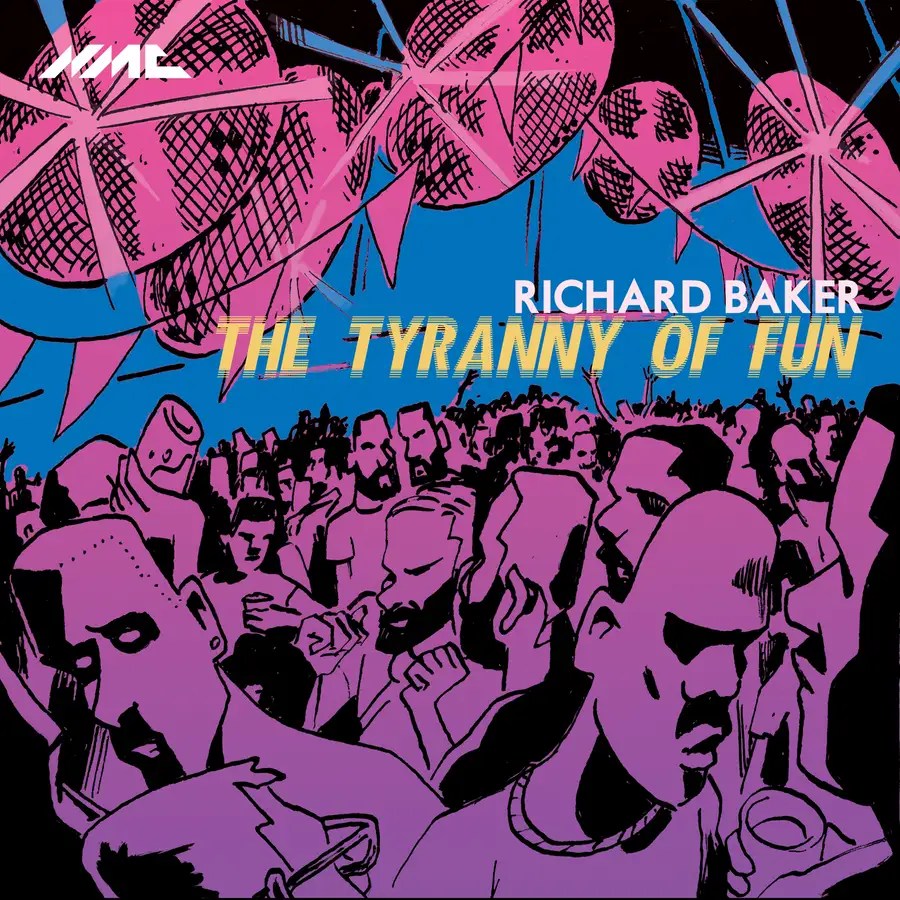
On Record – Richard Baker: The Tyranny of Fun (NMC Recordings)

Richard Baker
Crank (1994)a
Motet II (2020)b
The Tyranny of Fun (2012)c
Angelus (2004)d
Learning to Fly (1999)e
To Keep a True Lent (2001)f
Hommagesquisse (2008)g
Hwyl fawr ffriniau (2016, rev. 2020)h

hMelinda Maxwell (oboe); eOliver Janes (clarinet); bNye Parry (live electronics); aRichard Baker (diatonic music box); dThree Strange Angels (Richard Benjafield and Chris Brannick, percussion); fChoir of King’s College, Cambridge / Stephen Cleobury; bCHROMA Ensemble / Richard Baker; ceghBirmingham Contemporary Music Group / Finnigan Downie Dear

NMC D275 [60’37’’]
Producers/Engineers David Lefeber, fBen Collingwood
Recorded d19 April 2004 at St Giles’s Church, London; f29 February 2004 at Chapel of King’s College, Cambridge; b 4 August 2022 at Menuhin Hall, Cobham; cegh5 & 6 November 2022 at the CBSO Centre, Birmingham; a10 December 2023 at Parry-Williams Building, University of Aberystwyth

Reviewed by Richard Whitehouse

What’s the story?

NMC adds to its invaluable Debut Discs series with this timely release devoted to the music of Richard Baker, expertly realized by ensembles and musicians with which has been associated – not least the Birmingham Contemporary Music Group – whether as composer or conductor.

What’s the music like?

Prominent on the new music scene for over a quarter-century, Baker (b.1972) is equally well regarded as a conductor – notably for the German premiere of Gerald Barry’s The Triumph of Beauty and Deceit or the world premiere of Philip Venable’s 4.48 Psychosis – but he has built a select catalogue (published by Composers Edition), the variety of which is duly in evidence. BCMG has been central to his creative and executive work, so it is good to see this ensemble featured here – not least in two pieces commissioned as part of its Sound Investment scheme.

Baker was among numerous UK figures who undertook their postgraduate studies with Louis Andriessen, Crank being a whimsically oblique tribute in its unfolding of multiple pulses over a consistent tempo. The Dutch composer is also an influence behind Learning to Fly as takes its cue from those novels by Paul Auster for this compact concerto; the tonal range of basset clarinet tellingly to the fore in the eventful interplay of ‘Boisterous’, the subdued acceptance of ‘Somnolent’ and renewed animation of ‘Suddenly awake’ with its epiphanic closing phase.

Choral music features sparingly in Baker’s output, but his motet To Keep a True Lent captures Robert Herrick’s message unerringly. Hardly less affecting is his eliding between anxiety and repose in the dextrous percussion duo Angelus, while the punningly entitled Hommagesquisse serves as a laconic tribute to Pierre Boulez in alluding to his own music and that of others he advocated as conductor. Most substantial work here, The Tyranny of Fun draws on the notion of entertainment as distraction – hence escape – from the ambiguity of existence, along with a homage to Ravel (and Edgar Allen Poe) via Balanchine across two sections whose respective emergence and subsidence, then gradually accumulating energy outline a trajectory in which any tendency towards self-gratification is curtailed by vicissitudes of an encroaching reality.

The other pieces reflect aspects of Wales where Baker now lives. What translates as Goodbye Friends draws Edwin Christy’s song into a resourceful tribute, while Motet II makes reference to Welsh culture ‘then and now’ across six aphoristic movements understated yet provocative.

Does it all work?

Yes, inasmuch as this collection confirms the distinctiveness of Baker’s musical idiom across three decades of his composing. The recordings prove as assured as might be expected given these are artists with whom he has often collaborated, Oliver Janes taking time out as principal clarinettist of City of Birmingham Symphony Orchestra to demonstrate his prowess with the basset instrument, and Melinda Maxwell underlining why she has long been among the UK’s leading oboists. Gratifying too that a reading by the late Stephen Cleobury could be included.

Is it recommended?

Indeed, and those acquiring this release should be encouraged to investigate other of Baker’s works available from NMC – notably his breakthrough piece Los Rabanos (NMCD076), or his four diverse contributions to that label’s extensive download project Digital Discoveries.

Listen & Buy

To explore purchase options, visit the NMC Recordings website – and click on Richard Baker for his own website. Meanwhile for more on the performers, click on the names – Melinda Maxwell, Oliver James, Richard Benjafield, Chris Brannick, Nye Parry, King’s College Choir, Stephen Cleobury, Finnigan Downie Dear, CHROMA and Birmingham Contemporary Music Group

Published post no.2,130 – Wednesday 27 March 2024