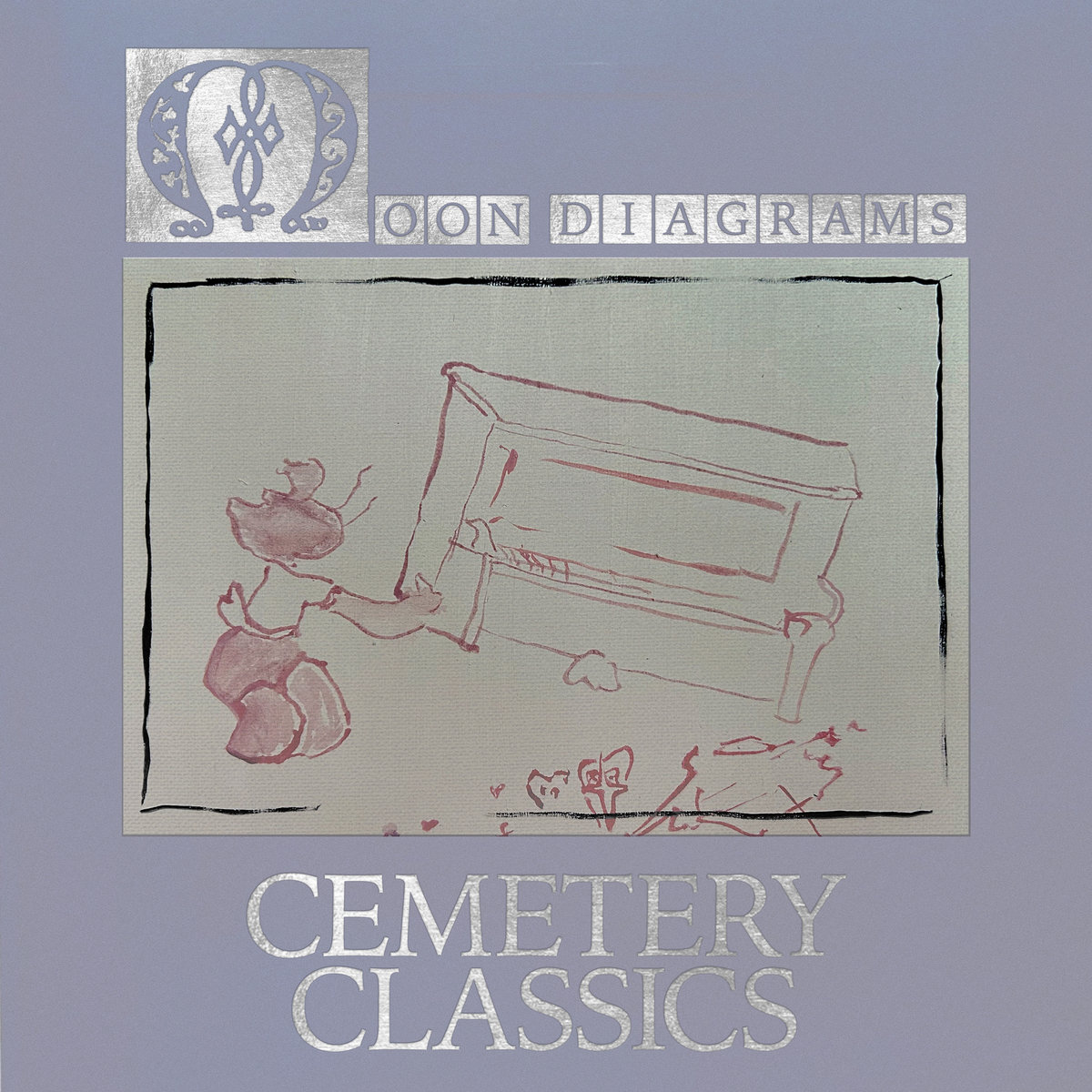
Moon Diagrams is the solo project of Deerhunter drummer Moses Archeluta – and Cemetery Classics is his second release, seven years after the acclaimed Lifetime Of Love, also on Sonic Cathedral.
Intriguingly, Moses’ description of the album is that “It’s about finding out your arms are too short to box with God…the inverse of a desert island disc – a graveyard disc. Songs to take into the afterlife.”
Cemetery Classics features guitar from Josh Diamond (Gang Gang Dance) and Patrick Flegel, along with vocals from Anastasia Coope – and, strikingly, keyboards and drum programming from James Ford.
What’s the music like?
The title may imply a gallows humour, but there is some dead good music here from Archeluta, and as Cemetery Classics progresses it delivers a bunch of excellent grooves and tableaus that vary from dark to uplifting.
On occasion his work resembles that of Andrew Weatherall, especially in the murmured vocals and smoky beat of Brand New Effie. The languid guitar and breezy mood of NRG hints at much sunnier climes, while Big Ref and Fifteen Shows At One time present irresistibly groovy music.
Listen To Me and Fragment Rock are compelling, widescreen grooves with more than a hint of dub, the latter featuring some disorientating brass and boomy, bassy vocals.
Does it all work?
It does. On occasion Archeluta’s work resembles Animal Collective or an outtake from an Adrian Sherwood session, but he can turn his work to so many styles, all of which knit together beautifully here.
Is it recommended?
It is, enthusiastically. One of those albums that impresses on first listen but gets you in a musical and emotional hold in the next few encounters. One of the sleeper albums of the year so far.
For fans of… Animal Collective, Andrew Weatherall, Adrian Sherwood
BBC Scottish Symphony Orchestra / Martyn Brabbins (Birthday Variations); Helsinki Philharmonic Orchestra / Pekka Kuusisto (Symphony)
Various Pictured Within: Birthday Variations for M.C.B. (2019) Jaakko Kuusisto (comp. Pekka Kuusisto & Eskola) Symphony Op.39 (2020-21)
BIS 2747 [66’32”] Producers Andrew Trinick (Variations), Robert Suff (Symphony) Engineers Graeme Taylor (Variations), Enno Mäemets (Symphony) Live recordings, 13 August 2019 at Royal Albert Hall, London (Variations); 8 December 2022 at Music Centre, Helsinki
Reviewed by Richard Whitehouse
What’s the story?
The BIS label issues one of the most fascinating among recent releases, one that juxtaposes a latter-day equivalent to Elgar’s Enigma Variations with a posthumously completed symphony by one of Finland’s leading conductors which now becomes a tribute to his untimely passing.
What’s the music like?
It was clearly a great idea that the BBC commission a piece to mark Martyn Brabbins’s 60th birthday, featuring 14 composers with whom this stylistically most wide-ranging of current British conductors has been associated. The outcome is Pictured Within: Birthday Variations for M.C.B. – each composer having provided a variation on the ‘anonymous’ theme for what here becomes an inverse take on Elgarian procedure in the latter’s Variations on an Original Theme; a work whose ground-plan also furnishes the formal framework of the present piece.
It is worth considering the ways in which these composers seem either inhibited or liberated by their placing (determined beforehand by Brabbins) within the overall scheme. Given this theme – understated to a fault – yields its potential more from the harmonic then melodic or rhythmic angle, the most successful tend to make a virtue of such constraints: thus the ‘Tact 60’ of Variation I finds Dai Fujikura hinting guardedly at ‘C.A.E.’. David Sawer capriciously conjures ‘H.D.S-P.’, while Sally Beamish offers a deftly ironic parallel to ‘R.B.T’ and Colin Matthews rumbustiously complements ‘W.M.B.’ Iris ter Schiphorst captures the pensiveness if not the geniality of ‘R.P.A.’, whereas violist-turned-composer Brett Dean proves a natural fit for the undulating poise of ‘Ysobel’ and Win Henderickx evokes ‘Troyte’ with real gusto.
His ruminative Variation VII finds Richard Blackford emulating more the connection with a country house than ‘W.N.’, while Harrison Birtwistle throws caution to the wind in a darkly inward contrast to ‘Nimrod’, and ‘Sixty Salutations’ finds Judith Weir in an engaging take on the halting charms of ‘Dorabella’. Gavin Bryars rouses himself to unexpected activity in his reading of ‘G.R.S.’, whereas Kalevi Aho is more suited to the sombre eloquence of ‘B.G.N.’ and Anthony Payne ably plumbs the inherent mysteries of ‘***’. John Pickard then takes on the daunting challenge of ‘E.D.U.’ in The Art of Beginning – the mingling of portentousness and humour appearing to make light of its Longfellow association, but whose organ-capped apotheosis confirms real appreciation of the ‘right ending’ as constituting an art unto itself.
The coupling is as unexpected as it proves apposite. Remembered as a notable violinist and a versatile conductor, Jaakko Kuusisto (1974-2022) turned increasingly to composition and, at his untimely death through brain cancer, had planned a symphony for Osmo Vänskä and the Minnesota Orchestra. Acting on behalf of his widow, his younger brother Pekka and copyist Jari Eskola realized this piece from several minutes of extant fragments such that Kuusisto’s Symphony takes its place as the last statement by one who ostensibly had much more to give.
Playing just over 25 minutes, the work falls into two separate movements. Shorter and more outwardly cohesive, the first of these emerges as imperceptibly as it evanesces – taking in a tersely rhythmic central episode, then a warmly expressive melody with more than a hint of American post-Minimalism. Almost twice as long, the Lento seems more discursive but no less absorbing – picking up where its predecessor left off as it builds to impulsive climaxes, separated by an eloquent span derived from a chorale-like theme. Nothing, though, prepares one for the ending – a sequence of quietly interlocking ostinato patterns, evidently inspired by light signals beamed in the Gulf of Finland and underpinned by undulating timpani. The effect is haunting and unworldly but, for these very qualities, wholly fitting as a conclusion.
Does it all work?
Pretty much always. Those expecting an Elgarian ‘re-run’ may be disconcerted by Pictured Within, but this only serves to reinforce the stylistic autonomy and variety of the composers involved (three of whom sadly no longer with us) in what is a tribute to Brabbins’s acumen for involving them in the first instance. Quirky and compelling, the Kuusisto is appreciably more than a labour of love on behalf of those who brought about its completion: both works deserving revival for their intrinsic merits rather than commemorating a particular occasion.
Is it recommended?
Absolutely. These live performances (that of Pictures Within being that of the premiere) have come up well as presented here, while there are detailed notes on each piece by John Pickard and Jaani Länsiö. This fascinating release more than justifies itself musically and artistically.
Orchestre National de France / Cristian Măcelaru with Choeur de Radio France (Symphony no.3)
Enescu 2 Romanian Rhapsodies Op.11: no.1 in A major, no.2 in D major (1901) Symphony no.1 in E flat major Op. 13 (1905) Symphony no.2 in A major Op. 17 (1912-14) Symphony no.3 in C major Op. 21 (1916-18, rev. 1920)
DG 4865505 [three discs, 2h42m24s] Producer Vincent Villetard Engineer Yves Baudry Recorded September 2022 (Symphony no.1, Rhapsody no.2) June (Symphony no.2, Rhapsody no.1) and July 2023 (Symphony no.3) in Auditorium de Radio France, Paris
Reviewed by Richard Whitehouse
What’s the story?
Deutsche Grammophon continues its survey of those symphonic cycles ‘less well trod’ with this collection of the three numbered symphonies which Enescu completed, performed by the Orchestre National de France and its music director these past four seasons Cristian Măcelaru.
What’s the music like?
Although symphonies were a preoccupation of Enescu over almost 50 years, his reputation in the genre rests on those written during the earlier phase of his maturity. Numerous cycles have appeared that feature Romanian forces, but only three from elsewhere – Lawrence Foster with orchestras in Monte Carlo and Lyon (EMI / Warner), Gennady Rozhdestvensky with the BBC Philharmonic Orchestra (Chandos) and Hannu Lintu with the Tampere Philharmonic (Ondine). Măcelaru thus enters a select but not uncompetitive field where his recordings generally hold their own.
Relatively compact as to its formal dimensions, the First Symphony gives a good overview of the relative strengths and weaknesses in Măcelaru’s approach. The initial movement is vividly launched with its proclamatory summons, but an increasing loss of focus means the climactic lead-in to the reprise is undersold and the coda lacks decisiveness. The slow movement finds the ONF woodwind at its most felicitous, though the beatific central span is more persuasively realized than the inward ambiguity on either side, while the finale seems more convincing in its purposeful opening than towards its close – when what should be among the most thrilling perorations in the symphonic literature of this period sounds almost offhand. Often performed in its early years, this is a work that could yet find its way back into the orchestral repertoire.
By contrast, the Second Symphony was a failure at its 1915 premiere then went unheard until six years after the composer’s death. Strauss replaces Berlioz as the primary influence, albeit with a fastidious instrumentation to which the ONF players do justice. That said, Măcelaru is no more successful than most others in maintaining momentum across the expansive opening Allegro, so that any impetus has dissipated well before the development unsuccessfully tries to regain it. Akin to a series of variations on a theme that the clarinet never quite defines, the central Andante is eloquently rendered while the finale’s martial introduction has the requisite stealthiness. Yet the Allegro fails to sustain itself to the most opulent of Enescu’s apotheoses, not least because orchestral sound lacks the weight and visceral force necessary in this music.
Composed during Romania’s torrid involvement in the First World War, the Third Symphony is among Enescu’s greatest achievements and the highlight of Măcelaru’s cycle. He paces the initial Moderato such that its questing and rhetorical elements are held in persuasive accord -building to a resplendent culmination from where the central Vivace surges forth; its alternate ebullience and ambivalence propelled intently towards a shattering climax which, as with the sinister coda, is seamlessly integrated into this movement overall. Never lacking for repose, the final Lento unfolds with intuitive if tangible poise – Choeur de Radio France effortlessly absorbed into a diaphanous music whose closing stages radiate an almost metaphysical aura. Whether or not Dante-esque as to its inspiration, this affords a transcendence rare in any era.
A pity no Enescu cycle has yet included the Fourth and Fifth Symphonies which, as realized in the 1990s by Pascal Bentoiu, make a logical and necessary continuation of his symphonic odyssey (they have been recorded by Peter Ruzicka for CPO). A pity too that, instead of the Third Orchestral Suite or the symphonic poem Vox Maris, Măcelaru opted for the ubiquitous Romanian Rhapsodies. The Second of these is more appealing here, for all that the fervency toward its centre and pathos at its close are under-projected, while the First is rushed early on and underwhelming thereafter. No match, then, for a host of previous readings – among these, Antal Doráti with the London Symphony (Mercury) and, especially, Constantin Silvestri with the Czech Philharmonic (Supraphon) retain their innate potency after more than six decades.
Does it all work?
Swings and roundabouts. In the context of those cycles mentioned earlier, Măcelaru’s take on the Third Symphony ranks with the best – but, in the First, Lintu or Foster and, in the Second, Foster are to be preferred. The quality of playing cannot be denied, and if the recording lacks a degree of definition and impact in more demonstrative passages, it presents this orchestra to advantage. Rob Cowan essays a personable booklet note, but to claim that these symphonies ‘‘…emerge more as extended tone poems clothed in symphonic dress’’ is simply not the case.
Is it recommended?
Yes, taken overall. Enescu’s symphonies are still on the periphery of the orchestral repertoire, so making the undoubted advocacy a high-profile conductor such as Măcelaru gives them the more admirable. Hopefully he will be continuing his exploration of a singular musical vision.
Open Symmetry is the first release on Erased Tapes from New York-based composer Tristan Perich.
As the commentary for the album describes, ‘Open Symmetry pares the ensemble down to just three musicians playing the resonant metal bars of three vibraphone accompanied with a glistening ensemble of 20 speakers, each playing their own separate musical part of the composition.”
Open Symmetry was the result of a meet-up in 2014 between Perich and Ensemble 0‘s Stéphane Garin, who commissioned the piece. Writing for three vibraphone and 1-bit electronics, Perich soon realised it would be a large-scale piece, and the piece occupied him until its premiere in 2019. This is the first recording.
What’s the music like?
Hypnotic is an oft-used word in musical descriptions, but it applies perfectly to the effect this epic piece has on its listener.
Perich’s treble-rich writing creates a rarefied atmosphere, and as the scope of the piece becomes clear there is a sense of assurance, the listener able to kick back and enjoy the piece on two levels.
The first and most immediate level is the short term, and the energetic loops Perich packs together for the vibraphones. Then, as the sections unfold, there is a long-term contentment, the music progressing naturally through each stage without losing any of its momentum.
After a bright introduction, Section 2 is where the pulsing qualities of the music really take hold, before Section 3 opens out beautifully into oscillating figures. Section 4 pulses with warmth and light, initially slow but ultimately powering through. Section 5 becomes like a shower of silvery rain, before Section 6 adopts a more percussive profile of chimes.
A buildup of energy ensues, emphatically released in Section 7 with a thrilling flurry of staccato chords that power to an ecstatic finish.
Does it all work?
It does. Perich writes with impressive conviction and creates vivid colours through motifs that dance in the half light.
Is it recommended?
Yes, enthusiastically. This is a highly impressive achievement, a substantial piece of minimalist music that is both original and effective. Like a long session of bell ringing, Open Symmetry will leave its listeners transfixed.
For fans of… Philip Glass, Steve Reich, Terry Riley
Matthew Bourne returns to first principles, with his first solo piano album since the 2017 release Isotach.
The press release reveals that there are, however, some restrictions around the recording of the album, “born from an off-hand comment by one of Matthew Bourne’s confidants. His instruction, “Do not delete,” provided Bourne with a commission of sorts, an ideal restriction to work within. Everything on the album was given a chance to shine in the studio, to be worked on amongst the freedom of that no deletion diktat – new inspirations now lie beside deep-mined remembrances. Cello and Dulcitone have been added sparingly for colour, but this is Bourne playing for his own enjoyment. Intimate. Reserved even. The real Matthew Bourne?”
What’s the music like?
There is a stillness about Matthew Bourne’s playing on this album that proves to be rather moving. Every note is carefully considered and weighted, and delivered in a conversational manner that makes the listener feel they are the only person in the room with him.
The titles give this away too, personal reflections like To Francesca, Dissemble (for Brian Irvine), Only When It Is (In Memoriam Bill Kinghorn) and Dedicated To You, Because You Were Listening (In Memoriam Keith Tippett) The first of these uses rich cello and crystalline Dulcitone beautifully to complement its lightly questioning phrases. The Bill Kinghorn and Keith Tippett tributes are stately, the latter with a mournful, tolling motif that gathers power before subsiding to near silence.
By contrast The Mirror And Its Fragments has an eerie undertone, with low cello again in the mix.
Does it all work?
It does – being a completely unforced way of making music. The emphasis is on communication of feelings and meanings more than anything else, with the result that the ‘less is more’ approach winds hands down.
Is it recommended?
It is. While Matthew Bourne’s exploits on the big screen should be encouraged, and his more experimental workings with keyboards and other instrumental groups, it is great to hear him go back to where it all began. With new insights, this is a piano-led album to savour.
For fans of… Yann Tiersen, Dustin O’Halloran, Zbigniew Preiser