
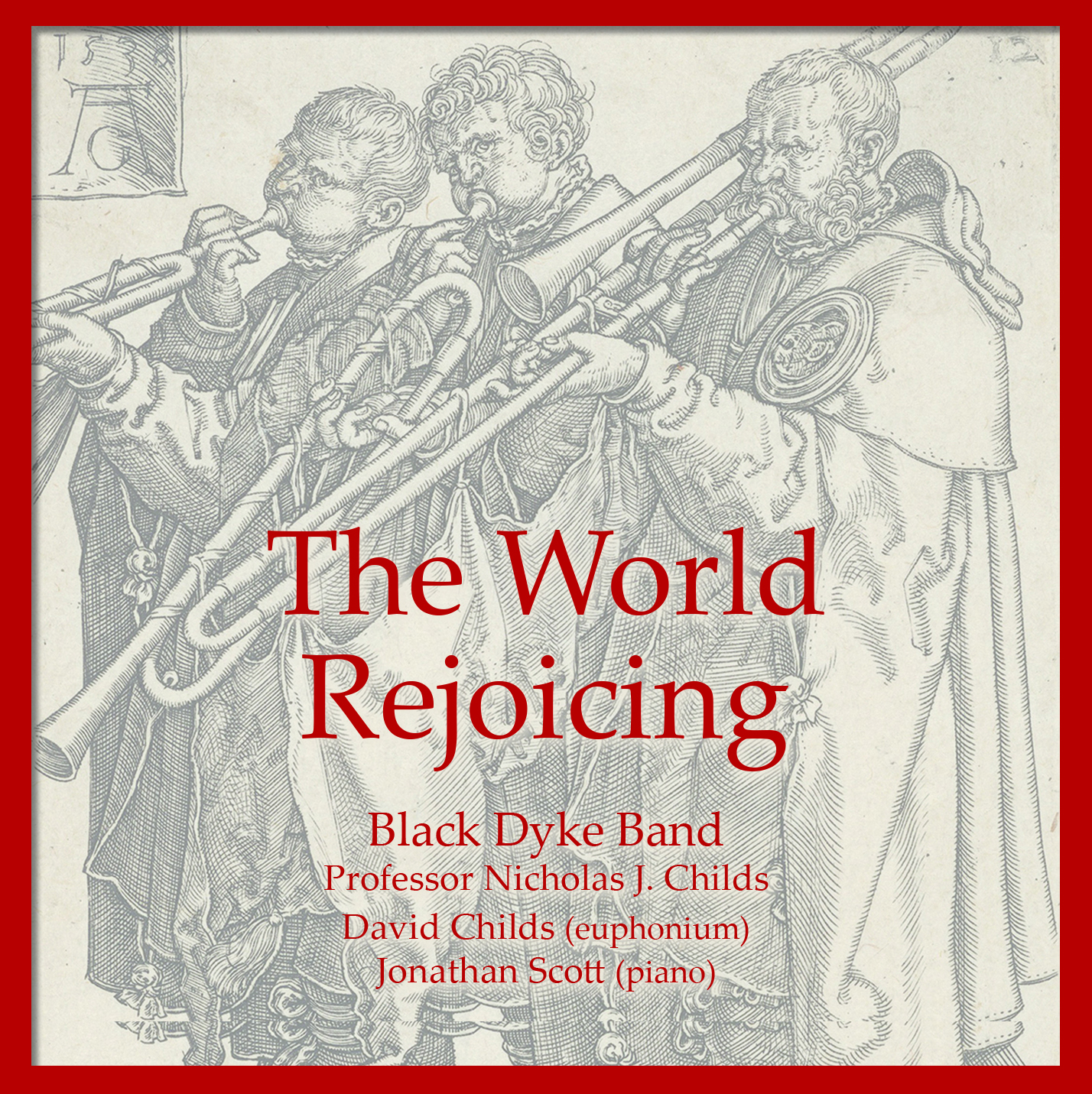
On Record: David Childs, Jonathan Scott, Black Dyke Band / Nicholas J. Childs – The World Rejoicing: The Music of Edward Gregson Volume VII

Gregson
Concertante for Piano and Brass (1966)
Variations on ‘Laudate Dominum’ (1976, rev. 2007)
Fanfare for a New Era (2000, rev. 2017)
Euphonium Concerto (2018)
The World Rejoicing – Symphonic Variations on a Lutheran Chorale (2020)

David Childs (euphonium), Jonathan Scott (piano), Black Dyke Band / Nicholas J. Childs

Doyen DOYCD414 [78’14”]

Producer Adam Goldsmith, Engineer Melissa Dee

Recorded 2021, 2022, Town Hall, Morley and Conservatoire, Leeds

reviewed by Richard Whitehouse

What’s the story?

Doyen releases its seventh volume devoted to the music for brass band by Edward Gregson, featuring two of his numerous concertante works and two sets of variations that confirm his all-round versatility in a medium which has not always been synonymous with innovation.

What’s the music like?

The programme begins with Fanfare for a New Era, written to mark the opening of Stoller Hall at Chetham’s School and filling the sound-space through its antiphonal exchanges. The Concertante for Piano and Band remained unheard for 50 years following its premiere, but the deftness of this combination amply justifies its revival. The Prelude suggests a passing acquaintance with Rachmaninov’s Fourth Concerto, the Nocturne makes affecting use of the hymn Escher and the Rondo alludes to a more famous such tune before its lively close.

Jonathan Scott despatches the solo part with no mean panache, as does David Childs that of the Euphonium Concerto. Among the latest in Gregson’s more than a dozen concertos, this denotes the more angular style of his recent music with its eventful interplay of soloist and ensemble in the initial Dialogues. The B-A-C-H motif underpins a wide-ranging cadenza which makes way for a Song Without Words, whose ruminations are not of an unalloyed tranquillity, before A Celtic Bacchanal sweeps all before it in its unbridled effervescence.

In between these concertos, Variations on ‘Laudate Dominum’ confirms Gregson’s always imaginative approach to this too often predictable form. Merely hinted at in the introduction, Parry’s theme is invoked to varying degrees and from different perspectives during those six variations which follow (the third and fourth were added over three decades later) – taking in an eloquent hymn then a virtuosic fugue whose accrued energy makes possible the return of the underlying theme, for a peroration that rounds off the sequence with fervent affirmation.

Even more impressive is the closing work. Commissioned by a consortium of bands to mark the composer’s 75th birthday, The World Rejoicing is subtitled Symphonic Variations on a Lutheran Chorale which duly confirms its highly integrated structure. A subdued Prelude precedes five continuous sections that play fast and loose with the chorale Nun danket alle Gott, while encompassing the spectrum of compositional devices and technical ingenuity. This is intoned as a powerful apotheosis and subsequently rendered as a decisive Postlude.

Does it all work?

Very much so. Gregson has enjoyed a long association with the brass band movement, such as is evident in the expertise and absence of inhibition of his writing. Nor is there any risk of routine or predictability in music which is almost always as gratifying to listen to as it must be to play. It helps that the performers are so demonstrably attuned to his idiom – the Black Dyke Band, which is evidently on a roll some 167 years after its inauguration, here giving   its collective all in this music under the expert and attentive direction of Nicholas J. Childs.

Is it recommended?

Indeed. The sound could not be bettered for detail and overall presence within a sympathetic ambience, and Paul Hindmarsh has contributed informative notes. Whether or not this is the best of Doyen’s releases devoted to Gregson, it is an ideal place to begin exploring his music.

Listen & Buy

You can listen to clips and get purchase options from the Chandos website

On Record: s t a r g a z e – ONE (Transgressive Records)

by Ben Hogwood

What’s the story?

s t a r g a z e is both an innovative ensemble crossing borders between classical and modern music, and a typist’s nightmare! The group was founded in Berlin and Amsterdam, and prides itself on a flexible and collaborative musical approach.

Collaboration was certainly the name of the game with ONE, whereby five different composers from around the world wrote a piece remotely in lockdown-imposed isolation. The music was then arranged for and with the help of the s t a r g a z e group, who recorded it online, part by part.

What’s the music like?

Engaging. Greg Saunier’s Metaphor begins in reserved fashion, with serious intonations that grow into more colourful statements, the wind section of the orchestra taking the lead. The orchestration has a timbre suggesting the 1920s, though as it progresses the music becomes more animated and a little playful, before an extended chorale led by the piano.

Arone Dyer’s Voicecream is much less conservative in its output, with sweeping statements suggesting an orchestra on the edge, with melodic movements that are much more difficult to predict or trace. A series of punchy block chords takes over half way through, stalling the momentum but adding impressive gravitas to the music.

Vacancy, written by Tyondai Braxton, is a compelling conversation between very different viewpoints – one, a series of swirling motifs, another a more relaxed but authoritative series of chords, yet another voice given out in flurries of woodwind. Nik Colk Void’s Recollection Pulse #3 is similarly convincing, though uses much more minimal material in its percussion. Just the one chord, repeated in syncopation, pushes this music forward over bass notes that effectively stand for the strokes of the oars on a boat. Gradually and inevitably the piece moves forwards before grinding into the dust somewhat, reaching an eerie and evocative conclusion.

Finally Descend, from Aart Strootman, evolves under a haze of orchestral light, some beautiful colours extracted from relatively coarse string and wind textures. A drone-like effect is cast, but with largely consonant harmonies that transport the listener into a comforting cloud, growing ever denser as they progress and then relaxing to softer, wind-based colours and a gently oscillating coda.

Does it all work?

Yes. It is tempting to say that a bit of spontaneity is lost in the recording method, but great credit should go to musicians and composers alike for ensuring that more often than not the musicians and instruments feel like they were recorded in the same room.

Is it recommended?

Yes. An intriguing suite for sure – with music that successfully sits at a junction between modern classical and improvisation, evading categorisation with grace, poise and a welcome dash of humour.

Listen

Buy

On Record: Set Fire To Flames – Sings Reign Rebuilder (21st anniversary reissue) (130701)

by Ben Hogwood

What’s the story?

The collective Set Fire To Flames were destined to release just two albums – but their debut Sings Reign Rebuilder has developed something of a cult following since its release in 2001. In the UK it was released on the Fat Cat imprint 130701 as its first ever release, the reason the whole label was begun – and it sold out within weeks. 21 years later it returns in the form of a remaster, reissued on a heavyweight black vinyl double LP.

Set Fire To Flames were a 14-piece collective set up in Montreal, with links to all manner of post rock or experimental outfits, including Godspeed You! Black Emperor, A Silver Mt Zion, Exhaust, Fly Pan Am and Hangedup. Godspeed’s guitarist David Bryant was effectively the group supervisor, establishing the membership and taking ownership of the recording, which took place in one heavily concentrated improvisation session.

For five days in an old Montreal house, the newly assembled band explored making music in one confined space, in various states of sleep deprivation and intoxication. The many hours resulting from the sessions were heavily edited, with Sings Reign Rebuilder the result.

What’s the music like?

In a word, uneasy! Yet that would be to throw away the obvious amount of effort that went into both the recording and editing processes.

Despite the name of the collective, Sings Reign Rebuilder is seriously dark and often mournful music. It does however have an intensity that is rare in instrumental music, the strength of feeling you would associate with classical music from the likes of Penderecki or Gorecki – even though this is improvised music from Montreal.

The band’s use of stringed instruments is especially gripping. Omaha… begins as a sorrowful duet, while the towering slow burner that is Shit-Heap-Gloria Of The New Town Planning… has a very steady build that culminates with the oscillation of two violins in a dark duet. There is also intense cello interplay on Two Tears In A Bucket.

Elsewhere the outlook tends to be rooted in noise – and a good deal of that is unsettling, with scratchy effects not too far removed from nails down a blackboard, or traffic-based noises that have a more mechanical basis. Vienna Arcweld… behaves like an instrument that refuses to function fully, with a sawing motion in the treble register, while Cote D’Abrahams Room Tone starts with what sounds like roadworks – and yet somehow possesses an ambience of the everyday. Injur: Gutted Two-Track also fidgets with extraneous noise.

Vocals are rare, though those used on Wild Dogs Of The Thunderbolt draw the listener in.

Does it all work?

It does – but the unremitting intensity and darkly shaded processes mean that this is not music for all seasons or moods. When it crackles into life, though, the music of Set Fire To Flames is hypnotic and magnificently brooding with its drones and subtle melodic interplay.

Is it recommended?

It is, as a highly effective project with compelling musical results. In remastered form, Sings Reign Rebuilder is even more gripping than it was in 2001.

Listen & Buy

On Record: Los Angeles Philharmonic / Susanna Mälkki – Steve Reich: Runner / Music for Ensemble and Orchestra (Nonesuch)

Steve Reich
Runner (2016)
Music for Ensemble and Orchestra (2018)

Los Angeles Philharmonic / Susanna Mälkki

Nonesuch 7559791018 [35’25”]

Producer Dmitriy Lipay, Engineer Alexander Lipay

Recorded 1-4 November 2018 (Music for Ensemble and Orchestra), 6-7 November 2021 (Runner), Walt Disney Concert Hall, Los Angeles, CA

reviewed by Ben Hogwood

What’s the story?

It is best to let Steve Reich himself tell the story of these two closely related orchestral pieces. Runner, he says, is ‘for a large ensemble of winds, percussion, pianos, and strings.  While the tempo remains more or less constant, there are five movements, played without pause, that are based on different note durations.  First, even sixteenths, then irregularly accented eighths, then a very slowed-down version of the standard bell pattern from Ghana in quarters, fourth a return to the irregularly accented eighths, and finally a return to the sixteenths but now played as pulses by the winds for as long as a breath will comfortably sustain them.  The title was suggested by the rapid opening and my awareness that, like a runner, I would have to pace the piece to reach a successful conclusion.’

Meanwhile its companion, the Music for Ensemble and Orchestra, is in effect Runner 2. It is described by Reich as ‘an extension of the Baroque concerto grosso where there is more than one soloist. Here there are twenty soloists – all regular members of the orchestra, including the first stand strings and winds, as well as two vibraphones and two pianos.  The piece is in five movements, though the tempo never changes, only the note value of the constant pulse in the pianos.  Thus, an arch form: sixteenths, eighths, quarters, eighths, sixteenths.  Music for Ensemble and Orchestra is modelled on my Runner, which has the same five movement form’.

The recording marks the first foray of both the Los Angeles Philharmonic and conductor Susanna Mälkki into the music of Reich in recorded form.

What’s the music like?

Reich clearly enjoyed writing these pieces, as he tells David Lang in the liner notes for this release. The quick tempo means that as the starting gun fires, Runner is immediately into its stride with brisk music and rich colours. When the tempo marking halves to become Eighths, and then Quarters, the slower music is beautifully managed through sustained notes, pulling out the tension. The piano and vibraphones come through beautifully here, while the harmonies continue to negotiate new corners and scenery as a runner would do. The feeling persists, though, that Reich is at his happiest in the music of Sixteenths, where the busy conversations of the woodwind and the bell tolls of the vibraphones give the music impressive stature. The piece ends quickly, with one of the composer’s trademark ‘fades’.

Music for Ensemble and Orchestra feels weightier in its own Sixteenths section starts, pianos oscillating and strings gathering in hymn-like unison before the pianos create an impressive grandeur with their sustained low notes. Reich’s command of the orchestra is immensely assured, more so than it was in earlier works such as the Variations for wind, strings and keyboards or The Four Sections, but never losing the luminosity of those works, nor their capacity to pan out into larger spaces.

The Eighths section is the most emotionally powerful music yet, with large scale harmonies that move freely between weighted dissonance and brief consonance, the latter appearing like shafts of light in the music. Quarters brings forward the choirs of woodwind, their distinctive motif alternating with the piano, before the percussive instruments drive Eighths to greater heights, pianos chiming with the vibraphones. In typical Reich fashion the acceleration from Eighths to Sixteenths is both seamless and thrilling, the clarinets pushing to the front as the music gathers itself for the finish. Then just as suddenly – and seamlessly – the bottom drops away and the figures float away like birds on the wing, all treble and no bass.

Does it all work?

It does. The performances from the Los Angeles Philharmonic and Susanna Mälkki are of a uniformly high degree, and the writing is subtly complex – meaning that Reich’s workings reward close inspection, but that the overall whole is beautifully realised and works well even in the middle foreground for the listener.

Is it recommended?

Of course. Steve Reich is a composer where nearly every move he makes is captured on record, to our advantage – and this pair of works, representing one of his most recently published chapters, are typically rewarding listening.

Listen

Buy

You can buy this new release at the Presto website. For more on Steve Reich himself, visit the composer’s website

On Record – Gunnar Idenstam & Ola Stinnerbom: A Saami Requiem (Toccata Next)

Ola Stinnerbom (yoik), Gunnar Idenstam (organ), Henrietta Wallberg (vocalist), Erik Weissglas (guitars), Rafael Sida Huizar (percussion)

Idenstam / Stinnerbom A Saami Requiem

Toccata Next TOCN0017 [63’35”]

Producer Jostein Andersen Engineer Anders Hannus

Live performance 21 September 2019, Studio Acusticum, Pileå, Sweden

Reviewed by Richard Whitehouse

What’s the story?

The enterprising Next imprint of Toccata Classics continues with A Saami Requiem, which   is neither a field recording nor an ethnomusicological construct but more a concept album in which the religious practice of this people is endowed with a distinctly ‘crossover’ twist.

What’s the music like?

As is indicated above, this is not the realization of a burial mass such as those peoples of the Sápmi region (formerly Lapland) would recognize. Instead, Sámi artist and yoik-singer Ola Stinnerbom has collaborated with the Swedish organist Gunnar Idenstam for what results in a fusion of musical styles and cultures that, if hardly new as an underlying concept, conveys much of the ritualistic atmosphere and emotional fervency as might be associated with this practice. The outcome is rarely less than engaging in content and sometimes much more so.

As with a Requiem or comparable funeral service, the present work comprises a number of sections that here fall into three parts. After its sombre organ ‘Entrée’, The Journey continues with a ‘Requiem aeternam’ in which yoik and organ gradually merge towards a ‘Misterioso’ whose percussive backing imparts greater rhythmic freedom. The ensuing ‘Blues Yoik in C’ ventures further into fusion territory – its blues-vamp afforded a rockier twist in ‘Pols Yoik’, then this first part ends with the mesmeric groove of ‘Saajva’ as it heads into the next world.

The Kingdom of Death begins with the longest section, a ‘Mirrored Chorale – Shimmering Yoik’ of no mean expressive subtlety, followed by a ‘Percussion Meditation’ that gradually disrupts the prevailing inwardness. An ensuing ‘Adagio’ restores something of a meditative calm, before ‘Jaamie Ahkka’s Death Yoik’ brings something of an emotional culmination with its free-form interplay of voices against circling organ harmonies and the distant yet unremitting toll of bells – music this evocative certainly creating its own distinct imagery.

The Return duly commences with ‘The Return Voyage’ and another section whose intensive rhythmic profile builds in a dynamic crescendo towards the relative contentment of ‘Back in this World’ and what sounds the closest approximation to a strophic song in this context. The ‘Blues Yoik in E’ that follows admits of overtly rock-like elements through its trenchant beat or vamping interplay of organ and guitar, which the ‘Epilogue and Hymn’ transmutes into a celebration of life overcoming death in what becomes a truly Messiaenic ‘Transports de Joie’.

Does it all work?

Yes, within those stylistic parameters which this piece embraces. Certainly, the combination of Stinnerbom and Idenstam is made the more formidable through the dextrous guitar playing of Erik Weissglas and inventive percussion of Rafael Sida Huizar; to say nothing of Henrietta Wallberg’s starkly otherworldly vocals. Quite who – if, indeed, anyone specific – this project is aimed at remains unclear, though those with a passing interest in more left-field rock bands (not necessarily limited to the 1970s) should find it an absorbing as well as rewarding listen.

Is it recommended?

It is, and not least on account of its amalgamation of traditional with composed music such as leaves a tangible emotional resonance. Idenstam and Stinnerbom’s succinct annotations cover the background to this project and take the listener deftly yet surely through its various stages.

For further information on this release, and to purchase, visit the Toccata Classics website. Click on the names to read more about Ola Stinnerbom, Gunnar Idenstam, Henrietta Wallberg, Erik Weissglas and Rafael Sida Huizar

Listen