On Record – Piet Koornhof, Albie van Schalkwyk & Susan Mouton – Kancheli: 18 Miniatures & Middelheim (Delos)

kancheli

Piet Koornhof (violin), Albie van Schalkwyk (piano), Susan Mouton (cello)

Kancheli
18 Miniatures (2019)
Middelheim (2018)

Delos DE3589 [62’41”]
Producer Piet Koornhof / Engineer Stefan van der Walt

Recorded 9 & 10 April 2021 (Miniatures), 29 April 2022 (Middelheim) at Conservatoire Hall, School of Music, North West University, Potchefstroom Campus, South Africa

Reviewed by Ben Hogwood

What’s the story?

Giya Kancheli made his name primarily in the field of orchestral music. The Georgian composer’s style ranges from prayerful reflection to more volatile thoughts, sometimes in immediate juxtaposition. The music carries a wide dynamic range, showing its worth for the big screen as well as the concert hall or home cinema.

Kancheli did indeed write for plays and films, and extracted some of this material into 18 Miniatures for violin and piano, a rare foray into chamber music. This new album takes that extended suite and adds a late piano trio, Middelheim, dedicated to the hospital of that name in Antwerp where the composer was resuscitated in 2016.

What’s the music like?

The miniatures are well realised musical postcards, at times playful or amusing and then serious or sardonic.

There is a childlike simplicity at play in Kancheli’s writing that is immediately evident in the first piece, Lontano, which ends in a haze of harmonics, and in the third piece, a deceptively simple utterance marked Cantabile. The same marking is used for piece no.16, a short piece whose phrasing has a notable breadth.

In the fourth piece (Grazioso) the violin trills and soars like a bird, while one of the longest pieces, the twelfth (Quasi recitando) finds the instrument brooding to distracted piano accompaniment. Another Quasi recitando, the piece no.14, gives vent to longer phrases that are beautifully sung yet autumnally tinged.

The trio is a powerful piece of work, depicting with startling clarity Kancheli’s moments of distress in the hospital in Antwerp. It does this through a stern, alarming gesture at the start.

Does it all work?

Yes – though listeners may want to dip into the 18 Miniatures a little more, rather than listen to them in an unbroken span of 45 minutes.

In the Miniatures, Piet Koornhof and Albie van Schalkwyk capture the simplicity and feeling of the music, helped by a recording that gives them space. The intensity of the trio is impressive in this performance, sustained throughout a tense and meaningful 17 minutes.

Is it recommended?

Yes – it offers another perspective on Kancheli’s writing, right at the end of his life. The performances are excellent too.

Listen

Buy

You can get more information on this release at the Delos website
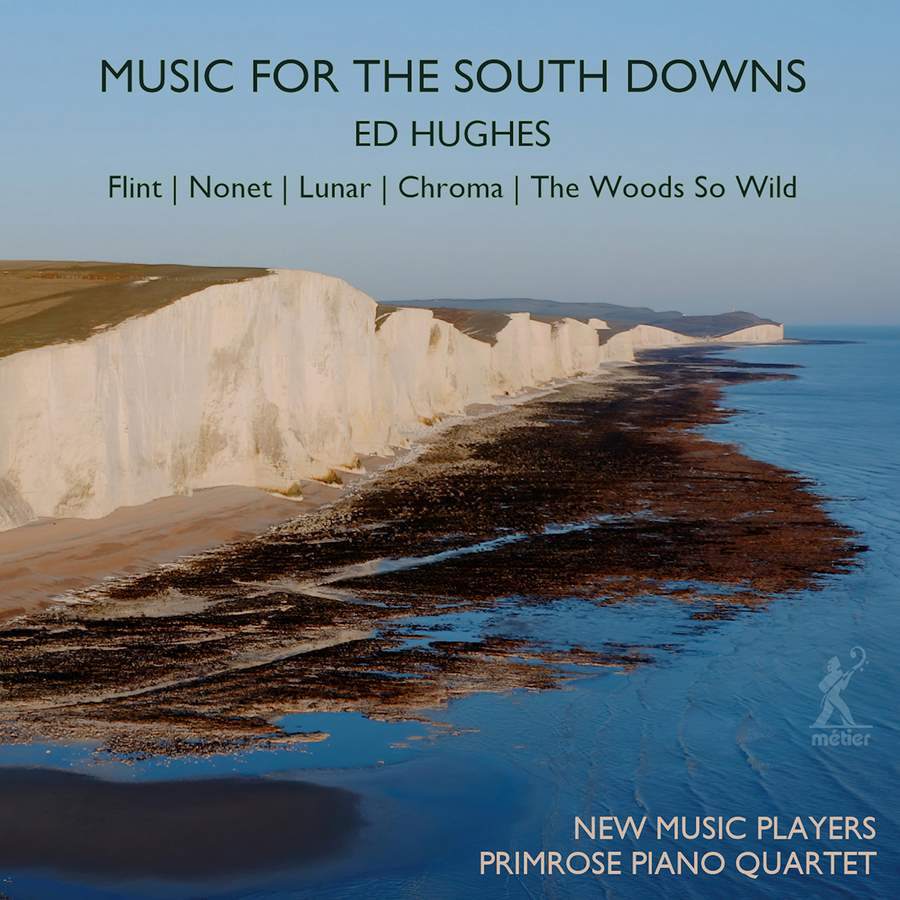
On Record – Primrose Piano Quartet, New Music Players – Ed Hughes: Music for the South Downs (Métier)

Primrose Piano Quartet [Susanne Stanzeleit (violin), Dorothea Vogel (viola) Andrew Fuller (cello) John Thwaites (piano)]; New Music Players / Ed Hughes

Ed Hughes
Chroma (1997)
Flint (2019)
Nonet (2020)
Lunar (2021)
The Woods So Wild (2020-21)

Métier msv28623 [68’32”]
Producer / Engineer David Marshalsea

Recorded 18 March 2021 at St John’s Smith Square, 28 October and 4 December 2021 at Attenborough Centre for Creative Arts, University of Sussex

Reviewed by Richard Whitehouse

What’s the story?

Métier continues its coverage of music by Ed Hughes (b1968) with a release of works partly inspired by and even permeated with the qualities of the South Downs, making for a cohesive selection whose five constituents are tellingly thrown into relief by having been so arranged.

What’s the music like?

Ed (formally Edward Dudley) Hughes has been an enriching presence on the UK new music scene since the BBC broadcast of his orchestral piece Crimson Flames marked him out as a name to watch over three decades ago. He has assembled a sizable as well as diverse body of work across a broad range of genres, one which reveals a notable awareness of the evolution of Western music not just over this past century but across what might reasonably be termed the ‘humanist’ tradition which stretches back through the Enlightenment to the Renaissance.

The present sequence opens with Flint that evokes the Sussex landscape in terms of natural cliff formations and man-made quarries. The three movements are pointedly distinct – often angular gestures of the first being contrasted with the restrained fervour of its successor (in which a local song once collected by George Butterworth threads it way across the content), before the third highlights solo violin for a texture whose shifting emphases add appreciably to its expressive impetus. Although written to complement a film by Sam Moore (which can be seen via Hughes’s website), Nonet is musically self-sufficient – whether in the undulating variety of incident in its initial ‘Con moto’, the sense of being side-tracked and even waylaid in the central ‘Tranquil’, or a gradual feeling of emergence then arrival in the final ‘Flowing’.

Very different in its concept is the Lunar diptych – inspired by Isamu Noguchi sculptures and juxtaposing the darkly translucent harmonies of ‘Lunar 1’ with the agile luminescent gestures of ‘Lunar 2’. The earliest work here, Chroma is also the most abstract in terms of content that derives meaning from its interplay of outward volatility with underlying calm; a process made manifest in the distinction between string quartet and string ensemble over much of its course. Finally, The Woods So Wild turns to the medium of piano quartet and a song from the Tudor era whose plangent modality is brought to bear on the animated melodic weave of its opening movement as on the harmonic eloquence of its central intermezzo – duly heading into a finale whose rhythmic intricacy does not prevent the song coming through affirmatively at the close.

Does it all work?

It does indeed. Without drawing attention to itself in technical terms, Hughes’s music has an understated virtuosity such as adds greatly to the attraction of those pieces featured here. The performances are audibly attuned to this music, whether those by the Primrose Piano Quartet (arguably the finest such ensemble in the UK) or New Music Players which Hughes founded over three decades ago. Nor does the sound, recorded at two different venues, leave anything to be desired in clarity and perspective. The composer has provided informative annotations.

Is it recommended?

Very much so. There are four earlier releases of Ed Hughes from Métier and those who have acquired some or all of these will want this new one too. Those new to his music will find the latest selection an appealing way into this composer and, as such, to be warmly recommended.

For further information on this release, and to purchase, visit the Divine Art website, and for more on Ed Hughes click here. Click on the artist names for more on the Primrose Piano Quartet and the New Music Players, and click here for the South Downs National Park website.

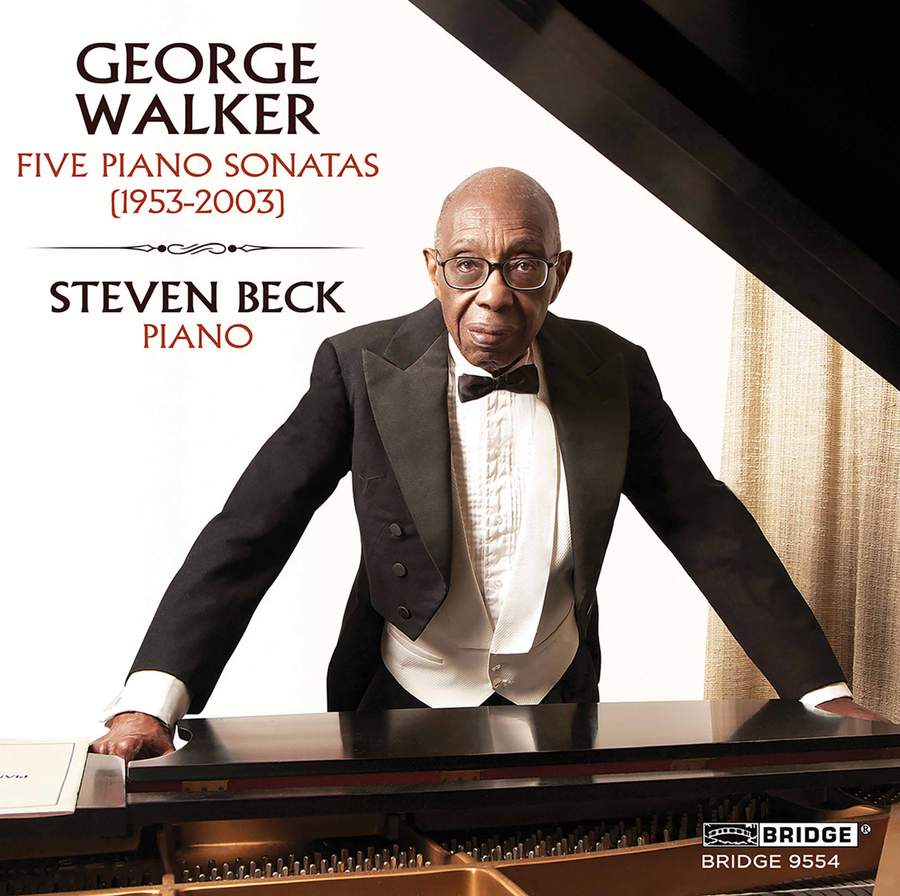
On Record: Steven Beck – George Walker: Five Piano Sonatas (Bridge)

george-walker

Steven Beck (piano)

George Walker
Piano Sonatas: no.1 (1953, rev. 1991); no.2 (1956); no.3 (1975, rev. 1996); no.4 (1984); no.5 (2003)

Bridge 9554 [53’13”]

Producer Steven Beck
Engineer Ryan Streber

Recorded 4 & 14 February 2021 at Oktaven Audio, Mount Vernon, NY

Reviewed by Richard Whitehouse

What’s the story?

Bridge continues its wide-ranging coverage of American music with this release featuring all five of the piano sonatas by George Walker (1922-2018), a composer who is now coming into his own on this side of the Atlantic and through, one trusts, the intrinsic quality of his music.

What’s the music like?

Although he achieved success in the USA, with commissions from several leading orchestras and a Pulitzer Prize in 1996 (making him its first black recipient), Walker was little known in the UK until recently – other than Natalie Hinderas’s account of his Piano Concerto in CBS’s ground-breaking Black Composers Series from the 1970s and occasional revival of his Lyric for strings (the most played such piece in America after Barber’s Adagio). That the current Proms season featured no less than three of his works is hopefully in itself a positive sign.

With its antecedents in Copland and Piston, the First Sonata appeared at a time of incipient change for American music – its three movements classically conceived but never adhering to formal archetypes; witness the flexible handling of sonata principles in the initial Allegro, followed by the contrasted sequence of six variations on a winsome folk tune, then dextrous contrapuntal texture and cumulative impetus of the rondo which comprises its final Allegro. Barely three years later, the Second Sonata sounds as if it might be responding to Sessions’s ‘transitional’ music of not long before – its initial movement’s theme the basis of 10 gnomic variations, followed by a Presto as brief as it is virtuosic, then an Adagio circumspect in its restiveness, and an Allegretto ensuring a degree of finality for all its harmonic ambivalence.

Almost two decades on and the Third Sonata postdates Walker’s most intensive involvement with serialism, but it does not eschew innovation – whether in the constantly metamorphosed shapes of the opening Phantoms, distanced yet ominous emotional resonance of the central Bell, or those myriad textural contrasts which build considerable momentum in the closing Choral and Fughetta. In the Fourth Sonata, number of movements may be further reduced but the emotional range is further extended – the forceful if never unyielding rhetoric of its Maestoso ideally complemented with the formal and expressive disjunction of its Tranquillo. Outwardly a concert study, the Fifth Sonata has as emotional impact out of all proportion to its brevity while leaving little doubt as to Walker’s creative prowess during his ninth decade.

Does it all work?

Almost always. As dates of composition suggest, these sonatas afford a viable (not inclusive) overview of Walker’s evolution – responding to the aesthetic changes in post-war American music methodically and resourcefully, without detriment to his creative integrity. It helps that Steven Beck is as audibly attuned to this music as to that by other US composers – rendering these pieces with precision and commitment, but the recording might have had a degree more warmth to complement its unfailing clarity. Succinctly informative notes from Ethan Iverson.

Is it recommended?

It is. All these sonatas have previous been recorded (notably as part of the extensive coverage on the Albany label), but this release is a clear first choice for anyone coming to them afresh. Hopefully Bridge will record further Walker – maybe an integral cycle of his five Sinfonias?

For further information on this release, visit the Bridge Records website, and for more on George Walker click here. You can read more about Steven Beck on his website

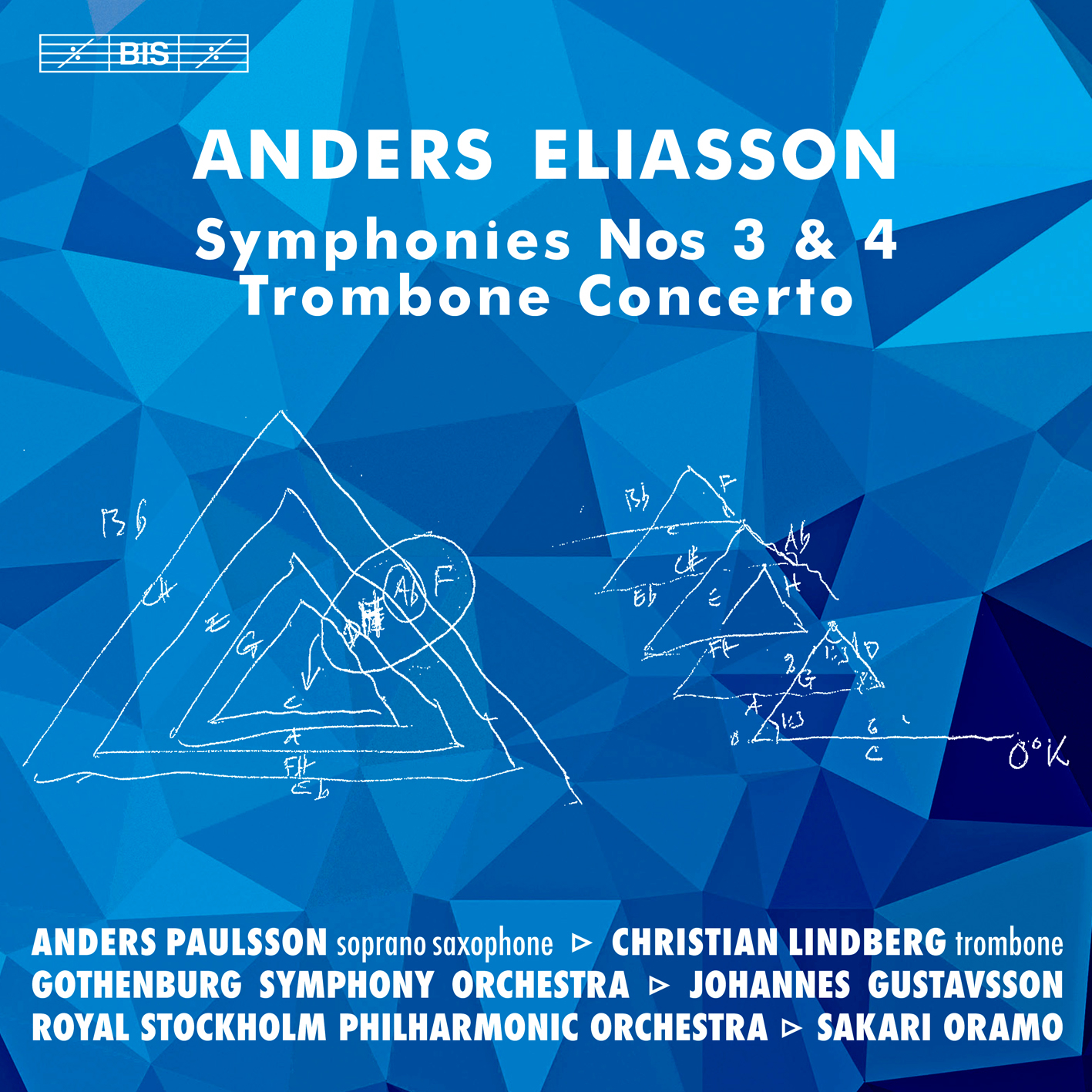
On Record – Anders Paulsson, Christian Lindberg – Anders Eliasson: Symphonies 3 & 4, Trombone Concerto (BIS)

Anders Eliasson
Symphony no.3 (1989/2010) (a)
Symphony no.4 (2005) (b)
Trombone Concerto (2000) (c)

Anders Paulsson (soprano saxophone) (a), Christian Lindberg (trombone) (c), Gothenburg Symphony Orchestra / Johannes Gustavsson (a), Royal Stockholm Philharmonic Orchestra / Sakari Oramo (b) and (c)

BIS 2368SACD [77’03”]

Producers Thore Brinkmann (a) Hans Kipfer and Mats Engström (b) and (c) Engineers Andreas Ruge (a), Fabian Frank (b), Mathias Spitzbarth (c)
Dates: (a) – 8-10 November 2017, Concert Hall, Gothenburg; (b) 23 September 2011, (c) 11 January 2020, Konserthuset, Stockholm

Reviewed by Richard Whitehouse

What’s the story?

BIS issues a follow-up to its ‘4 X Anders Eliasson’ (BIS2270) in this no less fine collection of his Third and Fourth Symphonies – together with a first recorded outing for the Trombone Concerto and featuring musicians who have long been associated with the Swedish composer.

What’s the music like?

Anders Eliasson (1947-2013) enjoyed an ambivalent relationship with the symphony. Among the most notable debuts in the genre of the post-war era, his First Symphony (1986, recorded on Caprice under CAP 21381) prompted a successor as failed to progress beyond sketches, with the Fourth intended as initial part of a trilogy that never materialized due to his untimely death, though the Fifth was commissioned with a date set for its premiere. There are also two chamber symphonies, with the violin concerto Solitary Journey (2010) arguably a symphony in all but designation.

Written for and frequently performed by American-born saxophonist John-Edward Kelly, the Third Symphony was written for alto (Neos NEOS11301) but later revised for soprano sax. Despite Kelly’s objections, this latter instrument undeniably merges even more effectively within its orchestral context. Anders Paulson has its measure as he traverses its five continuous sections – from an agitatedly expectant Quest, via the guardedly expressive Solitude and assaultive Shudders, to a plaintively affecting Sad before dissolving into the postlude that is Mists.

A decade on and the Trombone Concerto continues this integrative and inherently symphonic approach. As with Eliasson’s earlier concertos there are three continuous movements, though here a slow-fast-slow sequence opens with a ruminative Adagio that acts as ‘prologue’ to an extensive Allegro moderato whose frequent restraint yet requires a dexterity and incisiveness such as dedicatee Christian Lindberg typically meets head-on. A keen momentum is no less evident across its eventful course, prior to the ruminative Lento that duly serves as ‘epilogue’.

One of Eliasson’s most often heard works since its Munich premiere, the Fourth Symphony is among his most characteristic in its formal and expressive aims. Here a powerfully wrought Allegro summons up some of this composer’s most uninhibited music; evolving with no little motivic ingenuity to an Adagio whose concertante role for flugelhorn, eloquently rendered by Joakim Agnas, exudes a wistfully evocative tone. A scherzo-like section marked ‘threatening’ then builds to a climax, from where a brief Adagio returns the flugelhorn for a subdued envoi.

Does it all work?

Yes. Although his music could never be mistaken for that of his predecessor Allan Pettersson, Eliasson was similarly unequivocal in a musical language whose seriousness of purpose does not preclude lightness of touch or barbed humour. The latter two pieces here find his idiom at its most refined, unfolding with a cumulative inevitability that could be thought Nordic in its ethos. Performances are uniformly committed, and hopefully Sakari Oramo might yet take the Fourth Symphony to London in his ongoing association with the BBC Symphony Orchestra.

Is it recommended?

Indeed. The sound is on a par with BIS’s numerous other recordings from its Gothenburg and Stockholm venues, with Peter Kislinger’s annotations as informed and insightful as expected given his long-time advocacy of Eliasson’s music. Further such releases would be welcome.

For further information and purchasing options, visit the BIS website For more information on Anders Eliasson, click here, while you can click on the artist names for the websites of Anders Paulsson, Christian Lindberg, Johannes Gustavsson and Sakari Oramo, the Gothenburg Symphony Orchestra and the Royal Stockholm Philharmonic Orchestra

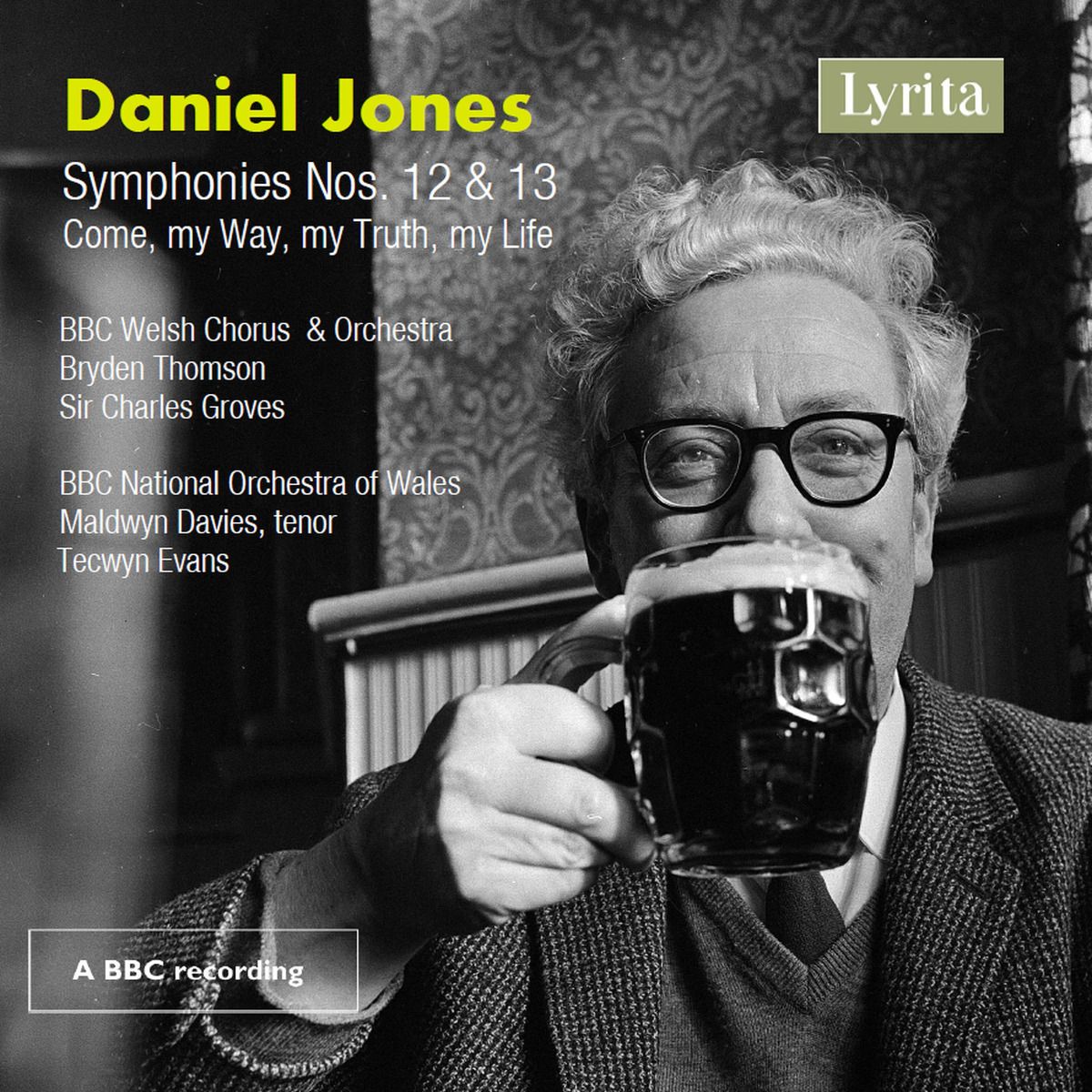
On Record – BBC Welsh Chorus & Orchestra / Bryden Thomson & Sir Charles Groves – Daniel Jones: Symphonies 12 & 13 (Lyrita)

Daniel Jones
Symphony no.12 (1985)a
Symphony no.13 ‘Symphony in memory of John Fussell (1992)b
Come, my Way, my Truth, my Life (1987)c

Maldwyn Davies (tenor) (c), BBC Welsh Chorus (c, BBC Welsh Symphony Orchestra (a) and (c) / Bryden Thomson (a), Sir Charles Groves (c); BBC National Orchestra of Wales (b) / Tecwyn Evans (b)

Lyrita SRCD391 [65’35”] English text included
Dates: (a) – BBC studio recording 22 March 1990; (b) – BBC concert broadcast 23 January 2017; (c) – BBC broadcast from Swansea Festival, 10 October 1987

Reviewed by Richard Whitehouse

What’s the story?

Lyrita completes its coverage of symphonies by Daniel Jones (1912-1993) with this coupling of his final two such works, alongside the premiere performance of his last cantata, heard in readings by artists who identified closely with the composer’s music throughout their careers.

What’s the music like?

It was only midway through this cycle that Jones realized he could start a symphony on each note of the chromatic scale. The Twelfth Symphony thus completes this process – its overall structure being among the composer’s most concentrated. At barely six minutes, the opening movement seems relatively expansive with the tensile sonata-form of its Agitato bookended by affecting Tranquillo passages. There follows a rumbustious Giocoso the more potent for its brevity, a Serioso such as might almost be thought a ‘song without words’ with its lyrical understatement, then a Risoluto which extends just long enough to round off the whole work by effecting an oblique return to its initial bars. Four decades on from his first so-designated piece and Jones can be said to have brought his symphonic cycle decisively to its conclusion.

That, however, was by no means the end of the story: the death, in 1990, of Jones’s friend the organist and administrator John Fussell prompted a Thirteenth Symphony as proved to be his last completed work (an Eighth String Quartet being realized by Malcolm Binney and the late Giles Easterbrook). Relatively expansive next to those later such pieces, with some especially imaginative writing for percussion (allocated to no less than seven players), this unfolds from the restless and eventful Solenne – at almost 10 minutes a worthy ‘memorial’ in itself – via an animated and nonchalant Capriccioso then a Lento whose plangent woodwind writing makes it among his most searching slow movements, to a finale whose Agitato-Tranquillo trajectory is pursued twice as this intensifies inexorably towards an ending as powerful as it is eloquent.

Coming between the two symphonies, Come, my Way, my Truth, my Life is the last of Jones’s four cantatas and again has recourse to metaphysical poetry – in this instance George Herbert, the seven short movements being arranged as to chart the spiritual progress of the author (by extension, that of John Aeron-Thomas – founder-member of the Swansea Festival, for whom this is a memorial). Intersected with a fervent orchestral Fantasia, the six choruses traverse contrasted and even conflicted emotions before attaining an unforced affirmation at the close.

Does it all work?

It does. As has previously been noted in these reviews, Jones was not a composer who sought or attracted easy plaudits – opting for an idiom whose methodical evolution is consistent and absorbing. The performances reflect this thinking, Sir Charles Groves and Bryden Thomson both focussed on capturing the essence of works whose integrity is abetted by deftness and no little humour. Tecwyn Evans’s conducting suggests he, too, is primarily concerned with projecting the spirit of this music. Nor does Maldwyn Davies’s contribution leave anything to be desired.

Is it recommended?

Indeed. The broadcasts have been expertly remastered (No. 13 understandably sounding the best), with Paul Conway contributing detailed and insightful annotations. Job done by Lyrita, which will now hopefully complete a similar intégrale of the symphonies by Alun Hoddinott.

For further information and purchasing options, visit the Lyrita website For more information on Daniel Jones, click here