Nightlands, the solo project of The War On Drugs bassist Dave Hartley, has reached its third instalment. Moonshine reflects a change in the pace of his home personal life, since leaving Philadelphia for the relatively deserted area of Asheville.
When crafting his music, Hartley has looked to build massive layers of keyboards and vocals on top of each other, creating ‘stacks’ of sound. They are in keeping with the album’s artwork, as the press release describes. “The surrealistic album art by Austin-based illustrator Jaime Zuverza depicts an archway opening to the stars over the surface of an idyllic sea flanked by both moon and sun”, it says. “Similarly, Moonshine reveals portals within portals leading to ever deeper places in Hartley’s vocal-centered labyrinth.”
What’s the music like?
As wide open as that introduction suggests it will be, but in spite of the big textures there is a touching intimacy too. On occasion it feels like the one person you are talking to has gone out for a quick smoke under the stars in a massive vista, and will be back inside shortly. The music pans out to give space to these thoughts, which are often tender and warm.
They are not without sharp-edged feeling, however. Stare Into The Sun has a direct observation on political machinations. “You’ve got your sheep but you’re no shepherd”, sings Hartley. “What does it mean…to buy everyone, and send someone’s son to Afghanistan?” No Kiss For The Lonely is equally pertinent, with its observation of “no love for you refugees, no rest for the weary”.
Most of the time, however, the album inhabits a calming place, the big vocals and keyboards complemented by languid saxophone lines and impressively supple rhythm tracks. The music unfolds with a slow and very natural groove, and Hartley’s warm-hearted vocals become its principle feature, often finding a style of music akin to a less troubled Bon Iver.
With You is a prime example, inhabiting a serene and content place, while Blue Wave goes even calmer, its keyboards like a slowly running stream.
Does it all work?
It does, especially at either end of the day. Moonshine has some very evocative moments, and it is beautifully written, rewarding background listening but also offering more to those paying attention to the lyrics.
Is it recommended?
Is it recommended?
Yes – an album of starry Americana that deserves its place in the moonlight.
Martin Plüddemann Liederzyklus. Jung Dietrich (both 1879). Vineta. Venetianisches Gondellied (both 1880). Graf Eberhards Weissdom. Einkehr. Siegfrieds Schwert (all 1881). Der Glockenguss zu Breslau (1882). Die Taufe. Dr Martin Luther. Ritter Kurts Brautfahrt. Arthur Schopenhauer (all 1883). Die Legende vom Hufeisen (1884/9). Altdeutsches Minnelied. Frau Mette. Don Massias. Russisches Lied. Des Sängers Fluch (all 1885). Gute Nacht (1887). Loewe’s Herz (1892). Niels Finn. Die Katzen und der Hauscherr. Der Sarg auf der Maasinsel. Die Meer-maid. Des Lebens Winter (all 1893). Sankt Peter mit der Geiss (1895). Drei Wanderer (1897).
Ulf Bästlein (baritone), Hedayet Jonas Djeddikar (piano)
Naxos 8.551460-61 [two discs, 2h34m15s] Producer/Engineer: Alexander Grün Dates: October 2nd-4th, 2020 and March 19th-22nd, 2021 at Studio TONAL, Pfaffendorf German texts and English translations can be found on the Naxos website, as can the additional notes
Reviewed by Richard Whitehouse
What’s the story?
Naxos once again puts inquiring listeners in its debt with a collection of Ballads, Songs and Legends from the short-lived though influential Martin Plüddemann, admirably realized and extensively documented by artists for whom this project has evidently been a labour of love.
What’s the music like?
Readers might recall the world premiere in late 1978 of an orchestral song Siegfrieds Schwert by Webern. In fact, its brash orchestration was all that the teenage composer had contributed to a ballad written 22 years earlier by Plüddemann – then so obscure that the connection was not made at this time. Born in Kolberg (now Kołobrzeg in Poland) in 1854, he had studied at Leipzig in the early 1870s then worked as a singing teacher, conductor and critic in, among other places, Munich and Graz before heading to Berlin where he died in 1897 aged just 43.
Although he championed the music of Wagner, Plüddemann was most influenced creatively by Carl Loewe – specifically his concept of the ballad which dominates those 50 or so pieces that he completed, and of which 33 are included in this collection. Examples can be found in such as Schubert, Schumann and Brahms, and while Plüddemann took this to a new level of formal and expressive density, the innately Teutonic nature of the genre consigned his music to oblivion once Austro-German culture had moved on near the start of the twentieth century.
The essence of Plüddemann’s thinking is amply conveyed by a collection as includes several of his songs, notably the winsomely understated Liederzyklus and mini-cycle after Heine that is Frau Mette – alongside the more substantial ballads in which the intertwined significances of story-telling and role-playing, coupled with the often graphically illustrative quality of the piano writing, results in music which is highly evocative or excessively mannered according to taste. Never in doubt, though, is the ability to draw each listener into its interiorized world.
Plüddemann’s most ambitious ballads are heard at the end of each disc – the Faustian pact as adumbrated by Wilhelm Müller when truth confronts beauty in Der Glockenguss zu Breslau, then the highly polemical relationship between art and the state in Ludwig Uhland’s familiar Der Sängers Fluch whose undeniably equivocal resolve says much for the aesthetic stance of the composer and many of his contemporaries. The shorter ballads evince a wide range of moods, not least Siegfrieds Schwert which sounds far more appealing in its original guise.
Does it all work?
Yes, provided listeners approach this music in the context of its intentions and limitations. As with Loewe, there is more than a hint of didacticism which might be thought off-putting, but it is to the credit of Ulf Bästlein and Hedayet Jonas Djeddikar that any such aspect has been integrated into the overall content of the piece at hand. Certainly, the former’s burnished yet never cloying baritone, allied to the latter’s dextrous while resourceful pianism, ensures that Plüddemann’s work benefits from a degree of advocacy it can seldom have received hitherto.
Is it recommended?
Indeed, not least as the sound has so realistic a balance between voice and piano, with essays by Bästlein, Michael Wilfert and Susan Youens that yield a wealth of information previously unavailable in English. Those drawn to the Austro-German musical byways need not hesitate.
Bruckner (ed. Korstvedt) Symphony no. 4 in E flat major ‘Romantic’ – 1874, rev. 1875/6; 1878-80, rev, 1881; 1887, rev. 1888. Finales – 1878 ‘Volksfest’; 1881. Earlier drafts and versions
Bamberger Symphoniker / Jakub Hrůša
Accentus Music ACC30533 [four discs, four hours 34 minutes] Producers: Sebastian Braun, Bernhard Albrecht; Engineers: Markus Spatz, Christian Jaeger Date: November 2020 at Joseph-Keilberth-Saal, Konzerthalle, Bamberg
Reviewed by Richard Whitehouse
What’s the story?
Jakub Hrůša directs the Bamberg Symphony Orchestra – whose chief conductor he has been since 2016 – in this survey of Bruckner’s Fourth Symphony: three ‘versions’ of the complete work, together with two additional versions of the finale plus over a dozen sundry excerpts.
What’s the music like?
Evidently this project had its basis in a period of lockdown during the Covid pandemic, thus enabling a focus on one specific piece such as would have been unfeasible under more usual working conditions. How one responds to it depends, firstly, on how one sees the legitimacy of the ever-increasing editions of Bruckner symphonies; secondly, on the qualities – whether interpretative or executive – of these performances. Certainly, the identity of this conductor with this composer – whose music he has not previously recorded – can hardly be gainsaid.
Undoubtedly the highlight here is the 1874 version, of which this is the first recording in its 1876 revision – significant in that Bruckner clearly intended for the work to be heard in this guise, rather than its being a ‘first attempt’ shelved on completion. Hrůša might have taken the opening movement at a swifter underlying tempo, but its relatively prolix course is well articulated; as is that of the Andante whose course might seem circuitous compared to later versions, but which eschews discursiveness even so. Its close, moreover, provides a catalyst for the scherzo: too often dismissed as a failure, but recklessly imaginative in its expressive character and benefitting here from the revision’s excision of those pauses between sections. Even finer here is the finale, one whose supposedly lightweight content belies its rhythmic propulsion or a stealthily accumulating momentum unequalled by either revision – certainly not in so viscerally energetic a coda. The Bambergers give their all, while confirming that what Bruckner got wrong here was not necessarily put right in either of those later versions.
The 1878-80 version has become the preferred option in the post-war era, the streamlined trajectories of its initial two movements being more easily absorbed by listeners and more comfortably navigated by the musicians. Without yielding any revelations, Hrůša has their measure – not least a magisterially projected coda in the former or an inexorable approach to the latter’s climax. The spacious acoustic of Joseph-Keilberth-Saal endows a convincing overall perspective but not the ultimate clarity, such as marginally obscures cross-rhythmic interplay of the brass during the Scherzo’s cumulative passages but ensures an ethereal aura in its trio. The Finale emerges broadly and patiently: maybe too much depending on whether one hears this version as the natural outcome of its music’s thematic potential, or an attempt to make this movement a weightier and more serious culmination that leaves an inevitable self-consciousness in its wake. Hrůša seems to have his doubts, though not in a fervent and headily cumulative account of what is undeniably among the most eloquent Bruckner codas.
The 1888 version is that by which earlier generations came to know this piece, making its latter-day rehabilitation the vindication of Bruckner’s final thoughts or an editorial cash-in according to vantage. Whether or not determined primarily by the composer or by his self-appointed acolytes, the cloyingly enriched harmony or theatrical reorchestrations speak of a desire to ‘sell’ the ‘Romantic’ as a would-be-Wagnerian equivalent to the symphonies of Brahms. Qualities, moreover, which Hrůša tacitly acknowledges in a dependable but often detached reading – tacitly underlining the myriad textural changes without ever seeking to condone them. Neither does he shirk from following those inane truncations as the Scherzo proceeds into then out of its trio, such as conductors who otherwise adhered to this version were wont to ignore, nor the excisions meted out on the Finale as only serve to fracture an already unwieldy and formally disjunct design. As with the final revisions of his first three symphonies, this is worth hearing in context but not as means to any deeper appreciation.
The fourth disc consists of 14 excerpts, mainly of variants from the second version Bruckner amended during the revision process. Few will need to hear these more than twice, as is also true of an 1881 finale differing only incrementally from that found in the main performance (and which would have been more worthwhile had it featured the coda’s 1886 amendment). More valuable is the inclusion of the Volksfest finale as originally intended for the second version, and which Bruckner rightly recognized as a transitional version towards one that he was never to get quite right. As it stands, though, this alternation between the humorous and portentous makes an engaging piece in its own right; one that could even now find favour as a concert overture or even symphonic poem such as the composer never actually envisaged.
Does it all work?
That depends on whether you regard it as legitimate to release a set as contains three versions of just one piece. Editorial reservations as there are focus on whether Benjamin Korstvedt has exceeded his remit by presenting his editions as being of comparable validity, which is hardly unknown in latter-day academic practice (Simon Rattle’s account of this work, due from LSO Live, takes a similar if less inclusive approach using the editions of Benjamin-Gunnar Cohrs). As to performances, those who already have accounts of the 1874 version by Michael Gielen (SWF Music) or Simone Young (Oehms Classics), the 1887 version by Osmo Vänskä (BIS) and 1878-80 version by upward of a dozen conductors can rest content. Hrůša is evidently a Bruknerian of note, however, and his perspective on this piece is well worth getting to know.
Is it recommended?
Indeed. The presentation, four discs in a slipcase plus a booklet featuring detailed notes from Korstvedt and a thoughtful interview with the conductor, is stylishly economical. Those most redoubtable among the ‘usual suspects’ might dissent, but this project is its own justification. Note too that Hrůša and the Bamberg have a recording of the ‘First’ Symphony by Hans Rott – now regarded as the aesthetic link between Bruckner and Mahler, pertinently coupled here with the former’s Symphonic Prelude and the latter’s Blumine – due out on DG this October.
For further information on this release, you can visit the Accentus website, and you can purchase by clicking on the link from Presto Music. Click on the names for more information on the Bamberg Symphoniker and their chief conductor Jakub Hrůša
Reich/Richter was originally written to be performed with German visual artist Gerhard Richter and Corinna Belz’s film Moving Picture (946-3). The film is based on Richter’s book, Patterns, where the author took a photo of one of his abstract paintings and scanned it into a computer. He cut the scan in half, then cut each half in two, and then reversed two of the four resultant quarters into mirror images. This process – ‘divide, mirror, repeat’ – was repeated all the way through from a half to a 4096th.
Belz helpfully described the film in terms of pixels, beginning with two-‘pixel’ stripes, while the music started with a ‘two-sixteenth’ oscillating pattern. The music then shadows the film as it moves to four, eight and sixteen stripes, at which point Reich introduced longer notes, expanding the music in response. As he then describes, the music returns to more rapid movement as the pixel count starts to diminish.
The match of visual artist and composer could hardly be more appropriate, and their resultant work was performed more than one hundred times at The Shed in New York during 2019. This recording, with the Ensemble Intercontemporain under George Jackson, was made in Paris at the Philharmonie.
What’s the music like?
One of Steve Reich’s many endearing qualities as a composer is the ability to take what sounds like a very complicated mathematical process and make it incredibly easy on the ear – and Reich/Richter repeats that trick.
As with the best ‘minimalist’ works it rewards attentive listening greatly, the ear drawing out shorter phrases and colour combinations, which prove to be every bit as vivid as the cover implies. Yet background listening works equally well, the ear and moreover the mind able to appreciate Reich’s hazy, impressionistic shades which recall earlier works such as Music for Mallet Instruments, Voices and Organ from 1973. Here, though, it is possible to appreciate Reich’s mastery of writing for wind instruments, incorporating them into the texture.
Unsurprisingly, Reich/Richter works best when experienced in its unbroken span of 37 minutes. There is some busy activity at all times but Reich’s sustained notes really stand out, giving the piece a broad scope that arches almost overhead. The ever-changing texture benefits from the lines afforded to brightly-toned violins, or crisp clarinets, but when these instruments retreat to make up the broad brushed colours in the middle background, a lovely haze ensues. This makes the piece one of Reich’s easiest to listen to, though by the time we get to the third part, Crossfades, the stretching of the notes introduces a notable tension not dissimilar to that experienced in the early Reich piece Four Organs. As the tempo recovers in Ending, the feeling is strangely exhilarating, like a flower opening out again in the sunlight.
Does it all work?
It does, achieving a very interesting blend of movement and stasis. The performance is excellent too, and intriguing that Ensemble Intercontemporain, the Parisian ensemble founded by Pierre Boulez, should now be recording his music! Boulez, it is safe to say, was not a fan of the so-called ‘minimalists’, and it would be fascinating if we could somehow know his thoughts on the recording.
Is it recommended?
Yes, enthusiastically – a compelling listen. The slightly short running time of the album release means that if you’re a Reich completist, it is worth bearing in mind that Nonesuch plan to release a collection of the composer’s complete works in 2023. Now that is definitely something for the diary!
Listen
Buy
You can explore purchase options for this album at the Nonesuch website
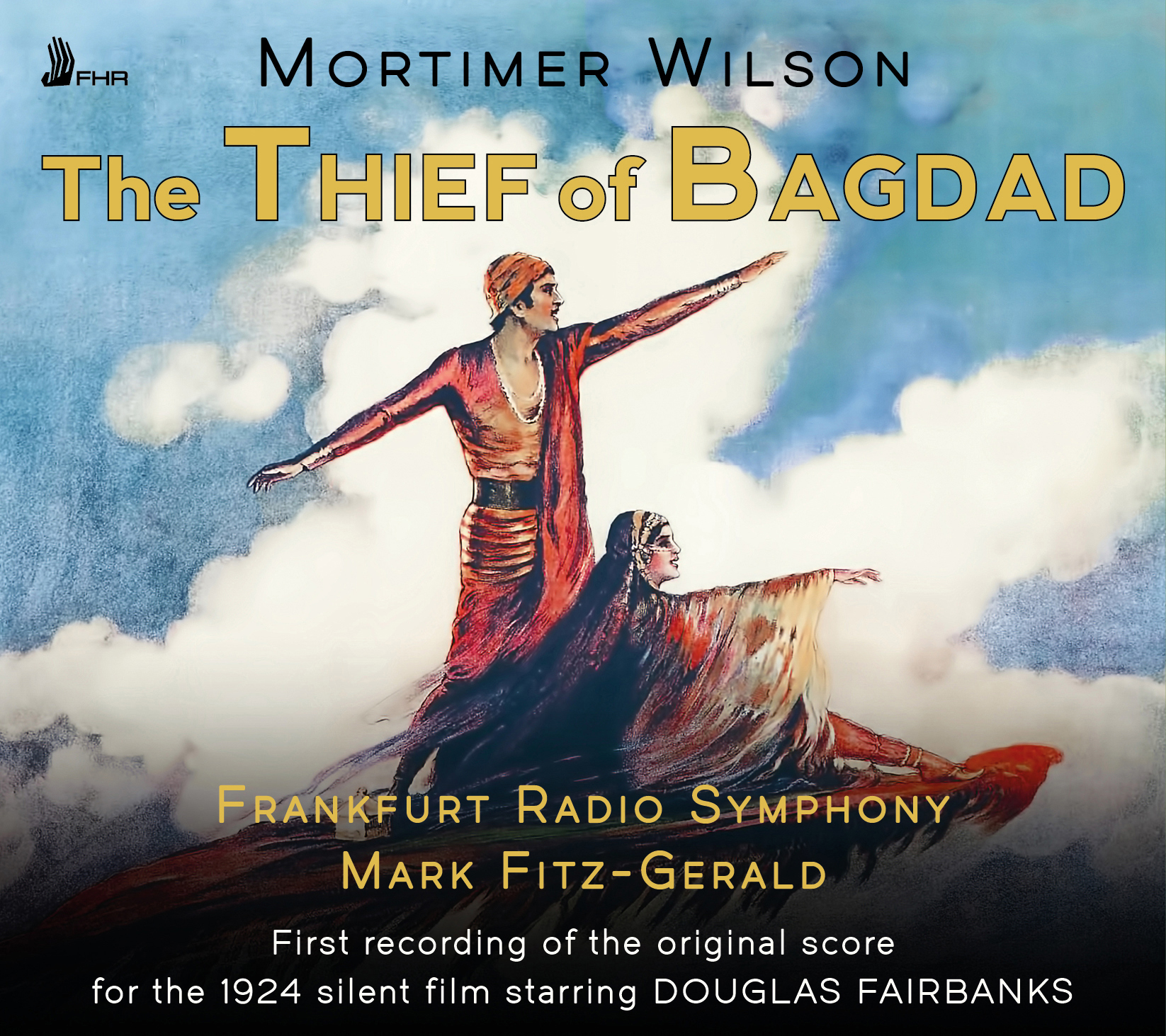
Frankfurt Radio Symphony Orchestra / Mark Fitz-Gerald
Wilson The Thief of Bagdad Op.74 (1924)
First Hand Records FHR126 [74’45”]
Producer Philipp Knop Engineer Lisa Harnest
Recorded 11 April 2019 at Sendesaal, Hessicher Rundfunk, Frankfurt
Written by Richard Whitehouse
What’s the story?
First Hand Records comes up with another ‘first’ in this recording of the score for the film The Thief of Bagdad starring Douglas Fairbanks – one that set new standards for the ‘epic’ during the silent era, and which originally featured music to match from Mortimer Wilson.
What’s the music like?
Having starred in several major films (The Mark of Zorro, The Three Musketeers and Robin Hood), Fairbanks Sr determined to take matters to another level with The Thief of Baghdad – not least making its score an integral component. For this he turned to Wilson (1876-1932) – who had studied in Leipzig with Reger and later directed the Atlanta Symphony Orchestra, writing numerous compositions and several pedagogical books – encouraging him to create music whose symphonic aspect and panoramic expression were in themselves innovative.
Not all those involved in the project shared Fairbanks’s enthusiasm – among them impresario Morris Gest, who conspired to replace Wilson’s score with one from a higher-profile figure. James C. Bradford’s hurriedly assembled concoction almost immediately fell by the wayside, allowing the film’s highly successful first run to continue with Wilson’s music firmly in situ. Understandable, perhaps, why it had garnered praise but also attracted reservations given an emotional intensity and technical intricacy in advance of those previously attempted within a cinematic context. That said, Wilson was keen to make realization as practicable as possible – using relatively modest forces to facilitate performances in out-of-town venues, limiting the number of tempo or expression markings and even printing its parts in an easy-to-use format.
Nine decades on, its restoration was inevitably a challenge such as Mark Fitz-Gerald, having done comparable work on Shostakovich’s similarly ground-breaking scores for New Babylon (Naxos 8.572824-25) and Alone (Naxos 8.570316), was well equipped to undertake. How the music was initially reassembled and then adjusted to ensure its absolute synchronization with the film is explained in the accompanying booklet, a process which took several months prior to the first present-day showing at the Pordenone Silent Film Festival in October 2016, with the French premiere at Lyon this March. DVD presentation will hopefully be possible in due course; for now, the opportunity to hear Wilson’s superbly crafted score in so sympathetic a performance can only be welcomed by admirers of silent films and early 20th century music.
Does it all work?
Nearly always. Wilson’s music is firmly within the late-Romantic vein of Glière or Respighi, though a pertinent comparison might be Ernesto Halffter’s score for the silent film Carmen released just two years later and on which Fitz-Gerald undertook a similar act of restoration (Naxos 5.572260). In both cases, the music’s panoramic sweep is reinforced by interplay of themes and motifs which sustains dramatic tension across the whole. Moreover, the exclusion of repeated sections makes for a ‘screen symphony’ which fits comfortably onto a single disc.
Is it recommended?
Indeed. The Frankfurt Radio Symphony Orchestra responds ably to Fitz-Gerald’s astute direction, and the sound has clarity as well as presence. The booklet, featuring extensive commentaries by Fitz-Gerald and Patrick Stanbury, sets the seal on this ambitious and worthwhile enterprise.