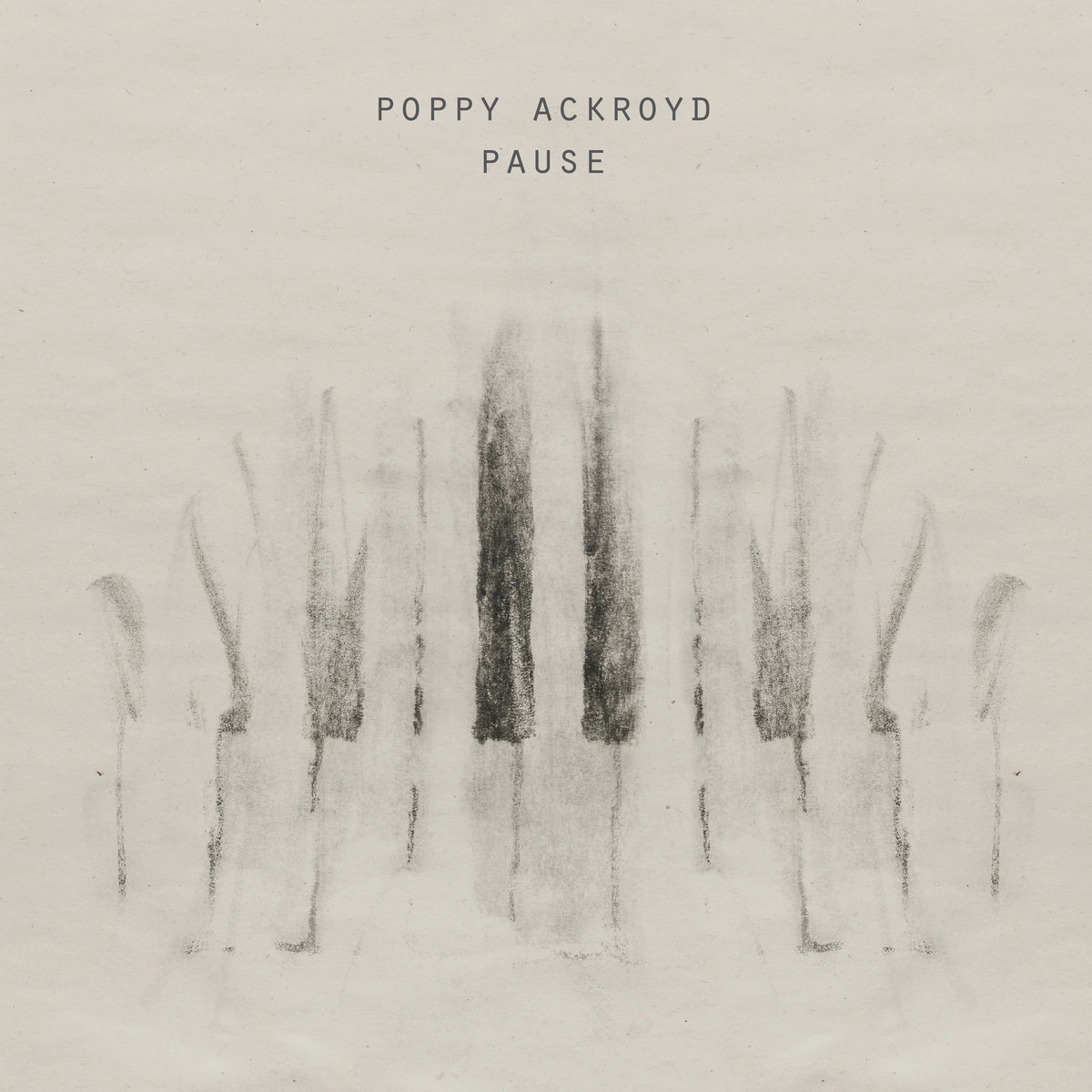
On Record – Poppy Ackroyd: Pause (One Little Independent Records)

poppy-ackroyd

reviewed by Ben Hogwood

What’s the story?

Poppy Ackroyd’s fourth album could hardly be a more personal document. Written during the pandemic, it is a first-hand account of life being put on hold – but at the same time tells the story of the birth of her son. Often the newborn was asleep on the composer as she wrote at the piano, while other work was done in the rare free moments the new mother was allowed.

What’s the music like?

Ideal for this time of year. Although a piano album there are a lot of imaginative sounds and colours not normally associated with the instrument, as Ackroyd stretches its capabilities. Not content with using the conventional white and black keys, she leans into the piano to utilise the taut strings, creating effects like that of a harp or harpsichord.

Suspended, for instance, is performed with both hands inside the piano, using a mysterious tapping sound like someone knocking on the window. Meanwhile Muted was recorded using cloth to dampen the strings in the piano’s lower half. The resultant pinpricks of melody are rather beautiful. Pause itself is a combination of conventional sounds and the inner strings, the music effectively set for two instruments as it extends its icy tendrils.

Impulse uses a wider range of the keyboard, with an easily flowing discourse that suggests it was written with a white flash of inspiration, using simple but expressive figurations that become gradually more expansive. Release enjoys its freedom, showing how Ackroyd’s titles are accurate descriptions of what happens in the music.

Perhaps the most vivid imagery can be found on Murmurations, which captures the rediscovered love for nature a lot of us have felt in recent times. The swirly give and take is compelling to the listener, especially on headphones.

Does it all work?

It does. Ackroyd’s work as a pianist is completely free of any mannerisms or clichés. It is a purely instinctive and personal piece of work, which means it flows beautifully as an album.

Is it recommended?

It is. Pause is an accurate reflection of the emotions we all felt during the pandemic, but it is an ultimately positive piece of work, making the most of freedom where it has been allowed. Ackroyd gets the balance of natural piano work and manipulation just right, her instrument blessed with some lovely autumnal textures but also an intensely personal communication.

Stream

Buy


On Record – The Limiñanas & Laurent Garnier: De Película (Because Music)

liminanas-garnier

reviewed by Ben Hogwood

What’s the story?

This is the tale of a friendship, a musical spark and the concept album that came out of it. Laurent Garnier met Lionel and Marie Limiñana back in 2017, and the three bonded initially over Lionel’s ringtone, The Kingsmen’s Louie Louie.

They stayed in touch, hooking up to make an album following a 1960s’ couple on a road trip. We join the pair, Juliette and Saul, at the southern border of France, near Spain, and we pass – in the words of the trio – through ‘squalid brothels, third-rate dance clubs, ‘60s vintage caravans, smack, Roger Harth and Donald Cardwell productions, distortion and fuzz-pedal sound effects. Gilles Deleuze, Professor X and the preacher from ‘The Night of the Hunter’ are some of the characters that inhabit the world of this drama-inspired record’.

Initially Lionel included some electronic beats in the album, leaning towards Garnier’s long-established techno workings, but the Frenchman rejected these in favour of keeping the Spanish duo’s psychedelic sound at the front of the mix.

What’s the music like?

Prepare for some adrenalin-fueled highs as the music of De Película takes shape. The three musical protagonists have harnessed their love of Krautrock – and especially Can – to make a set of driving musical grooves that are by turns thrilling and mesmeric.

They express themselves through propulsive rhythms on tracks which often choose a single pitch as a bass and stick to it, creating a hypnotic groove for the listener. When pared with a spoken word narrative the music works really well. Je rentrais par le bois…definitely falls into this category with its slowly creeping melody and psychedelia, as does Juliette dans le caravane, which adopts a similar profile. Steeplechase speeds off into the distance, a thrilling rush of sound over a pulsating groove, If anything Que Calor! is even better, with the attitude of Edi Pistolas’ spoken word coursing through its veins.

Some of the slower rhythm tracks hark back to the big beat sound emanating from Brighton in the late 1990s, but ultimately go beyond that to ape the cavernous sound of late 1960s’ psychedelia . Tu tournes en boucle is one such example, while Juliette adds a smoky texture and atmospheric commentary.

Does it all work?

It does. De Película is a lot of fun, flexing its muscles but not wanting to be taken too seriously. It is easy to sense the fun Garnier and the Limiñanas had in each others’ company

Is it recommended?

Yes. Laurent Garnier’s fascinating musical evolution continues, but this collaboration reflects well on both sides, bringing out their strongest musical identities in music that gives its listener plenty of thrills and spills.

Stream

Buy


Switched On – Quivver: Revelate (Bedrock)

quivver

reviewed by Ben Hogwood

What’s the story?

Quivver, the alias of John Graham, has been held in high regard by lovers of house music for more than two decades now, channelled through the decks of top level DJs including Paul Oakenfold, Sasha and John Digweed. Graham’s moniker stands for high quality house, occasionally known as ‘progressive’ or even ‘trancey’, but never regarded as anything other than consistently good.

Graham has overseen a stream of good singles releases that have been lapped up in the clubs, and occasionally he has put them together in album format. Revelate is the third of those, delivered for his good friend John Digweed’s Bedrock label – the two DJs having been acquainted for a good three decades now.

What’s the music like?

Everything Quivver has already established is present here – and yet he always manages to make music that sounds both old and new. By that I mean that some of the tracks could easily fit on a Renaissance compilation from the mid-1990s, but equally they sound fresh out of the studio.

The chunky beat and flickering electronics for Altered are a great example of his craft, while Funkfly sounds like a classy update of one of those Renaissance tracks. Hold has some lovely washes of sound while Crystals has a similarly deep warmth, a flicker of heat at the edge of its synth lines. The disposition of the album is gloriously moody, but fully supports an extended session on the dancefloor.

Rather than do what many house albums do and opt for tracks of 7-8 minutes, Graham has gone for tightly formed tracks, almost all of which clock in after 5. Just occasionally – Funkfly especially – the track could easily go on for double its length, but other than that the Quivver instinct for punchy and effective material is rewarded.

Does it all work?

Yes. It’s great to see such a long-established name back with a high-quality album like this. Graham’s structure is impeccably cast and tells its own story, acting a bit like a DJ mix by one artist.

Is it recommended?

Definitely. If you’ve had even a passing acquaintance with the music of Quivver in the past, you need not waste any more time in adding Revelate to your collection. If his is a new name to you, it’s also a great place to start!

Stream

Buy


Bernard Haitink – An appreciation

by Ben Hogwood

Last week we heard the sad news of the death of Dutch conductor Bernard Haitink at the ripe old age of 92.

Haitink was a special man indeed, seen by many as the last in a long line of ‘old school’ conductors. He was an artist of great craftsmanship and elegance, who earned the respect of his peers through an incredibly long career that only ended in 2019.

The tributes flooding in from ensembles the conductor worked with say everything about Haitink as a man. The Salzburg Festival declared, “The music world has lost one of its very greatest. His aim was never to triumph; probably that is why his interpretations became such triumphs.” The Berliner Philharmoniker praised how “He always impressed and inspired us with his qualities – his great craftsmanship, his perfect knowledge of the score, his warm, noble bearing.” From Sir Simon Rattle, an insight borne of personal experience: “He was one of the rare giants of our time, and even rarer and more precious, a giant full of humility. My dear Bernard, we keep you deep in our hearts.”

Like many people I have had the pleasure of listening to Haitink’s recordings for many years, but my first live memories go back to the first ever BBC Proms concert I attended in September 1997. There he conducted the European Union Youth Orchestra in Bruckner’s Symphony no.7, following a sensitive account of Beethoven’s Piano Concerto no.4 where the soloist was Emanuel Ax. By coincidence the same works and soloist featured at Haitink’s last Prom in 2019, this time with the Vienna Philharmonic.

I also saw Haitink at the Proms in 2005, conducting the London Symphony Orchestra as soloist Hélène Grimaud performed the Ravel Piano Concerto. After the interval, Haitink gave a characteristically poised account of Shostakovich’s Eighth Symphony, which left its mark on this particular listener for days:

I remember too a very special pair of Proms in 2011, Haitink and Ax united once again for Brahms with the Chamber Orchestra of Europe, one of several ensembles with which the conductor forged a special relationship.

As a recording artist, Haitink gave us a vast array of special symphony, concerto and opera recordings. He recorded multiple symphony cycles of Mahler, Bruckner, Beethoven, Brahms and Schumann, not to mention landmark collections of Shostakovich and Vaughan Williams symphonies with the Concertgebouw and London Philharmonic Orchestras, and fine cycles of Rachmaninov and Beethoven piano concertos with Vladimir Ashkenazy and Alfred Brendel respectively. That’s before we even get to opera! There he delivered much-loved recordings of Mozart, Wagner, Richard Strauss and Britten to highlight just a few.

I have delved into the discography for a set of recordings with personal significance – which can be accessed on the Spotify playlist below. They include Mahler, Bruckner, Shostakovich and begin with Vaughan Williams’ Symphony no.5, with the London Philharmonic Orchestra.

It is safe to say that Bernard Haitink will occupy a special place in the heart of many a musician and listener, and this gives just a small number of reasons why:

On Record – MF Robots: Break The Wall (BBE)

reviewed by Ben Hogwood

What’s the story?

MF Robots is the continuation of a prestigious family tree in British soul and funk music. The new project is spearheaded by Jan Kincaid and Dawn Joseph, who were once part of the Brand New Heavies. Jan, a founding member and part of the group since 1985, found that when he and Joseph started working together they were instantly musically compatible. Drawn to the new project, they wasted no time in building a substantial group together.

There has never been an explicit desire to deviate greatly from their roots, the group’s Bandcamp page professing a continued love of 1970s and 1980s American rhythm sections while recognising the importance of their part in Acid Jazz with the Heavies in the early 1990s. MF Robots, though, is a move towards a more improvised and instinctive way of working, collaborating with a number of illustrious guests.

The group is completed by keyboard player Alex Montaque, bass player Naz Adamson, guitarist Mark Beaney, Jack Birchwood on trumpet and Ben Treacher on saxophone. The guests include bassist Gail Ann Dorsey, who has session work with David Bowie and Lenny Kravitz under her belt, and guitarist Cory Wong, a solo artist and member of the Vulfpeck collective.

What’s the music like?

MF Robots are like an Indian summer. Their approach is incredibly fresh, their grooves and rhythms straight off the page and with a whole set of brilliant songs to offer. The chemistry between players is evident, but the song is always the winner. In the best tracks we get a good song and an excellent instrumental section, with extended grooves like Crazy Life hitting the spot consistently.

That track is a faster number and is immediately complemented by the slower funk of Gold, beautifully sung by Kincaid with an easy, natural groove and punctuation from the brass of Birchwood and Treacher.

The band’s early songs, over a year old now, sound brilliant in the context of the album. Mother Funkin’ Robots is a celebration of their funk heritage, with some seriously taught grooves, while the extended version of Happy Song leans provocatively towards the sounds of Masters At Work. Good People has a radio friendly chorus that the likes of Trevor Nelson have been quick to exploit, while the breezy Make Me Happy has immediate sunshine appeal. Brand New Day is another singalong number, while Foster adds a really nice touch to songs like The Love It Takes and You, ‘walkin’ the walk with your head in the clouds’ rather beautifully.

Does it all work?

Absolutely. The band do pay an obvious homage to the music of their immediate past, but their own musical instincts and personalities shine through in a set of fresh, upbeat and celebratory songs. If you want to sing and dance with considerably less cares in the world than you currently have, then this is the place to come!

Is it recommended?

It certainly is. Break The Wall hangs together effortlessly, a stream of rhythmic consciousness and good feelings that manifest themselves into some excellent songs. MF Robots are an outfit to keep tabs on, for sure.

Stream

Buy