Switched On – Bonobo: Fragments (Ninja Tune)

bonobo

reviewed by Ben Hogwood

What’s the story?

Perhaps surprisingly, this is the first album from Bonobo in five years. Simon Green – whose pseudonym this is – describes his new record as the most emotionally intense record that he has ever had to make. As with previous releases he takes a number of guest vocalists with him on the journey, dovetailing those tracks with instrumentals.

What’s the music like?

Familiar. If you have heard Bonobo’s music before, the manner of its construction on Fragments will tick a number of boxes. Beautifully orchestrated, the instrumentals work well with the broken beats that Green employs, which have more power and depth this time.

The vocal guests complement his sensitive work with some meaningful lyrics. There are strong contributions from Joji, Kadhja Bonet, Jamila Woods and O’Flynn, but pick of the turns is from Jordan Rakei, who lends a powerful tug to the heartstrings on Shadows.

The thicker set grooves may be welcome, but does the familiarity of Bonobo’s sound breed contempt? Certainly the chopped up vocals on Age Of Phase feel familiar, very much a continuation of what Bonobo does best. Rosewood is also a characteristically moody instrumental with vocal snippets, though Otomo is more acidic, dropping a heavy set beat. On the calmer side the shuffling beats of the comforting Closer work well, while the silvery strings to close out Tides are reminiscent of Ravel. Elysian also has alluring strings, especially when teamed with a harp.

Does it all work?

It does, but the feeling persists that this is music we have heard before – and possibly in more meaningful colours. In spite of the emotion invested by Green the music does feel grey at times. That may seem harsh on Bonobo, for the music is beautifully constructed and executed, but it is more than a little downbeat in a way we have experienced before.

Is it recommended?

It is for Bonobo devotees, as there are some good moments here – and especially the Jordan Rakei contribution – but for those new to his sound an album from earlier in his output, such as Black Sands, is arguably the best place to start.

Stream

Buy


Switched On – FMS-80: Lifestyle 02 (Rednetic)

fms-80

reviewed by Ben Hogwood

What’s the story?

FMS-80 is one of the pseudonyms used by Joseph Auer. It is shorthand for FM Synthesis 1980, and is influenced by the Yamaha DX FM compositions of that time – and especially those made by a number of Japanese producers in their environmental tracks.

Auer offers a nine-track album as the second in the Lifestyle series, released on his co-founded label Rednetic. The artwork and musical language suggest a close kinship with the music of the Far East, so expectations are high for a production as clean and invigorating as suggested by the cover.

What’s the music like?

Richly rewarding. Auer spends much of his time on this album in the treble range, exploring brightly coloured textures and a wide range of timbres. Many of these explorations use consonant harmonies, bathing the listener in a warm glow, but there is always an edge to the ambience that stops it from becoming too comfortable.

Beidaihe Loop, for instance, is scored for a body of metallic, percussive sounds, its effect like a peal of bells. By contrast later tracks on the album have more white noise and scattered beats, with Changgo House behaving like an active radiation counter and Swedish Container adding white noise to the picture.

Esplanade View is a warm-hearted gem, softening the timbres and creating a rich pool of sound, beautifully realised as a track to dive into at high volume. Housing Development has a glitchy texture but pans out quite a way, its effect akin to silvery droplets landing on a windscreen. Engawa Pergola paints a watery picture, while Sentul East Atrium offers a rather beautiful open vista and another bright view for the headphone-based listener.

Does it all work?

It does, and Auer knits together the different shades and moods in a rather seamless patchwork of ideas. The titles and music are borne of the far East but travel well.

Is it recommended?

Enthusiastically. The Rednetic label is hitting its stride as a positive force to be reckoned with in electronic music, and this is another feather in their cap.

Stream & Buy


On record – Ronald Stevenson: Piano Music Volume Five: Transcriptions of Purcell, Delius and Van Dieren (Christopher Guild) (Toccata Classics)

stevenson-5

Delius The Young Pianist’s Delius (1962, rev. 2005)
Purcell Toccata (1955); The Queen’s Dolour – A Farewell (1959); Hornpipe (1995); Three Grounds (1995)
Stevenson Little Jazz Variations on Purcell’s ‘New Scotch Tune’ (1964, rev ’75)
Van Dieren String Quartet No. 5 (c1925, rev. 1931; transcr. c1948-1987); Weep You No More, Sad Fountains (1925, transcr, 1951); Spring Song of the Birds (1925, transcr. 1987)

Christopher Guild (piano)

Toccata Classics TOCC0605 [80’57”]

Producer / Engineer Adaq Khan

Recorded 5 – 6 September 2020, 5 January 2021 at the Old Granary Studio, Toft Monks, Norfolk

Written by Richard Whitehouse

What’s the story?

Christopher Guild continues his survey of Ronald Stevenson’s piano music with this volume comprising transcriptions of Purcell, Delius and Van Dieren – the latter’s Fifth Quartet fairly exemplifying Stevenson’s dedication to the spirit as much as the letter of the music at hand.

What’s the music like?

The essence of Stevenson’s re-creative approach is evident in his Purcell transcriptions, not least the Toccata with its deft changes of register and tensile rhetoric where Busoni’s benign presence can be felt. A lighter and more playful manner is evident in the Hornpipe, whereas the Three Grounds point up conceptual as well as musical links with Bach and, through their forming a ‘sonatina’ of unlikely cohesion, Beethoven. Greater license is demonstrated in the Little Jazz Variations, surely among Stevenson’s most delightful pieces in its blurring of the ‘boundary’ between transcription and composition and enhanced by its discreet take on pre-bop jazz idioms. The Queen’s Dolour looks to the poignant final aria from Dido and Aeneas for what is one of the most characteristic and, moreover, affecting Stevenson transcriptions.

All these pieces have been previously recorded, but not the remainder of this programme. A pity that The Young Pianist’s Delius is not more widely known, as this cycle of 10 miniatures drawn from across the composer’s output is a gift to pianists who have little original Delius to work with, whereas listeners who are unfamiliar with or deterred from investigating this easily misunderstood figure could hardly hope for a more representative or appealing breviary of his music. It helps that Stevenson’s transcriptions are straightforward but not in the least didactic.

Two songs by Bernard van Dieren – gravely eloquent as regards Weep You No More or deftly effervescent in Spring Song of the Birds – have secured a measure of familiarity when heard as encores. Not so the Fifth Quartet, never recorded in its original guise, whose transcription occupied Stevenson over almost four decades. Premiered in its revision in 1931, this work is among the most substantial from its composer’s later years as it unfolds from a discursive (if never rhapsodic) sonata design, via circumspect and headlong intermezzi, to a lively scherzo then soulful Adagio – before a resolute finale offers closure. Tonal ambivalence and textural intricacy are borne out in this recasting in terms of piano which lasts five minutes longer than the Allegri Quartet’s 1988 broadcast; not that Guild’s reading seems to lose focus in any way.

Does it all work?

Yes, given Stevenson’s command of keyboard technique and, moreover, his placing of this at the service of the piece in question. To paraphrase his comments on Liszt – were the classical repertoire suddenly to disappear, much it could still be accessed through those transcriptions that he made over the greater part of his career. Nor is the technique required of a consistently advanced degree, with the Delius and several of the Purcell pieces accessible to most capable pianists, though the Van Diren quartet necessitates an ability not far short of the transcriber!

Is it recommended?

Indeed. Christopher Guild is a resourceful and probing guide to Stevenson’s art; his Steinway D heard to advantage and his booklet notes readably informative. One final thought – the Van Dieren Quartets positively cry out for an integral recording: how about it, Toccata Classics?

Listen

https://open.spotify.com/album/6EDUvp6G1WYgOY3yIHegtF

Buy

You can discover more about this release at the Toccata Classics website, where you can also purchase the recording. To find out more about the composer, visit the Ronald Stevenson Society, while for more on Christopher Guild, click here

Switched On – preston.outatime: Mirror Radius (Subexotic Records)

preston-outatime

reviewed by Ben Hogwood

What’s the story?

Brighton-based producer Preston Parris has been making music since the early 2000s, and this is his third long player under the preston.outatime moniker. Mirror Radius explores the theme of being lost but from a positive viewpoint, giving rise to opportunities for discovery within the natural world.

What’s the music like?

Mirror Radius is one of those albums immediately transporting the listener from their starting position to another world. Describing the album from start to finish, Permafrost begins as the track responsible for this transportation, its icy piano tendrils extending beyond the other treble lines, with a reassuring bass pulsing away underneath. All the while in between there is the constant spray of water, more balm to the listener’s ear:

Focusing Out pans even further towards the horizon, its thick ambience surrounding the headphone listener, though this is gradually cut up into a glitchy series of fragments. Postshadowing shows Parris’ ability to find original sounds and textures, with a glinting edge to the texture suggesting wintry sunshine reflected on metal. Mirror Radius forms the central point of the album, looking forward and back with a loop suggesting steel pans and recalling some of the best Plaid material.

The busy beats of this track segue into the immensely calming Antechamber, another watery experience of cool, rippling textures, before Slitscan paints a more distracted and mysterious set of images, distorting the light and pushing slow, irregular beats into the mix. Cut The Knot is a moody beauty, its probing lines underpinned by a solid, concrete rhythm track. Finally Backmask, a bonus, shimmers in the half light, the cold textures having returned.

Does it all work?

Yes. There is an abundance of ideas in this music, some of it drawn from the Replanar album of 2020, but everything here sounds very instinctive under Parris’s guidance. The combination of ambience and foreground material is finely judged.

Is it recommended?

It is – another excellent addition to preston.outatime’s increasingly substantial body of work, which finds consistently original timbres and vistas. There is much to enjoy here.

Stream

Buy


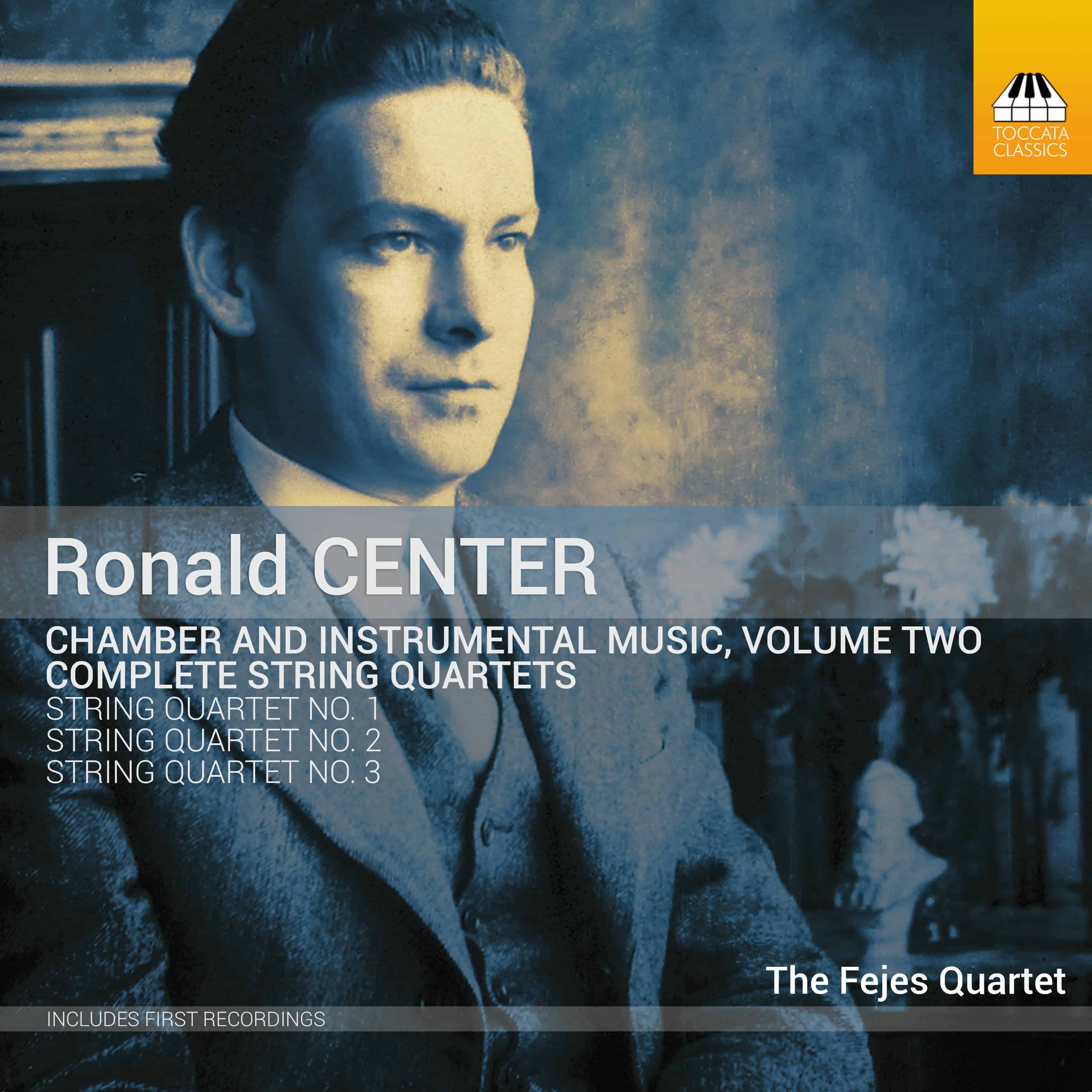
On record – Ronald Center: Chamber and Instrumental Music Volume 2 – String Quartets 1-3 (The Fejes Quartet) (Toccata Classics)

center

Robin Center
String Quartet no.1 (c1955)
String Quartet no.2 (1962-4)
String Quartet no.3 (1967)

Fejes Quartet [Tamás Fejes and Yoan Hlebarov (violins), Theodore Chung Lei (viola), Balázs Renczés (cello)

Toccata Classics TOCC0533 [70’34”]

Producer / Engineer Michael Ponder

Recorded 29 June – 2 July 2019 at RSNO Centre, Glasgow

Written by Richard Whitehouse

What’s the story?

Toccata Classics continues its coverage of the Chamber and Instrumental Music by Ronald Center (1913-73) with this release of his three string quartets, written over his final 12 years of creativity and illustrating in full measure the strengths and weaknesses of his composing.

What’s the music like?

Born in Aberdeen then resident in the town of Huntly during his final three decades, Center was evidently a circumspect and retiring figure – if a hard taskmaster for those who studied with him. His modest output includes the powerful cantata Dona nobis pacem (issued on LP by Altarus back in the 1980s and well worth a new recording) and three string quartets – the first being the only work of his which saw publication in his lifetime. Taken as a whole, they epitomize an idiom that is trenchant and idiosyncratic, but often touching in its vulnerability.

The First Quartet is launched by an introduction whose dense textures duly set up the main Allegro by turns forthright and acerbic, its dissonance imbued with stealthy onward motion. There follows a scherzando-like movement whose tensile rhythms underpin ideas of a folk-inflected vitality, then an Adagio where facets of chorale and canon merge into a plangent and haunting threnody. After its equivocal opening bars, the final Allegro maintains a keen impetus – spurred on by pronounced ostinato patterns – through to its curtly decisive close.

The Second Quartet is on an incrementally larger scale, the opening movement setting forth with a proclamatory summons which the main Allegro unfolds in varied and often ingenious ways – not least the way its deceptively episodic trajectory evolves a long-term momentum. There follows a Vivace whose waspish demeanour is by no means devoid of humour, then a Mesto whose modal inflection and wistful central section make it the work’s emotional heart. Dance elements pervade the finale, an Allegro of headlong and ultimately unresolved energy.

The Third Quartet is outwardly more exploratory in its intensive use of serial elements and a seven-movement format, out of which larger sub-groupings emerge. Hence the opening two movements outline a methodical then ruminative first part; balanced by the speculative then quizzical, and impetuous then halting character of those which follow. That leaves the final Allegro to provide its forceful if increasingly eloquent and not a little fatalistic conclusion to a work which, though he was to live for a further six years, proved to be the composer’s last.

Does it all work?

Almost. Center was evidently a composer fully aware of what had been written in Europe up to the Second World War and after 1945, yet his three quartets suggest an ongoing struggle to redefine the possibilities of Bartók and Shostakovich et al in his own terms – hence leading to a sense of frustration, even inhibition, which is reflected in the frequent formal and expressive discontinuities of each piece. Qualities that come over in these excellent accounts by the Fejes Quartet, whose interpretative equivocation is – necessarily? – bound up with that of the music.

Is it recommended?

Yes. The first two quartets have been recorded (by the Saltire and Isla Quartets respectively) but having all three in first-rate sound with insightful notes by Alasdair Grant can only be to Center’s benefit. Might it be possible to record the music for string orchestra in due course?

Listen

Buy

You can discover more about this release at the Toccata Classics website, where you can also purchase the recording. To find out more about the composer, visit the Ronald Center website, while you can click on the links for more on the Fejes Quartet and Deveron Projects