On record – Mihalovici: Piano Music (Matthew Rubinstein) (Toccata Classics)

TOCC-0376-Mihalovici-piano-music-cover

Mihalovici
Sonatine, Op. 11 (1922-3). Quatre Caprices, Op. 29 (1928). Ricercari, Op. 46 (1941). Quatre Pastorales, Op. 46 (1950). Sonate, Op. 90 (1964). Passacaille (pour la main gauche), Op. 105 (1975)

Matthew Rubinstein (piano)

Toccata Classics TOCC0376 [73’52”]

Producer Boris Hofmann
Engineer Henri Thaon

Recorded 5 & 6 June, 30 & 31 July 2018 at Jesus-Christus-Kirche, Berlin

Written by Richard Whitehouse

What’s the story?

Toccata Classics turns to the Romanian émigré Marcel Mihalovici (1898-1985) whose music has been poorly served by recording but whose works for piano, most often premiered by his wife Monique Haas, affords (in this selection) a representative overview of his sizable output.

What’s the music like?

Among the shorter pieces, the Sonatine typifies the neo-classical objectivity of the composer’s earlier music with the nimble fluidity of its outer movements framing an Andante of winsome delicacy. More testing pianistically, the Quatre Caprices recall Mihalovici’s slightly younger (and similarly Paris-based) contemporary Alexander Tcherepnin in their oblique poise along with that stealthily accumulating energy made manifest in the motoric Allegro – its ‘furioso’ marking subtly underlined here – though not before an Andantino of ruminative elegance. If the Quatre Pastorales strikes a deeper note, this is likely through the deft folk inflections as are manifest across the alternate whimsy and exuberance of these miniatures – culminating with a final Allegro reminiscent of Enescu in its ringing sonorities and cascading harmonies.

A breakthrough in several respects, Ricercari proceeds less as a set of variations than of free variants on a discursive theme whose indebtedness to a passacaglia – not merely for its tempo – is explored intensively during what follows. Surprisingly, perhaps, most of the ‘variations’ are rapid or at least flowing in manner – the propulsive ninth of these heading into a fugue as revisits the theme with renewed impetus in a gradual accumulation of energy; culminating in a notably equivocal restatement of the theme, itself making way for the tenuous final gesture.

The latter two works come from Mihalovici’s high maturity – the Sonate outwardly evoking Classical precepts with its clearly defined three movements. Less so the opening Allegretto’s nonchalant overriding of expected formal divisions, the central Lento’s freewheeling play on gesture and phrase (with its tangible recourse to the ‘doina’ crucial to Romanian traditional music), then the final Allegro’s capricious yet purposeful unfolding towards a conclusion of no mean agility in which the composer’s pianism is at its most combative and declamatory.

The left-hand Passacaille is a fair definition of ‘late masterpiece’, its gnomic theme made the basis of 18 variations whose diversity of motion and consistent brevity belie the formal focus with which the composer builds towards the lengthier closing brace. Hence the 17th with its plaintive demeanour and probing introspection, then the 18th – a ‘quasi una cadenza’ – that steers a determined course through to its unexpectedly stark close: mastery of means allied to that of technique in this undoubted enhancement of a distinctive if often intractable medium.

Does it all work?

It does, not least because Mihalovici is clearly a master at combining different stylistic facets that are more than the sum of their influences. Matthew Rubinstein evidently appreciates this with interpretations of methodical attention to detail, allied to playing of undoubted panache.

Is it recommended?

It is, given that only two pieces had been earlier recorded with only Ricercari easily available. Spaciously defined sound from the fabled Jesus-Christus-Kirche, and detailed notes by Lukas Näf. Hopefully, recordings of Mihalovici’s orchestral and chamber music will prove feasible.

Listen

Buy

You can discover more about this release at the Toccata Classics website, where you can also purchase the recording.

On record – Early Stereo Recordings Vol.4: Albéniz, Bizet, Kodály & Ravel (First Hand)

early-stereo-recordings-4

Philharmonia Orchestra / Eugene Goossens (a), Guido Cantelli (d); Royal Philharmonic Orchestra / Vittorio Gui (b) Paul Kletzki (c), Eugene Goossens (e)

Albéniz (orch. Arbós) Iberia – excerpts (1905-09, orch. c1928) (a)
Bizet Petite Suite (1871, orch. 1880) (b)
Kodály Dances of Galánta (1933) (c)
Ravel Daphnis et Chloé Suite no.2 (1909-12): Danse générale (d); Boléro (1928) (e)

First Hand Records FHR79 [78’21”]

Producers David Bicknell (a), Lawrance Collingwood (b,d,e), unknown (c)
Engineers Christopher Parker (a-d), Robert Gooch (e)

Recorded 12 July 1955 (b), 18 September 1957 (e) at Abbey Road Studios, London; 15 February (a), 24 March (c) and 28 May 1956 (d) at Kingsway Hall, London

Written by Richard Whitehouse

What’s the story?

First Hand Records continues its exploration of pioneering stereo recordings from the EMI archives with this collection of orchestral works, mainly from the earlier decades of the 20th century, as demonstrates the success of various HMV producers and engineers in harnessing the potential of stereophonic sound to the playing of what, in the 1950s, were the two finest London orchestras – the Philharmonia and Royal Philharmonic, working with conductors in music with which they were not necessarily associated over the greater part of their careers.

What are the performances like?

Starting with an incisive yet expressively deadpan take on Ravel’s Danse générale, all that survives in stereo of Guido Cantelli’s recording of the Second Suite from Daphnis et Chloé, the selection proceeds to excerpts from Albéniz’s piano cycle Iberia, orchestrated by Enrique Arbós. Seldom encountered in concert nowadays, these five pieces (all of the First, plus one each from the Second and Third Books) constitute a worthwhile suite in themselves. Eugene Goossens duly underlines his prowess in earlier 20th-century music with performances that bring out the evocative poise of Evacación, then alternate fervour and piety of El Corpus en Sevilla, before the capricious charm of Triana and capering energy of El Puerto; the cumulative emotional charge of El Albaicin closing this sequence with unfailing panache.

Goossens is hardly less persuasive in Ravel’s Boléro – at this time, not quite the ubiquitous showpiece it became – the inexorably accumulating momentum ideally served by his refusal to rush its devastatingly effective trajectory; the final stage largely taking care of itself when allowed to emerge inevitably. A further worthwhile revival is that of Bizet’s Petite Suite, five miniatures drawn from his earlier cycle for piano duet Jeux d’enfants and given with winning deftness by Vittorio Gui – demonstrably in his element when the sessions for his re-recording of Mozart’s Le nozze di Figaro finished ahead of schedule. Kodály’s Dances of Galánta has itself returned to favour in recent years, but few accounts are ever likely to match that of Paul Kletzki in his steering this ever more animated sequence through to its breathless conclusion.

Do they all work?

Pretty much, allowing for occasional lapses in ensemble that are notably few given the hectic schedule these London orchestras pursued at this time. Remastering has been deftly handled by Ian Jones – Albéniz and Bizet being transferred from HMV Stereosonic tapes, respectively by Giampaolo Zeccara and Ted Kendall (the latter’s 1997 set of Mahler ‘first recordings’ for Conifer is fondly remembered). There are extensive background notes from David Patmore, along with observations by Peter Bromley, whose tenacity has made possible this FHR series.

Are they recommended?

Indeed, not least given the interest of the actual music and the relative unfamiliarity of most of the recordings. The rapid standardization of the listening experience through the medium of streaming has made such releases as this more valuable by (hopefully) making potential listeners aware of just what became possible with the greater recourse to the stereophonic process, as of those numerous triumphs (among not a few failings) which resulted given the right combination of technology and musicality. Further instalments are keenly anticipated.

Listen & Buy


You can get more information on the disc at the First Hand website, where you can also find information on the first, second and third volumes in the series 

Let’s Dance – Defected presents House Masters: Todd Edwards (Defected)

house_masters_todd_edwards_4000x4000

Various ArtistsDefected presents House Masters: Todd Edwards (Defected)

reviewed by Ben Hogwood

What’s the story?

The time is ripe for a Todd Edwards retrospective. The much-loved producer, credited as one of the founding fathers of late-90s garage, UK style, has always had a distinctive way of working his beats. With clipped percussion, cleverly-used samples, good humour and a large dose of soul, he has been a go-to man for remix and production for nigh on 30 years. Daft Punk have credited his influence, and worked with him on two albums, while a whole host of chart bothering artists, among them Moloko, Robin S, Wildchild and Wretch 32, have gone his way for a remix.

Recently Defected have taken Edwards under their wing, restoring hundreds of previously unavailable productions to the catalogue, and this double album provides a useful retrospective and a reminder of what might be in store for the collector.

What’s the music like?

Brilliant. You don’t get to be dance music royalty without making good music – and there’s no doubt Edwards makes great music for good times. His fluid grooves are sliced and diced, the clipped percussion sounds putting a skip in each beat.  The approach is largely soulful, and on grooves like God Will Be There and the landmark Edwards production Saved My Life, more than a bit spiritual.

Defected have divided the collection in two, with a set of full length original productions complemented by some excellent examples from the remix collection.  The original productions are equally represented by past and present, with You’re Sorry one of his best recent songs, and the Sinden collaboration Deeper working really well on the vocal front. All I Need is more percussive, while Dancing For Heaven is a buoyant treat and Fly Away is super cool. The Daft Punk association is well represented, with the charmer Face To Face bringing out the best in both sides, and Fragments Of Time, from the Random Access Memories album, a great track for top-down driving.

There is a smoother version of St Germain’s Alabama Blues, with a warm guitar and organ but not quite the heat soaked charm of the earlier version. Indo’s R U Sleeping fares really well, as does Moloko’s Pure Pleasure Seeker – while Zoot Woman’s Taken It All gets a shiny remix.

Does it all work?

Yes. Edwards has an effortlessly cool style and it runs throughout this collection, moving between house and garage with great ease. He always gives the vocal plenty of room, but still packs the production with all kinds of riffs, beats and soundbites, keeping the dancefloor moving at all times.

Is it recommended?

It is – but be warned, listening to this might take you down a Todd Edwards rabbit hole. With so many productions remastered and now available through Defected, it would be churlish to stop here!

Stream

Buy

You can buy David Penn’s House Masters compilation from the Defected website here

On Record – Daniel Wylie’s Cosmic Rough Riders: Atoms and Energy (Last Night From Glasgow)

daniel-wylie

reviewed by Ben Hogwood

What’s the story?

Daniel Wylie has had a long and distinguished career in songwriting, whether with his band, Cosmic Rough Riders, or as a solo artist. Throughout he has stayed true to a classic approach with plenty of room for influences from the 1960s onwards, but with room too for originality of thought in both music and lyrics.

Atoms And Energy is confirmation that the fire still burns brightly. Recorded in Glasgow’s La Chunky Studios in 2019, the album is headed by Wylie but includes contributions from Neil Sturgeon (acoustic guitars), Stu Kidd (percussion) and Johnny Smillie (electric guitars and arrangements), who also engineered the album

What’s the music like?

A mark of Wylie’s career has been his consistency. Even when he returned from the relative wilderness in 2004 to start his solo career with Ramshackle Beauty, the songs confirmed his quality threshold had not dimmed a bit – and the same is true now. If anything, life experience and the discipline of writing songs on an almost daily basis has fed into the music for Atoms And Energy, taking it right up there among the best work Wylie has yet produced.

The lyrics can always be clearly heard – a property often underrated in songs! – and they are notable for their frank and occasionally uncomfortable take on life, warts and all, especially on songs like God Is Nowhere. A melodic approach is sustained throughout, and after several hearings the listener will have several of these songs firmly embedded in the brain.

The lyrics are key to understanding where Wylie is at. A good deal of the memory bank is used as the songwriter harks back to childhood days, but he does so from the context of adulthood and particularly in the wake of his mother’s death. A Memory brings these reminiscences to life with great clarity, while the breezy Heaven’s Waiting Room hangs on to treasured memories while asking the pertinent question ‘why does everybody leave?’ Red Sunset (Green Eyes) is a whimsical number, and although Wylie is ‘feeling sad about my plight’, the outlook – musically at least – is positive.

Many of Wylie’s songs are bittersweet or have darker shades around the edges. The Bruises And The Blood is one such song, a thoughtful opener, while Ruth The Truth ups the ante on the guitar sound, a punchy number where ‘I caught her lying again’.

His wife remains the chief muse, and she appears to be the obvious inspiration for songs like Our Love Will Never Die, an unabashed and tender ode to a long relationship. Saddle Up The Horses comes from a similar emotional place, the album closer doffing its cap to Neil Young along the way.

Arguably the most striking of the nine here, however, is Listen To The Sound Of The Rain, a shimmering beauty that could have been written and imported from the late 1960s. Its dappled psychedelia stretches far in Wylie’s hands, the vocals beautifully poised as he sings of ‘a world full of wonder’, the guitar sound dancing on the musical horizon.

Does it all work?

Yes. Anyone familiar with Wylie’s previous work will know what to expect here – but with part of that expectation comes the knowledge that the songs won’t be routine and won’t be presented without emotive input or instrumental dexterity. The guitar playing is a strong feature of the record, and the lovely shimmering textures are a possible reflection of the cloud-strewn skies under which they were written.

Is it recommended?

Wholeheartedly. Daniel Wylie continues to write moving songs with hooks that take gradual root in the listener’s mind and then prove very difficult to dislodge. Atoms and Energy offers more of the same – but with even greater conviction and quality. 

Stream

Buy

You can purchase Atoms and Energy from the Last Night From Glasgow website


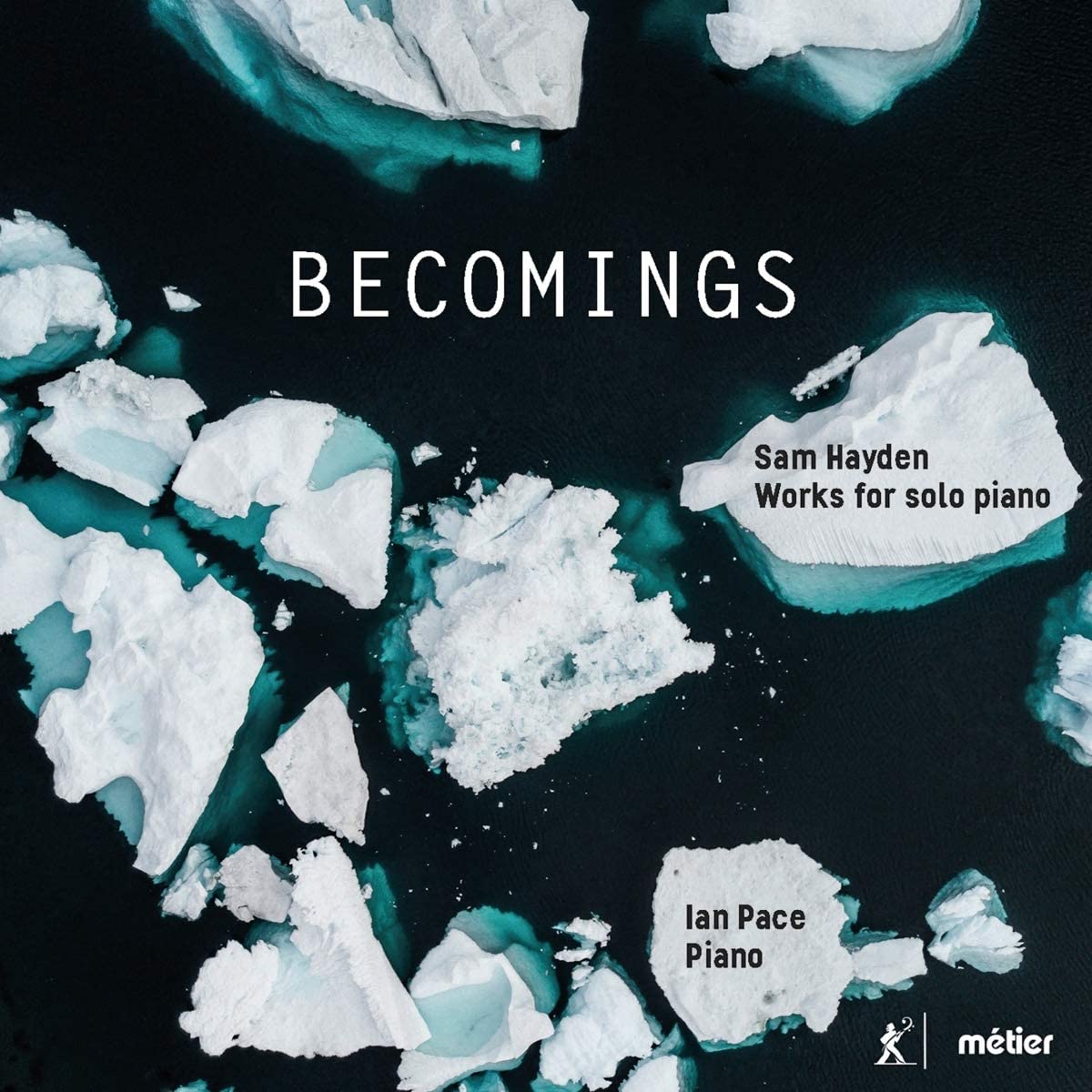
On record – Becomings: Sam Hayden Works for solo piano (Ian Pace) (Métier)

hayden-pace

Sam Hayden
Becomings (Das Werden) I-VII (2016-18)
Fragment (After Losses) (2003)
…still time… (1990)
Piano Moves (1990)

Ian Pace (piano)

Métier MSV28611 [two discs, 89’31”]

Producers / Engineers Will Goring, Sophie Nicole Ellison, Sam Hayden

Recorded August & September 2020 at City University, London

Written by Richard Whitehouse

What’s the story?

A major release of music from Sam Hayden (b1968), currently Professor of Composition at Trinity Laban Conservatoire of Music and Dance – the extent (thus far) of whose output for piano is featured here, and which makes for listening as engrossing as it can seem daunting.

What’s the music like?

It may be significant that, as if mindful of the reception that is nowadays accorded the more radical of today’s music, the composer’s own annotations seem intent on observing his music from the outside – as if to encourage objectivity on the part of those listening. This is by no means an unreasonable gambit for approaching his sometimes intricate, frequently oblique, and always provocative music which is made more so through the constant tension between the systematic and the spontaneous in his thinking. Not least with Becomings (Das Werden), whose notion – as has preoccupied philosophers from Heraclitus to Wittgenstein and beyond – of the state of ‘becoming’, as opposed to ‘being’, pervades the seven pieces at conceptual and semantic as well as musical levels; any tangible sense of finality remaining out of reach.

‘I’ functions as a prelude, but its textural dexterity and hectic passagework plunge straight in. ‘II’ takes this harmonic and polyphonic interplay much further as the intensifying waves of activity culminate in music of assaultive impact, whereas ‘III’ adopts a more improvisatory approach to formal elaboration. ‘IV’ assumes the guise of a central slow movement with its leisurely evolution and trill-permeated texture almost claustrophobic in its intricacy, while ‘V’ finds the superimposition of chromatic and spectral harmonic cycles at its most clearly defined. ‘VI’ unfolds as though a toccata of jagged expressive contrasts before it subsides into simmering anticipation, then ‘VII’ brings this sequence full-circle with its allusions to the opening piece as if a coda whose finality is pointedly offset by the desire to begin anew.

Of the other items, Fragment (After Losses) takes its material from an earlier orchestral piece as the basis for a short while eventful study in disjunct alternations of rhythm and timbre. As his earliest acknowledged work for solo piano, …still time… is audibly a statement of intent with its abrupt if methodical contrasts across the spectrum of pianistic facets; one whose debt to earlier composers (notably Stockhausen) is discharged via the constant pivoting between stasis and dynamism. Larger in overall conception, Piano Moves utilizes an amplified piano in music whose encroaching resonance and polyrhythmic intricacy gradually and inexorably saturate the sound-space; an extended ‘coda’ reducing previously dense textures to a hieratic succession of repeated chords such as sets the primary material at a vastly different remove.

Does it all work?

It does, not least through the unwavering focus of Ian Pace (who gave the complete premiere of Becomings two years back) in clarifying and articulating music whose complex textures never feel merely abstruse – thereby making for an experience seldom less than intelligible.

Is it recommended?

Indeed. These are fiercely committed readings, recorded with clarity and presence, making for a release worthy of attention from all adventurous and inquiring listeners for its dedicated and impressive music-making. Hayden’s chamber music (NMCD168) is also worth investigation.

Listen

Buy

You can discover more about this release at the Divine Arts website, where you can also purchase the recording. For the composer’s website, click here, and for more information on Ian Pace click here