On record – Norrköpping Symphony Orchestra / Christian Lindberg – Pettersson: Symphony no.12 ‘The Dead in the Square’ (BIS)

pettersson-12

Swedish Radio Choir, Eric Ericson Chamber Choir, Norrköpping Symphony Orchestra / Christian Lindberg

Pettersson
Symphony no.12 ‘De döda på torget’ (The Dead in the Square) (1973-4)

BIS BIS 2450SACD [55’40”]

Producer Hans Kipfer
Engineers Stephan Reh, Mathias Spitzbarth

Recorded March 2019 and January 2020 at Louis de Geer Concert Hall, Norrköpping

Written by Richard Whitehouse

What’s the story?

Christian Lindberg (presumably) concludes BIS’s Pettersson cycle, with the Norrköping Symphony Orchestra, with the Twelfth Symphony – featuring poems by the then recently deceased Chilean poet Pablo Neruda in what is a typically unflinching statement of intent.

What’s the music like?

When he began the work, Allan Pettersson had not written for voices in almost three decades and his accepting a commission from Uppsala University for its 500th anniversary was never likely to result in a celebratory paean. To Swedish translations of nine poems from the Canto general collection by Pablo Neruda (1904-73), he created a continuous structure whose texts are not so much set as fashioned into a stark melody line (the choral writing almost entirely in rhythmic unison) as articulates the work’s musical evolution as surely as its emotional impact.

Although not charting any systematic evolution, the Twelfth Symphony does pursue a definite trajectory. The first and longest section, The Dead in the Square, follows its short yet active orchestral prelude with an ominous rendering of the tragedy being related at Santiago on 28th January 1946. Other than establishing an atmosphere of unrelieved anxiety, this also sets out the essential musical parameters of choral writing that does not attempt to ‘clothe’ the textual imagery so much as define and propel the musical content. Hence the smouldering desolation of The Massacres as follows an eventful orchestral interlude (used subsequently to comment on and/or anticipate these choral sections), then the stealthy evoking of human degradation in The Men of the Nitrate and the increasingly wretched imploration of the workers in Death.

The work’s emotional (if not temporal) mid-point arrives with the single stanza of How the Flags were Born, whose fleeting while unmistakable promise of change is intensified in the fervent roll-call of departed heroes in I Call on Them then the accusatory righteousness of The Enemies which is duly made the emotional fulcrum of the overall design. The ongoing struggle is vividly evoked through the hectic onward motion of Here They Are before past, present and future are drawn together in Always – bringing with it the most contemplative music of the whole work prior to the final outburst of defiance. A reminder, also, that Chile was in the process of succumbing to fascist rule even while Pettersson completed this work, whose ricocheting climactic chord of C must have appeared an ever more distant prospect.

Does it all work?

Yes, when as purposefully marshalled and cumulatively shaped as it is here. The pioneering account by Carl Rune Larsson (Caprice) has comparable emotional force but relatively little inner clarity, while Manfred Honeck’s version (CPO) – featuring the same choirs – evinces more character in individual sections but less sure a grasp of its ongoing structure. Precisely because of the way texts articulate content, those who are coming anew to Pettersson should find the piece an ideal way into its composer’s combative and unequivocal musical mindset.

Is it recommended?

Indeed. Anyone unfamiliar with the work should certainly opt for this new recording, whose sound and annotations are fully on a par with earlier instalments in this Pettersson symphony cycle. Live performances outside of Sweden will hopefully become more frequent over time.

Stream

Buy

For more information on this release visit the BIS website

On Record: Floating Points, Pharoah Sanders & the London Symphony Orchestra: Promises

floating-points-pharoah-sanders-lso

reviewed by Ben Hogwood

What’s the story?

Promises may have only just been released, but it is a high-level collaboration five years in the making. Floating Points, the electronic alias for Sam Shepherd, teamed up with senior jazz royalty Pharoah Sanders to record their parts for the album in Los Angeles in 2019, while the orchestral parts, arranged by Shepherd, were set down by the London Symphony Orchestra at Air Studios in the summer of 2020.

What’s the music like?

The album is essentially one span of music lasting three-quarters of an hour, divided into nine sections. Everything germinates from a deceptively simple seven-note motif given out by the keyboards at the start, and from this minimal and seemingly unremarkable start a gradual climb of intensity begins.

Sanders is used sparingly, which makes his saxophone contributions all the more meaningful. The statement in Movement 1 has a spiritual air. Shepherd, too, operates well within himself as far as density of musical notes is concerned, supplying dappled colours in response to the saxophonist’s chant-like figures. This is notable because anyone who is familiar with the rich, luminous colours of Floating Points’ previous album Crush will know the energy and rapid movement his music can generate.

The influence of Ravel remains as part of the orchestral style, especially at the start of Movement 2, where everything is written in thrall to the saxophone, giving Sanders the room he needs to work his magic. Promises develops as a meditation, the seven-note motif underpinning almost everything. Movements 3 and 4 develop a vocalise, the addition of a glockenspiel giving a sound that glitters at the edges. Sanders returns with greater urgency, then pulls back to a magical and breathy Movement 6, where the long lines of a solo cello shine. This ushers in the strings’ big moment, and with a swell of intensity the musical waves crash on to the shore.

From here the tide pulls back, giving room for more thoughts from Sanders. This time the build is towards a more dissonant but similarly exultant climax, reaching for the skies in a musical murmuration of upper strings and electronics. From here everything subsides to a peaceful close, the seven-note motif murmuring for one last time.

Does it all work?

In every way. Many collaborations between electronics, jazz and / or symphony orchestra miss the mark because of balance issues, with everything turned up too loud or with too many notes given to too many instruments, or because one or more of the musical parties are not on the same wavelength. This makes Promises all the more remarkable, for even the LSO strings, adding their contribution a year hence, are fully in the moment.

The ‘less is more’ approach of this collaboration pays off in every way. Sure, the music is slow moving, but that is an essential part of its appeal, a meditation for large forces securing the most intimate of responses.

Is it recommended?

Without question. Promises is an enchanting album, spanning its magic across the 45 minutes – after which the listener will simply wish to repeat the experience. It crosses genres effortlessly, appealing to fans of jazz, classical and electronica without becoming rooted in any of those areas. It is simply wonderful music for meditative thought.

Intriguingly we are told to ‘stay tuned for the next chapter of Promises, which will be announced soon’. If that proves capable of following up what is already one of the best albums of the year, we will be well and truly spoilt!

Stream

Buy


On Record: Various Artists: Indaba Is (Brownswood)

indaba-is

reviewed by Ben Hogwood

What’s the story?

Gilles Peterson’s Brownswood Recordings are so good at compilations that bring vibrant new sounds from around the world. This time they focus on South Africa, with a compilation of improvised music headed by Thandi Nthuli and Siyabonga Mthembu.

It is extremely helpful to read the commentary accompanying this release on Bandcamp, as it gives insight into the extremely wide range of influences at play here. It goes some way to explaining how the music can be approached from very different directions – jazz, classical, funk and soul to name just four.

What’s the music like?

As implied above, the eight tracks here have a musical freedom that proves to be intoxicating for the listener. The structures are impressive – The Ancestors, for example, give us eleven minutes of fluid music making on Prelude to Writing Together. Some of the issues raised are pertinent, too , few more so than The Wretched’s question What Is History, with hard hitting spoken word examples from Kwame Toure and Winnie Madikizela-Mandela complemented by a vibrant rhythm section.

Bokani Dyer finds a strong sense of purpose on Ke Nako, with its keenly felt references to the ANC, while iPhupho L’ka Biko ft Hymnself & Kinsmen build their way towards an ecstatic melodic loop on the invocation Abaphezulu, crowned by high vocals at the end. A sonorous vocal starts off Umdali, a collaboration between Sibusile Xaba, Naftali, Fakazile Nkosi and AshK, ending with what sounds like a theremin soaring high. The meditative and soulful Dikeledi, from Thandi Ntuli, makes a strong impression with its searching questions, as does the thoughtful Umthandazo Wamagenge from The Brother Moves On, complete with cool keyboards.

Does it all work?

Yes. Indaba Is celebrates musical freedom in a very important context, and rewards an open minded approach with vibrant, deeply felt music.

Is it recommended?

Without doubt. If like me you make irregular forays into jazz and improvised music, Brownswood prove to be an indispensable guide, opening up avenues to explore. At the same time, this is music offering hope for the future, resilient in difficult times and optimistic for where we could go from here.

Stream

Buy


On record: Soloists, Wiener Konzertchor, ORF Vienna Radio Symphony Orchestra / Friedrich Cerha – Wellesz: Die Opferung des Gefangenen (Capriccio)

wellesz

Wolfgang Koch (bass-baritone) Field Commander, Robert Brooks (tenor) Prince’s Shield Bearer, Ivan Urbas (bass) Head of the Council, Hae-Sang Hwang (soprano), Patricia Dewey (contralto), Wiener Konzertchor, ORF Vienna Radio Symphony Orchestra / Friedrich Cerha

Egon Wellesz
Die Opferung des Gefangenen Op.40 (The Sacrifice of the Prisoner) (1924-5)

Capriccio C5423 [56’01”]

Producer Kurt Kindl
Engineer Hans Moralt

Recorded 24 March 1995 at Konzerthaus, Vienna (live peformance)

Reviewed by Richard Whitehouse

What’s the story?

Capriccio continues its coverage of Egon Wellesz (1885-1974) with this live recording of the stage-work Die Opferung des Gefangenen (The Sacrifice of the Prisoner), one of his most striking large-scale dramatic pieces from the inter-war era when he was established among Austria’s leading composers.

What’s the music like?

Although now most highly regarded for the orchestral and chamber works written while in exile after 1938 (settling in Oxford, he was made a fellow of Lincoln College and became a leading authority on Byzantine music and opera of the early Baroque), Wellesz was earlier best known for his theatrical works (four ballets and five operas) as were heard throughout German-speaking territories. Not least The Sacrifice of the Prisoner, first staged in Cologne on 2nd April 1926 and whose designation ‘opera-ballet’ indicates a hybrid conception that was very much in vogue during this period – composers as distinct as Stravinsky, Martinů, Milhaud and Weill all attempting something similar, whatever the differences in aesthetic.

With a scenario by Eduard Stucken, the work concerns the territorial (and, moreover, tribal) conflict between those peoples of Quiché and Rabinal – in what is present-day Guatemala – during the early 15th century. The action is unfolded in starkly ceremonial terms (Capriccio has not included an English translation of the libretto, but Hannes Heher’s detailed booklet provides more than sufficient context) such as leave little room for exploration of character or scenic evocation, yet this does not preclude (indeed, might have encouraged) a musical response as is both personal and affecting. Sample any of the five ‘Dances’ (tracks 6, 8, 11, 13 and 15) to hear Wellesz opening out its expressive ambit in striking and evocative ways.

After the Cologne premiere, there were stagings at Magdeburg in 1927 and Berlin in 1930, before the advent of the Third Reich made further performances impossible. This account, still the only one from the post-war era, was of a concert presentation given in Vienna just over a quarter-century ago and conveys this work’s hieratic power as well as its emotional pathos in gratifying measure. Perhaps a future DVD release of a full staging will yet reveal even more of its dramatic potency, but no-one with even a passing interest in the theatrical possibilities of what was arguably the most innovative decade from the last century should pass up the opportunity to encounter what is much more than just a fascinating period piece.

Does it all work?

It does, and not least for reasons such as might have irked its composer – Wellesz’s invoking of a highly stylized and ritualistic theatre being not that far removed from what his younger German contemporary Carl Orff was working towards at around this time. There are fervent contributions by Wolfgang Koch and Robert Brooks among the vocalists, while chorus and orchestra respond with comparable dedication to Friedrich Cerha who, whether as composer, conductor, or administrator, has left an indelible mark on post-war Austrian musical culture.

Is it recommended?

Indeed, allowing this music will not appeal to all tastes. Those new to Wellesz may prefer to start with the earlier of his nine symphonies (CPO) or Capriccio’s release of his concertos for violin and piano (C67181), but no-one hearing the present piece will likely be left unmoved.

For further information on this release, and to purchase, visit the Capriccio website. For more on Egon Wellesz, the composer’s website is a helpful resource.

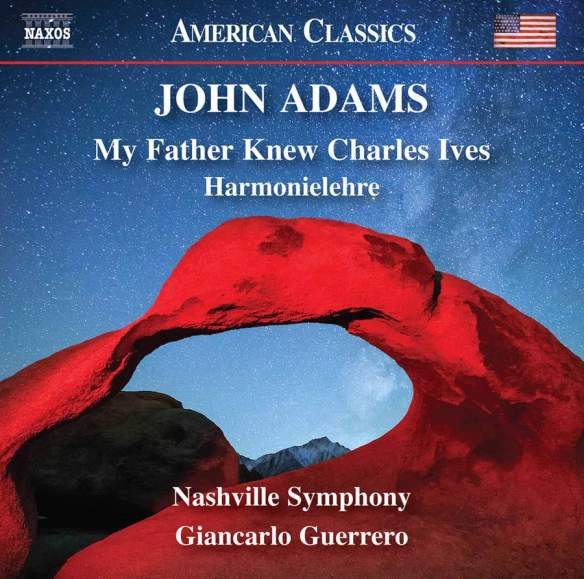
On record: Nashville Symphony / Giancarlo Guerrero – John Adams: My Father Knew Charles Ives, Harmonielehre (Naxos)

Nashville Symphony / Giancarlo Guerrero

John Adams
My Father Knew Charles Ives (2003)
Harmonielehre (1985)

Naxos American Classics 8.559854 [69’03”]
Producer Tim Handley
Engineer Trevor Wilkinson

Recorded 5-7 October 2018 (Harmonielehre), 25-27 October 2019 (My Father Knew Charles Ives), Laura Turner Concert Hall, Nashville

Reviewed by Richard Whitehouse

What’s the story?

Naxos adds to its coverage of John Adams with this release featuring two major orchestral works – the one among the most enticing of his latter-day output, the other among the most characteristic (and recorded) of the pieces that first accorded him international prominence.

What’s the music like?

Adams has long expressed a penchant for the music of America’s great visionary of the late-Romantic era, and My Father Knew Charles Ives is his oblique while affectionate homage to the composer who gave American classical music its aesthetic basis. Not that the title should be taken literally – rather, the work’s three movements add up to an inclusive portrait of Ives in a way not dissimilar to that of the composer’s orchestral sets. Thus, the opening Concord deftly identifies the cultural environment behind Ives’s thinking besides alluding to some of his most inimitable music, while The Lake builds upon this with evocative and atmospheric writing whose concertante role for piano also finds resonance in the senior composer’s music. The final and longest movement, The Mountain returns to those transcendental strivings as infused Ives’s creative maturity, though its finely sustained initial pages are not followed up by the falling back on well-rehearsed minimalist routines that ensue. Conversely, the closing pages inhabit an ethereal introspection as makes for an understated and affecting apotheosis.

Hard to believe it is now 36 years since Harmonielehre first blazed a trail over the Western musical landscape, or that what once provoked extreme reactions (causing a near riot at the 1987 Huddersfield Contemporary Music Festival) should have come to represent a musical lingua franca imitated many times in the interim. That this earliest of Adams’s ‘symphonic’ works remains among his most representative is fully reaffirmed here. Giancarlo Guerrero finds a viable balance between drama and lyricism in the lengthy opening movement, then builds the mingled Wagnerian and Mahlerian resonances of The Amfortas Wound toward a climax of potent anguish (if such is the music’s intent). The luminous opening of Meister Eckhardt and Quackie demonstrates the best in the Nashville Symphony – as with its superb release of Christopher Rouse (Naxos 8.559852) – and while even astute pacing cannot make the closing peroration sound other than manufactured, the approach yields a methodical and eventful sense of purpose as makes its ‘travelling in hope’ more compelling than any arrival.

Does it all work?

It does, from the perspective that Adams often makes his larger-scale works cohere through sheer force of impact more than formal ingenuity – his trademark post-minimalism proving renewable at almost every turn. Guerrero’s take on My Father Knew Charles Ives is certainly preferable to the composer’s rather calculated account with the BBC Symphony Orchestra (Nonesuch), while his Harmonielehre can rank high among the seven available recordings of this piece – among which, Kent Nagano with the Montréal Symphony Orchestra (Decca) currently leads the field.

Is it recommended?

Yes, not least when recording and annotations are first rate. Hopefully, future Naxos releases of Adams will explore further his extensive back catalogue and revive such as the impressive ‘symphony’ El Dorado, which still awaits its second recording after virtually three decades.

For further information on this release, and to purchase, visit the Naxos website. For more on John Adams, the composer’s website is a great resource. Meanwhile the Nashville Symphony website is here, and you can visit conductor Giancarlo Guerrero’s website here