On Record – Emma Tring, BBC NoW / Martyn Brabbins – John Pickard: Symphonies 2 & 6; Verlaine Songs (BIS)

John Pickard
Symphony no.2 (1985-87)
Symphony no.6 (2021)
Verlaine Songs (2019-20, orch. 2022)

Emma Tring (soprano), BBC National Orchestra of Wales / Martyn Brabbins

BIS 2721 [72’51’’] French text and English translation included

Producer Thore Brinkman Engineers Simon Smith, Mike Cox
Recorded 29-31 March 2023, Hoddinott Hall, Cardiff

Written by Richard Whitehouse

What’s the story?

BIS continues its coverage of John Pickard (b.1963) with a pertinent coupling of his Second and Sixth Symphonies, heard alongside his song-cycle to poems by Verlaine, in what is the most wide-ranging release – whether chronologically or stylistically – to date in this series.

What’s the music like?

It hardly seems 35 years since the Second Symphony blazed forth at its Manchester premiere, so establishing Pickard’s reputation. The composer had earlier studied with Louis Andriessen, to whose confrontational minimalism this piece is indebted in certain particulars – but, unlike other among his contemporaries who were so influenced, Pickard was alive to its symphonic potential. Unfolding over six continuous sections, the work builds via an intensifying process of tension and release to a seismic culmination as marks a seamless, even inevitable return to its start. Those familiar with that pioneering version by Odaline de la Martínez (on YouTube) will find this new one hardly less attentive to the visceral power of what, given its predecessor remains unheard, is a symphonic debut with few equals and one that urgently warrants revival.

Almost 35 years on and the Sixth Symphony offers a very different though no less involving perspective on what this genre might be. The first of its two movements channels a modified sonata design such that an almost whimsical opening has become brutalized well before the despairing close. Its successor refashions the expected continuity from an even more oblique vantage – the music heading eloquently if funereally toward a plangent climax that subsides into a delicate intermezzo, infused with the sound of nature, then on to a final section which recalls earlier ideas in a mood of rapt anticipation. Not that this understatement offers in any sense an easy way out: indeed, the work concludes with its composer poised at a crossroads as much existential as musical, and from where the whole creative process can begin afresh.

Separating two substantial statements of intent, the Verlaine Songs continues Pickard’s recent involvement with poetic texts and, while Paul Verlaine might seem far removed from Edward Thomas or Laurence Binyon, his evocations fanciful while sometimes unnerving – hence Le sqelette with its graphic aural imagery – finds the composer reciprocating in kind. Coming in between scorings with ensemble or violin and piano, this version with orchestra finds Pickard enriching a lineage of French song-cycles from Berlioz, via Ravel and Messiaen, to Dutilleux.

Does it all work?

It does, not least because Pickard is conscious of the need for his music to determine its own course. However dissimilar these symphonies might seem, the sensibility behind them is the same and any stylistic differences more apparent than real. It helps when Martyn Brabbins is a conductor familiar with this idiom as to inspire a committed response by the BBC National Orchestra of Wales, with Emma Tring alive to the manifest subtlety of the vocal writing, and the recordings consistently heard to advantage in the spacious immediacy of Hoddinott Hall.

Is it recommended?

Indeed, in the hope this series will be continued. Both the First and Third Symphonies await recording, as do Partita for strings and large-scale choral work Agamemnon’s Tomb, so that Pickard’s discography has a way to go even without addition of new pieces to his catalogue.

Listen

Buy / Further information

For purchase options and more information on this release, visit the BIS website. Click on the names for more on composer John Pickard, the BBC National Orchestra of Wales, conductor Martyn Brabbins and soprano Emma Tring

On Record – Helsinki Philharmonic Orchestra / Pekka Kuusisto; BBC Scottish SO / Martyn Brabbins – Jaakko Kuusisto: Symphony (BIS)

BBC Scottish Symphony Orchestra / Martyn Brabbins (Birthday Variations); Helsinki Philharmonic Orchestra / Pekka Kuusisto (Symphony)

Various Pictured Within: Birthday Variations for M.C.B. (2019)
Jaakko Kuusisto (comp. Pekka Kuusisto & Eskola) Symphony Op.39 (2020-21)

BIS 2747 [66’32”]
Producers Andrew Trinick (Variations), Robert Suff (Symphony) Engineers Graeme Taylor (Variations), Enno Mäemets (Symphony)
Live recordings, 13 August 2019 at Royal Albert Hall, London (Variations); 8 December 2022 at Music Centre, Helsinki

Reviewed by Richard Whitehouse

What’s the story?

The BIS label issues one of the most fascinating among recent releases, one that juxtaposes a latter-day equivalent to Elgar’s Enigma Variations with a posthumously completed symphony by one of Finland’s leading conductors which now becomes a tribute to his untimely passing.

What’s the music like?

It was clearly a great idea that the BBC commission a piece to mark Martyn Brabbins’s 60th birthday, featuring 14 composers with whom this stylistically most wide-ranging of current British conductors has been associated. The outcome is Pictured Within: Birthday Variations for M.C.B. – each composer having provided a variation on the ‘anonymous’ theme for what here becomes an inverse take on Elgarian procedure in the latter’s Variations on an Original Theme; a work whose ground-plan also furnishes the formal framework of the present piece.

It is worth considering the ways in which these composers seem either inhibited or liberated by their placing (determined beforehand by Brabbins) within the overall scheme. Given this theme – understated to a fault – yields its potential more from the harmonic then melodic or rhythmic angle, the most successful tend to make a virtue of such constraints: thus the ‘Tact 60’ of Variation I finds Dai Fujikura hinting guardedly at ‘C.A.E.’. David Sawer capriciously conjures ‘H.D.S-P.’, while Sally Beamish offers a deftly ironic parallel to ‘R.B.T’ and Colin Matthews rumbustiously complements ‘W.M.B.’ Iris ter Schiphorst captures the pensiveness if not the geniality of ‘R.P.A.’, whereas violist-turned-composer Brett Dean proves a natural fit for the undulating poise of ‘Ysobel’ and Win Henderickx evokes ‘Troyte’ with real gusto.

His ruminative Variation VII finds Richard Blackford emulating more the connection with a country house than ‘W.N.’, while Harrison Birtwistle throws caution to the wind in a darkly inward contrast to ‘Nimrod’, and ‘Sixty Salutations’ finds Judith Weir in an engaging take on the halting charms of ‘Dorabella’. Gavin Bryars rouses himself to unexpected activity in his reading of ‘G.R.S.’, whereas Kalevi Aho is more suited to the sombre eloquence of ‘B.G.N.’ and Anthony Payne ably plumbs the inherent mysteries of ‘***’. John Pickard then takes on the daunting challenge of ‘E.D.U.’ in The Art of Beginning – the mingling of portentousness and humour appearing to make light of its Longfellow association, but whose organ-capped apotheosis confirms real appreciation of the ‘right ending’ as constituting an art unto itself.

The coupling is as unexpected as it proves apposite. Remembered as a notable violinist and a versatile conductor, Jaakko Kuusisto (1974-2022) turned increasingly to composition and, at his untimely death through brain cancer, had planned a symphony for Osmo Vänskä and the Minnesota Orchestra. Acting on behalf of his widow, his younger brother Pekka and copyist Jari Eskola realized this piece from several minutes of extant fragments such that Kuusisto’s Symphony takes its place as the last statement by one who ostensibly had much more to give.

Playing just over 25 minutes, the work falls into two separate movements. Shorter and more outwardly cohesive, the first of these emerges as imperceptibly as it evanesces – taking in a tersely rhythmic central episode, then a warmly expressive melody with more than a hint of American post-Minimalism. Almost twice as long, the Lento seems more discursive but no less absorbing – picking up where its predecessor left off as it builds to impulsive climaxes, separated by an eloquent span derived from a chorale-like theme. Nothing, though, prepares one for the ending – a sequence of quietly interlocking ostinato patterns, evidently inspired by light signals beamed in the Gulf of Finland and underpinned by undulating timpani. The effect is haunting and unworldly but, for these very qualities, wholly fitting as a conclusion.

Does it all work?

Pretty much always. Those expecting an Elgarian ‘re-run’ may be disconcerted by Pictured Within, but this only serves to reinforce the stylistic autonomy and variety of the composers involved (three of whom sadly no longer with us) in what is a tribute to Brabbins’s acumen for involving them in the first instance. Quirky and compelling, the Kuusisto is appreciably more than a labour of love on behalf of those who brought about its completion: both works deserving revival for their intrinsic merits rather than commemorating a particular occasion.

Is it recommended?

Absolutely. These live performances (that of Pictures Within being that of the premiere) have come up well as presented here, while there are detailed notes on each piece by John Pickard and Jaani Länsiö. This fascinating release more than justifies itself musically and artistically.

Buy

For purchasing options, and to listen to audio clips, visit the Presto website. For more information on the artists, click on the names for more on Martyn Brabbins, Pekka Kuusisto, the BBC Scottish Symphony Orchestra and the Helsinki Philharmonic Orchestra For dedicated resources on the composer, you can visit a website dedicated to Jaakko Kuusisto

Published post no.2,265 – Friday 9 August 2024

On Record – Orchestre National de France / Cristian Măcelaru – Enescu: Symphonies nos.1-3; Romanian Rhapsodies 1 & 2 (Deutsche Grammophon)

Orchestre National de France / Cristian Măcelaru with Choeur de Radio France (Symphony no.3)

Enescu
2 Romanian Rhapsodies Op.11: no.1 in A major, no.2 in D major (1901)
Symphony no.1 in E flat major Op. 13 (1905)
Symphony no.2 in A major Op. 17 (1912-14)
Symphony no.3 in C major Op. 21 (1916-18, rev. 1920)

DG 4865505 [three discs, 2h42m24s]
Producer Vincent Villetard Engineer Yves Baudry
Recorded September 2022 (Symphony no.1, Rhapsody no.2) June (Symphony no.2, Rhapsody no.1) and July 2023 (Symphony no.3) in Auditorium de Radio France, Paris

Reviewed by Richard Whitehouse

What’s the story?

Deutsche Grammophon continues its survey of those symphonic cycles ‘less well trod’ with this collection of the three numbered symphonies which Enescu completed, performed by the Orchestre National de France and its music director these past four seasons Cristian Măcelaru.

What’s the music like?

Although symphonies were a preoccupation of Enescu over almost 50 years, his reputation in the genre rests on those written during the earlier phase of his maturity. Numerous cycles have appeared that feature Romanian forces, but only three from elsewhere – Lawrence Foster with orchestras in Monte Carlo and Lyon (EMI / Warner), Gennady Rozhdestvensky with the BBC Philharmonic Orchestra (Chandos) and Hannu Lintu with the Tampere Philharmonic (Ondine). Măcelaru thus enters a select but not uncompetitive field where his recordings generally hold their own.

Relatively compact as to its formal dimensions, the First Symphony gives a good overview of the relative strengths and weaknesses in Măcelaru’s approach. The initial movement is vividly launched with its proclamatory summons, but an increasing loss of focus means the climactic lead-in to the reprise is undersold and the coda lacks decisiveness. The slow movement finds the ONF woodwind at its most felicitous, though the beatific central span is more persuasively realized than the inward ambiguity on either side, while the finale seems more convincing in its purposeful opening than towards its close – when what should be among the most thrilling perorations in the symphonic literature of this period sounds almost offhand. Often performed in its early years, this is a work that could yet find its way back into the orchestral repertoire.

By contrast, the Second Symphony was a failure at its 1915 premiere then went unheard until six years after the composer’s death. Strauss replaces Berlioz as the primary influence, albeit with a fastidious instrumentation to which the ONF players do justice. That said, Măcelaru is no more successful than most others in maintaining momentum across the expansive opening Allegro, so that any impetus has dissipated well before the development unsuccessfully tries to regain it. Akin to a series of variations on a theme that the clarinet never quite defines, the central Andante is eloquently rendered while the finale’s martial introduction has the requisite stealthiness. Yet the Allegro fails to sustain itself to the most opulent of Enescu’s apotheoses, not least because orchestral sound lacks the weight and visceral force necessary in this music.

Composed during Romania’s torrid involvement in the First World War, the Third Symphony is among Enescu’s greatest achievements and the highlight of Măcelaru’s cycle. He paces the initial Moderato such that its questing and rhetorical elements are held in persuasive accord -building to a resplendent culmination from where the central Vivace surges forth; its alternate ebullience and ambivalence propelled intently towards a shattering climax which, as with the sinister coda, is seamlessly integrated into this movement overall. Never lacking for repose, the final Lento unfolds with intuitive if tangible poise – Choeur de Radio France effortlessly absorbed into a diaphanous music whose closing stages radiate an almost metaphysical aura. Whether or not Dante-esque as to its inspiration, this affords a transcendence rare in any era.

A pity no Enescu cycle has yet included the Fourth and Fifth Symphonies which, as realized in the 1990s by Pascal Bentoiu, make a logical and necessary continuation of his symphonic odyssey (they have been recorded by Peter Ruzicka for CPO). A pity too that, instead of the Third Orchestral Suite or the symphonic poem Vox Maris, Măcelaru opted for the ubiquitous Romanian Rhapsodies. The Second of these is more appealing here, for all that the fervency toward its centre and pathos at its close are under-projected, while the First is rushed early on and underwhelming thereafter. No match, then, for a host of previous readings – among these, Antal Doráti with the London Symphony (Mercury) and, especially, Constantin Silvestri with the Czech Philharmonic (Supraphon) retain their innate potency after more than six decades.

Does it all work?

Swings and roundabouts. In the context of those cycles mentioned earlier, Măcelaru’s take on the Third Symphony ranks with the best – but, in the First, Lintu or Foster and, in the Second, Foster are to be preferred. The quality of playing cannot be denied, and if the recording lacks a degree of definition and impact in more demonstrative passages, it presents this orchestra to advantage. Rob Cowan essays a personable booklet note, but to claim that these symphonies ‘‘…emerge more as extended tone poems clothed in symphonic dress’’ is simply not the case.

Is it recommended?

Yes, taken overall. Enescu’s symphonies are still on the periphery of the orchestral repertoire, so making the undoubted advocacy a high-profile conductor such as Măcelaru gives them the more admirable. Hopefully he will be continuing his exploration of a singular musical vision.

Buy

For purchasing options, visit the Deutsche Grammophon website and for more information on the artists, click on the names for more on Orchestre National de France and conductor Cristian Măcelaru. For dedicated resources on the composer, you can visit The International Enescu Society

Published post no.2,258 – Friday 2 August 2024

On Record – MahlerFest XXXII: Joshua DeVane sings Lieder eines fahrenden Gesellen, Kenneth Woods conducts Symphony no.1

Joshua DeVane (baritone); Colorado MahlerFest Chamber Orchestra (Lieder eines fahrenden Gesellen), Colorado MahlerFest Orchestra / Kenneth Woods

Mahler Symphony no.1 in D major (1887-8, rev, 1898)
Mahler arr. Schoenberg Lieder eines fahrenden Gesellen (1884-5, arr. 1920)
Mahler Blumine (1884, rev. 1889)

Colorado MahlerFest 195269164287 [79’02”]
Live performances on 18 May 2019 (Lieder eines fahrenden Gesellen), 19 May 2019, Macky Auditorium, Boulder, Colorado

Reviewed by Richard Whitehouse

What’s the story?

Recorded representation of the current MahlerFest era continues to grow with this release on CD (previously available as a download) of the First Symphony with related pieces, given at its 32nd edition and what was the fourth such event with Kenneth Woods as artistic director.

What’s the music like?

What was doubtless intended to inaugurate a chronological traversal began in 2019 with this performance of the First Symphony, the first to be heard in the critical edition published that year by Breitkopf & Härtel. Woods has written about this extensively at his website [Ken on the Great Mahler Debate of 2019 | Kenneth Woods – conductor]: suffice to add the numerous corrections and textural amendments enhance that fuller and more stratified orchestral sound such as Mahler favoured in 1899 when compared with earlier versions from 1889 and 1893.

Interpretatively, this performance is a satisfying one with few overt surprises but no obvious idiosyncrasies. Any lack of atmosphere during the first movement’s mesmeric introduction is offset by its easeful if never uneventful continuation – thus a subtly differentiated exposition repeat, then stealthy marshalling of expressive tension to a coda whose joyousness is rightly kept within limits. The scherzo is robust yet propulsive and the trio even finer in its unforced suavity, while the funeral march never over-inflects its Klezmer elements unfolding from the ominous and ironic, via gentle repose, to a closing fatalism. Woods succeeds better than most in holding together the unwieldy finale, allowing due emotional space for the recall of initial ideas that is its sure highlight, and the ensuing apotheosis lacks nothing in blazing affirmation.

Included as an encore is Blumine, the ‘romance’ salvaged from earlier incidental music which formed part of this symphony until being jettisoned in 1894 – here emerging with its elegance and pathos devoid of wanton sentiment. The actual concert continued with Korngold’s Violin Concerto then Beethoven’s Third Leonora Overture reorchestrated by Mahler, but the present release opens with a performance from the previous day’s concert of Lieder eines fahrenden Gesellen. This is heard in a chamber arrangement as supervised by Schoenberg for the 1920 season of his Society for Private Musical Performances, its textural transparency underlining the soulfulness then buoyancy of its opening two songs. If the (over-wrought?) drama of the third song is under-projected, the wistful radiance of its successor comes across unimpeded.

Does it all work?

Indeed it does, overall. Mahler symphonies may have been performed and recorded by a host of international orchestras, but that of the Colorado MahlerFest lacks nothing in commitment or tenacity; any lack of atmosphere and finesse owes more to the clear if confined acoustic of Macky Auditorium than absence of quiet playing or overriding of dynamics. Joshua DeVane is a thoughtful exponent of the song-cycle, at his best in the restrained inwardness of its outer numbers, while the ensemble drawn from the CMO makes a persuasive case for this reduction.

Is it recommended?

It is. The orchestral playing may have grown in conviction with each new instalment, but this is a notable statement of intent for MahlerFest under Woods’s direction. That the 33rd edition had to be scaled down then presented online had little effect on the resolve of those involved.

Buy

For further purchase options, visit the MahlerFest website – and for more information on the festival itself, click here. Click on the names for further information on conductor Kenneth Woods and soloist Joshua DeVane

Published post no.2,247 – Monday 22 July 2024

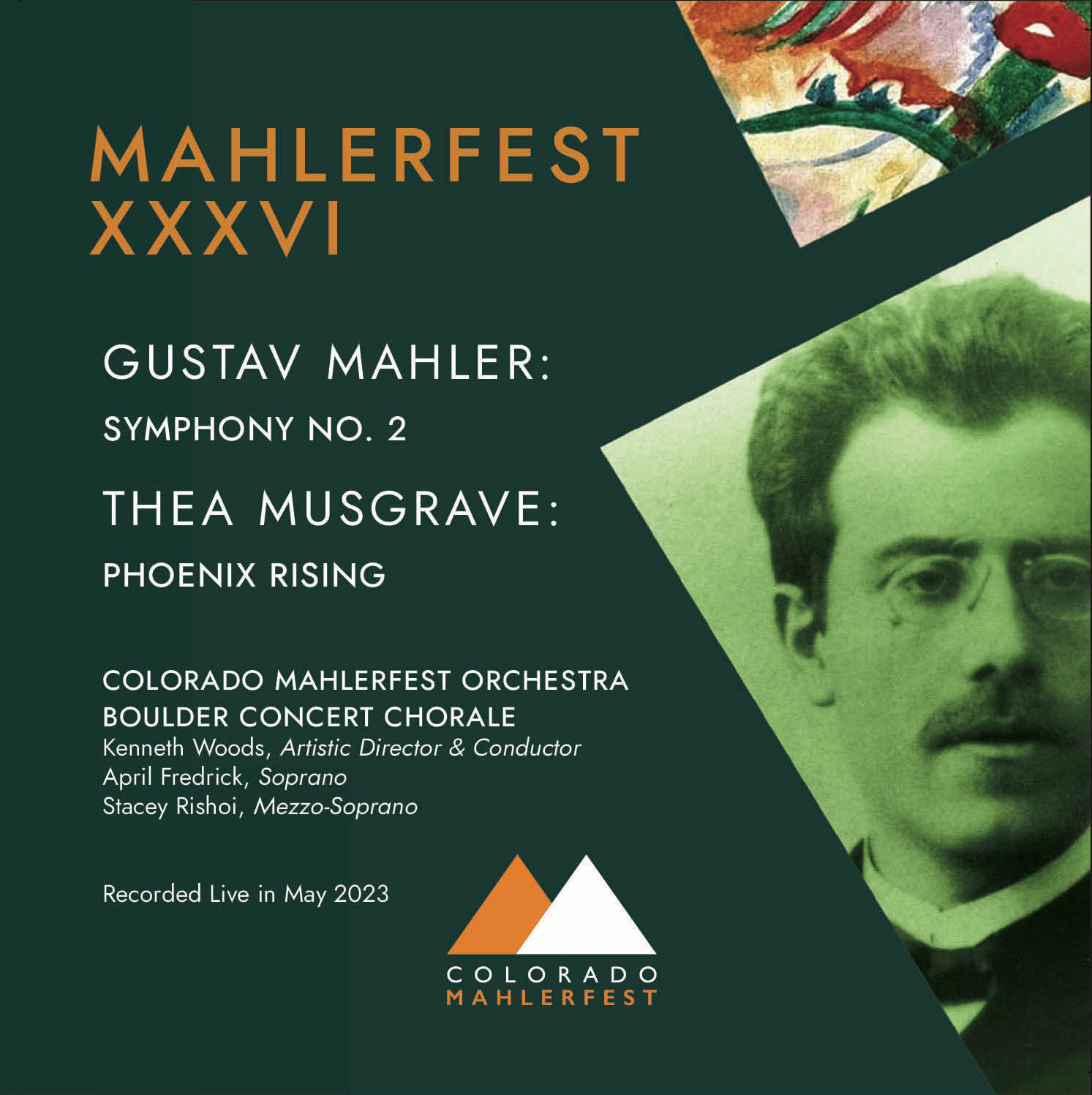
On Record – MahlerFest XXXVI: Kenneth Woods conducts ‘Resurrection’ Symphony & Musgrave’s Phoenix Rising

April Fredrick (soprano), Stacey Rishoi (mezzo-soprano), Boulder Concert Chorale, Colorado MahlerFest Orchestra / Kenneth Woods

Musgrave Phoenix Rising (1997)
Mahler Symphony no.2 in C minor ‘Resurrection’ (1888-94)

Colorado MahlerFest 195269301194 [two discs, 104’02”]
Live performances on 21 May 2023, Macky Auditorium, Boulder, Colorado

Reviewed by Richard Whitehouse

What’s the story?

Last year’s edition of MahlerFest continued its latest, not-quite-chronological traversal of the symphonies with the Second – appropriately coupled on this release (as in the concert) with a work such as considers ‘resurrection’ from a very different while no less relevant perspective.

What’s the music like?

Six years in the writing, Mahler’s Second Symphony fairly laid the basis for his reputation as a composer at its Berlin premiere in 1895. It is a measure of this performance that it captures something of the shock or excitement no doubt in evidence back then, not least in an opening movement with Kenneth Woods notably more interventionist tempo-wise as compared to that of the Third Symphony a year before. What emerges is imposing but never diffuse, at its most gripping in that baleful lead-in to a development whose terseness duly accentuates its impact, with the pathos of the second subject on its reprise making the coda’s sardonic recessional the more acute. After which, the second movement feels the more enticing through its alternation of warm sentiment with capering animation while heading to a conclusion of beatific repose.

There is no lack of incident in a scherzo whose glancing irony is leavened yet not lessened by its trios, the first as soulful with its lilting trumpets as the second is ominous in its import; but not before Stacey Rishoi has characterized the Urlicht setting with rapt inwardness. What to say about the finale other than, while this may not be the most overwhelming take on its vast fresco, it is matched by relatively few as regards an organic unfolding that sees the movement whole. Its contrasting elements here fuse with unforced cohesion to a fervent rendering of the chorale episode then on to a surging Toten-marsch – the kinetic momentum carried through to a methodical reprise of earlier ideas, then a rendering of Klopstock’s text (much altered by the composer) as only grows in intensity before the majestic affirmation of its closing pages.

As the ‘first half’, Thea Musgrave’s Phoenix Rising provides an ideal complement. The much esteemed (latterly more in the US than the UK) nonagenarian has written often for orchestra, but seldom with such immediacy than in a piece whose formal and expressive trajectory feels nothing if not symphonic in its progress. Comparison with the 2016 studio recording by BBC National Orchestra of Wales and William Boughton (Lyrita SRCD372) confirms that, passing tentativeness in ensemble excepted, Woods’s reading demonstrably makes more of this aspect.

Does it all work?

Yes, pretty much always. As on previous releases in this ongoing Mahler cycle, the Colorado MahlerFest Orchestra punches appreciably above its weight in music which should never fall prey to wanton virtuosity. The unyielding acoustic of Macky Auditorium is less an issue than before, with the finale’s offstage brass adeptly managed. April Fredrick brings her customary eloquence to bear on this movement, and the Boulder Concert Chorale – as prepared by Vicki Burrichter – rises to the occasion with notable fervency as this work reaches an ecstatic close.

Is it recommended?

It is. There have been too many superfluous Mahler cycles, but this traversal is shaping up as one of the most worthwhile and more than the memento of a memorable occasion. Hopefully such standards will be maintained by the Sixth Symphony as part of next year’s 37th edition.

Buy

For further purchase options, visit the MahlerFest website – and for more information on the festival itself, click here. Click on the names for further information on conductor Kenneth Woods, soloists April Fredrick, Stacey Rishoi and composer Thea Musgrave

Published post no.2,244 – Friday 19 July 2024