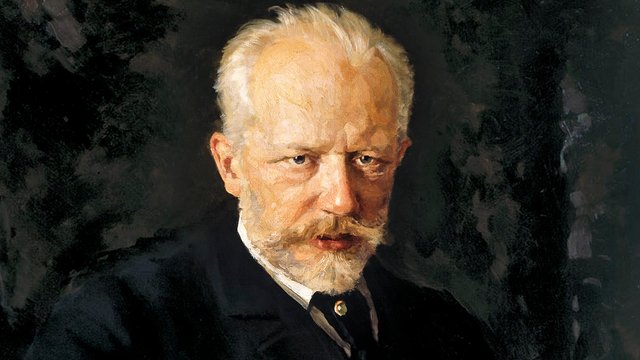
With the weather taking a sharp turn for the colder in the UK today, thoughts turn to wintry music. An underrated gem in this area is the first symphony of Tchaikovsky, which the composer subtitled Winter Daydreams.
This is a tuneful and highly appealing work from 1866, showing the influence of Mendelssohn but also revealing Tchaikovsky’s own individual grasp of symphonic form, and his aptitude for writing programme music.
The full subtitle of the first movement is Dreams of a Winter Journey, while the second movement, Land of Desolation, Land of Mists, is the emotional heart of the symphony with a yearning slow theme. The cool, slight melancholy of the untitled third movement Scherzo is swept away by a jubilant Finale, bringing Tchaikovsky’s first symphonic structure to a satisfying end.
There was much more to come, of course! You can enjoy the symphony in a performance from the Berlin Philharmoniker and Herbert von Karajan below:
Steve Reich Runner (2016) Music for Ensemble and Orchestra (2018)
Los Angeles Philharmonic / Susanna Mälkki
Nonesuch 7559791018 [35’25”]
Producer Dmitriy Lipay, Engineer Alexander Lipay
Recorded 1-4 November 2018 (Music for Ensemble and Orchestra), 6-7 November 2021 (Runner), Walt Disney Concert Hall, Los Angeles, CA
reviewed by Ben Hogwood
What’s the story?
It is best to let Steve Reich himself tell the story of these two closely related orchestral pieces. Runner, he says, is ‘for a large ensemble of winds, percussion, pianos, and strings. While the tempo remains more or less constant, there are five movements, played without pause, that are based on different note durations. First, even sixteenths, then irregularly accented eighths, then a very slowed-down version of the standard bell pattern from Ghana in quarters, fourth a return to the irregularly accented eighths, and finally a return to the sixteenths but now played as pulses by the winds for as long as a breath will comfortably sustain them. The title was suggested by the rapid opening and my awareness that, like a runner, I would have to pace the piece to reach a successful conclusion.’
Meanwhile its companion, the Music for Ensemble and Orchestra, is in effect Runner 2. It is described by Reich as ‘an extension of the Baroque concerto grosso where there is more than one soloist. Here there are twenty soloists – all regular members of the orchestra, including the first stand strings and winds, as well as two vibraphones and two pianos. The piece is in five movements, though the tempo never changes, only the note value of the constant pulse in the pianos. Thus, an arch form: sixteenths, eighths, quarters, eighths, sixteenths. Music for Ensemble and Orchestra is modelled on my Runner, which has the same five movement form’.
The recording marks the first foray of both the Los Angeles Philharmonic and conductor Susanna Mälkki into the music of Reich in recorded form.
What’s the music like?
Reich clearly enjoyed writing these pieces, as he tells David Lang in the liner notes for this release. The quick tempo means that as the starting gun fires, Runner is immediately into its stride with brisk music and rich colours. When the tempo marking halves to become Eighths, and then Quarters, the slower music is beautifully managed through sustained notes, pulling out the tension. The piano and vibraphones come through beautifully here, while the harmonies continue to negotiate new corners and scenery as a runner would do. The feeling persists, though, that Reich is at his happiest in the music of Sixteenths, where the busy conversations of the woodwind and the bell tolls of the vibraphones give the music impressive stature. The piece ends quickly, with one of the composer’s trademark ‘fades’.
Music for Ensemble and Orchestra feels weightier in its own Sixteenths section starts, pianos oscillating and strings gathering in hymn-like unison before the pianos create an impressive grandeur with their sustained low notes. Reich’s command of the orchestra is immensely assured, more so than it was in earlier works such as the Variations for wind, strings and keyboards or The Four Sections, but never losing the luminosity of those works, nor their capacity to pan out into larger spaces.
The Eighths section is the most emotionally powerful music yet, with large scale harmonies that move freely between weighted dissonance and brief consonance, the latter appearing like shafts of light in the music. Quarters brings forward the choirs of woodwind, their distinctive motif alternating with the piano, before the percussive instruments drive Eighths to greater heights, pianos chiming with the vibraphones. In typical Reich fashion the acceleration from Eighths to Sixteenths is both seamless and thrilling, the clarinets pushing to the front as the music gathers itself for the finish. Then just as suddenly – and seamlessly – the bottom drops away and the figures float away like birds on the wing, all treble and no bass.
Does it all work?
It does. The performances from the Los Angeles Philharmonic and Susanna Mälkki are of a uniformly high degree, and the writing is subtly complex – meaning that Reich’s workings reward close inspection, but that the overall whole is beautifully realised and works well even in the middle foreground for the listener.
Is it recommended?
Of course. Steve Reich is a composer where nearly every move he makes is captured on record, to our advantage – and this pair of works, representing one of his most recently published chapters, are typically rewarding listening.
Two years ago, in the midst of the pandemic, I wrote a piece for Arcana FM on ‘Mahler’s Eighth and coming out of COVID-19’. I concluded by saying that I wouldn’t get to see a performance of this epic ‘Symphony of a Thousand’ – and complete my personal Mahler live symphony cycle – any time soon, but that when I did it would have a very particular significance.
I certainly didn’t know that the performance would be by the Royal Philharmonic Orchestra conducted by Vasily Petrenko at the Royal Albert Hall on a Sunday afternoon in late October 2022, a concert that was itself rescheduled due to the pandemic.
And what a performance it was. The Royal Albert Hall could be said to be purpose built for this work, accommodating not just an expanded orchestra (including seven off-stage brass players in the gods) but three choirs, two boys’ choirs, eight soloists and a huge concert organ (the Royal Albert Hall’s was once the largest instrument in the world).
You get the full blast of the organ from the off with the tumultuous opening of Part 1’s Veni Creator Spiritus. It’s quite a ride from there on in, and Petrenko and the RPO handled it superbly all the way through to the powerful finale of Part 2’s setting of the end of Goethe’s Faust. This was not just about the big sections, the delicate moments were deftly done too.
But this work is really all about the singing, and the assembled choirs of the Philharmonia and Bournemouth Symphony Choruses and City of London Choir, as well as the Tiffin Boys’ Choir and Schola Cantorum of the Cardinal Vaughan Memorial School were magnificent.
And it wasn’t just the massed voices, as glorious as they were. The soloists – and let’s name them (above): Sarah Wegener (Magna Peccatrix), Jacquelyn Wagner (Gretchen), Regula Mühlemann (Mater Gloriosa), Jennifer Johnston (Mulier Samaritana), Claudia Huckle (Mary of Egypt), Vincent Wolfsteiner (Doctor Marianus), Benedict Nelson (Pater Ecstaticus) and James Platt (Pater Profundus) – were excellent too.
I made the point in my earlier piece that there is something about the combination of the mass assembled forces performing together and being joined by an audience in an even bigger collective. I think the standing ovation from the near sell-out crowd at the end was testimony to this.
Mahler’s Eighth is definitely one of those pieces that you need to see performed live. I’m so glad that I finally did.
John Earls is Director of Research at Unite the Union and tweets at @john_earls
Debussy Prélude à l’après-midi d’un faune L86 (1894); Jeux, L133 (1912) Dukas La Péri (1911) Roussel Bacchus et Ariane Op.43 – Suite no.2 (1931)
Royal Liverpool Philharmonic Orchestra / Domingo Hindoyan
Onyx Classics ONYX4224 [68’07″’] Producer Andrew Cornall Engineers Philip Siney, Christopher Tann Recorded 20-21 January, 24, 25 & 27 February 2022 at Philharmonic Hall, Liverpool
Reviewed by Richard Whitehouse
What’s the story?
Domingo Hindoyan’s first release as Chief Conductor of the Royal Liverpool Philharmonic Orchestra is a sequence of French ballet music which stretches across almost three decades, taking in that broad stylistic succession from Impressionism to Neo-Classicism as its remit.
What’s the music like?
Belatedly acknowledged as one of the defining masterpieces from the 20th century, Debussy’s Jeux is more familiar in the concert hall, where its myriad of formal subtleties and expressive nuances can more fully be savoured. Without ever feeling rushed, Hindoyan’s take is an alert and impulsive one – lacking just a last degree of mystery in its opening and closing pages, but with its larger sections maintaining a flexible momentum and those calmer interludes exuding a tangible expectancy. A reading, then, which would rank high on any shortlist of recordings.
Almost two decades on, Roussel’s Bacchus et Ariane ballet inhabits a very different aesthetic. Effectively its second act, the Second Suite is not lacking for any sensual appeal – witness the interplay of violin and viola in its ‘Introduction’ (eloquently rendered by Thelma Handy and Nicholas Bootiman), or mounting fervour of The Kiss then ingratiating poise in Dance of Ariadne and Bacchus. Hindoyan has their measure, duly taking the final Bacchanale at an impetuous if never headlong tempo that builds to an apotheosis of finely controlled abandon.
Although it achieved notoriety via Nijinsky’s choreography (and dancing) in 1912, Debussy’s Prélude à l’après-midi d’un faune was fully established as a game-changer in Western music – its opening flute melody (languidly played by Cormac Henry) setting in motion a sequence of episodes whose content is only marginally less remarkable than those seamless transitions between them. Ensuring an unbroken continuity, Hindoyan summons a response of unforced rightness in music whose essence is only made explicit as the last notes resonate into silence.
Finally, to Dukas and La Péri which proved his final work of any real consequence. After its brass delivers a lusty rendering of the Fanfare, the orchestra makes the most of this ‘poème dansé’ – whether in its crepuscular initial stages, the sweeping melody that duly comes to the fore then that orgiastic passage which sets in motion a gradual if unfaltering approach toward the main climax. Suitably uninhibited here, Hindoyan rightly places greatest emphasis on the ensuing postlude – its mingled radiance and regret surely as affecting as any music of this era.
Does it all work?
Yes, in terms of individual works. Hindoyan is evidently at home in this music, and the RLPO clearly relishes playing music not at the forefront of its programmes during recent years. The Roussel seems a little out of context, those ‘symphonic fragments’ from his earlier ballet Le festin de l’araignée would have been more appropriate, with Debussy’s Prélude replaced by Ravel’s Valses nobles et sentimentales for a cohesive selection of French ballet music from just before the First World War. Hopefully Hindoyan will tackle these pieces in due course.
Is it recommended?
Indeed. The RLPO’s playing is abetted by the spaciousness and definition of sound obtained from Liverpool’s Philharmonic Hall, and Andrew Stewart pens succinctly informative notes. The association between orchestra and conductor looks set to go from strength to strength.
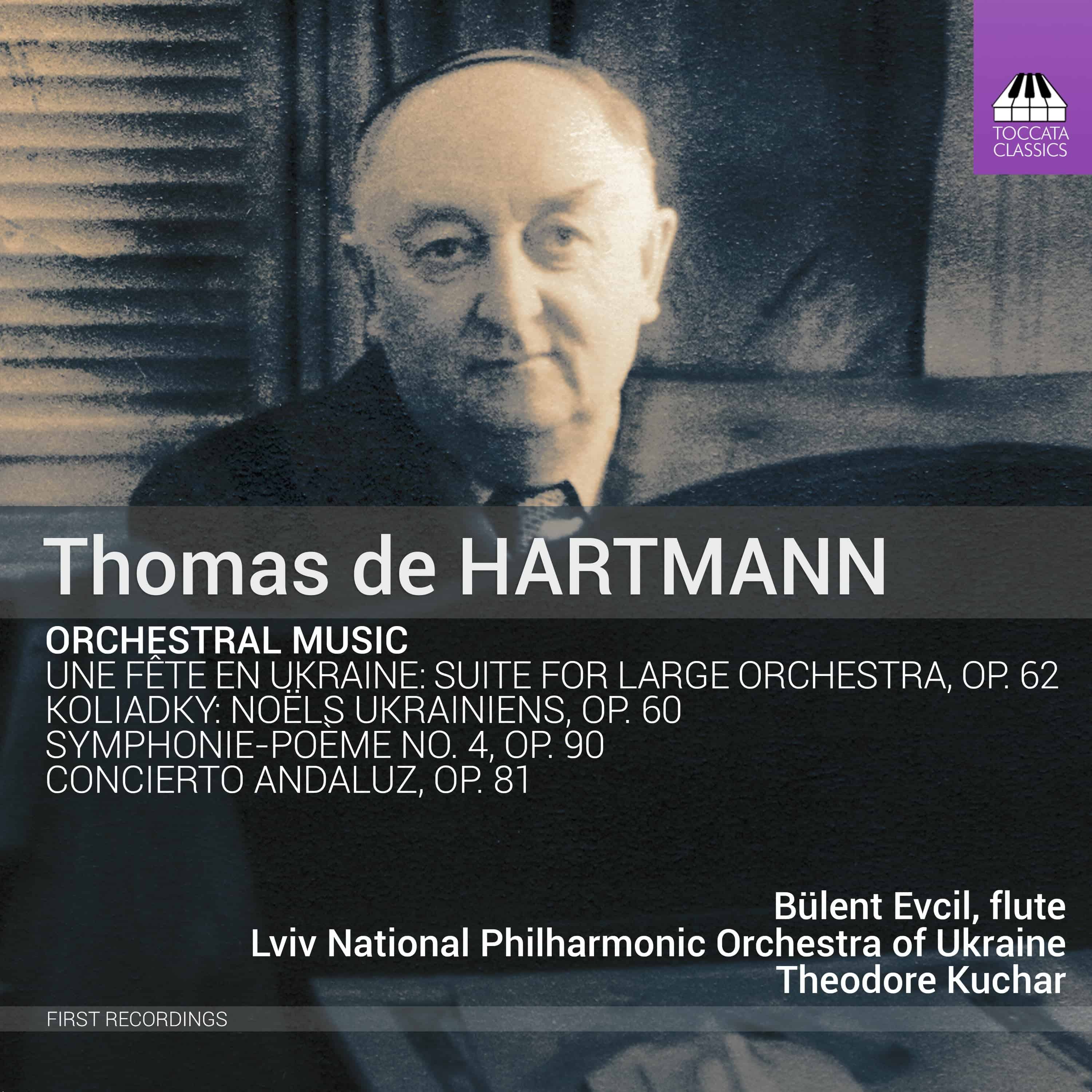
Thomas De Hartmann Koliadky – Noëls Ukrainiens Op.60 (1940) Une fête en Ukraine Op.62 (1940) Concierto Andaluz Op.81 (1949) Symphonie-Poème no.4 Op.90 (1955)
Bülent Evcil (flute), Lviv National Philharmonic Orchestra of Ukraine / Theodore Kuchar
Toccata Classics TOCC0633 [65’43″’] Producer Andriy Mokrytskiy Engineer Oleksii Grytsyshyn Recorded 11-13 September 2021 at National Philharmonic Hall, Lviv, Ukraine
Reviewed by Richard Whitehouse
What’s the story?
Toccata Classics continues its explorations with this release of orchestral music by Thomas de Hartmann (1885-1956), his posthumous reputation largely centred on his association with the Armenian philosopher George Gurdjieff but whose own music is well worthy of revival.
What’s the music like?
Although the Noëls Ukrainiens might appear as the descendent of folk-inspired sets by such as Rimsky-Korsakov or Lyadov, de Hartmann seeks rather to evoke the essence of this music than by quoting traditional melodies. The initial Chant spiritual for strings is a pertinent case in point – its textural and expressive restraint characteristic of what follows, notably the more developed final numbers: the chorale-like solemnity of La veille de l’Épiphanie, simmering fervour of Adieu, Koladá and Mussorgskian vigour of Goussak for an effervescent ending.
In his later years de Hartmann tackled the symphonic genre, albeit from a typically personal vantage in his Symphonie-Poèmes. The fourth of these remained unfinished at his death, with only its initial movement fully orchestrated. Over little more than five minutes, it provides a fair encapsulation of the composer’s later thinking – not least through an elaborate and often imaginative orchestration which accentuates formal obliqueness and expressive disjunctions. Intriguing as it is to speculate what came next, this remains a cohesive statement as it stands.
Written for Jean-Pierre Rampal then taken up by equally illustrious flautists such as Marcel Moyse, the Concierto Andaluz packs a considerable amount into its 10 minutes. Whether in the plaintive lyricism of the Entrada y Romanza, the fleet-footed and capricious Scherzino that is Juego – its winsome trio providing for necessary contrast, or the sultry evocation of Cante y Juerga, this is something of a hidden gem from the repertoire of concertante works for flute and deserving of greater exposure. Bülent Evcil leaves no doubt as to his advocacy.
Arranged from an eponymous ballet celebrating Catherine the Great, Une fête en Ukraine is de Hartmann at his most engaging. Not least the festive Ouverture, with its antecedents in the Russian ‘silver age’, or regal eloquence of Fanfare et Sarabande. The final three items are most substantial – the suitably fanciful imaginings of Incantation et danse du Chamane, the plangent modality of Nocturne, then the panache of Danilo Coupor (an English dance popular among Russian nobility in the early 19th century) which brings a scintillating close.
Does it all work?
Pretty much. That all four of these pieces are from de Hartmann’s maturity means that such influences as there were of earlier composers, primarily the melodicism of Tchaikovsky and harmonic innovations of Rimsky, have been subsumed into a more astringent while always eventful idiom. Both the shorter pieces would make attractive additions to a concert, and the larger collections each feature several items that are worth encountering in their own right – maybe as encores to round-off a programme from one of the more enterprising orchestras.
Is it recommended?
Yes, not least with the Lviv National Philharmonic giving of its best under the astute direction of Theodore Kuchar. Unexceptionally fine sound, with exceptionally detailed annotations from John R. Mangan and Evan A. MacCarthy. A follow-up volume of de Hartmann is imminent.



 Arcana.fm