
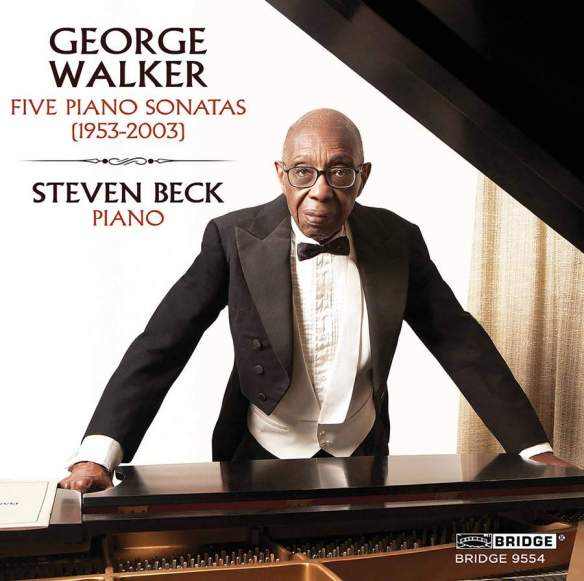
On Record: Steven Beck – George Walker: Five Piano Sonatas (Bridge)

george-walker

Steven Beck (piano)

George Walker
Piano Sonatas: no.1 (1953, rev. 1991); no.2 (1956); no.3 (1975, rev. 1996); no.4 (1984); no.5 (2003)

Bridge 9554 [53’13”]

Producer Steven Beck
Engineer Ryan Streber

Recorded 4 & 14 February 2021 at Oktaven Audio, Mount Vernon, NY

Reviewed by Richard Whitehouse

What’s the story?

Bridge continues its wide-ranging coverage of American music with this release featuring all five of the piano sonatas by George Walker (1922-2018), a composer who is now coming into his own on this side of the Atlantic and through, one trusts, the intrinsic quality of his music.

What’s the music like?

Although he achieved success in the USA, with commissions from several leading orchestras and a Pulitzer Prize in 1996 (making him its first black recipient), Walker was little known in the UK until recently – other than Natalie Hinderas’s account of his Piano Concerto in CBS’s ground-breaking Black Composers Series from the 1970s and occasional revival of his Lyric for strings (the most played such piece in America after Barber’s Adagio). That the current Proms season featured no less than three of his works is hopefully in itself a positive sign.

With its antecedents in Copland and Piston, the First Sonata appeared at a time of incipient change for American music – its three movements classically conceived but never adhering to formal archetypes; witness the flexible handling of sonata principles in the initial Allegro, followed by the contrasted sequence of six variations on a winsome folk tune, then dextrous contrapuntal texture and cumulative impetus of the rondo which comprises its final Allegro. Barely three years later, the Second Sonata sounds as if it might be responding to Sessions’s ‘transitional’ music of not long before – its initial movement’s theme the basis of 10 gnomic variations, followed by a Presto as brief as it is virtuosic, then an Adagio circumspect in its restiveness, and an Allegretto ensuring a degree of finality for all its harmonic ambivalence.

Almost two decades on and the Third Sonata postdates Walker’s most intensive involvement with serialism, but it does not eschew innovation – whether in the constantly metamorphosed shapes of the opening Phantoms, distanced yet ominous emotional resonance of the central Bell, or those myriad textural contrasts which build considerable momentum in the closing Choral and Fughetta. In the Fourth Sonata, number of movements may be further reduced but the emotional range is further extended – the forceful if never unyielding rhetoric of its Maestoso ideally complemented with the formal and expressive disjunction of its Tranquillo. Outwardly a concert study, the Fifth Sonata has as emotional impact out of all proportion to its brevity while leaving little doubt as to Walker’s creative prowess during his ninth decade.

Does it all work?

Almost always. As dates of composition suggest, these sonatas afford a viable (not inclusive) overview of Walker’s evolution – responding to the aesthetic changes in post-war American music methodically and resourcefully, without detriment to his creative integrity. It helps that Steven Beck is as audibly attuned to this music as to that by other US composers – rendering these pieces with precision and commitment, but the recording might have had a degree more warmth to complement its unfailing clarity. Succinctly informative notes from Ethan Iverson.

Is it recommended?

It is. All these sonatas have previous been recorded (notably as part of the extensive coverage on the Albany label), but this release is a clear first choice for anyone coming to them afresh. Hopefully Bridge will record further Walker – maybe an integral cycle of his five Sinfonias?

For further information on this release, visit the Bridge Records website, and for more on George Walker click here. You can read more about Steven Beck on his website
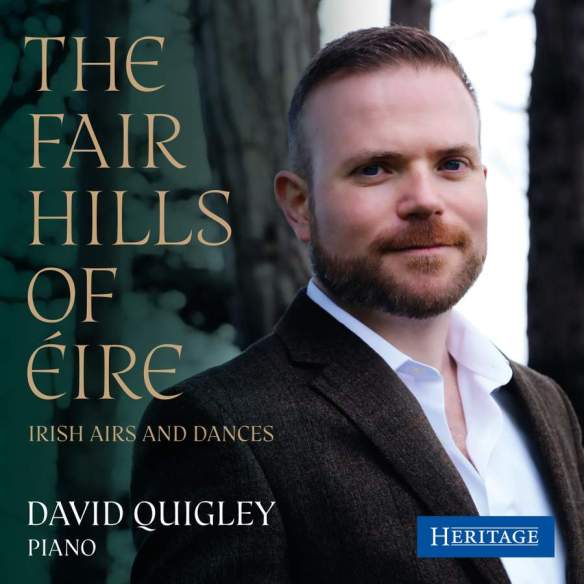
On Record – David Quigley – The Fair Hills of Éire: Irish Airs and Dances (Heritage Records)

david-quigley

David Quigley (piano)

Beach The Fair Hills of Éire Op.91 (1922)
Esposito Two Irish Melodies Op.39 (1883)
Field Go to the Devil and Shake Yourself (1798)
Hammond Miniatures and Modulations (2011) – No. 5, Old Truagh; No. 21, The Beardless Boy
Hennessy Variations sur un air Irlandais ancien Op.28 (1908)
Hough Londonderry Air (2014)
Martin Sionna – Spirit of the Shannon (2018)
Moeran Irish Love Song (1926); The White Mountain (1929)
Smith Paraphrase on ‘The Last Rose of Summer’ Op.173 (1883)
Stanford arr. Grainger Four Irish Dances Op.89 (1916) – no.1: Maguire’s Kick; no.4: A Reel

Heritage Records HTGCD152 [62’39”]
Producer / Engineer David Marshalsea

Recorded 9 & 11 April 2022 at Elgar Concert Hall, The Bramall, University of Birmingham

Reviewed by Richard Whitehouse

What’s the story?

The enterprising Heritage label continues its association with David Quigley in this recital   of Irish piano works as cover over two centuries, reminding listeners of the wealth of folk or traditional music from that island and its influence on successive generations of composers.

What’s the music like?

Published as Favorite (sic) Irish Dance Arranged as a Rondo for the Piano Forte, the first item is not unreasonably attributed to the teenage John Field and make for a breezy recital-opener – following which, pianist Stephen Hough demonstrated his prowess as an arranger with what is surely the most famous of all Irish melodies. Two pieces by the Italian émigré Michele Esposito – the trenchant Avenging and Bright, followed by the pensive Though the Last Glimpse of Erin – complement each other ideally, whereas the first from a set of dances by Charles Villers Stanford exudes bracing humour most likely accentuated in this idiomatic arrangement by no less than Percy Grainger. By some distance the longest piece here is from Swan Hennessy, an Irish/American later resident in France – his 12 variations on an (unidentified) theme in the lineage of various such works from the 19th century but diverting in its ingenuity. Best known as an inquiring pianist, Philip Martin the composer is represented by this evocative set of ‘rhapsodic variations’ written for the present artist.

Sidney Smith’s Paraphrase de concert on another Irish staple is the most virtuosic music and would make a dashing encore even today. Philip Hammond is the other contemporary composer featured – the present brace, part of a sequence of 21 drawn from the Edward Bunting collection and likewise written for Quigley, respectively searching and animated     in their emotional profile. From among her many mood-pieces, that by Amy Beach yields       a limpid poetry that more than deserves to provide the title for this collection overall. An English composer with direct Irish ancestry, Ernest Moeran’s predilection for all-things Celtic is made plain by the two pieces heard here, their recourse to traditional melodies enhanced by an idiomatic pianism which adds greatly to the winsomeness of their appeal. Back, finally, to those Stanford/Grainger dances with the fourth from this set a reminder that the former, whatever his formidable reputation as a pedagogue, was never averse to indulging his Irish roots in the writing of music as scintillating as it remains appealing.

Does it all work?

Admirably. Quigley is as committed to the music of his homeland as have been numerous of his predecessors, not only with performing these pieces in recital but also by finding ways of integrating them into a cohesive overall programme. Only one achieves (just) the 10-minute mark and another is almost eight minutes, making them ideal for combining into a judicious sequence – one which, at little more than an hour’s length, can be enjoyed at a single hearing. Quigley will hopefully have the chance to mine the ‘Irish piano-book’ further in due course.

Is it recommended?

Indeed. Quigley is a perceptive exponent of this repertoire, his Kawai Shigeru SK-EX heard to advantage in the spacious yet detailed acoustic of the Elgar Concert Hall. With succinctly informative notes from Andrew H. King, this recital warrants the warmest recommendation.

For further information on this release, and to purchase, visit the Heritage Records website, and for more on David Quigley click here

On record – Ronald Stevenson: Piano Music Volume Five: Transcriptions of Purcell, Delius and Van Dieren (Christopher Guild) (Toccata Classics)

stevenson-5

Delius The Young Pianist’s Delius (1962, rev. 2005)
Purcell Toccata (1955); The Queen’s Dolour – A Farewell (1959); Hornpipe (1995); Three Grounds (1995)
Stevenson Little Jazz Variations on Purcell’s ‘New Scotch Tune’ (1964, rev ’75)
Van Dieren String Quartet No. 5 (c1925, rev. 1931; transcr. c1948-1987); Weep You No More, Sad Fountains (1925, transcr, 1951); Spring Song of the Birds (1925, transcr. 1987)

Christopher Guild (piano)

Toccata Classics TOCC0605 [80’57”]

Producer / Engineer Adaq Khan

Recorded 5 – 6 September 2020, 5 January 2021 at the Old Granary Studio, Toft Monks, Norfolk

Written by Richard Whitehouse

What’s the story?

Christopher Guild continues his survey of Ronald Stevenson’s piano music with this volume comprising transcriptions of Purcell, Delius and Van Dieren – the latter’s Fifth Quartet fairly exemplifying Stevenson’s dedication to the spirit as much as the letter of the music at hand.

What’s the music like?

The essence of Stevenson’s re-creative approach is evident in his Purcell transcriptions, not least the Toccata with its deft changes of register and tensile rhetoric where Busoni’s benign presence can be felt. A lighter and more playful manner is evident in the Hornpipe, whereas the Three Grounds point up conceptual as well as musical links with Bach and, through their forming a ‘sonatina’ of unlikely cohesion, Beethoven. Greater license is demonstrated in the Little Jazz Variations, surely among Stevenson’s most delightful pieces in its blurring of the ‘boundary’ between transcription and composition and enhanced by its discreet take on pre-bop jazz idioms. The Queen’s Dolour looks to the poignant final aria from Dido and Aeneas for what is one of the most characteristic and, moreover, affecting Stevenson transcriptions.

All these pieces have been previously recorded, but not the remainder of this programme. A pity that The Young Pianist’s Delius is not more widely known, as this cycle of 10 miniatures drawn from across the composer’s output is a gift to pianists who have little original Delius to work with, whereas listeners who are unfamiliar with or deterred from investigating this easily misunderstood figure could hardly hope for a more representative or appealing breviary of his music. It helps that Stevenson’s transcriptions are straightforward but not in the least didactic.

Two songs by Bernard van Dieren – gravely eloquent as regards Weep You No More or deftly effervescent in Spring Song of the Birds – have secured a measure of familiarity when heard as encores. Not so the Fifth Quartet, never recorded in its original guise, whose transcription occupied Stevenson over almost four decades. Premiered in its revision in 1931, this work is among the most substantial from its composer’s later years as it unfolds from a discursive (if never rhapsodic) sonata design, via circumspect and headlong intermezzi, to a lively scherzo then soulful Adagio – before a resolute finale offers closure. Tonal ambivalence and textural intricacy are borne out in this recasting in terms of piano which lasts five minutes longer than the Allegri Quartet’s 1988 broadcast; not that Guild’s reading seems to lose focus in any way.

Does it all work?

Yes, given Stevenson’s command of keyboard technique and, moreover, his placing of this at the service of the piece in question. To paraphrase his comments on Liszt – were the classical repertoire suddenly to disappear, much it could still be accessed through those transcriptions that he made over the greater part of his career. Nor is the technique required of a consistently advanced degree, with the Delius and several of the Purcell pieces accessible to most capable pianists, though the Van Diren quartet necessitates an ability not far short of the transcriber!

Is it recommended?

Indeed. Christopher Guild is a resourceful and probing guide to Stevenson’s art; his Steinway D heard to advantage and his booklet notes readably informative. One final thought – the Van Dieren Quartets positively cry out for an integral recording: how about it, Toccata Classics?

Listen

https://open.spotify.com/album/6EDUvp6G1WYgOY3yIHegtF

Buy

You can discover more about this release at the Toccata Classics website, where you can also purchase the recording. To find out more about the composer, visit the Ronald Stevenson Society, while for more on Christopher Guild, click here