Switched On – Ralph Kinsella: Lessening (8D Industries)

reviewed by Ben Hogwood

What’s the story?

If you are a home producer you will immediately relate to the thoughts behind Ralph Kinsella’s debut album Lessening. Kinsella refers to ‘the poetics of the bedroom’, capturing the intimacy of our most private room for listening to and creating music.

The confined space is the stimulus for the ten tracks of Lessening, all recorded through lockdown in Kinsella’s Dumfries and Galloway. He talks of ‘the boondocks, interspersed with fragments of debris and flickering housing scheme street lights.’

What’s the music like?

Lessening is a set of ten tableaus with varying degrees of ambience and animation. Kinsella’s guitar is the main instrument, but he uses it sensitively among more ambient effects that often give a much bigger sound picture.

The subtly varied guitar sounds provide close up attention to detail or far off wisps of colour, and when the two elements come together, as they do in The Angel Of Raasay, the listener has the feeling of becoming airborne, especially with the ambient surrounds on headphones. That feeling is heightened on In The In-Between Light, where the music soars overhead on a bank of slowly changing effects, panning out to even wider vistas.

On the darker side the slow moving Suffuse has a similarly wide picture to go with its brooding harmonic backdrop, while the expansive Lung Noise, the album’s emotional centre, is similarly introspective but has a lovely mixture of cloudy keyboards to complement the bowed instrument in the foreground.

The layers of white noise laced around T(h)reads work as a comforting blanket, an explicit suggestion of shoegaze acts such as Slowdive, while Born On The Cusp works well with widescreen reverberation. Conversely the studied ambience of Gallows Hill has beautiful details for the ear to focus in on, with intricately picked guitar and woozy atmospherics working together.

Does it all work?

It does, because the structure of Lessening is ideal, giving the music a natural ebb and flow. Kinsella creates a winning mixture of blurred forms and much more studied portraits, portraying both the intimacy of the bedroom where the music will have been made but also the Dumfries and Galloway vistas outside.

Is it recommended?

Very much so. Any lovers of 1990s shoegaze will find much to dive into here, but so will those admiring more recent, post-classical efforts from the likes of Nils Frahm or A Winged Victory For The Sullen. It will be interesting to see what Kinsella turns his guitar to next, for his form of localized ambience creates memorable images of both time and place.

Stream

Buy
Switched On – Twinkle3: Minor Planets (Marionette)

reviewed by Ben Hogwood

What’s the story?

Minor Planets completes a trilogy spanning 15 years from Twinkle 3. The trio – Richard Scott, David Ross and Clive Bell – have a very open musical approach, which on this album allows influences from diverse sources such as Lee ‘Scratch’ Perry and Stockhausen to be taken in, via some sounds of the Far East evoked by Bell’s shakuhachi. The press release for Minor Planets tells a vivid story, promising ‘aleatoric analogue sequencing, chamber-like acoustic improvisation and dub treatments’…which ‘become distilled into a district and emotive narrative that takes us on an exilharating hyperspace cruise to the outer reaches.’

What’s the music like?

Fluid, instinctive and never less than intriguing. Minor Planets captures the sense of emptiness outer space portrays, but also the elements of strangeness, discovery and wonder. From the strange ticking and slightly acidic electronics of Opik 2099 to the mysterious Ziziyu 26946, the textures constantly evolve and the dubby beats provide both comfort and on occasion edginess. The shanachi sounds rather wonderful when used on Soma 2815 and on Kallope 22, taking the listener far away.

Does it all work?

Yes, it does, though headphones are recommended to get the best sonic perspective. Minor Planets does indeed take the listener far from home on its nine very different excursions.

Is it recommended?

Definitely. Those with a mind for ambient music should seek this out, especially if they like a bit of exploration and experimentation at the same time.

Stream & Buy

Switched On – Manu Delago: Circadian Live (One Little Independent)

reviewed by Ben Hogwood

What’s the story?

Releasing a live album in these times of isolation is a bittersweet experience. Manu Delago will know more than most, as he has played well over 1,000 gigs – but this is the one program he wanted to freeze frame and share with his home audience.

The music centres on the European tour of Delago’s Cicadian album in late 2019, where the 18 gigs in 21 days were performed by the nine-piece Cicadian Ensemble. This is a band long in the making but with a pleasing symmetry, three players each assigned to the areas of percussion, strings and wind instruments.

The aim of Cicadian Live is to show that while electronic music forms an important part of Delago’s thinking, his musical communication is equally strong – and arguably emotionally deeper – through acoustic performance.

What’s the music like?

Every bit as enchanting as we heard on Cicadian, but with the added frisson of the live music environment. To hear these tracks evolve in the moment is to be there in the cycle with Delago himself, hanging on the next move of each of his instrumentalists.

As tracks like Draem evolve, with their striking textures, the ear is drawn to each new melodic development, each percussive layer and each twang of the string bass. Delago’s enchanting sound world benefits greatly from the intimacy of these live recordings, and the instinctive chemistry between all the players involved.

The collection Immediately creates its own rarefied atmosphere with The Silent Flight Of The Owl, one of Cicadian’s standout moments, and does not let up until we are set down 70 minutes later with B.F.G.

In the middle there are intimate moments of rare beauty, where the listener dare not breathe lest the peace be broken, and these contrasts with powerful bursts of momentum such as Almost Thirty, where a series of crescendos break out into no-holds barred freak-outs, and Zeitgeber, a blend of virtuosity and concentrated feeling which is a testament to the fine musicianship of all involved.

The brassy rasps of Satori work well, building up a head of steam, and contrast nicely with the ripples of Circadian itself, stopping time to mesmerising effect. Down To The Summit, like Almost Thirty a fully scored piece from 2015’s Silver Kobalt, captivates with its twists and turns.

Does it all work?

Yes, because the instincts and musical understanding of the nine ensemble members is compelling the whole way through. This was clearly a special tour, and it serves to hear the new tracks from the Cicadian album rub shoulders with the more established Delago output.

Is it recommended?

Very much so. The live album works even better if you have heard the studio account of Cicadian first – but if not it serves as an excellent introduction to Delago’s craft. Each track sets its own unique atmosphere but captures the attention with intricacy, craft and spontaneity.

Stream

Buy

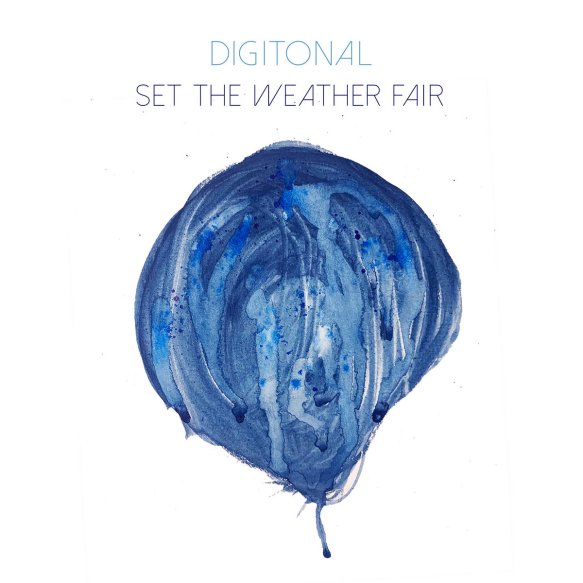
Switched On – Digitonal: Set The Weather Fair (Just Music)

reviewed by Ben Hogwood

What’s the story?

For Digitonal’s fourth studio album, Andrew Dobson is joined by producer Dom Graveson for a fusion of analogue and digital setting natural scenes to vivid music. Set The Weather Fair will be a comforting reassurance to those who have already enjoyed Dobson’s first three albums under the Digitonal moniker, but this one offers greater depths of texture and musicianship.

What’s the music like?

Blissful – but also wholly immersive. This is music that paints vivid pictures but in the same breath possesses a great deal of emotion. One of the biggest pluses here is the way Dobson uses his clarinet and cello to colour the textures and to make the melodies more distinctive. He also knows his way around small and expansive structures – the ten-minute Gold Of The Azure is every bit as captivating as The End Is Just The Beginning that follows it.

Those two tracks are notable for their use of the clarinet, which comes to the fore on Gold Of The Azure, and then the cello on The End Is Just The Beginning, which features a slowly tolling piano. The Dance’s Pattern, too, is ideally paced.

On his Bandcamp page Dobson sets out the story behind the album and its sonic images, citing a number of influences in a modest tribute to the music he listens to. The truth of the matter is however that this music, instrumental thought it is in his make-up, is all used to make a wholly original piece of work, a recognisably British affair where both restraint and bold colours are used to great effect.

Does it all work?

Yes. The colours are captivating, the use of beats and beatless music is just right, and the proportions feel right too. Dobson has a winning way with melody, and Graveson’s production nouse is the icing on the cake.

Is it recommended?

It is. Set The Weather Fair can easily be divided into the nine elements that make up the whole, but it is best experienced in a single sitting, a seamless flow of musical ambience that settles the mind and gently moves the soul. It is right up there with Digitonal’s best work.

Stream

Let’s Dance – Detroit Love 4 mixed by Mirko Loko (Detroit Love / !K7)

by Ben Hogwood

What’s the story?

Carl Craig’s Detroit Love mix series moves onto a fourth instalment under the watchful eye of Mirko Loko, who Craig recruited for the Detroit Electronic Music Festival back in 2001. With such a longstanding attachment to the city and its techno heritage, the Swiss DJ is a natural choice and takes the chance to say thank you to Detroit and its cultural legacy. He does so in the form of a 22-track mix including homegrown talent but also casting an eye further afield to show off the influence of the city.

What’s the music like?

This is a really fine set, mixed with impressive fluidity by Mirko Loko. From the start he creates a good deal of space, Fred P’s Vision In Osaka setting the scene beautifully before Loko’s own excellent Detroit Love Mix of It’s Like, with persuasive vocals from Ursula Rucker. As the mix proceeds Loko moves between quite minimal tracks and bigger, expansive moments like Chaos In The CBD’s Comfort Zone, or the blissful Aos Si of Takuya Yamashita.

However the real high point comes with Derrick May’s appearance on Loko’s Mentors Heritage, a mix made especially for the compilation. The booming voice and percussion are an ideal match, especially when segueing into the bare bones of the piano in Laurent Garnier’s mix of Gilb’R’s Pressure.

From then the mix rolls on, taking in the propulsive Madness of Temo Howard before an excellent finish from Mirko Loko and Stacey Pullen with Tronic Illusion – another exclusive mix – and Lady B’s Cruising Around Motor City.

Does it all work?

It does indeed. Well paced, structured and full of subtly euphoric moments uniting past and present in an effortless blend.

Is it recommended?

Yes – a very strong addition to what is proving to be an extremely collectable series.

Stream

Buy