

As Arcana discovered only the other week, Andy Bell is a musician with several strings to his bow. Many will know him as a founder member of Ride, the Oxford group popular in the early 1990s and enjoying a creative renaissance capped by new album This Is Not A Safe Place, released as this interview is being written. Others will recognise the Ride genesis but think of Bell more as a sometime member of Oasis – where he played bass guitar – and Beady Eye. Add to that Bell’s time as front man for Hurricane #1, at peak Britpop in the late 1990s, and you have a pretty formidable indie discography.
As it turns out, this is only part of the story, for Andy also makes music in a solo capacity, under the name of GLOK. Here the keyboards take over, and a love of Krautrock and other weird and wonderful electronica becomes clearer – as does the sense that here Bell is really able to indulge his full portfolio of styles.
Last week we had the chance to talk all things GLOK – and to ask Bell that now he’s been ‘outed’ if he intends to make it a more full time piece of work.
Arcana: When you started making music as GLOK, was it your intention to keep it private?
Andy Bell: Originally I was using the name to hide behind. I didn’t want people’s first experience of hearing it to be tied to a mental image of me, or what they thought I stood for. A side effect of this was that the tracks barely got noticed, or at least it felt that way. But in a way that was what I wanted. Dissident got added to a pretty big Spotify playlist and that was cool. But after that none of the other tracks did much.
At the time the tracks were signed to a label called Globe. This was a couple of years ago. I’m still signed to Globe, myself, as a composer, that’s the nature of that deal. GLOK was just one way of getting music out into the world really, but after a couple of years, the tracks were basically sitting dormant on iTunes and Spotify, until I got a call from Bytes about doing a physical release. There were 5 tunes out at the time, from a group of around 10 or so GLOK tunes which I’d made and had mastered for Globe. By that time it was no longer a secret that GLOK was me, I’d done a few remixes under that name including one for Ride. When Bytes got in touch Joe Clay told me that he loved Pulsing way before he knew it was me, which was really cool to hear.
When did you start to realise the potential of making your own music with synthesizers?
I bought a Yamaha CS-5 after Dave Sitek had used one in the studio with Beady Eye. That was because I saw how easy it was to use and what great sounds you could get with it, especially using it with guitar pedals. Dave had brought over a ton of gear with him to London and I ended up getting a lot of things he turned me on to, for example that was the first time I came into contact with the Eventide Space Reverb, which for me now is like a member of my family or something. It gradually spread from there. I got a Roland SH 101 and a couple of things from the Critter and Guitari range, a little bit of modular, apps on the iPad like the mellotron etc. Initially I was buying this stuff to augment the sound of songs that were still in guitar world. The catalyst for me to start to get my head into actually making electronic music was kind of a side effect of the Music recording software Logic going from version 9 to version X.
I had been using Logic 9 – by trial and error, after Jeff Wootton showed me the ropes. Jeff was horrified that I was making demo’s on Garage Band! He was like “You’re using kids’ software man. Here’s the grown-up Garage Band, you need to be using this”. So then I was stumbling around inside Logic 9 but able to get ideas down. Then 9 kind of became obsolete and the next version, X, was totally different. I was completely lost by it so signed up to learn Logic X at a place called Sub Bass Academy, near Waterloo. I spent six months inside Logic X and it was amazing. The course started with sampling and went from there. As soon as I learned to use the onboard sampler I was away. Just like when I learned the guitar, I started off re-making tracks I liked (Mr Fingers‘ Can You Feel It, Underworld Rez, and A Guy Called Gerald‘s Voodoo Ray) and then moved on to coming up with my own stuff. And I was getting help from them along the way. So basically after that six months, I was OK at sampling, synthesis, all the stuff I’d been getting interested in but didn’t really know. Logic became the way I made demos, and therefore, a lot of the time, the way I wrote songs.
Was it a leisure activity to start with, or did you always see a single / album release as part of it?
Leisure, for sure. I don’t feel like I have an actual ‘job’ ever, except maybe when I’m doing promotional stuff. It built up into quite a collection of music over a year or two, and then through conversations with Marc Robinson at Globe, he told me he’d like to put some of the tracks out. It wasn’t envisaged as a conventional album at the time. I think they did one track a month, for five months. But I kept on making GLOK tracks long after Globe stopped putting them out. OK, so most of them are half finished, but so were the first seven until Marc gave me a deadline!
Fully electronic music has become something I do equally as prolifically as guitar songs, and it’s never something which I start with a release, or even an end product in mind. What it comes down to, is I would much rather start a track than finish one. I’m lazy and on any given day I’ll just start about five ideas, name them, and forget about them. They could be electronic or guitar-y. I’m always finding tracks that I have zero memory of making. I love that. Some of them are even half decent.
Was it enjoyable keeping GLOK a secret, and has your approach to it changed at all now it’s out in the open?
Maybe I didn’t need to use another name at all, but that just made me more comfortable with it at the time. Nothing has changed about the way I make music since then.
What other music using synthesizers / keyboards do you admire?
Everything from The Beatles onwards and outwards. Psychedelia and Krautrock opened rock music up in the ‘60s and ‘70s and from that point there’s no huge need to categorise. But if we are talking pure electronic music, then for me the biggest influence is Mr Fingers. I love the home made feel of his records. There’s a direct line there to Voodoo Ray which is another of my favourites, I bought that on 12” when it came out. Recently I’ve heard Harald Grosskopf – he’s an artist I think I’m going to really love. But my taste is pretty broad and I think I’m not that unusual in that respect. That’s how people listen now I think.
How did you get to writing much longer pieces like Dissident, and when did you realise you could write much more substantial tracks while keeping the interest high?
Dissident was almost that long right from the first demo. I’d set up an arpeggiator and started playing chords over it with a softsynth, and in essence the track hasn’t changed that much since then. I hadn’t realised how long it was, I was just noodling around with it. I think the first version was about 12 minutes, and I repeated a couple of sections along the way, and it ended up around 20, which feels like its natural length.
Have you ever considered writing in a more classical form – and has classical played any part in your musical development so far?
I have never had any interest in classical music, but Loz Colbert did get me into Minimalism, which I think had a lot of influence in the rock world, that’s something I’d never heard about, and it blew my mind when I started connecting the dots. Steve Reich is the man, and I especially like Come Out and Piano Phase. Phases and Music for Eighteen Musicians are two albums of his I play a lot the whole way through. I’ve also been to see two Philip Glass operas, Satyagraha and Akhnaten – they are incredible. A couple of hours passes in what seems like 15 minutes! I’m still waiting for a chance to check out Einstein On The Beach.
Do you think you’d like to take GLOK out as a live concern?
Yes, I’d like to but I have no idea how it would work. There’s a lot of scope for what a GLOK live thing could be, from a DJ set with bells on, all the way to a full live band. I don’t think it is going to happen anytime soon. I’m about to go around the world with Ride.
In terms of songwriting, how would you summarise the contributions you’ve made as a band member to Ride, Hurricane #1, Oasis and Beady Eye?
All those songs, even the GLOK ones, all come from the same source. There’s no rule as to the end point, whatever the starting point has been. I am quite instinctive and I don’t always know when I’ve written a really good, or really bad song. I’ve put out a few of both. It’s hard to tell at the time, weirdly. I know when a song feels special to me, but often those particular songs don’t mean much to anybody else. The ones people really like are normally the ones that took the shortest time to write. Those ones can feel quite throwaway to me until time passes and I can look back and see where the quality really was. I think it’s normal to associate effort with quality but it’s not always that way at all.
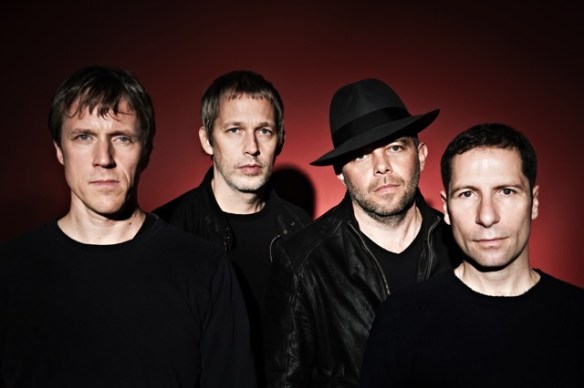
On the new Ride album (the band photographed above), the approach allows for more electronics. Was that your input?
No, not at all. I use bits and pieces in places. But I think Steve Queralt is the one whose demos are the most full of synths. When Erol Alkan came on board, I felt the door was open for us to make a fully electronic album. It’s still open. It would be cool to do. But Erol plugged into the band element. I think that was the braver move in the circumstances, and the better one for the big picture of the band.
It must be gratifying to see how Ride have developed over the years.
It’s great, it still feels like we have so much to do. I just mentioned an electronic Ride album. But a full on, “Daydream Nation” kind of Ride album is something I think we could do. I think that could be incredible. To go in and just turn up the guitars, jam out on open tunings, do some real long freeform songs, make like a mid 70’s Neil Young or late 80’s Sonic Youth album, would be fantastic.
What are your plans for the rest of the year – and do you have many beyond that?
The Ride tour will take us through into the middle of next year. But alongside that there are various other things I’ve been working on. GLOK is one of them, but there are a few other things in the pipeline as well.
Finally, could you select a Ride song (or any other) that you’ve had a big hand in that you’re particularly satisfied with?
Cool Your Boots is one of my all time favourite Ride records, mainly because of the last two minutes.
The Glok album Dissident is out now on Bytes…while the new Ride album This Is Not A Safe Place is newly available on Wichita Recordings. Both can be heard below on Spotify:


 Arcana.fm