
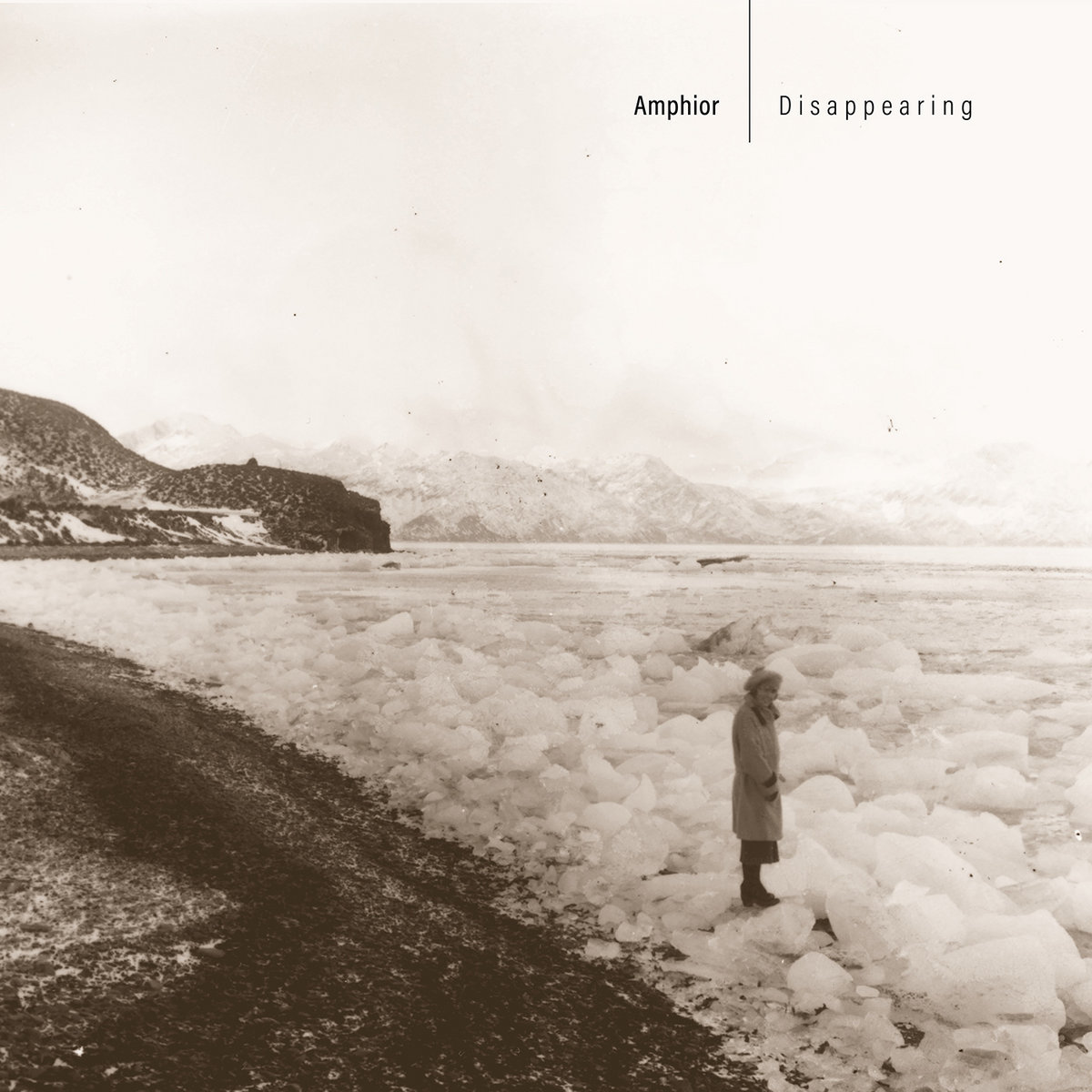
Switched On – Amphior: Disappearing (Glacial Movements)

by Ben Hogwood

What’s the story?

For his second album in Glacial Movements under the Amphior alias, Danish musician Mathias Hammerstrøm explores the point where tangible dissolves into ethereal.

It is a deeply personal exploration, as he explains. “The album is a meditation on anxiety and the longing for a time when it had less sway over me. Reflecting on my childhood, I remember how playing the piano was deeply meaningful to me, and crafting Disappearing felt like reconnecting with my younger self through the music.”

What’s the music like?

The eleven tracks here cast a wide net, their moods very different as though experiencing different hours of the day. Some of them cut off abruptly, as though passing through a door from tangible to intangible.

Under The Stars has a suitably wide panorama in its musical outlook, with low piano and spacious textures, the sky arching overhead. By contrast Time Is A Thief has softer and slightly more ominous musings, its added notes portraying the anxiety Hammerstrøm mentions before growing in power.

Echoes From The Past presents a lighter picture, though is slightly wobbly on its feet, while other tracks are much less certain in outcome. The eerie Costume Party briefly resembles the fuzzy nostalgia at the chilling close to The Shining, while some tracks, notably Bring To Light, collapse into disconcerting fragments.

Disappearing itself has an impressive grandeur, a distinctive loop asserting itself against a texture the listener can dive into, while the clock ticks ominously through the fuzzy Bloom. Everything Is Passing has a good deal of musical wow and flutter, removing the firm ground from the listener’s feet before ending in cold ambience.

Does it all work?

It does, and Mathias Hammerstrøm’s music often plays tricks with the listener’s sense of perspective. This is overall a good thing, though can be quite unnerving at times.

Is it recommended?

It is. Amphior’s latest has some highly descriptive music in its eleven short chapters, and though anxiety is never fully quelled it is certainly confronted with the overall ambience of Mathias Hammerstrøm’s distinctive writing.

For fans of… Tim Hecker, Biosphere, Aphex Twin

Listen / Buy

Published post no.2,473 – Friday 14 March 2025

On Record – Andy Bell: pinball wanderer (Sonic Cathedral)

by Ben Hogwood

What’s the story?

Andy Bell is on a creative roll these days. While it’s not clear if the Ride guitarist will become part of the Oasis live tour later in the year, he is pressing ahead as he hits a rich vein of form in his solo career. Whether under his own name or the GLOK alias, where he operates more electronically, Bell has maintained a satisfying blend of recent past and future, bringing together song-based material with experimentation and the joy of repetitive beats.

pinball wanderer looks set to further his enjoyment in these areas, with a busy year ahead!

What’s the music like?

Bell achieves a really satisfying blend of electronic and acoustic here, bringing in some elements of the GLOK alias – especially an enjoyment of Krautrock – to rub shoulders with influences from early 1990s Manchester and, further back, a healthy dash of Byrds.

The result is music that is never short of a hookline, but adds some really interesting and rewarding quirks when the mood takes it. A great example is the groovy Apple Green UFO, a track aware of the groovier side of Stone Roses’ repertoire, but striking out through dropping a beat in the bar, giving it a subtle edge the likes of A Certain Ratio would enjoy.

Panic Attack is equal parts Krautrock and Manchester, promising warmer climes, while a well judged cover of The PassionsI’m In Love With A German Film Star features ideal guest turns from Dot Allison and Michael Rother. The title track is a brightly coloured groove, while the dreamy Space Station Mantra allows the mind to wander at the cosmic close.

Does it all work?

It does – and with repeated listens, Bell’s music grows in stature and impact. Be warned, there are many earworms in this album!

Is it recommended?

It is. Andy Bell is clearly relishing his music making at the moment, and this meeting of his different musical minds is thoroughly enjoyable, laden with grooves, riffs and good times.

For fans of… A Certain Ratio, Neu!, Andrew Weatherall, Primal Scream

Listen / Buy

Published post no.2,470 – Tuesday 11 March 2025

Switched On – ANiML: Star Walk (Stratasonic)

by Ben Hogwood

What’s the story?

There is an element of mystery behind German / Canadian collective ANiML, who made their first appearance a year ago as the first release on their own label Stratasonic.

Then they released the four track Accidental Effects, but here they go two better with an album to showcase their grooves.

What’s the music like?

ANiML’s music is consistently engaging. Their loping grooves are powered by string bass lines, with nods to hip hop, dub and funk but with a welcome freedom that means you can’t fully pin the music down.

Cherry has the warm promise of summer in its dubby beats and languid riff, while Baby D has a nocturnal feel, evoked by the vibraphone. Star Walk is a descriptive cross genre beauty, with hints of a march in its cross rhythms. The clipped beats of Bruv are effective, nicely on the scratchy side, while Titles is a really strong, low-slung groove.

That leaves the opening Breather, an evocative track laced with tension as its loping beat takes hold. Its keyboard hook would suit an opening credits sequence.

Does it all work?

It does – the only regret being there isn’t more music! ANiML’s grooves are consistently satisfying.

Is it recommended?

Yes, enthusiastically. If you want some quality, streetwise grooves, with a dose of freshness and invention, ANiML are your new find.

For fans of… Massive Attack, Portishead, DJ Shadow, Unkle

Listen / Buy

You can listen to clips and explore purchase options at the Traxsource website

Published post no.2,469 – Monday 10 March 2025

On Record – Gaspar Claus: Un Monde Violent OST (InFiné)

by Ben Hogwood

What’s the story?

In Maxime Caperan’s thriller Un Monde Violent, two brothers plunge into a spiral of violence, with uncomfortable results. For the soundtrack, he enlisted cellist and composer Gaspar Claus who has responded with a score in which he produces and performs.

What’s the music like?

In a word, tense. Claus has already shown a gift in his music to evoke scenes and emotions, and those qualities immediately come to the fore.

The Ouverture is laden with dread, its dark ambience creating waves of uncertainty, though it is still possible to admire the rich and fulsome colours Claus applies in his playing.

His Tancade album of 2021 showed how a wide range of techniques and skills with the cello can produce an unusually wide range of sounds, and that is again the case here, from the unsettling tremolo figures of Un meutre to the pizzicato thrumming of Moto joie or the existential dread of Moto Drame, with its widescreen panning.

Vers l’hôpital is a different story, its affecting chorale richly scored, and Claus moves from this to the flickering, wispy arpeggios of Le père, showing the sonic palette his cello has at its disposal.

The last two tracks are more substantial – Channel is a co-production with vocalist Caspar Clausen, but also features the disorientating appearance of a brass band in the middle of is cluster of chords. Peace is finally achieved in the closing credits, delivered in a concoction of softly voiced harmonics and drones.

Does it all work?

It does, provided you’re in a quiet room. Claus achieves a wide range of dynamics in his writing, and a silent backdrop will ensure all are brought to the fore.

Is it recommended?

It is. Gaspar Claus writes for the cello with great imagination and inventiveness, and this response to the story of Un Monde Violent is as dramatic as it is musically convincing. Strongly recommended.

For fans of… Julia Kent, Sarah Neufeld, Hildur Guðnadóttir, Peter Gregson

Listen / Buy

Published post no.2,460 – Saturday 1 March 2025

Switched On – Optometry: Lemuria (Palette Recordings)

by Ben Hogwood

What’s the story?

OptometryJohn Tejada and March Adstrum – return with a second album. Lemuria is described as a ‘sci-fi musical diary – a deeply personal record that processes the year’s events through introspection and creative exploration’.

By way of background, Tejada is known as a quality source of largely instrumental techno, while Adstrum is a guitarist and vocalist, whose parents played baroque violin. She toured backstage with a number of their ensembles.

This time the pair share production duties, realising the whole project in person and with lyrics taken from Adstrum’s diary entries. The songs ‘explore themes of rebirth, loss and closure.

What’s the music like?

There is certainly a wider range of emotions on this album than the pair’s After-Image debut, though there is a strong sense of melancholy that can be felt in the downtempo offerings. Unanswered captures this keenly, Adstrum singing of “another step on the treadmill”, before changing gears for the excellent Never Coming Back, a compelling quicker number.

Fear (Is The Mind Killer) is expressed through a twisted synth line, whose presence is a vivid source of anxiety. Distortion of a different kind pervades the slow and stately Target Practice. Emphasising the contrasts on the album, resignation is the overriding feeling on Antidote, but Bon Voyage promises a great deal more with its bubbling energy.

Does it all work?

It does, largely – with an instinctive meeting of minds that works well. Lemuria is defined as “an annual event in the religion of ancient Rome, during which the Romans performed rites to exorcise any malevolent and fearful ghosts of the restless dead from their homes”. This is not necessarily a dramatic rite, but a therapeutic one.

Is it recommended?

It is. Tejada and Adstrum have a compelling musical chemistry and their storytelling is well worth following.

For fans of… Steffi, John Tejada, Francis Harris, Michael Mayer

Listen / Buy

Published post no.2,459 – Friday 28 February 2025