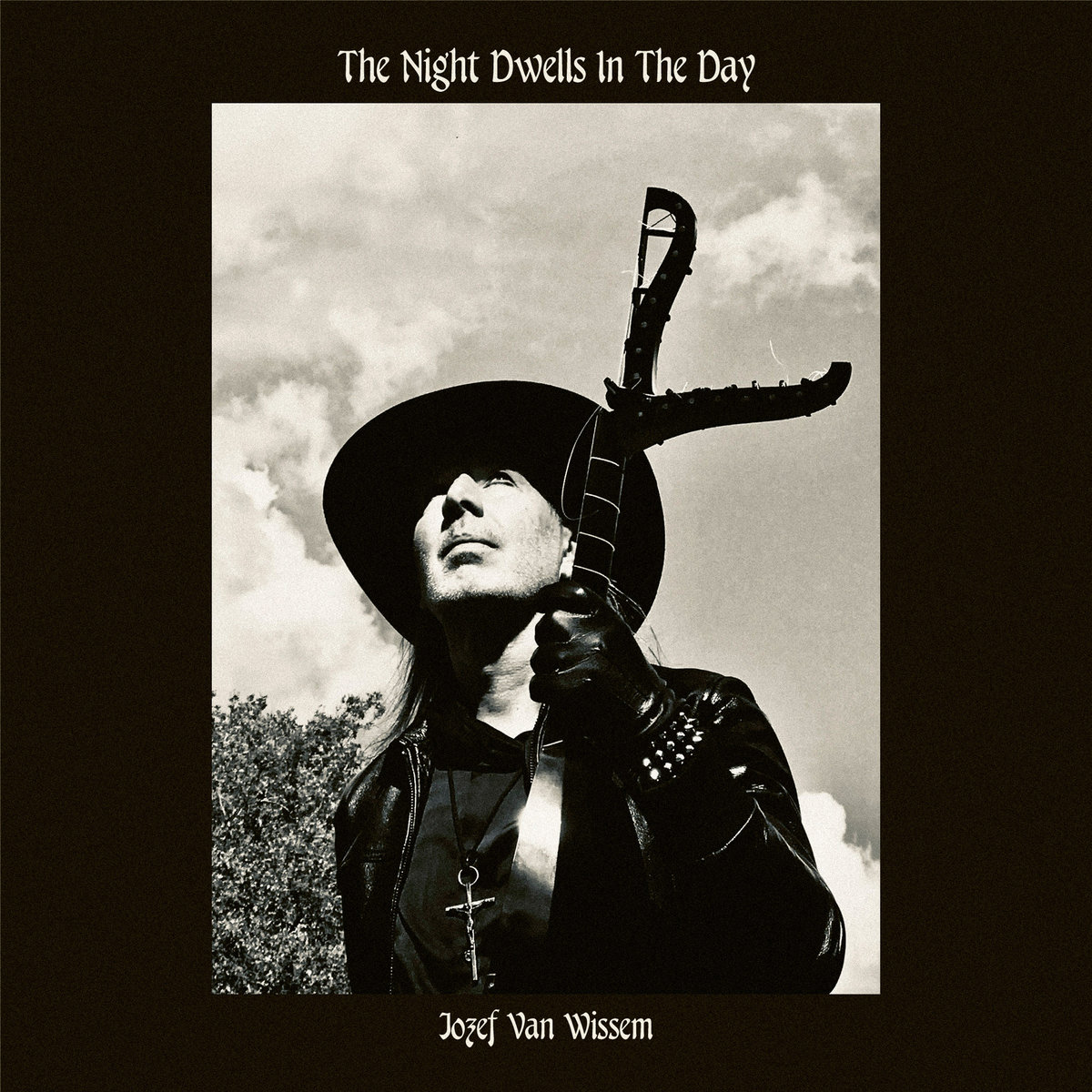
Switched On – Jozef Van Wissem: The Night Dwells In The Day (Incunabulum Records)

by Ben Hogwood

What’s the story?

Jozef Van Wissem is a musician whose music transcends time. His instrument, the lute, has an ancient tradition with a huge amount of music written for it in the Renaissance and Baroque periods. Yet, as the Dutch composer has shown, it has little trouble fitting in with contemporary styles and practices, showing its versatility with guitar-like figures and sounds but with a distinctive tone.

He has enjoyed collaborations with Jim Jarmusch and Tilda Swinton and written soundtracks for computers and films, the latest of which is Pierre Creton’s film A Prince last year. The Night Dwells In The Day began life in the pandemic, Van Wissem writing the standout track The Call Of The Deathbird, on which he makes a rare appearance as a vocalist alongside his guest Hilary Woods. The rest of the album charts the reaction of the world as it moved on, and the elements of darkness and light existing side by side.

What’s the music like?

Don’t expect anything too bright in the course of Van Wissem’s album…but don’t let that put you off, either. There are some truly unique musical colours that unfold during the course of this work, and a theatrical poise that gives the music a good deal of drama.

As you might expect, The Call Of The Deathbird is the album’s calling card. It is a startling piece of music, led by the lute with an urgent undulating figure. What proves even more striking than the lute, however, are the voices – Van Wissem’s tones with a sonority approaching Nick Cave. When Hilary Woods appears, almost off stage, the effect is genuinely ethereal, and the electronic effects give the effect of sonic displacement. The Day Of The Lord also has the feeling of a ritual, and here Van Wissem’s haggard, weather-beaten vocals carry it forward.

The lute proves to be a versatile instrument, capable of soft intonations but also coarse arpeggios, and when multiple layers are built up, as they are on In Exile Here We Wander, the effect is genuinely thrilling. When the electronics complement the acoustic material, which they often do with subtle effects, then there is plenty for the listener to get hold of. Slowly The Rays Of Daylight Fade takes on the form of the winter sun, a stark timbre for the instrument as the light drops over the horizon.

Does it all work?

A good deal of the time. On occasion the writing for lute does retreat into quite lengthy loops of arpeggios, which aids the meditative aspect of Van Wissem’s writing if the listener is in the moment, but they do sound repetitive as the album progresses.

Is it recommended?

It is – provided the mood is right. This is an imaginative album, dark but glinting at the edges, and with a protagonist who knows how to soundtrack a drama. Jozef Van Wissem has an unusual talent for blending ancient and modern at the same time.

For fans of… Nick Cave, Mark Lanegan, PJ Harvey, Gravenhurst

Listen

Buy

Published post no.2,061 – Friday 19 January 2024

Switched On – Mike Sheridan: Atmospherics (hfn music)

by Ben Hogwood

What’s the story?

Mike Sheridan returned to the long playing game in late November 2023 with his first album since 2012. It had been a while in the making, evolving over three years, with the Danish producer taking his time in comparison to his first album I Syv Sind, released in 2008 at the age of 17.

Sheridan has had a good deal of life experience since then, and Atmospherics was planned as a quiet release, almost devoid of melodies. The title refers to electrical disturbances, such as those that occur during a thunderstorm and tamper with wireless signals. Rather than being devoid of melodies, he adds to them with vocal guest slots for Agnes Aldén and Indra-Rios Moore.

What’s the music like?

Very…atmospheric. Sheridan writes in a compelling style however, so while the music works in an ambient context the events on each track do combine to pull the listener in.

He operates in a widescreen environment, established early on with the instrumental Impulse, but there is a lot of detail in the foreground, too. On occasion the dark colours and textures hint at an industrial setting, the listener placed up the end of a large structure while mechanical processes work their way out in a largely ambient way. The interference he speaks about is generally easy on the ear, aiding the ambience rather than interfering with it, but there are moments of unexpected beauty where brief string loops (Impulse, CME), vocals or gentle guitar lines (Strata) make themselves known.

The beats are effective, too, slower patterns that walk forward at an easy pace, but generate a kind of subtle urgency. The vocals are well chosen and ideally spaced, headed by the two contributions from Swedish singer Agnes Aldén – whose turn on the urgent Minds I is particularly good. BYLJA appears on the unexpectedly uptempo Subspace, where the audio scenery suddenly goes past at a quicker rate.

Everything comes together to great effect on the finale. Universal Automation, made with Janus Rasmussen, is a superb piece of work where the beats flick around the edges of a broad sonic canvas like the flames of a candle, before taking over emphatically.

Does it all work?

It does. Sheridan is an impressive composer who writes with no padding – everything is there for a reason, no matter how the ambience is created. This is especially rewarding on headphones when the layers of detail can be fully appreciated.

Is it recommended?

Yes. Mike Sheridan’s brand of electronics may be ambient, but it proves a stimulating listen too.

For fans of… Dave Gahan solo, Trentemøller, Jon Hopkins, The Black Dog

Listen

Buy

Published post no.2,060 – Thursday 18 January 2024

On Record: Bruce Brubaker – Eno Piano (InFiné)

by Ben Hogwood

What’s the story?

To read the full story behind Eno Piano, you can read Arcana’s recently published interview with Bruce Brubaker. In it he sets out his quest to recreate Brian Eno’s ambient masterpiece Music For Airports, made through tape loops and studio techniques, for a living and breathing musician to play on the piano.

To get the necessary sustain Brubaker has employed a number of intriguing techniques, not least the use of electro-magnetic bows over the piano, enabled by Florent Colautti.

While Music For Airports is the main act, Brubaker places it in the context of shorter works by Eno that have a more descriptive edge – The Chill Air, a collaboration with the late Harold Budd, By This River, co-written with Dieter Moebius and Hans-Joachim Rodelius, and Emerald and Stone, where his collaborators are Jon Hopkins and Leo Abrahams, with whom he still works a great deal.

What’s the music like?

Incredibly restful – which of course is a description you could level at the original Music For Airports. Job done, you would think, but the reproduction of this music in human hands does reveal a slight and unexpected intensity, the performer having to maintain a very high degree of concentration and control to get close to honouring Eno’s original music.

Brubaker certainly does that, and the electro-magnetic bows help the sustain very subtly at the start of Music For Airports 2/1. The whole thing is so carefully thought through that each note feels researched but also instinctive, especially in 2/2 where the angular lines create an extraordinary sense of space.

While Music For Airports is indoors, the other three pieces are very much outside, and have a refreshing clarity. The Chill Air and By This River are bracing, wintry piano music.

Does it all work?

It does. When Bang On A Can released their chamber ensemble version of Music For Airports in 1998 it gave a new dimension to Brian Eno’s thinking. This piano work will have a similar effect, and is even more intimate in its confines.

Is it recommended?

Yes. Any Eno fan will want to hear this, and Bruce Brubaker shows just how imaginatively and thoughtfully he can attend to the music of others. This is a quiet revelation.

Listen & Buy

Published post no.2,046 – Thursday 21 December 2023

Switched On: Alphabox – Only Forward EP (VLSI)

by Ben Hogwood

What’s the story?

Alphabox is the new pseudonym under which Andrew Dobson is operating. Dobson has a good deal of previous form, as the much-loved Digitonial – where ambience could be found through cultured and beautifully sculpted electronica.

Alphabox looks to do similar, though is more beat-based and has a new home on the VLSI label.

What’s the music like?

Deeply satisfying – and, on the strength of this EP, music with staying power. The cool textures and easy profile of Feather set the tone, with the assurance that Dobson has clearly kept from his previous work. Gateway Station is relatively easy going, though there is more depth to the piano line than meets the eye, and a loop of consonant harmonies to go with the offbeat rhythm track which prove oddly reassuring.

Meanwhile the closing Blyth feels more like Plaid, but with a folky undertone containing a lot of agreeable melodic content, backed by a purposeful rhythm.

Does it all work?

It does indeed – and is beautifully produced by an expert hand.

Is it recommended?

It is – an auspicious beginning for a project that already looks like one to follow.

Listen and Buy

Switched On: Ambient Focus – Terry Riley & Cornelius

by Ben Hogwood

It is relatively rare for Arcana to recommend a radio program, but we are more than happy to make an exception for this rather wonderful two-hour slot. Taking the reins are Cornelius and Terry Riley, with two hours of ‘handpicked tracks curated in collaboration…featuring field recordings made in Kyoto by radio producer and sound artist Nick Luscombe. This Ambient Focus special celebrates the Ambient Kyoto Festival (2023), featuring performances by Terry Riley and Cornelius, both based in Japan.

There is a delicate intensity to the first two tracks we hear from Sleepy Dragon and Raymond Scott, before the beautiful Dream from Ryuichi Sakamoto. Riley’s own Journey From The Death Of A Friend picks up a compelling, understated momentum, as does the colourful orchestration of Toumani Diabeté’s Elyne Road in the hands of the London Symphony Orchestra. To be continued…with ever more adventurous work from John Zorn, Bill Frisell, Julien Lage and Gyan Riley (The Forking Path), Terry Riley (The Harp Of New Albion), and Jon Hassell (the gorgeous if haunting Last Night The Moon Came). The mix moves to beatific waters with Cornelius’ own Dream In The Mist and Kaitlyn Aurelia Smith’s Milk, finishing with restrained, thoughtful and exotic music from La Monte Young and Marian Zazeela, The Well-Tuned Piano in the Magenta Lights.

You can listen to the mix on BBC Sounds until the end of the year, here