This is the debut album from Scottish artist Joshua Mannie, better known in musical circles as Barry Can’t Swim.
His singles Sunsleeper and Woman have fared particularly well during 2023, fulfilling Mannie’s wish to deliver the energy of electronic music but with real time performance, so that the music doesn’t sound too manufactured.
The diversities of this album include the sampling of Brazilian group Trio Ternura on Dance Of The Crab, and a rich choral palette on Always Get Through To You. There are vocal guests, too – somedeadbeat, Falle Nioke & Blackboxx and just lil.
What’sthemusiclike?
There is a great deal of positive energy in the music here, helped by Barry Can’t Swim’s refusal to limit himself to a single area of music. Instead he shows himself to be a prodigious shape shifter, capable of bringing uplifting vocals to a mix that includes Afrobeat, deeper house, a bit of jazz, and what sounds like a freely improvised piano.
All of Mannie’s music is freshly minted, as though it were recorded yesterday. It ranges from Sonder, a lovely bit of airy, down tempo music with a soaring sax solo and bumpy rhythm, to Sunsleeper, which is a beauty with its rippling piano line. How It Feels is a good vocal, and could easily be a lot longer, but that promise is fulfilled by I Won’t Let You Down, which is a beauty thanks to the voices of Falle Nioke and Blackboxx. Often the music of Barry Can’t Swim reaches a semi-spiritual high, thanks to songs like Always Get Through To You.
Does it all work?
It does – and because of the instinctive approach to recording, this is electronically based music with a living, breathing heart.
Is it recommended?
Yes. When Will We Land? is an uplifting piece of work made by a producer of great promise and potential. Barry Can’t Swim has definitely provided some sunshine for the winter months, serving notice of another new talent on the Ninja roster.
Brian Eno (vocals, instruments), Melanie Pappenheim (vocals), Leo Abrahams (guitar), Peter Chilvers (instruments, software), Peter Serafinowicz (vocals), Baltic Sea Philharmonic Orchestra / Kristjan Järvi
Brian Eno The Ship [The Ship, Fickle Sun (I), Fickle Sun (II) The Hour Is Thin, Fickle Sun (III) I’m Set Free] By This River, Who Gives A Thought, And Then So Clear, Bone Bomb, Making Gardens Out Of Silence, There Were Bells
Royal Festival Hall Monday 30 October (9 pm concert)
by Ben Hogwood photos (c) Ben Hogwood, not to be reproduced without permission
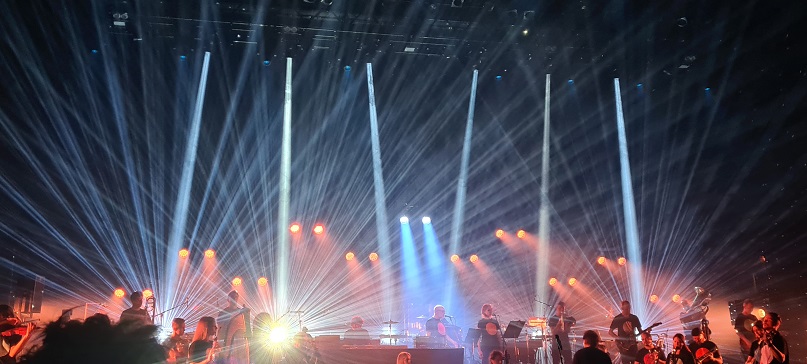
The estimable Setlist website, documenting the concert history of artists and bands, has a notable seven-year gap between Brian Eno’s last live appearances and this new tour, in which he has been bringing an orchestral perspective to his 2016 album The Ship.
Many artists in Eno’s ambient sphere have looked at the orchestra as a vehicle for original composition, but more recently the tendency has been for artists to use it to regenerate past material, and – perish the thought – boost awareness and bank balance by association through touring. This tactic is clearly not for Eno, who invested a great deal of time in finding the right ensemble before even looking at the layout of this tour. Seeking fresh talent and players with flexibility, he alighted on the Baltic Sea Philharmonic Orchestra, a ten-year-old ensemble conducted by the dynamic Kristjan Järvi. It is fascinating to think that Kristjan, part of a remarkable Estonian conducting trio after father Neeme and elder brother Paavo, is creating new directions for his family, stepping out on ever more adventurous voyages into contemporary music.
This one – on the banks of the Thames – takes its lead from the most famous voyage of the 20th century, the Titanic. Yet Eno chooses not to tell the story in graphic detail, portraying the ship instead through shades of orchestration, atmospheric noise and folk-like utterances. These are made through his own sonorous tones, which worked in this concert to vivid effect. The sonic picture was surely aided by the inclement weather in the UK, the audience becoming part of the vessel as the sea spray splashed against the side. Meanwhile the creaks of the orchestra’s wooden instruments portrayed the boat’s natural bowing and bending.
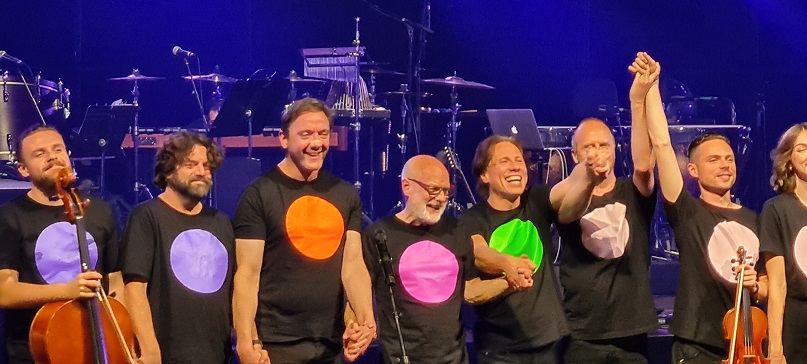
Eno’s music for The Ship reflects his ambient work, in which the music makes incremental changes in its own sweet time, but it shows how ambient music can also be loud. As time progressed this performance assumed a dramatic intensity way above that of the home listening experience. The orchestra’s control was a key aspect, with Järvi ensuring the musicians had as much freedom as they wanted. He walked around the stage to cajole individual players or sections, then faced the audience as though looking out to sea himself. Dressed in colour-co-ordinated t-shirts, the players could see each other and their conductor in the dark – not to mention the cerise shirt of Eno, a point of vivid colour in the middle.
Eno’s vocal was complemented by the understated yet versatile voice of Melanie Pappenheim, and the thoughtful input of guitarist Leo Abrahams and keyboard player / software designer Peter Chilvers. Also present was the actor and comedian Peter Serafinowicz, reading a monologue on war through rich bass tones.
The Ship, a three-movement suite, had at its heart Fickle Sun, itself in three parts. Here the onward motion of the orchestra was irresistible, still moving slowly like the Titanic but flattening everything in its path. Then, the struggle over, Eno reached for the Velvet Underground cover I’m Set Free, its heart-shifting chord progression nudging at the emotions with every repetition, providing an tidal swell for the audience.
This performance was a triumph of spirit and resolve, a warming combination in these troubled times. The encores continued in the same vein, though the deeply uncomfortable Bone Bomb, from 2005 album Another Day On Earth, provided painful relevance with its response to an article on a suicide bomber in Palestine. Eno paused the music after this to give his own unstinting views on the conflict with Israel, declaring proceeds from the Ships gigs would go to help those suffering from the war in Gaza.
Of the other encore items Making Gardens Out Of Silence, from last year’s ForeverAndEverNoMore, reached a more obvious inner peace, before There Were Bells, found Eno’s music once again reaching beyond the ambient to find notes of sustainable emotional power. Equal strength was found in By This River, the earliest music of the night (from 1977), and the track that stayed with the audience long after the concert had finished.
At the end Eno and Järvi generously credited the band and orchestral musicians, looking beyond to single out those responsible for monitoring and lighting, two crucial overlooked b but crucial elements of any performance. The lighting was wholly suitable, the relative darkness allowing the audience to use their mind’s eye in response to Eno’s resolute constructions. Thus was a memorable evening, and one in which the main man himself was also deeply moved.
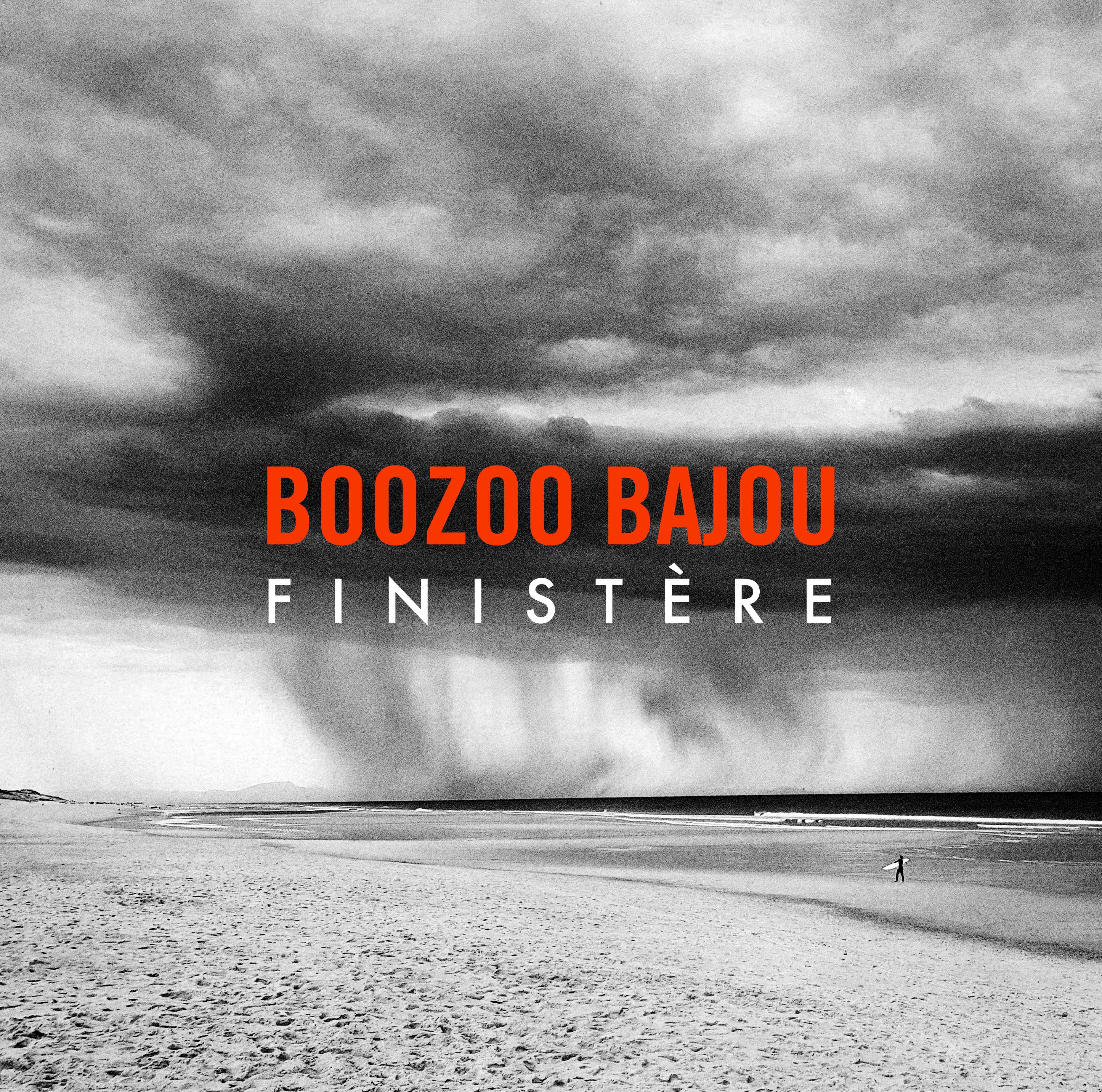
This is the first long playing release from Boozoo Bajou for nearly ten years. The Nürnberg duo of Florian Seyberth and Peter Heider are up to their fifth album, and in that time they have seen little reason to change a musical philosophy that has seen them produce some high quality down tempo music over the last 20 years.
Finistère sees them migrate to a new label, their own Pilotton imprint, presumably giving them more autonomy over musical decisions. These include vocalists JULES and Steve Spacek, who contribute guest slots along with co-producers Fürsattl and MODALiST.
The vinyl edition contains exclusive album versions.
What’sthemusiclike?
Boozoo Bajou have the knack of making their music sound completely effortless from the first note., and so it is with this album. “You don’t have to say anything, you don’t have to do anything”, says the voice on Pen Ar Bed – and so it proves. This is music borne of the outdoors, with slow, dusty beats that creep across the sonic perspective, with easy guitar-based material close up and various atmospherics far off.
The beats are typically slow and dub-infused, with heat-soaked panoramas opening up on tracks like Tough Times. This is one of two excellent vocals from JULES, who adds more of a vocalise to Tiefer, later on in the album. She is complemented by Steve Spacek, whose contribution to Sparks features a beautifully measured vocal that takes the groove unexpectedly near to Sade territory.
Of the instrumental tracks, the tick-tock of Orfeu marks the easy passing of time, Calcutta Glow ambles easily down the street and Viajantes, an exotic-sounding number, comes to the listener through a thick heat haze of atmospherics. All these and No Catch, a sultry number, could easily last for twice as long and not outstay their welcome.
Höhensonne is rather lovely in its extended mix, the glare of the sun beating down on the listener, the musical equivalent of the middle of a hot day.
Does it all work?
It does. Boozoo Bajou play to their strengths throughout, the collaborators are very well chosen and the music finds just the right balance between laziness and emotional involvement.
Is it recommended?
It is, without reservation – an album that proves every bit as good as the last four Boozoo Bajou albums. These guys know the meaning of the word ‘consistency’!
Listen
This album is due for release on Friday 3 November, when a Spotify link will appear here.
Steve Butler‘s brief is to deliver polished music under his moniker of Abel, for which this is his second album.
To do it, he has enlisted a team of live musicians, who are well worth name-checking as they are some of the best in the business. Lloyd Wright, who plays regularly with Smoove and Turrell, plays guitar and bass, while extra bass is added by Stan Woodward a member of Knats along with trumpeter Ferg Kilsby. Meanwhile Ross Hillard (Magic Number) gives out bass on Traveller. Vocals are supplied by Rona Ray and Sabrina Chyld.
What’sthemusiclike?
This is an excellent and classy dance music album, and the live musicianship is the cherry on the top, right from the sultry introduction with Kilsby’s muted trumpet before the beat drops on Traveller. The instrument also takes the lead in the smooth grooves of In My Dreams.
The vocals are excellent, both Chyld and Ray complementing the hot weather grooves with effortless ease. Ray’s regretful vocal on Can’t Let You Go is an emotive one, while Sabrina Chyld’s pair I Just Can’t Wait and Come And Save Me are very nicely done.
The instrumental numbers are great, too – Glasshouse, Jazz In The Room and the percussion-rich Latin Love are all very nicely done.
Does it all work?
It does. Whether chilling by the pool in Mediterranean heat or ready to hit the floor in a sultry club, Abel’s music is more than fit for the job.
Is it recommended?
It is. Cosmic Love offers up sunny vibes from Abel to brighten up the dreariest of days.
The story behind Sofia Kourtesis‘ debut album is an inspiring one. It is dedicated to neurosurgeon Peter Vajkoczy, for the life saving surgery he performed on the Peruvian DJ’s mother. Following the sad loss of her father, Sofia’s mother had become gravely ill, but she sought out Vajkoczy, dedicating a track to him, and rather wonderfully he agreed to treat her mother – who is now better and living in Berlin.
Madres, the Spanish word for mother, is a musical depiction of the emotions Sofia has gone through in the course of her own mother’s illness – but also represents Vajkoczy’s part in the album, for he joined Sofia on nights out in Berghain. As well as documenting her mother’s recovery, Madres is a document from Kourtesis to her home country, containing percussion and field recordings from her homeland, as well as documenting the pain of being ostracised for her queerness.
What’sthemusiclike?
As uplifting as much of the story told above, but with deep emotional fluctuations. Kourtesis writes fluently, making richly expressive house music that has attractive twists and turns. The voice of Kourtesis complements her warm synth registrations. Only one track has guest vocals, but it’s a cracker, Estación Esperanza harnessing a strong percussion soundtrack while featuring the voice of Manu Chao. Lead single Si Te Portas Bonito is an absolute beauty, a hot weather treasure with full bodied synths and the voice of Kourtesis herself.
Vajkoczy – a tribute to the man himself – has a persuasive rhythmic lilt, while true euphoria is reached from the wonderful How Music Makes You Feel Better, an ode to the power of recovery at the hands of our favourite art form. Meanwhile Funkhaus goes more for the jugular, a propulsive dancefloor winner.
Does it all work?
It does. Madres is a beautifully executed album, its ebb and flow ideally managed so that Kourtesis hits all the right spots.
Is it recommended?
Very much so. A fine debut from a bona fide dance music talent.
Listen
Buy
Published post no.1,992 – Saturday 28 October 2023