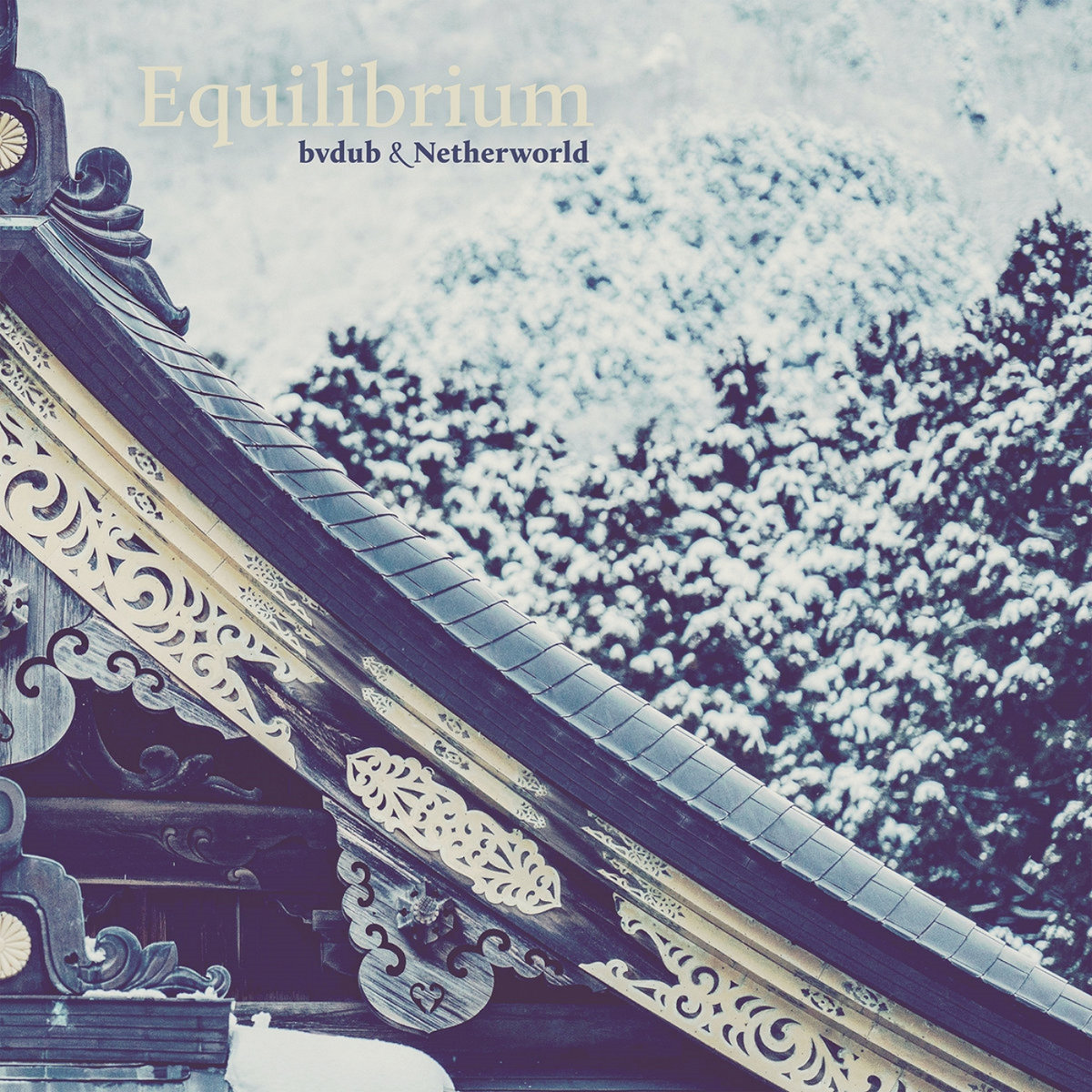
Switched On – bvdub & Netherworld: Equilibrium (Glacial Movements)

by Ben Hogwood

What’s the story?

This is the first official collaboration between bvdub (Brock Van Wey) and Netherworld, otherwise known as Glacial Movements founder Alessandro Tedeschi. It is described as ‘a testament to a friendship that has endured and grown for well over a decade’.

The ‘equilibrium’ of the title is used in the context of a glacier, describing the point at which it achieves a perfect balance between the mass of snow and ice that comprises its mass. This means it is never advancing nor retreating, with the gritty warmth (bvdub) above, and the glacial cold (Netherworld) below.

What’s the music like?

It is to be assumed that bvdub and Netherworld stuck to the description above, and that the former took on the more variable elements of the music while the latter stretched out the harmonic outlines beneath. However they did it, Equilibrium works beautifully as a quartet of intense yet deeply ambient compositions.

Each piece is of equivalent length, weighing in around the 20 minute mark, and the music within casts a lasting spell.

The evocatively titled No Trees For Miles establishes the cold climate through its icy textures, and secures a strong home melodic pitch to contain the broad canvas above. The melodic lines, such as they are, move very slowly, like birds circling on the wing, though when the wordless vocals appear there is greater activity, as though zooming in closer to the mass.

Darkness From The Sun works as a gradual crescendo, like a huge keyboard getting itself into gear, before long pauses enable the listener to take in the scene around, with a massive echo giving us an idea of the sheer scale of the glacier, working up to slab of white noise at the end. Seas of Stones and Sand adds an air of mystery, its wordless voices forming weird and ethereal mini-melodies. The slowly evolving scenery takes on a vast scope with a blast of treble from an organ-like instrument, which proves overwhelming for a while before dropping back to distant, calming echoes.

Finally Ice on Fire creates the most movement, underpinned by long notes as the treble arpeggios dance like flames. Again it paints an uncannily vivid picture, one that proves extremely striking on headphones or with surround sound. As with the other pieces, it gradually subsides to silence.

This combination of rapt stillness and subtle movement is ideal for mindful meditation, but along with that the two artists paint a very vivid sound picture of the environment. The scratchy, grainy exterior maps to the hard edges of the glacier, while the stretched-out harmonies places it in stasis rather than outright movement.

Does it all work?

It does. Equilibrium is a highly descriptive quartet of works, intense yet deeply restful at the same time.

Is it recommended?

It is. Both artists have clearly spent a lot of time in getting Equilibrium just right – which in itself makes sense. What they have made is an exquisite, lasting musical stillness to ease the mind.

Listen

Buy

In concert – Hannah Peel: Fir Wave Live premiere

by Ben Hogwood

How appropriate that Hannah Peel should be placed in Hall One at Kings Place for the live premiere of her 2021 album Fir Wave. The hall is, after all, constructed with the material from a single, 500 year-old German oak tree named Contessa – and here it absorbed music that could have been written in its honour, as part of Peel’s artist residency in the venue’s Sound Unwrapped series.

Fir Wave originated in lockdown, its open air textures providing solace for many – your reviewer included – during several different phases of isolation. Its appeal lies both in the past and the future. Peel based her musical inspiration on the music of Delia Derbyshire and the Radiophonic Workshop, re-sampling and regenerating their work, and absorbing it into her own style and processes. The resultant work is an emotive one, celebrating the environment while fully aware of the issues it faces.

Peel’s deeply felt electronic music is often achieved through a ‘less is more’ approach – as the vocals on first track Wind Shadow demonstrated. With her live accomplice, Hazel Mills, she proceeded to sculpture and layer some beautifully earthy sounds, the melodic motifs coming up from the ground itself but becoming airborne through their expression by voice, synthesizer treble, violin or piano. For Peel is a multitalented artist, her roots nearer to folk music but now fully embracing the electronic idiom.

This included the intricate and sensitively handled beats. These cut through the smokescreen in Hall One with clear precision, drawing back to enable the appreciation of bigger vistas, both in the title track and Emergence In Nature. Peel was an endearing presence, addressing the audience only occasionally as she preferred to let her music do the talking. While understandably nervous at the reaction to music that hadn’t played in public since its release two years ago, the warmth of the reception confirmed she need not have worried. Patterned Formation had an angular beauty to its repeated loop, while Reaction Diffusion packed a heavier punch.

The attentive audience became fully immersed in the music, transported to the natural spaces it was portraying. Fir Wave itself was a treasure, describing a remarkable process found on certain mountains in the world. When the wind hits a mountainside full of trees, it starts to kill off the front arm of the fir trees, allowing the ones at the back to grow. Over years and years, the steady pattern creates a beautiful sound wave across the mountainside that shifts through a long period of time. Peel somehow described this in her music, which left a lasting impression.

With the album ingrained in our thoughts, Peel returned for two charming encores given with the aid of a music box. This gave her the appearance of standing in a cosmic post office, preparing to dispatch a lettercard to a significant other. The music told compelling stories through a charming cover of Cocteau TwinsSugar Hiccup, dating back to 2010, and a revelatory interpretation of New Order’s Blue Monday, turning the music on its head in duet with Mills.

Even these were not the emotional peak of the evening, however, for in a final encore of Unheard Delia Part 1 we heard the voice of Derbyshire herself, caught in an interview in a sunlit room. This detail, imparted by Peel before we heard the music, helped us to capture the moment itself, and the track remained in thrall to a pioneer of electronic music taken too soon. Peel, to her enormous credit, stepped back at this point to ensure Derbyshire’s voice could, at last, be fully heard and appreciated.

Switched On – теплота – Skynned (Accidental Meetings)

by Ben Hogwood

What’s the story?

теплота is the London-based duo of Grundik Kasyansky & Tom Wheatley. In their biography they are described as ‘half techno, half free jazz’ – and goes into a bit more detail on how they use ‘feedback synthesizer and computer-acoustic bass’, and ‘fuse a spontaneous interplay orthogonally over cyclical structures, with techno as perpetual fulcrum’.

What’s the music like?

A coiled spring – Skynned has a good deal of energy, but often keeps it confined in tight musical spaces. Often it feels like the musical equivalent of a lithograph drawing in musical form, darkly shaded and executed.

First track Isolator is fidgety, beset by repetitive and glitchy noises, while Motus Haru has a more regular profile. The track Cycle appears in two versions – the first nervy, and a bit unsettled, showing its mechanical workings, while the second carries more dramatic weight. Sling strains at the edges, a treble line trying to break free but ultimately constricted, while there are brief snatches of woozy fairground rides that drift into view in the intriguing and distracted visions of Yagi. Apical, a substantial track, sends transmission codes through bass drum and monotone treble.

Does it all work?

It does – though the moody soundscapes and glitchy musical figures make for claustrophobic listening at times.

Is it recommended?

It is. There are some imaginative and detailed sound pictures here, often presented in the form of fever dreams. Occasionally unsettling, but always intriguing.

Listen & Buy

Let’s Dance – Various Artists – Sven Väth: What I Used To Play (Cocoon Recordings)

Reviewed by Ben Hogwood

What’s the story?

This is a proper labour of love from Cocoon Recordings, in honour of the rich musical heritage of their leader and founder Sven Väth. It is, in effect, a 36-track autobiography telling not just the story of his early DJing career through the 1980s, but a compendium of important electronic music released in that time.

Väth started the mammoth project during lockdown, a response to being unable to attend any parties or club nights of his own. Inevitably he started looking back at past successes and good times, and the idea of a full bodied compilation was born.

For vinyl afficionados, the collection is released on a set containing a dozen individually coloured 12” records, with full size portraits of Sven and each embossed with silver hot foil. There is also a triple CD release.

What’s the music like?

To say there are some classics in here would be an understatement, for the tracklisting is packed with electronic musical royalty. Kraftwerk’s Computerwelt, New Order’s Blue Monday, Frankie Knuckles and Jamie Principle in Your Love and the Andy Weatherall mix of Primal Scream’s Loaded are just four of the heavyweights here.

Most listeners will surely own these and not need them again, so the real interest comes when you dig deeper into the collection. Here you find uplifting anthems such as Hugh Masekela’s Don’t Go Lose It Baby, the self-titled Balearic classic from Sueño Latino, the early landmark Break 4 Love from Raze and Model 500’s No UFOs.

A Split create a real buzz with Second – Flesh, while Anne Clark’s Our Darkness is a thrill. Bobby Konders’ Nervous Acid works wonders with squiggly synthesizer lines, while one of the Afrobeat highlights is Le Serpent, from Guem Et Zaka Percussion. Logic System’s Unit starts the compilation, while Väth’s own collaborative effort 16 Bit gets a very welcome runout with Where Are You?

Does it all work?

It does – a thrilling documentary of some era-defining music. Whether or not the package itself is desirable will depend on the depth of peoples’ wallets, for the 12” box will set you back a cool €200.

Is it recommended?

Yes, enthusiastically – few history lessons are as enjoyable as this! Musically it is a no-brainer, but financial constraints may dictate otherwise.

Listen & Buy

You can explore purchase options via Sven Väth’s Bandcamp site, while you can hear musical clips on the Juno website

Switched On – Gaspar Claus: Scaphandre (InFiné)

by Ben Hogwood

What’s the story?

It is helpful to reproduce in full the accompanying notes Gaspar Claus has written for this release on Bandcamp:

Scaphandre is the story of an image found in a lost time on the internet a few years ago. It inspired two sound pieces conceived so that one can dive into it as into the sea.

Once their composition was finished, I looked for the origin of this image. It is one of the very first submarine pictures in history, taken by Louis Boutan in 1893 in the bay of Banyuls-sur-Mer… my home town. The original photo as well as a fantastic series of archives documenting this event can be found at the Arago Laboratory, where I often went as a child, after school, amazed by what the researchers were showing me. They just had never told me this story. This is how this record found its scenery.”

The two pieces Claus brought together on Scaphandre (which translates as ‘diving suit’ or ‘space suit’ in English) are described as ‘an abstract and mysterious B-side of Tancade’, the album released by the French cellist and composer towards the end of 2021.

Both pieces were written alongside the composition of the album, and are broader in scope, each lasting more than 10 minutes.

What’s the music like?

Compelling, and often deeply mysterious.

Inside starts right from the depths, the instrument detuned by a distance of more than two tones. The scratchy, almost pitchless sounds gradually form a rich chord as layers of sound build up, until a rich, wooden wall of sound is secured, constantly evolving and yet acting as an immovable block. As this progresses the treble pitches start to gather and swirl, slowly orbiting the centre. There is a forbidding intensity about the progression of this piece.

Beyond has more consonant harmonies in its beginnings and occupies a safer space, suspended in a rich drone of mostly G major – but with another massive wall of sound to back it up. Gradually the music lifts, and the foundation drops away to leave mere threads, the elements of pitch dissolving into white noise.

Does it all work?

It does – but it is important to listen to these tracks in the right environment, as they are only fully impactful when a static half hour is set aside.

Is it recommended?

Yes, as a complement to the Tancade album – but if you haven’t heard that yet then it is the best place to start. Either way, Scaphandre is further proof of Gaspar Claus’s powers of invention, knowledge and deep love of the cello. He pushes its sonic boundaries further here, for sure!

Listen

Buy