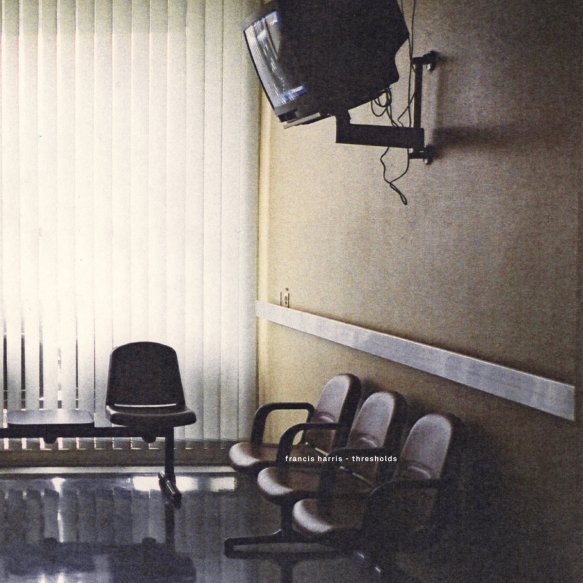
Switched On – Francis Harris: Thresholds (Scissor and Thread)

francis-harris

What’s the story?

Francis Harris has already delivered a brace of thoughtful electronic albums in Lelend (2012) and Minutes of Sleep (2014), where he has considered some of our slowest moving and abstract ‘virtualities’. The train of thought continued with two albums as half of the Aris Kindt duo, but now Harris turns back to a solo identity for Thresholds.

In it, he ‘aspires to sonic universality and the presentation of a fully formed psychoacoustical world’, though it is not an ‘album of ideas’. In the commentary from his label, ‘inspired by the ecological and political upheavals of the present and the role of speculative thought as an avenue of global transformation, Thresholds is the work of a mature artist fully in control of his powers’.

What’s the music like?

While it is certainly important to consider the elements above, Thresholds stands on its own two feet for the listener who is completely new to its thoughts and sound worlds.

Often these worlds cross over, the album acting as the sonic equivalent of being on a train journey, or standing still while observing an object pass against overhead against a starry backdrop. The most effective tool here is the wide range of percussion, some of it very subtle, that Harris has at his disposal. The instruments and sounds, both acoustic and electronic, decorate the slow awakening of Useless Machines, then pepper Rebstock Fold with what feels like spots of electronic rain as a slower moving sequence of chords takes hold.

Harris keeps a background haze to proceedings, while a variety of musical languages unfold in the foreground. Many of these are slow moving, honing in on certain details, such as the muffled trumpet solo or vocal snippets that feature in Earth Moves. The dappled colours created by the music are often softly mesmerising. The title track, for instance, has digital chattering in the foreground while chords shift slowly in the background. The trumpet reappears on Speculative Nature Of Purposive Form as part of a largely static soundscape, but Cut Up responds to this with a good deal of nervous energy, its percussive buzzing suggesting an outlying jazz influence.

Does it all work?

Yes. These thoughtful compositions are consistently engaging but work as a whole in shifting the focus of the mind to calmer areas, the listener taking in the musical activity around the stereo picture but able to let it run on its way simultaneously.

Is it recommended?

Yes – Francis Harris makes ambient music with a difference, its intricate construction creating all sorts of moving patterns that the listener can either latch on to or allow to run free. Its imaginative colours and textures reveal something different with each encounter.

Stream

Buy

Switched On – Fragile X: Human Condition (Cue Dot Records)

What’s the story?

The Cue Dot Series reaches a dozen releases with this substantial piece of work from Fragile X – the alter ego for Glasgow-based musician J. Gorecki. He has designed an album to question aspects of human nature and instinct, in particular personal growth, but – as he details in the commentary alongside the album – the answers are firmly weighted towards the positive.

There are six stages of the human condition represented here – birth, growth, emotion, aspiration, conflict and mortality.

What’s the music like?

Human Condition – as its title implies – is a mixture of highs and lows, but the music here gives the listener a wholly positive experience. Gorecki writes with great assurance, gently probing at our thoughts and feelings as he does so. Cogito ergo sum (which translates as I think, therefore I am) is the ideal way to set the scene, soft-grained textures cushioning some more probing melodic lines, and introducing us to a warm blend of electronically and acoustically-derived sounds.

The softly oscillating figures of The Good And The Beautiful have attractive, treble-rich colouring which is a hallmark of Gorecki’s writing, with golden hints to the textures from half way through. Object / Subject has murmuring voices as part of its overall ambience, before it pans out into a wonderfully spacious train of thought. Eudaimonia uses what appears to be a small collection of time pieces, each one creating an ambience among themselves, while A Question I Have Become For Myself has some distorted thoughts but also a reassuring, slow chorale in the background.

You Are has watery percussion and rippling chords, presenting a beautiful epilogue that gradually falls under the influence of a slow, brooding melodic line. This slightly darker aspect has already revealed itself in the shady Space Of Appearance, a relatively brief but sombre time for contemplation.

Does it all work?

It does. The album is best experience as a single span of music, its natural flow secured early on and sustained throughout the nine tracks. Gorecki shows himself to be as at home in longer structures approaching ten minutes as he is in creating shorter snapshots.

Is it recommended?

Yes. Human Condition is a thoughtful meditation, which works both as a foreground and background feature. Foreground listening is by far the best, mind, for the inner parts of Gorecki’s patchwork are fully revealed and the colours can be best appreciated. A subtle experience but a lasting and uplifting one.

Stream and Buy

Switched On – Franck Vigroux: Atotal (Aesthetical)

Franck_Vigroux_Atotal_Artwork_LP_3000

reviewed by Ben Hogwood

What’s the story?

The music for Atotal is half of an intricate story. To quote from the press release, Franck Vigroux created it as an audiovisual performance with regular collaborator Antoine Schmitt, their aim ‘to reconstruct in order to better deconstruct the processes of imposition of will by repetition and absolute synchronism, to propose a breach to a potentially life-saving decoincidence. The total work of art, when pushed to its paroxysm of absolute coincidence of the perceptions of a captive spectator, is similar to the techniques of mental manipulation of totalitarian regimes, proceeding by annihilation of the critical mind, repetitive semantic pounding, subliminal messages.’

Got that?! It bears reading a few times, along with the rest of the detail on Vigroux’s Bandcamp page, because the more you read it the more you realise how much thought the pair have put into the work.

What’s the music like?

The success of this album depends on how Vigroux’s music sits on its own, without visuals, as a single work of art. The answer is emphatic, for Atotal is never less than a powerful encounter for the listener, to the extent where it can be overwhelming on headphones. Certainly the images conjured up in the listener’s mind are very close to Schmitt’s pictures in the excerpt here:

The blasts of white noise circling around a two-note riff on Swinging Total are an illustration of how Vigroux creates a great deal from minimal beginnings. By contrast Atotal010 is well within itself, with remote breathing noises giving a primal, intimate air. Lame is another thrilling rush, a widescreen vortex of sound underpinned by a big beat, while Accelerando has similarly big textures but is disorientated, like the processing of a large machine.

Vigroux works his sparse material into the thrilling forward drive of Communication, and his writing has lots of spatial, semi-industrial elements to it. He can be caustic in style, but the likes of Perdu find him in descriptive mood, with flickers of sound near and far. Communication is again sparse material but has a thrilling forward drive. Side Total contrasts wave effects with blocks of sound, while Total Primus is great, a substantial track with rumbling bass and purer tones in the treble, not to mention a lumbering rhythm.

Does it all work?

It does, but a certain amount of caution should be advised – in a good way. This is music that can often hit its target square between the eyes, and while the effect can be thrilling it is not for every mood, being a treble espresso of music at times!

Is it recommended?

Very much so. Vigroux’s music is always worth exploring, his approach always interesting – and the music for Atotal is no exception to that rule.

Stream

Buy


Switched On – Charlotte Harding: III (TRI Remix)

Composer Charlotte Harding returns with the intriguing track III, marking her debut as a solo artist.

Her new track, shown here in TRI Remix form, uses a string quintet and plays around with their sounds to make a musical language Harding calls ‘clectro’. Put simply, clectro = classical + electronic!

If you watch the video, directed by John Minton with artwork from Keaton Henson, you will see how the description is rather apt – and also get an idea for Harding’s powers of invention. She looks set to bring a fresh approach to the meeting point of the two styles – we will certainly keep our ears peeled for more!

You can read more about Charlotte Harding’s work at the Faber Alt. website, and also her own website here

Switched On – Heavenly Remixes 3 & 4: Andrew Weatherall (Heavenly)

heavenly-3

reviewed by Ben Hogwood

What’s the story?

Heavenly have already released two volumes of compilations celebrating the art of the remix on their label. They have turned to a wide range of their artists either as remixers or as providers of the original song, moving from older staples from Saint Etienne and Doves to more recent Heavenly royalty Working Men’s Club, The Orielles and Gwenno.

Volumes 3 and 4 tell a different story, coming to you directly from the mixing desk of the much missed Andrew Weatherall. Weatherall was a shining light in dance music – rock music, too – from the 1990s onwards, sprinkling his production stardust on albums from Primal Scream (notably Screamadelica) and Beth Orton, while providing production and remixes for a huge range of artists.

This selection is all exclusive to the Heavenly label, celebrating his achievements and status with the label, for their first ever remix was from Weatherall himself.

What’s the music like?

In a word, brilliant. Weatherall made so many remixes but managed the difficult juggling act of having his own distinctive style without ever making the same mix twice.

That first remix – the Andrew Weatherall Soul Of Europe Mix of Sly & Lovechild’s The World According To Sly & Lovechild – is an uplifting call to arms at the start of this collection. It may begin with the vocal gambit “These are dark days” but it is a wholly positive vocal, dressed with undulating marimbas and a chunky bassline. Next up is Mark Lanegan, the legendary vocalist who as I write this review sadly passed away only yesterday. Beehive gets an upfront remix with the couplet “lightning coming out of the speakers, wanna hear that sound some more”. After these two heavyweights, an even bigger mix lies in wait in the form of Flowered Up’s ‘Weekender’ from 1992. This is expertly paced over 17 minutes, no less, getting into its groove early on and never letting up. A similar rhythm permeates Gwenno’s Chwyldro but this is a wholly different approach, with a hazy palette and some weird harmonies complementing her softer tones.

Another legendary remix follows, Weatherall taking Saint Etienne to the dancefloor with his take on Only Love Can Break Your Heart, a dub-infused version that drops into a full vocal version half way through. A heady remix of Confidence Man’s Bubblegum follows, then a Sabres of Paradise mix of Espiritu, whose Conquistador goes through the wringer in an up-tempo flurry of percussion and rave riffs. Finally The OriellesSugar Taste Like Salt plays havoc with the stereo placement and rolls out a big set of drum fills, both favourite tricks of Weatherall’s as he succeeds in displacing the listener.

heavenly-4

Volume 4 is just as good – and once again presents a set of shapeshifting beats that manages to twist the original artists almost beyond recognition. audiobooks are first, Weatherall taking them to the electro disco with the groovy, spacey, Dance Your Life Away, before an edit of the Two Lone Swordsmen Dub of Saint Etienne’s Heart Failed In The Back Of A Taxi, a suitably grubby affair.

Next up is DovesCompulsion, an unlikely candidate but packed with reverb and big vocals as it settles into a brilliant chugging groove with constantly flickering electronics. TOY’s Dead and Gone gets a minimal, relatively straight remix with a good deal of white noise, then Confidence Man’s Out The Window makes the most of a vocal that could have been sent from the Hacienda. LCMDF’s Gandhi is a shape-shifter in Weatherall’s hands, then another Espiritu track – Bonita Mañana – gets taken to the cleaners over 13 glorious minutes. Finally – and regretfully – we reach the end with Unloved and a slow, loping take on Devils Angels, doom-laden and disorientating on headphones.

Does it all work?

It does, handsomely – and it matters not a jot that some of these remixes weigh in at more than a quarter of an hour. Flowered Up’s Weekender is a great example of how to make one remix sound like half of a DJ set, and it says a lot for Weatherall’s craft that it would be easy to listen to the track all over again.

Is it recommended?

Yes – for this is the sound of an artist constantly finding new ways to express familiar vocals, always with both eyes on the dancefloor. It is clear that Andrew Weatherall had nothing but fun in his studio! Weatherall fans and anyone wanting to learn the dos and don’ts of a good remix should get this, as should anyone with a passing interest in dance or indie music from the 1990s onwards. Even without any of the historical baggage, this is simply a brilliant set of grooves with a feelgood atmosphere running throughout!

Stream and Buy