The first movement of the Sinfonietta, by Leoš Janáček (born on this day in 1854):
The Sinfonietta is a thrilling orchestral work, begun with a powerful brass fanfare but containing five incident-packed movements.
How does it work?
The main melody of the first movement Fanfare is the basis for Emerson, Lake & Palmer’s song, but in his keyboard part Keith Emerson refers to other parts of the work.
Then, on his solo from 2’40”, Emerson departs from Janáček’s blueprint with a characteristically incisive solo, backed by a virtuosic drum track. From 3’25” the style broadens to include explicit references to J.S. Bach, the Allemande of his French Suite no.1 in D minor:
What else is new?
You can hear the whole of the Sinfonietta below, in a thrilling performance from the Vienna Philharmonic Orchestra under Sir Charles Mackerras, in a recording made in 1980:
A choral piece by Johann Sebastian Bach, called Jesu Bleibet Meine Freude (Jesu, Joy of Man’s Desiring). It is the tenth movement of his cantata Herz und Mund und Tat und Leben (Heart and mouth and deed and life), written early in Bach’s time in Leipzig, thought to have been in 1723. The melody, however, is understood to have been written by Johann Schop, with Bach providing the harmonisation.
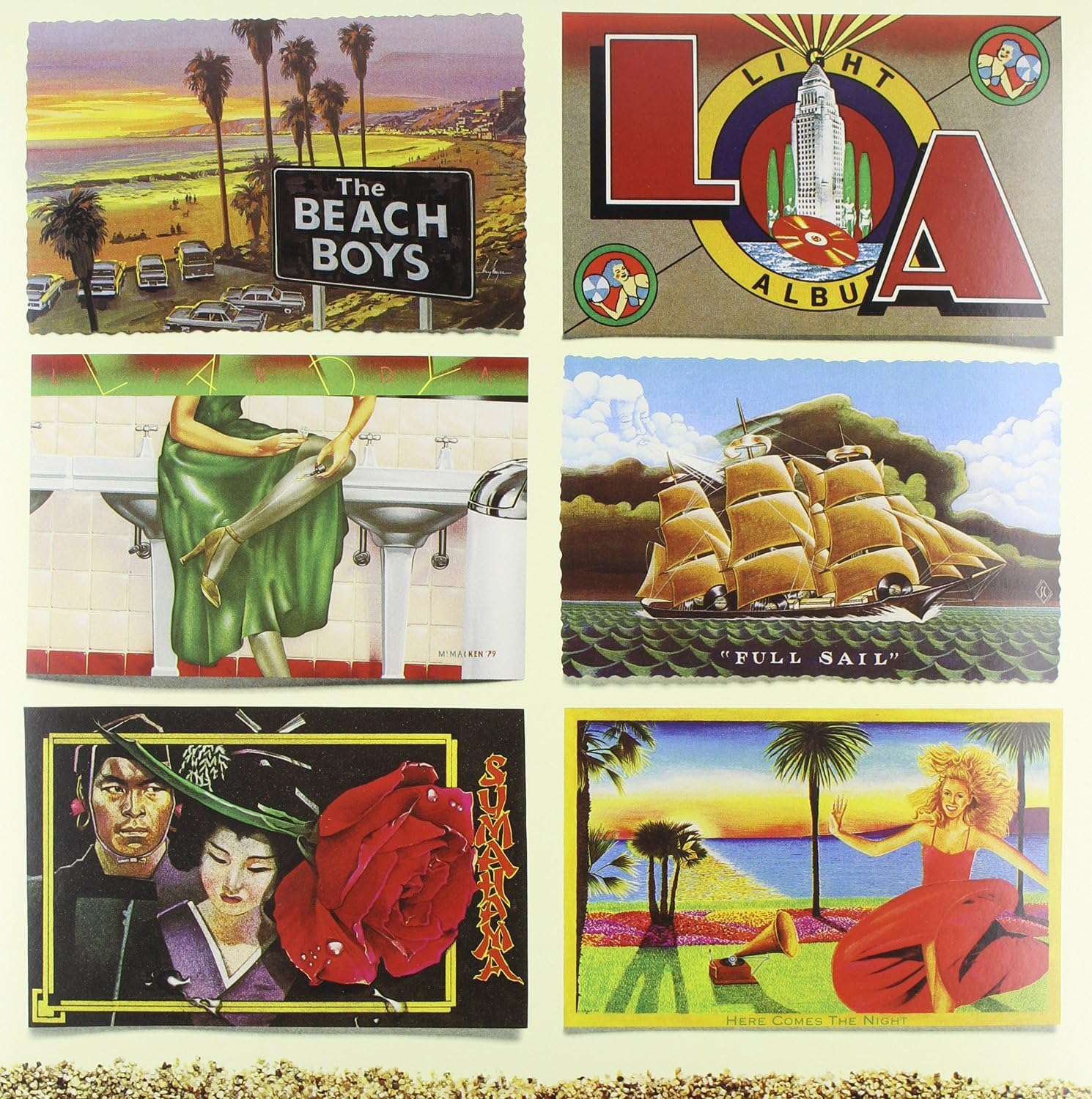
The song itself was written by Beach Boys co-founder Al Jardine, paying tribute to his wife Lynda – with a co-credit also given to keyboard player Ron Altbach. Jardine sings the main vocals, with a large ensemble of session musicians given credit at the song’s Wikipedia page.
How does it work?
The song begins with a note-for-note reproduction of the Bach / Schop melody, with the harpsichord adding a metallic brightness to the thick string sound. Then Jardine starts to play around with the speed of Bach’s work, making the transition to the full-blown Beach Boys sound reasonably seamless, with the addition of some woozy syncopations.
The song has the Beach Boys’ characteristically sunny sound, but there is a certain flatness to its delivery, perhaps belying the band’s fraught relationship at the time and even foretelling the fate of Al and Lynda’s marriage.
That said, it is a bright and relatively positive song, its dappled textures and syncopations presenting Bach’s work in a new and imaginative light.
What else is new?
Lady Lynda was the third single from the Beach Boys’ relatively unsuccessful album L.A. (Light Album), released in the spring of 1979. In a streamlined radio edit, with the introduction removed, it reached no.6 in the UK singles chart.
It was however recast when Jardine and his wife divorced, pointing towards a different Lady (the Statue of Liberty) and becoming Lady Liberty instead.
The Dance of the Knights from Sergei Prokofiev’s ballet Romeo and Juliet.
Arguably Prokofiev’s most famous piece of music, Romeo and Juliet has some fantastic music and tunes – and the Dance of the Knights is one of its most impressive calling cards. It has recently gained extra exposure as the opening titles for the BBC programme The Apprentice.
How does it work?
Williams uses the two heavy bass notes from the start to power the chorus:
A bigger sample gets used for the first chorus:
Then some snippets from later in the dance are incorporated:
The Prokofiev material appears to be replayed throughout, and Robbie adds a big male chorus for some bits, but unfortunately the bluster of verse and chorus, plus some really clunky rhyming (Russian – concussion!), mean the song itself is relatively unmemorable. The posturing in the video takes away from the music – of which Prokofiev’s contribution is arguably the most memorable.
What else is new?
Williams made far more effective use of a sample in his UK no.1 hit from 1998 Millennium, where a loop of John Barry’s You Only Live Twice tied together with a beat and a much more memorable chorus:
Prokofiev is no stranger to pop music, and has been used by Emerson, Lake and Palmer on a number of occasions. Here is their slightly foursquare take on the Dance of the Knights:
A much more effective Prokofiev transcription can be found with their transcription of the Scythian Suite – its second movement, The Enemy God Dances with the Black Spirits:
Where can I hear more Prokofiev?
The playlist below gives an introduction to Prokofiev’s symphonies and includes his Classical Symphony and Symphony no.5 – with brilliant tunes at every turn:
The second album is music for the stage, a brilliant collection under Claudio Abbado that includes Alexander Nevsky, Lieutenant Kije (with the brilliant Sleigh Ride as used by Greg Lake!) and the Scythian Suite:
Let’s also not forget Peter and the Wolf…here voiced by none other than Alice Cooper in a new version!
The Sleigh Ride (or Troika from Prokofiev‘s score for the 1934 film Lieutenant Kijé.
How does it work?
Lake lifts the entire melody and uses it at the end of the first verse, from 0’43”:
Then after the second verse the tune appears once more :
Finally after the third verse we hear it again, by which time the song has built through a crescendo with a sizable orchestra and chorus:
Here is the original:
and here it is when the tune really gets going:
What else is new?
Prokofiev is a popular composer for lovers of pop music, and it is quite possible you hear his music more often than you realise. His Dance of the Knights from Romeo and Juliet, for instance, has been used as the theme for the BBC show The Apprentice since it started in 2005:
Greg Lake, of course, is no stranger to arranging or manipulating classical music. Here is arguably his most famous piece of work in that area, the rocking out of Copland’s Fanfare for the Common Man as part of Emerson, Lake & Palmer:
The third section of Steve Reich’s Electric Counterpoint.
Ask any electronic musician worth their salt who their greatest influences are and the chances are it won’t be long before they come round to mentioning Steve Reich – which our interview with John Tejada has already confirmed!
Reich’s talent for taking pop-friendly melodies and looping them almost to breaking point (a technique often labelled as minimalism) has been one of the single biggest influences on electronic music up to this point, especially in techno, which often uses similar principles of repetition and expansion.
How does it work?
The Orb use a direct sample of the first recording of Reich’s Electronic Counterpoint, a piece written for guitarist Pat Metheny in 1987. He recorded it by setting down seven channels of guitar loops and two of bass guitar, before playing along as a tenth ‘person’. Yet The Orb place this music in context with a beautiful dub bass line and a host of ambient sound effects, most notably a clip of an interview with Rickie Lee Jones. The section of music they lift from Reich comes from the third section of Electric Counterpoint:
The Orb sample it directly here, as the beginning of their ‘chorus’:
and again nearly a minute later:
Here is the whole of the third section from Reich and Metheny, sat in the same key of A major:
What else is new?
Little Fluffy Clouds came to symbolize a lot of what was right about the so-called ‘ambient house’ style of the early 1990s, which acted as a springboard for Aphex Twin and a number of today’s leading electronic producers. Reich himself got involved later on, commissioning a remix album from such electronic luminaries as Coldcut, DJ Spooky and Four Tet. Here’s a remix of a section of Reich’s masterpiece Drumming by Mantronik:
The cross-over between Reich and techno goes back a long way too – and one intriguing spot is that Japanese producer Ken Ishii – now a widely respected techno artist – played cello on the first recording of Music for 18 Musicians, made for ECM in 1978. Now if you haven’t heard that particular piece, I suggest you stop what you’re doing right now and watch this!
Or you can go some way to sharing one of the great live experiences in music in this live performance:
Likewise if this is your first encounter with the music of The Orb, I should direct you towards their Top of the Pops performance of the wonderful, peerless Blue Room, heard in edit form below. Definitely the first band to play chess on the program!

 Arcana.fm