Listening to Beethoven #225 – 32 Variations in C minor WoO80

Oil painting of Beethoven by Isidor Neugass in the collection of Prince Lichnowsky, 1806

32 Variations in C minor WoO80 for piano (1806, Beethoven aged 35)

Dedication unknown
Duration 11’30”

Listen

by Ben Hogwood

Background and Critical Reception

1806 was proving to be an extremely productive year for Beethoven. So much so that Jan Swafford, in his biography of the composer, talks of it as a ‘minor work’, which Beethoven ‘dashed off and forgot about’. He failed even to recognise them in public when the daughter of the piano maker Streicher played them.

For Lewis Lockwood, the variations ‘belong to a group of ‘heroic’ works written in 1806’. He describes the ‘standard Baroque passacaglia theme’, and how ’every variation except the last is equally brief, making the work a parade of short, brilliant pianistic transformations in the same rigorously maintained length and form.’ Beethoven’s contemporary, Carl Czerny, was impressed, who recommended that ‘since the theme is short, this work is best performed in public for a thinking public’.

32 variations was an inordinately high number of variations, almost certainly the most any composer had used in a single piece at that time. Lockwood notes that this may have acted as a spur when Beethoven outdid himself by one more variations when writing his great Diabelli opus later in life.

Thoughts

This certainly doesn’t sound like a minor work, at any point!

Beethoven casts an imposing theme, in spite of its brevity, sharply dotted like the beginning of a baroque overture. Stabbed, repeated notes means we fly through the first variations (1-3), and Beethoven almost gestures for the listener to keep up as he proceeds on his way with incredibly fluent composition, the variations easily but indelibly linked.

The massive seven-note chords to Variation 6 show the scale on which he was thinking for the pianist, though after a flurry of notes there is a rare note of calm as C major arrives for Variation 12. The next four variations proceed in the major key, as the compelling arguments continue – before we return to the minor key and some remarkable outbursts and figurations, straining at the link with almost unbridled fury.

The whirlwind of inspiration includes passages reminiscent of the Pathétique and Waldstein sonatas, before the variations finish almost as quickly as they arrived, signing off with a cheeky pianissimo for the last two chords.

Recordings used and Spotify playlist

Cécile Ousset (Eloquence)
Rudolf Buchbinder (Teldec)
Ronald Brautigam (BIS)
Emil Gilels (EMI)
Olli Mustonen (Decca)
Angela Hewitt (Hyperion)

There are some very fine recordings of these variations, from Angela Hewitt, Mitsuko Uchida and Rudolf Buchbinder. Two, however, stand proud – the magisterial Emil Gilels, typically masterful in performance and execution, and Cécile Ousset, a performance of great character and flair as part of her wonderful collection of Beethoven variations. The work is much-loved and a great concert piece, too.

Also written in 1806 Hummel 7 Hungarian Dances

Next up 6 Ecossaises WoO83

Switched On – Four Tet: Loved (Bandcamp)

What’s the story?

Four Tet has an album ‘coming soon’, as announced on his Instagram page today (10 January) The first track released from it is Loved, presenting his first new original material in eight months. As regular followers will know this is a relatively long period of inactivity for the producer – real name Kieran Hebden – but suggests the start of a busy year.

What’s the music like?

Languid – and enjoyably so. This is a contented side to Four Tet that picks up where previous track Three Drums left off, though this time there is a leaner texture and even more dreaminess. Both pieces of music suggest he is in a better place where music is concerned, a year and a half after his legal wranglings with former label Domino were resolved.

A slow beat, borne of hip hop and not far from the likes of early DJ Shadow, sets a relaxed backing over which cool and airy keys spin their magic. It is a blissful listen.

Does it all work…and is it recommended?

Yes indeed. Hebden is known for his consistency while always forging ahead or taking interesting paths – and this is no exception. Loved bodes well for the new album.

Listen and Buy

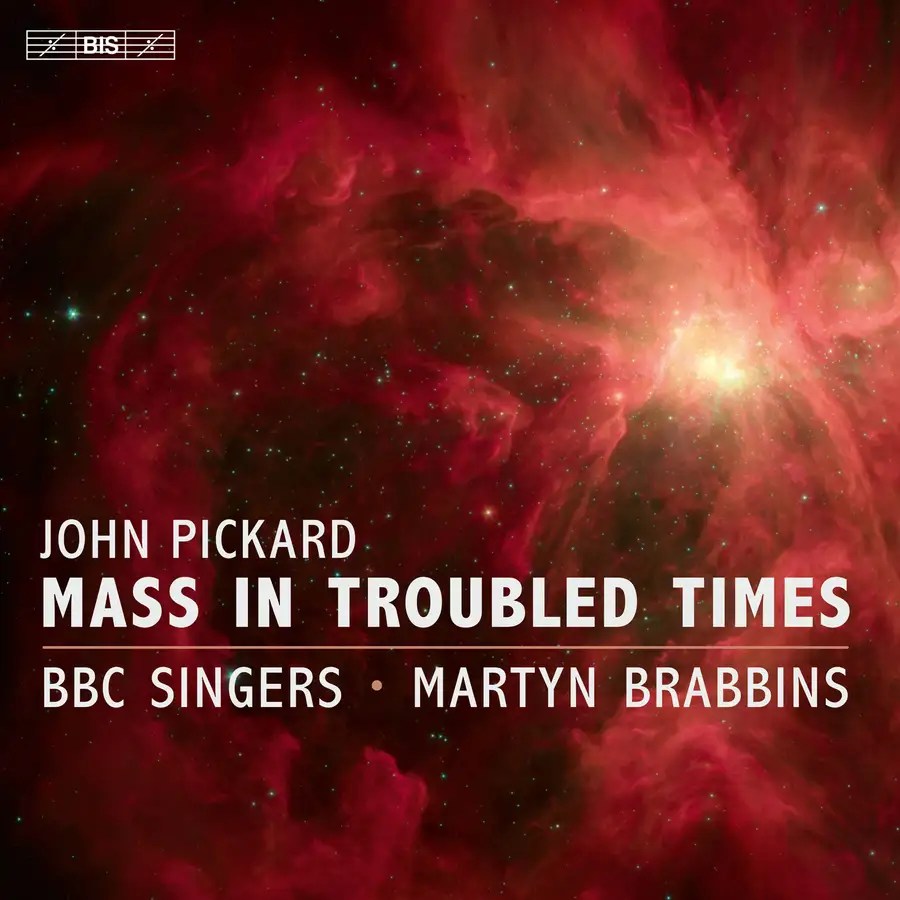
On Record – BBC Singers / Martyn Brabbins – John Pickard: Mass in Troubled Times (BIS)

John Pickard
Three Latin Motets (1983-7)
O magnum mysterium (2015)
Orion (2004)
Ave Maris Stella (1992)
Ozymandias (1983)
Tesserae (2009)
Mass in Troubled Times (2018)

BBC Singers / Martyn Brabbins with Chloë Abbott (trumpet/flugelhorn, Orion); David Goode (organ, Orion and Tesserae)

BIS 2651 [74’30’’] Texts and English translations included

Producer Adrian Peacock Engineer Pete Smith
Recorded 13 & 14 October, St Jude-on-the-Hill, Hampstead, London

Written by Richard Whitehouse

What’s the story?

Although known primarily for his substantial orchestral and chamber output, John Pickard has written several notable choral pieces. This latest release from BIS to be devoted to his music brings most of them together, and in the company of two major instrumental works.

What’s the music like?

Ranging across 35 years of his music, the collection features Pickard’s earliest acknowledged work – a teenage setting of Shelley’s Ozymandias that elicits a response both imaginative and impassioned. Already assured, his choral writing was further honed and refined in Three Latin Motets where limpid renderings of O nata lux and Ubi caritas et amor frame a melting Te lucis ante terminum for female voices. A rapturous Ave Maris stella and touchingly restrained O magnum mysterium duly reinforce Pickard’s confident handling of the a-cappella medium.

The two non-choral items indicate their composer’s abiding fascination with astronomy and antiquity. Scored for trumpet and organ, Orion strikingly evokes said constellation from the vantage of increasing energy in Nebula, an alternating lyricism (courtesy of the flugelhorn) and impetus in Alnitak, then incisive rhythmic interplay of Betelgeuse with its distanced close. Its title indicating those ‘tiles’ used in a mosaic, Tesserae builds cohesion via a steadily accumulating momentum such as tellingly underlies this showpiece with substance for organ.

For 18 unaccompanied voices (in six groups), Mass in Troubled Times is not a setting of the Mass, but a text assembled by the author Gavin D’Costa – lines from T. S. Eliot, Edith Sitwell and Matthew Arnold heard alongside extracts from the Syriac Orthodox Liturgy, the Shahada and the Qur’an. The key is a Turkish Twitter-hashtag from 2015, “Humanity washed ashore”, relating the flight from Aleppo then the drowning of Ayesha – her tragedy an emotional focus over six sections whose expressive intensity seems the greater for their formal concentration.

An Introitus precedes the customary sections of the Mass – reaching a dramatic apex at the climax of the Gloria while carrying the accrued intensity through those that follow; ending with the juxtaposition of lines from William Blake and thrice-repeated Agnus Dei that, next to an evocation of the child’s body off Palermo, has a poignancy shorn of sentiment thanks to Pickard’s acute eloquence. With its wide range of vocal techniques and demanding tessitura, Mass in Troubled Times is a rewarding challenge which all enterprising choirs should tackle.

Does it all work?

It does, not only through the quality of this music but also of these performances – the BBC Singers conveying the immediacy or pathos of Pickard’s response with unstinting clarity and precision. If a demonstration of this choir’s continued existence were needed, this surely is it – Martyn Brabbins (late of English National Opera) directing with his customary conviction. Nor are Chloë Abbott and David Goode to be found wanting in their pieces, rounding out a collection enhanced with vividly analytical recording and the composer’s informative notes.

Is it recommended?

It is, and not merely to those who have been following this invaluable series, which is set to continue with a coupling of Pickard’s Second and Sixth Symphonies. Certainly, the Mass in Troubled Times must feature in any representative selection of works from the 21st century.

For purchase options and more information on this release, visit the BIS website. Click on the names for more on composer John Pickard, the BBC Singers and conductor Martyn Brabbins, trumpeter Chloë Abbott and organist David Goode

Friday music – Grieg: In Autumn

If you live in the UK it will not have escaped your notice that the weather is shifting away from summer and into autumn. That change has already taken place with marked effect in Scotland of course, but now London and the south (where Arcana is based!) are caught up in the wind and the rain.

Autumn does, of course, inspire a great deal of creativity as composers and songwriters respond to the season – and this rather charming early piece by Grieg is one such example, the concert overture In Autumn Op.11, published in 1865. Here it is conducted by Neeme Järvi:

On Record – Various Artists: Come Together: Adventures On The Indie Dancefloor 1989-1992 (Cherry Red)

by Ben Hogwood

What’s the story?

A generous 4-CD compilation from Cherry Red, billed as a celebration of the Madchester / baggy scene and the Indie-dance crossover.

If you were anywhere near Radio 1 or even Radio 5 in the early 1990s you will have known about the influence this scene had on the singles charts, but Cherry Red are looking at it from the perspective of the clubs. With that in mind the tracks here are presented unmixed and mostly in 12″ form.

What’s the music like?

This is a buoyant collection to raise many smiles among listeners who were there at the time…but will surely serve as the ideal way in to the curious first-timers.

The big hits take care of themselves – Happy MondaysStep On, The CharlatansIndian Rope and Stone RosesFools Gold are pure Manchester gold. That’s before you consider Inspiral Carpets, James (via the mixing desk of Andrew Weatherall) and Primal Scream (via Terry Farley)

That the scene crossed over to Ibiza is clear from the inclusion of 808 State‘s Pacific State and The Beloved’s The Sun Rising. Shoegaze classics abound too, from Chapterhouse and Spacemen 3 – or leaner, more direct efforts from the likes of Carter USM and Pop Will Eat Itself.

While it’s great to have the well known classics, the bubbles from beneath the surface are even more valuable. Lesser known names such as Paris Angels, The Wendys, Sinister Groove and New Fast Automatic Daffodils prove their worth too.

Does it all work?

It does – and the breadth of styles means that this is a collection to dip into over and over again. It also has the added value of putting overplayed radio hits back in their best context. The Mock TurtlesCan You Dig It? is a prime example!

Is it recommended?

Wholeheartedly. As a snapshot of a euphoric time in British music history, Come Together works an absolute treat.