In concert – Quatuor Danel: Shostakovich & Weinberg #6 @ Wigmore Hall

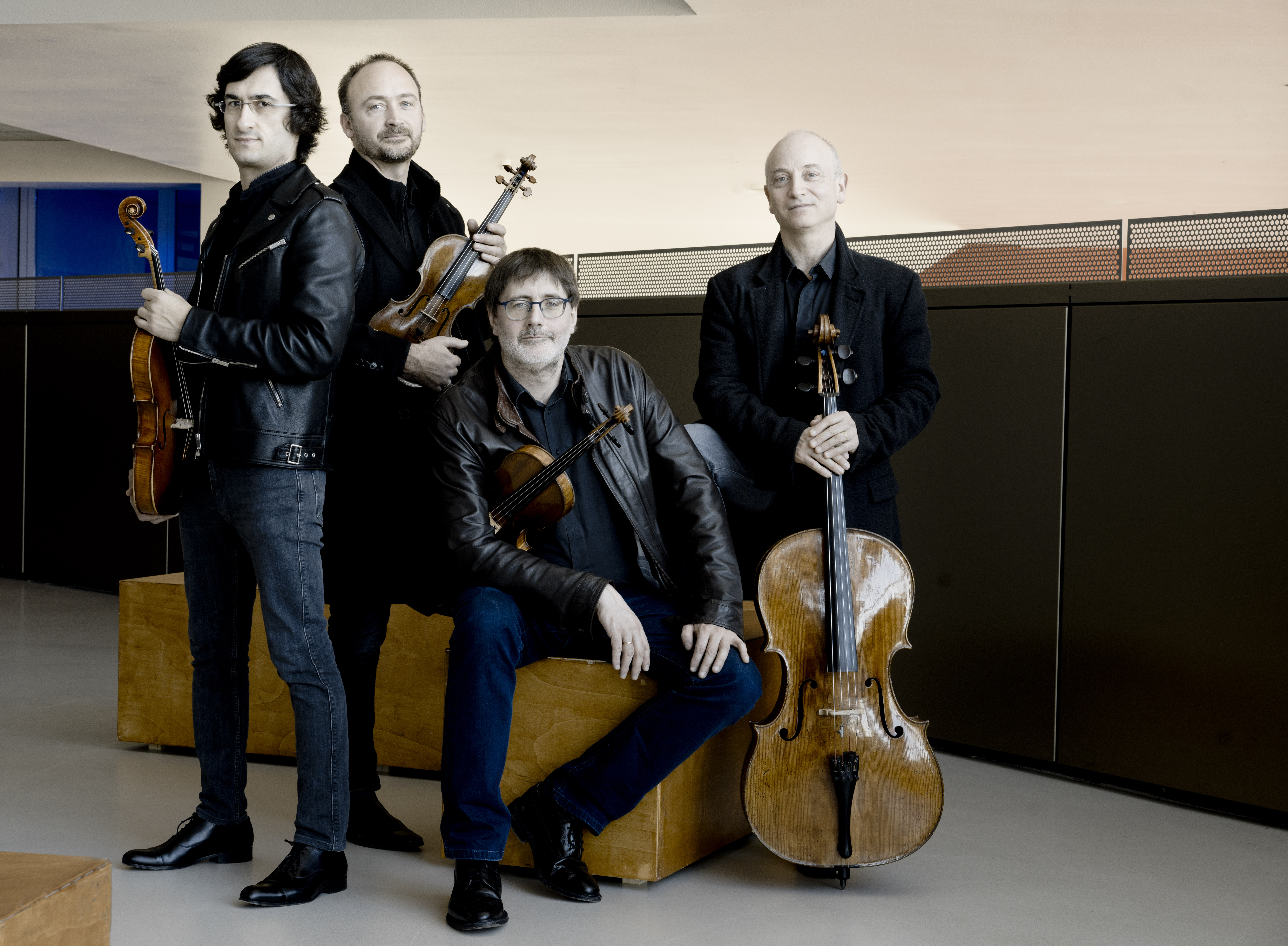
Quatuor Danel [Marc Danel & Gilles Millet (violins), Vlad Bogdanas (viola), Yovan Markovitch (cello)]

Weinberg String Quartet no.9 in F# minor Op.80 (1963)
Weinberg String Quartet no.10 in A minor Op.85 (1964)
Shostakovich String Quartet no.9 in E flat major Op.117 (1964)

Wigmore Hall, London
Wednesday 16 October 2024

by Richard Whitehouse Photo (c) Marco Borggreve

Quatuor Danel reached the effective mid-point of its Shostakovich and Weinberg cycle with this programme featuring two of the latter composer’s lesser if still absorbing string quartets alongside one from the former that has come belatedly to be held among his most revealing.

Coming soon after his Fifth Symphony (arguably the finest of this cycle), the Ninth Quartet finds Weinberg at something of a stylistic crossroads with those essentials of his subsequent phase almost within reach. It opens with an Allegro which is among his most visceral in any medium – the Danel (rightly) giving full rein to a seething energy, barely held in check, then to which the Allegretto functions as a shock absorber given its intermezzo-like speculations. The ensuing Andante ventures further towards that secretive and often confessional intimacy central to its composer’s thinking henceforth, though here its introspection is mitigated by a finale which unfolds almost as a synthesis of what went before – the Danel duly mindful of a gradual momentum that does not bring resolution as evade the issue with a nonchalant shrug.

Barely a year on, the Tenth Quartet has the same four-movement and 25-minute dimensions but is otherwise a very different proposition. Here the initial movement is an Adagio whose rhetorical fervency has turned in on itself well before the end, leaving an Allegro to provide oblique continuity with its simmering intensity that never quite risks outright confrontation. If the Adagio that follows promises such, its gestures prove too brittle and short-winded to sustain a more expansive movement – the intensity soon making way for a final Allegretto that sounds intent on avoiding closure with its succession of fugitive interactions, elegantly articulated here, whose lilting gait ultimately alights on the tardiest of cadences. As with its predecessor, any bringing of the work emotionally full circle is conspicuous by its absence.

Now that a first movement has been realized and performed, it is clear what Shostakovich had intended as his Ninth Quartet would have been very different from what emerged – the trenchant while slightly foursquare manner of that earlier effort replaced by the undulating lyricism of a Moderato as methodically sets out all those salient motifs for what follows. Its equivocation was ideally conveyed here – no less than the elegiac character of its successor, then a central movement of a liveliness increasingly waylaid by questioning and self-doubt.

From here, a second Adagio veers between inward musing and explosive pizzicato outbursts as provoked impassioned responses. The emotional ante duly upped, the final Allegro surges forth with new-found energy and purpose – taking in a truculent, folk-tinged episode before breaking off for a return to those pizzicato exchanges. Performances of this work often lose focus at this juncture, but the Danel brooked no compromise as the movement fairly hurtled to a close of manic defiance in what was a notable instance of music ‘playing’ its musicians.

Quite a performance with which to end this latest instalment of the Danel’s dual odyssey but, as has become usual, an encore was forthcoming: the Polka from the ballet The Golden Age affording a sardonic postlude with the insouciance of an earlier, not necessarily ‘golden’ age.

You can hear the music from the concert below, in recordings made by Quatuor Danel -including their most recent cycle of the Shostakovich quartets on Accentus:

For more information on the next concert in the series, visit the Wigmore Hall website. You can click on the names for more on composer Mieczysław Weinberg and Quatuor Danel themselves.

Published post no.2,236 – Saturday 19 October 2024

On Record – Various Artists: Shapes 25 (Tru Thoughts)

by Ben Hogwood

What’s the story?

Since 1999, Brighton’s Tru Thoughts label have produced an annual Shapes compilation, showcasing the best of the label while offering rarities and remixes. As a way in to their output it has been consistently rewarding, while fans have the chance to expand their collections with the new music on offer.

The 25th instalment from label head Robert Luis stays true to the program, split into two parts. The first offers a taste of soul, downtempo and jazz releases, while part two heads to the club for some dancefloor action.

What’s the music like?

Typically varied and vibrant.

It feels right for Luis to start with Bonobo, the zither adding colour to Terrapin – taken from his debut album Animal Magic that the label released in 2001. Quantic is another essential inclusion, and Look Around The Corner has the irresistible combination his production quality and Alice Russell’s wonderful vocals. Nostalgia 77’s Cheney Lane is a highlight, as are The Bamboos, Kylie Auldist a guest on their breezy I Don’t Wanna Stop. Meanwhile Steven Bamidele’s enchanting Kaleidoscope is complemented by a smoky groove from the Hidden Orchestra’s Spoken.

Two extended mixes in the centre of the compilation are both winners – Obas Nenor’s loping dub remix of Sefi Zisling’s The Sky Sings, and Hot 8 Brass Band’s Sexual Healing cover, a triumph that you surely will have heard by now.

Quantic whips up another treat with Furthest Moment, before Omar & Zed Bias’s irresistible Dancing, featuring Fox. Tiawa’s Soldiers is a lovely bit of funk, while hazy sunshine pokes through in STR4TA’s warm remix of Anushka’s Bad Weather. Magic Drum Orchestra bring the carnival with Ragga Samba, Ebi Soda goes left field with Yoshi Orange, then the king of dubstep Zed Bias saves one of the best cuts until last with his remix of SandunesFollow Me.

Does it all work?

It does – Shapes 25 catches the essence of Tru Thoughts, a huge range of colourful music.

Is it recommended?

Very much so. If by some freak of nature you’ve not heard the music of Tru Thoughts yet, this is the ideal place to start. Be prepared for a long journey of wonderful discoveries!

Listen and Buy

Published post no.2,335 – Friday 18 October 2024

On paper – The Durutti Column – A Life of Reilly by James Nice

The Durutti Column – A Life of Reilly
by James Nice
Burning Shed 2024 (hardback 272 Pages, ISBN: 978-0993303647)

Reviewed by John Earls

The guitar playing of Vini Reilly has been described as understated (which is not to say that it is not hugely influential and affecting). One could say the same of the man himself. So, the arrival of this authorised biography of the musician and his band The Durutti Column is both timely and welcome.

Written by James Nice, author of Shadowplayers: The Rise and Fall of Factory Records, it is a well-researched and compelling account of the band and one of the most unique guitarists ever. It is particularly gripping if you are interested in the Manchester and Factory music scene in the 1980s.

The book is also beautifully produced and presented in hardback with quarter bound cloth spine reminiscent of much of Factory Records’ own output (however, it’s a shame there wasn’t a bit more diligent proof-reading).

It opens with Reilly’s early years growing up in Manchester, with him cocking an ear to his engineer Dad listening to jazz and classical music, tinkering on the piano and switching to guitar under the tutelage of Miriam ‘Mimi’ Fletcher, a German expatriate who escaped Nazi persecution before the war and was to become Reilly’s first significant creative mentor.

Already exposed to classical composers such as Tchaikovsky through his father’s musical listening, ‘Mimi’ broadened Reilly’s exposure to include others such as Bach and Bohuslav Martinů (who Reilly cites as a favourite). It is after discussing Tchaikovsky’s Pathétique Symphony that Reilly goes on to outline his own thoughts in respect of responses to music:

“For me there are three main responses to music: the physical response, which is the most basic, where you dance about to it; an intellectual response, where you listen to the construction, evolution and development of the piece; and third, and most important to me, the emotive response, and this really is the greatest expression of emotion anyone has ever managed to write”.

The music of Vini Reilly and The Durutti Column certainly hits those spots.

We then get taken through Reilly’s playing with punk band Ed Banger and the Nosebleeds, coming into contact with then local TV personality Tony Wilson, the formation of Durutti Column and the release of their first album The Return of the Durutti Column in 1980, also Factory Records’ debut album.

Needless to say the presence of Factory supremo and Durutti Column manager Wilson looms large. The, at times difficult, relationship between him and Reilly is revealingly and sensitively handled, sometimes movingly so with Reilly reporting “I owe him my career…I loved him, really. He was almost like a father figure to me. He was also really generous spirited”.

There are some great reminiscences. I particularly liked the story about former Chelsea and Everton winger Pat Nevin (who had a Durutti tune Shirt No.7 dedicated to him) and Reilly (apparently no mean footballer himself in his youth) visiting one Steven Patrick Morrissey of The Smiths and having a kick about in Morrissey’s back garden. Reilly played guitar (along with Stephen Street) on Morrissey’s first solo album Viva Hate and the book delves into its writing, recording and records the reflections of involved parties (not always harmonious).

As well as Reilly’s guitar playing, we are also reminded of his musical innovation, such as the use of sampling on the album Vini Reilly (1989) which preceded Moby’s Play (1999) of which Reilly is still scornful.

The concentration on the 1980s – nearly each year from 1979-1990 gets a dedicated chapter – is where the book goes deepest. There is a chapter on 1991-1999 (‘A Turbulent Decade’) and 2000+ (‘Requiem’, all of two pages). The final ‘Interlude’ (there are several interspersed between chapters) is 2009: ‘A Paean to Wilson’ featuring a 2010 interview by Wilson Neate.

The omission of the latter years which include the Chronicle album and performance, Chronicle XL and Reilly’s deteriorating health is noticeable and unexplained.  

Finally, the other significant and consistent presence in the book is Bruce Mitchell, stalwart Durutti Column drummer and latterly also Reilly’s manager and organiser.

Reilly has long been self-critical often openly so in the music press to the detriment of the albums he was supposed to be promoting. Mitchell comes across as not only a loyal friend (“the best friend I’ve ever had” says Reilly) and simpatico musical colleague, but one of Reilly’s best advocates:

‘Vini doesn’t really listen to his old stuff,’ jokes Bruce, making light of the maestro’s chronic and enduring lack of insight. I just wanted to say that I’m proud of them for him’.

Amen to that.

John Earls is Director of Research at Unite the Union. He tweets / updates his ‘X’ content at @john_earls

For more information on the book and to explore purchase options, visit the Burning Shed website

In concert – Sheku Kanneh-Mason, Sinfonia of London / John Wilson: Hesketh, Shostakovich & Rachmaninov @ Barbican Hall

Sheku Kanneh-Mason (cello), Sinfonia of London / John Wilson

Hesketh PatterSongs (2008)
Shostakovich Cello Concerto no.2 in G major Op.126 (1966)
Rachmaninov Symphony no.1 in D minor Op.13 (1895-7)

Barbican Hall, London
Tuesday 15 October 2024

Reviewed by Ben Hogwood Picture (c) Mark Allan

This memorable concert enhanced the Sinfonia of London’s status as orchestral game changers. Conductor John Wilson re-established the ensemble in 2018 as a group taking on special projects, both in the studio for Chandos and in the concert hall. To date these have included early musicals, with Oklahoma! and Carousel in the bag, alongside top drawer recordings of orchestral works by Korngold, Ravel and Rachmaninov. The latter’s Symphony no.1, set down the previous week, completes a cycle of his symphonies.

Before that, we heard an orchestral tour de force from Kenneth Hesketh, fully established as a striking voice in British contemporary music. PatterSongs is a dense orchestral collage of music drawn from his opera The Overcoat, after Gogol. Its colourful score is decorated and ultimately dominated by the woodblock, part of a vibrant percussion section whose contributions bring the piece to theatrical life. They were brilliantly played here, as Wilson kept a tight grip on proceedings. With moods ranging from exuberant to grotesque, the sonics panned between slithering trombones, luscious strings and smoky, jazzy interludes with a slow drumkit. All contributed to the spirit of the dance in an ideal modern concert opener.

The Cello Concerto no.2 by Shostakovich offered a marked contrast. Sheku Kanneh-Mason has a special affinity with the composer’s music, having won the BBC Young Musician of the Year in 2016 with a performance of his first cello concerto. Since then he has also played the scarcely heard Cello Concerto by his contemporary and close friend Weinberg. The second concerto is a very different animal to the first, a private and often worrisome affair whose attempts at jollity and light-heartedness are compromised by music of latent menace. The personality of the concerto’s dedicatee, Mstislav Rostropovich, is never far from the music’s mind.

Kanneh-Mason and Wilson found the work’s qualities, if not its beating heart. This was down to a desire to push for faster tempi, their account not always pausing for breath where it might, as though the silence between notes might give something away. The first movement Largo was ideally pitched, questioning and with the occasional hint of a smile. Ultimately it succumbed to the brooding, omnipresent lower strings, who often finished the soloist’s sentences. The Allegro released this tension with impressive solo cadenzas from Kanneh-Mason, who inhabited the outbursts of energy but received the ideal complement in similar phrases from the outstanding horns (Chris Parkes and Jonathan Quaintrell-Evans), bassoons (Todd Gibson-Cornish and Angharad Thomas), timpani (Antoine Bedewi) and percussion (the superb quintet of Alex Neal, Owen Gunnell, Paul Stoneman, Fiona Ritchie and Elsa Bradley).

The transfer to the finale, while Allegretto as marked, felt breathless, the cello’s recurring sweep up to a top ‘B’ robbed of the room it needed for maximum impact. Similarly the macabre ticking of the percussion was clipped. In spite of this, however, Shostakovich’s feverish statement – direct from the sanatorium where he spent his sixtieth birthday – still made a profound impact. As a side note, how gratifying it was to see Kanneh-Mason, a gracious soloist, acknowledge the orchestral contributions mentioned above, before a well-chosen encore of Weinberg, the 18th of his 24 Preludes for solo cello.

Rachmaninov’s Symphony no.1 received a famously disastrous premiere in 1897, one that would affect its composer’s mental health for many years. Indeed he did not hear the work again in his life, the memory of its ragged and disrupted performance under an intoxicated Glazunov fuelling monumental bouts of self doubt. This account could hardly have been more different, John Wilson presiding over a performance of feverish intensity and white hot rhythmic precision. The Sinfonia of London were simply outstanding, led by a first violin section so fully invested in the music they were practically burning a hole in their musical scores!

Wilson clearly loves this piece, and as they set out the immediate drama of the first movement fugue the Sinfonia added clarity to their list of qualities. The silvery strings and rolling timpani of the Intermezzo were beautifully turned, Wilson heightening the connections with Tchaikovsky, whose Pathétique symphony predated this piece by just one year. It was possible to sense a passing of the baton between the two, such was the strength of feeling generated in this performance.

The slow movement had heavenly strings, its central section with increasingly fractious brass that dissolved with the return of the main theme, Wilson crouching towards the floor as he cajoled the strings to greater heights, with hints again of Tchaikovsky’s Romeo and Juliet.

Everything cut loose in the finale, a thrilling drive to the finish from the jubilant main theme to the crash of the gong at the end – where the percussion section were once again on top form, the full force of Rachmaninov’s orchestra laid bare. In these hands it was difficult to see how the first symphony could be perceived as anything other than a masterpiece, its lean structure supporting powerful emotions and meaningful tunes. Wilson and the Sinfonia of London had them all in spades, finishing a concert that will live long in the memory. My ears are still ringing!

You can find more information on further 2024 concerts of this program at the Sinfonia of London website

Published post no.2,333 – Wednesday 16 October 2024

New music – Sasha: Da Vinci Genius (Night Time Stories)

published by Ben Hogwood, using the press release.

Sasha returns to Night Time Stories with his latest project – Da Vinci Genius – an immersive exhibition celebrating the work of Leonardo Da Vinci, the great Italian Renaissance polymath.

His 2016 release Scene Delete’ on the same label, an imaginary movie score, saw an adventurous but logical left-turn for the veteran DJ/producer. Now he is fully embracing the world and structure of classical music, combined with the deep sonics for which he’s renowned. He used his experience as an electronic music producer – and movie buff – to re-frame his work, enlisting Scene Delete veterans Dennis White, Dave Gardner and Barry Jamieson to assist in this complex task.

“I’ve never written music for a project like this before, so it was really exciting and interesting to work with the show’s designers Flora and Fauna Visions (FFV) on this incredible brief. 

The show is a past-present-future peek into Da Vinci’s mind, presenting a lot of his iconic work, using computers to play around with it, and creating a stunning visual experience. We needed the music to support and enhance that.

We wanted to capture some of the atmosphere of those incredible film scores we love, and the modern electronic composers we were inspired by. People like Nils Frahm, Jon Hopkins, Steve Reich, even Vangelis and Jean Michel Jarre. We were inspired by Kubrick’s approach to using classical music in his films, but also the modern film composers like Hans Zimmer, who use classical movements with amazing electronic sounds around them.

We also managed to find some beautiful medieval choral music of LDV’s era from a Renaissance composer Josquin des Pres, which inspired some of the more ambient sections. When we started the score we hadn’t seen any of the visual, so had to be guided by FFV’s mood boards. It was a different, challenging way of working.” Sasha

A dream-like journey from start to finish, the nuances, atmosphere and melodic layers of compositions such as Mosiac, Equality and Clouds are woven into soft melodies and emotive timbres, and are perfectly presented. It’s only with compositions such as the beatific Super Hero (with Sentre) and Into The Metaverse where Sasha reverts to more familiar sounds. Listen to the trailer below for an idea of how effective Sasha’s blend of his own language and newer influences can sound:

With Da Vinci Genius, it feels like Sasha is very much at home in unfamiliar territory – revelling in the simply beautiful and undeniably moving music he has created. He recounts, “I really wanted to take something classical but flip it on its head, make it modern. Although the show focuses on Leonardo’s original art, in most points of the show it’s getting messed with electronically. For instance, the Mona Lisa appears out of thousands of digital fragments, and some of his other famous portraits melt into electronic visual glitches. I wanted to frame the show with a classical mood, but then allow electronics to pulse behind it. It was a wonderful collaboration with FFV and I’ve loved doing this.”

Da Vinci Genius debuted in Berlin in 2021 and then transferred a year later to Amsterdam. The show is set to wow audiences in Florida, USA and India at the end of this year, with more details to be announced.

You can pre-order Sasha’s album here:

Published post no.2,332 – 15 October 2024