On Record – Howe Gelb: Weathering Some Piano (AKP Recordings)

by Ben Hogwood

What’s the story?

Howe Gelb is a seasoned musician of many projects, so it is entirely within character to see him popping up with a solo piano album for AKP Recordings.

Made in his Arizona dwelling, it is a private affair, with Gelb on the piano in an adobe room insulated with denim, ensuring the acoustic is intimate and without reverberation.

Discussing the album, Gelb says, “Nature is in itself an improvisation. It can never be an accurately nor consistently planned thing. It should also be noted an extreme climate resonates with emotional wherewithal. Thus, these captured pieces of pianistic atmospheres are simple paintings of the horizon, a semi still life, the net result of allowance, and never intended to be drawn again. Resonance achieved via residence.”

What’s the music like?

Listening to this album gives the impression of eavesdropping on a pianist from the room next door. Gelb’s conversational way of playing is at once appealing, the soft tones of the piano providing an ambience like no other.

The musical language is simple but in a rewarding sense, like an Erik Satie Gymopèdie might be. Weathered itself wears a distracted look, as though the pianist is preoccupied with looking out the window, but Barometer is more structured and completely charming. There is light humour in Coffee vs Rain and Puddle Jumpin’, and a touch of humidity in The Promise Of Thunder.

Gelb’s melodies have light inflections and ornaments, suggesting a jazz influence that sits in the middle ground. Although the reverberation is deadened by the recording conditions, Gelb keeps the sustain pedal down for much of Rhapsody In Cloud Formation, the pitches colliding softly with consonant overtones until an unexpected ending in the lower pitches.

Perhaps the most meaningful piece is the extended central opus, The Sky That Can’t Make Up Its Mind. Here the thoughts and moods are varied, at times going off centre but then coming back, exploring each end of the piano with a youthful mind. There are sudden sharp bursts of clarity and a surprisingly discordant centre, before the piece comes home to rest having traversed all the moods.

Does it all work?

It does. With an intentionally lazy, improvised approach, Gelb has made an instinctive album that allows the mind to wander.

Is it recommended?

It is. Weathered Piano is a pleasing anecdote to the more clinical piano sound served up alongside many a morning coffee. It is a charming piece of work, a more than pleasant distraction for home listening.

For fans of… Erik Satie, Chilly Gonzales, Joep Beving

Listen and Buy

http://a%20href=

Published post no.2,189 – Saturday 25 May 2024

Switched On – Machinedrum: 3FOR82 (Ninja Tune)

by Ben Hogwood

What’s the story?

Travis Stewart releases his 11th album under the Machinedrum alias, a work that began on his 41st birthday when he took a trip to the Joshua Tree National Park in California. There the thought process towards this 12-track opus began; 12 tracks that include a whole host of collaborators.

It traverses a wide range of speeds and styles in the company of Jesse Boykins III, a close friend and the album’s producer, while the vocal roster includes Tinashe, KUČKA, Duckwrth, AKTHESAVIOR, Mick Jenkins, Ezri, Tanerélle, Deniro Farrar, Topaz Jones, deem spencer, aja monet, ROZET, Will Johnson and Ian Maciak.

What’s the music like?

This is a pretty hectic album, in a good way. There is a great deal going on in a short space of time, Machinedrum packing most tracks into three minutes or less. He does this by getting straight to the point with his beat work and lyrics.

It proves to be a thrilling ride, especially on tracks such as ILIKEU, with its appealing bumpy garage, the bassy RESPEK, and the helium-inflected vocals of KUČKA, who brings euphoria to the quickfire beats of U_WANT.

The lyrical observations are pertinent, too – especially WEARY’s observation from Mick Jenkins that “I don’t see too much backbone these days”.

There are vibrant rhythms throughout, as Machinedrum moves between drum & bass, hip hop, R&B and quickfire house, and this stylistic melting pot comes to a head on tracks like Zoom, where the heady production is complemented by brilliant vocals by Tinashe.

Does it all work?

It does – and if anything it’s all over a bit too soon, as the 12 tracks whizz by in a euphoric blur.

Is it recommended?

Yes. 3FOR82 is a thrilling ride through the mind of Machinedrum, who manages to keep all his collaborators true to his own musical identity. This particular melting pot serves up a rewarding musical dish.

Listen & Buy

Published post no.2,196 – Saturday 1 June 2024

In concert – Anne-Sophie Mutter, London Symphony Orchestra / Thomas Adès: Myth and Magic @ Barbican Hall

Anne-Sophie Mutter (violin), London Symphony Orchestra / Thomas Adès

Stravinsky Orpheus (1947)
Lutosławski Partita (for Violin and Orchestra) (1988)
Adès Air – Homage to Sibelius (Violin Concerto) (UK premiere) (2021-22)
Stravinsky Agon (1953-57)

Barbican Hall, London
Thursday 31 May 2024

Reviewed by Ben Hogwood Pictures (c) Mark Allan

This rewarding concert featured the imaginative programming of four works looking simultaneously backwards and forwards, with two great Stravinsky ballets framing shorter works for violin and orchestra.

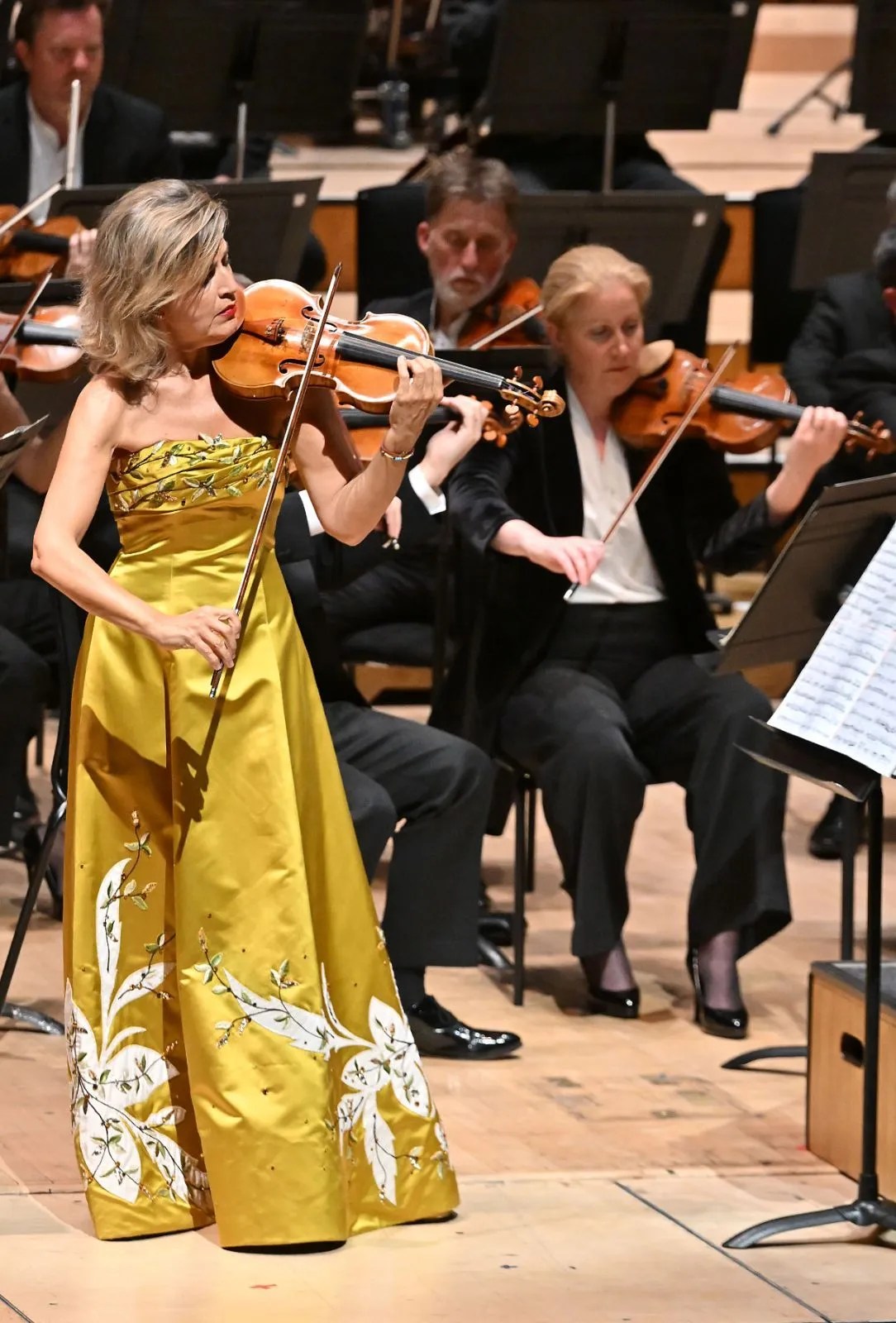
Anne-Sophie Mutter (below) has forged a pioneering path for contemporary music throughout her career, and added another dedication to an illustrious list that includes Lutosławski, Penderecki, Sir André Previn and Unsuk Chin. Air – Homage to Sibelius was written in the light of her admiration for Adès’ Concentric Paths, his Violin Concerto of 2005. It is a very different work indeed, an extended meditation based on a single melody written in the slow days of lockdown in 2021. In the execution Adès brought his music unexpectedly close to that of John Tavener or Arvo Pärt, the latter’s Cantus in memoriam Benjamin Britten recalled by the solemnly descending melody. Beginning on high with the orchestral violins, this was soon joined by Mutter’s silky-smooth tones. Now the piece developed with the soloist in charge, its serene progress tinged with longing. With no brass in the orchestra the textures were light, with tuned gongs suggesting a soft breeze, before the music gained weight on the gradual descent as though nearing the bottom of a mountain. The Sibelius homage could be determined in the line and structure of the piece, and also the rarefied light that it cast adrift.

Before the interval we heard Lutosławski’s Partita, written initially for violin and piano in 1984 but orchestrated for Mutter four years later. The word ‘partita’ is interpreted by Lutosławski in its 18th century form, and this work begins with a stern Allegro giusto that comes adrift when the soloist starts to use portamento, the melody travelling through microtones. Mutter’s control here was masterful, yet the feeling of dislocation was compounded. The central Largo was powerful indeed, the violin singing a darker song, before the closing Presto brought a terrific burst of energy, the colourful orchestration prompting and cajoling. Mutter’s voice, though, spoke the loudest.

The concert had begun with a relatively rare live account of Orpheus, the second of Stravinsky’s three Greek ballets. Thomas Adès directed a compelling performance of a work whose dynamic levels remain quiet for almost the entire half hour – yet contain music of acute description and poignancy. There is dread too, which Adès brought out in the scenes where Orpheus is surrounded by the Furies, then where he met his untimely demise at the hands of the Bacchantes. With the harp of Bryn Lewis treading a solitary, elegant line, Orpheus’ lyre remained as a ghostly presence right through to the end – in spite of the efforts of the Angel of Death, brilliantly voiced by violinist and orchestra leader Benjamin Gilmore.

The concert finished with the remarkable Agon, with which Stravinsky completed his Greek trilogy and indeed entire ballet output when premiered in New York in 1957. Even in his mid-70s the composer was pushing boundaries, this time in the direction of Schoenberg’s serial technique, without compromising his dramatic instincts. With no plot, Agon is essentially a celebration of movement, Stravinsky free to explore old dance forms through the prism of twentieth century harmony and melody, with remarkably imaginative instrumentation. This performance fully revealed its genius, the Renaissance and Baroque dances given a new lease of life with orchestration turned on its head. The colours were enhanced by mandolin (Huw Davies), harp (Bryn Lewis) and percussion (Neil Percy and Tom Edwards), not to mention the superb LSO brass, wind and string sections. Double basses got in on the act, playing high in the register, the weird and wonderful sounds given gruff harmonies and comedic punctuation as the ballet unfolded. Light and shade were exquisitely explored, the advantage of having a composer-conductor such as Thomas Adès at the helm meaning no stone was left unturned. This was a memorable interpretation, capping a wholly stimulating evening of music making.

You can find more information on further 2023/24 concerts at the London Symphony Orchestra website

Published post no.2,195 – Friday 31 May 2024

New music – Floorplan: The Master’s Plan (Classic Music Company)

by Ben Hogwood

Robert and Lyric Hood announce the release of their fourth studio album The Master’s Plan, landing on Luke Solomon’s Classic Music Company imprint on Friday 21 June. Spanning 18 crafted house and techno tracks, Robert and Lyric playfully juxtapose the light and dark of their signature sound, navigating a spectrum of genres and styles on this highly anticipated body of work.

Robert recognises the uplifting qualities of their music, saying, “In these troubled times, we are grateful to be able to share our music with the world. Especially the dance community. We hope this album will uplift and invoke you to dance.” Meanwhile daughter Lyric comments, “I want people to feel inspired and empowered, but most of all to feel the love of God and his connection in every track. This album was made for the fans that love house music as much as we do.”

The album features Detroit trio Dames BrownEunice Hood (Earthtone) and Lowell Pye, while Honey Dijon appears on Fake & Unholy. Feel It is the final piece of the pre-release jigsaw, with a deep beat and typically strong riff typical of Floorplan’s best – not to mention the uplifting, gospel qualities that sit at the centre of their music.

Luke Solomon, Classic’s founder, says The combination of wonderful people and wonderful music is always the absolute top for me. Floorplan are an unstoppable force that stay in their lane and deliver dancefloor music in a way that no one else can, but beyond that they are special human beings and I am beyond grateful to be able to call them Classic family.”

Published post no.2,194 – Thursday 30 May 2024

Let’s Dance – I. JORDAN: I AM JORDAN (Ninja Tune)

by Ben Hogwood

What’s the story?

I AM JORDAN is a celebration. I. JORDAN, real name Jordan Tek, has written this 10-track album as a dance music diary, a celebration of ‘collective ecstasy as a mode of self-discovery’.

It expresses “joy as a trans person, and trans joy generally, working with trans people, making all this fun music together”.

What’s the music like?

Without overusing the word, this is a joyful piece of work. I. JORDAN certainly knows how to get people up and dancing, and does so in a distinctive way that immediately lets the listener know who is involved. This is fundamentally house music, but making use of a number of other different styles, covering trance, a splash of hardcore and a touch of garage to make its point.

It’s also very cleverly crafted. The intro and outro work perfectly, raising the expectations (When Lights Flash) and bringing us back down to earth (Rapt Finis) In between, the highs include Real Hot n Naughty, featuring Felix Mufti, Casino High and The Countdown, each of them using the first principles of house music with nippy beats, clever riffs and clipped percussion. The rolling beats and bass of Butterlick, featuring Sister Zo, are also a treat.

Meanwhile the more introspective tracks, Reification and Pathetic Fallacy and People Want Nice Things, also work a treat, the latter setting flickers of treble against thick bass notes.

Does it all work?

It does – and with the guest artists, I AM JORDAN feels like a communal album, not just the product of one creative mind.

Is it recommended?

Enthusiastically. I. JORDAN have made a hugely uplifting dance music document, one that makes you smile pretty much as soon as you start listening. When it sets you down in a heap some 45 minutes later, there is the sort of satisfaction you get after a night on the dancefloor. Job done.

Listen & Buy

Published post no.2,193 – Wednesday 29 May 2024