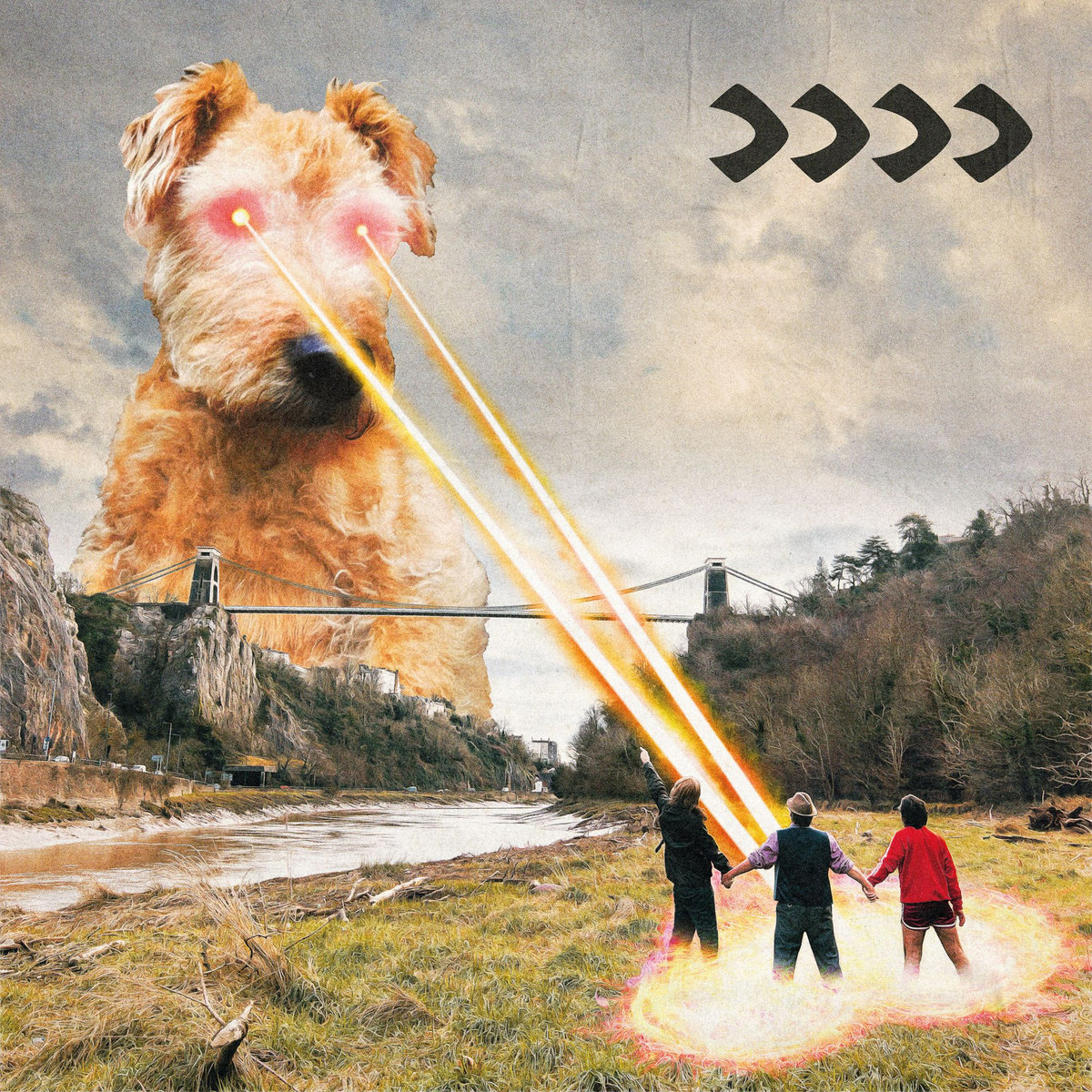
Beak> have delivered a surprise release of their first album in six years today. The aptly titled >>>> is released by Invada and Temporary Residence Ltd
The band – Geoff Barrow (of Portishead), Billy Fuller (Robert Plant’s Sensational Space Shifters) and Will Young (Moon Gangs), explained the reason for their surprise delivery.
“At its core we always wanted it to be head music (music for the ‘heads’, not headphone music), listened to as an album, not as individual songs. This is why we are releasing this album with no singles or promo tracks.”
They have also spoken about the genesis of >>>>. “The recording and writing initially began in a house called Pen Y Bryn in Talsarnau, Wales in the fall out from the weirdness of the Covid days. Remote and with only ourselves and the view of Portmeirion in the distance we got to work. With the opening track, “Strawberry Line” (our tribute to our dear furry friend Alfie Barrow, who appears on the album’s cover) as the metronomic guide for the album, we then resumed recording, as before, at Invada studios in Bristol, whilst still touring around Europe and North/South America.After playing hundreds of gigs and festivals over the years we felt that touring had started to influence our writing to the point we weren’t sure who we were anymore. So we decided to go back to the origins of where we were at on our first album. With zero expectations and just playing together in a room.“
Michael Collins (clarinet), BBC Concert Orchestra / Martin Yates
Carwithen Suffolk Suite (1964) Delius Idyll de Printemps, RTVI/5 (1889) Stanford Clarinet Concerto in A minor Op.80 (1902) Vaughan Williams Richard II: A Concert Fantasy (1944) [World Premiere Performance] Holst Symphony in F major H47 ‘The Cotswolds’ (1899-1900)
The Abbey, Dorchester-on-Thames Friday 25 May 2024
Reviewed by Richard Whitehouse
This latest edition of the English Music Festival, also the first to take place entirely within the spacious ambience of the Abbey at Dorchester-on-Thames, began with the customary concert from the BBC Concert Orchestra and Martin Yates. As conceived for amateur players, Suffolk Suite by Doreen Carwithen feels nothing if not resourceful – whether in the regal opulence of Prelude, evocative poise of Orford Ness then the alternately rumbustious or genial humour of Suffolk Morris; the martial tread of Framlingham Castle bringing about a resolute close.
Recent years have seen renewed interest in Delius’ early orchestral work, Idylle de Primtemps an appealing instance of the composer harnessing Nordic influences to the impressionist style then emerging in his adopted home of Paris – resulting in this short yet atmospheric tone poem.
It was enticingly given by the BBCCO, which then partnered Michael Collins (above) for a revival of the Clarinet Concerto by Stanford. As with numerous concertante works from the period, this is a three-movements-in-one design. The preludial Allegro introduces two main themes, their development continued (albeit understatedly) in a central Andante that unfolds with mounting eloquence, before the final Allegro brings a transformed reprise of the initial themes on route to its decisive ending. As with the First Cello Concerto of Saint-Saëns or the Violin Concerto of Glazunov, this is a piece the accessibility of whose idiom belies the ingenuity of its formal thinking or appeal of its ideas, and Collins (who evidently last played the piece four decades ago) brought subtlety and insight to music which ultimately delivers more than it promises.
These EMF opening concerts regularly feature first performances, and this evening brought that of the ‘Concert Fantasy’ as adapted by Yates (above) from Vaughan Williams’ incidental music to a production of Richard II for a BBC radio production and subsequently shelved. As might be expected, this abounds in allusions to earlier VW works from the period (notably Job and the Fifth Symphony), but the skill by which the composer reflects salient events in Shakespeare’s play and ease with which these fuse into a relatively continuous whole is its own justification.
It made sense to feature a major work by Holst in this, the 150th anniversary-year of his birth as well as the 90th of his death, with his Cotswolds Symphony certainly a welcome inclusion. If the weight and intensity of its second movement, Elegy (In Memoriam William Morris), rather dwarfs those other three, this is less an issue when the overall sequence was as astutely balanced as here. Yates secured a keen response in the opening Allegro, the personality of its ideas here outweighing any short-windedness, while there was no lack of verve and grace in the Scherzo or of animation in the Finale. That Elegy, though, is the real highpoint and the BBCCO did not disappoint with the sustained plangency of its playing. Numerous of Holst’s early pieces qualify as his primary achievement pre-Planets and this is arguably the greatest.
It duly rounded-off a fine opening to this year’s EMF. Maybe a future such occasion could see the revival of Stanford’s once popular Third ‘Irish’ Symphony or, even more pressingly, the first hearing for over a century of Holst’s doubtless unfairly derided suite Phantastes?
Brooklyn artist Yaya Bey returns with a new album for Big Dada, her response to a difficult year in which her father died. Grief can often act as a powerful stimulus within music, and Bey has responded with a candid document, her lyrics channelled through a wide scope of musical forms.
What’s the music like?
Bey is a captivating vocal presence, and Ten Fold is a meaningful and ultimately positive response to those life events. She has clearly been through the wringer but is not afraid to face her feelings head on, copying the listener in on her experiences.
Her father, Ayub Bey – also known as Grand Daddy I.U., pops up at regular intervals with snippets and samples, and there is an underlying positive mood. Her versatility means the music travels through smoky soul, intimate house / garage hybrids, and off kilter funk, as in all around los angeles, which is brilliantly sung. crying through my teeth and me and all my niggas present a frank assessment of her feelings, while the final let go is a fitting culmination.
Does it all work?
It does – Yaya Bey pulls the listener in, converses directly and has you rooting for her long before the end.
Is it recommended?
Very much so – a captivating vocal presence showing how music can be the best possible medicine when dealing with the loss of a loved one. Anyone who has experienced that difficult time will find much to enjoy and relate to here – while musically it is a triumph.
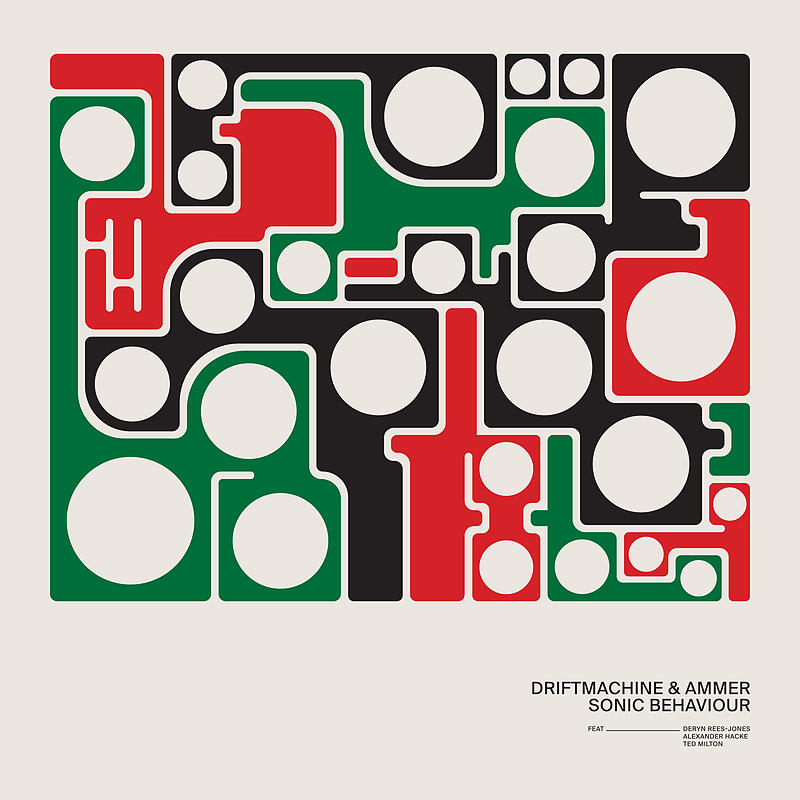
Driftmachine (Andreas Gerth and Florian Zimmer) are pushing the sonic boundaries with this new four-track album.
On it they explore ‘the origins of sound, noise, and various music genres’ – and as the press release writes, “alongside lyrical declarations of love for noise (Song To Noise), the album delves into sonic reflections on how beauty and emotion emerge from mundane vibrations in the air (The Siren Is A Simple Device). For the first time, the analogue sound researchers of Driftmachine incorporate spoken language and noise into their sound research. They have collaborated with word and sound artist Andreas Ammer, renowned for his radio plays with Acid Pauli, aka Console (Spaceman 85), or FM Einheit (Radio Inferno, Symphony of Sirens).
What’s the music like?
This is a remarkable, thought-provoking quartet of tracks that ask questions of the listener, but do so through music of great intensity and drama, creating a rarefied atmosphere.
Much of this is down to the spoken word material as much as the music. The Siren Is A Simple Device is a particularly captivating piece of work, the story told by the sonorous tones of 81-year-old Ted Milton, and we hang onto his every word. At times it is genuinely alarming with its sonic range, the build up of percussion taking us through a series of Latin musical influences. Milton also contributes to Sonic Sculpture, a sprawling but gripping piece exploring the sonic effect of a piano falling down the stairs, building in such a way that the listener can barely wait for the final denouement.
Song To Noise, meanwhile, is equal parts dub and drone, with birdsong around the edges, a minimal but powerful outlook in both its guises.
Does it all work?
It does. Experimental and thought provoking, this is music leaving as many questions as it does answers.
Is it recommended?
Enthusiastically. This is music going back to first principles, hard to categorise but holding the listener in its grasp as it challenges a number of sonic frontiers. I would go as far as to say it is essential listening for any electronic music follower.




 Arcana.fm